When you speak or write, you link one idea to another, and even a short line like “She sings and he plays” depends on a small word that joins the actions. These linking words, called connectors, help your sentences move smoothly and make your meaning easy to follow in everyday English. They show how ideas relate and guide the reader from one point to the next.
In this lesson, you’ll learn what connectors are and how they work in simple, practical situations. I’ll walk you through clear examples so you can see how connectors join ideas and help you express yourself with confidence in both speaking and writing.
What are Connectors in English?
Connectors are linking words that show how ideas relate within a sentence or across sentences. They signal patterns such as cause, contrast, time, condition, or addition, and they help map the logical path from one idea to the next. Each connector shapes the link it introduces, whether it sets a reason, marks a shift, shows a sequence, or introduces a choice. This allows the reader to follow the structure of the message through clear and predictable relationships.
Types of Connectors
Connectors help ideas move together in a smooth line. They link words, phrases, or clauses so the message feels complete and easy to follow.
1. Coordinating Connectors
These join ideas that carry equal importance.
- And adds one idea to the next
- But marks a turn in thought
- Or gives alternate paths
- So leads to a result
- Yet adds a softer contrast than but
2. Subordinating Connectors
These attach a dependent idea to a main one. They show reasons, contrasts, conditions, or time.
- Because shows cause and effect
- Although introduces contrast
- While links actions happening at the same time or sets a contrast
- Since points to a reason or starting time
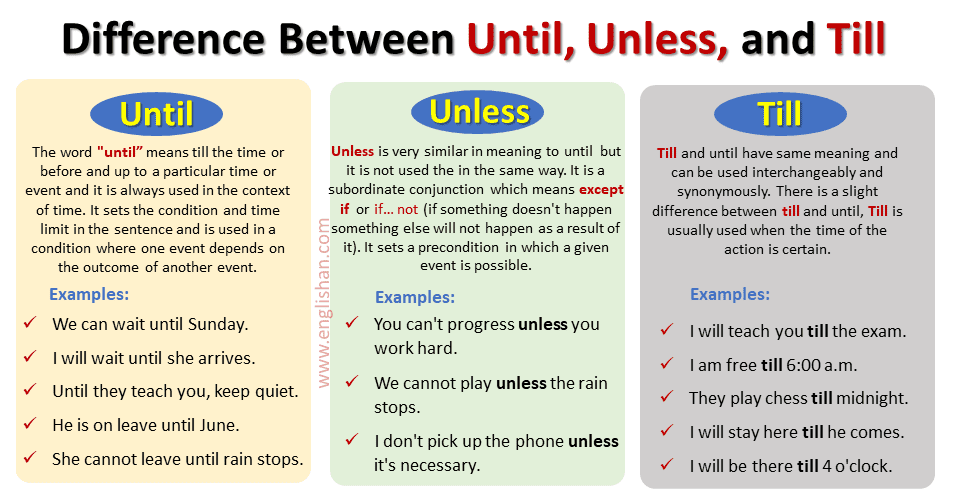
- Unless sets a condition that affects the outcome
3. Correlative Connectors
These work in pairs and must stay balanced on both sides.
- Both…and joins two equal ideas
- Either…or presents two choices
- Not only…but also adds strong emphasis
- Whether…or shows two possible outcomes
- As…as helps you make comparisons
4. Adversative Connectors
These shift direction and bring contrast or an alternate view.
- However introduces a competing idea
- Nevertheless accepts the earlier point but moves to stronger contrast
- On the other hand sets up a second viewpoint
- Instead replaces one idea with another
- Conversely shows a reversed relationship
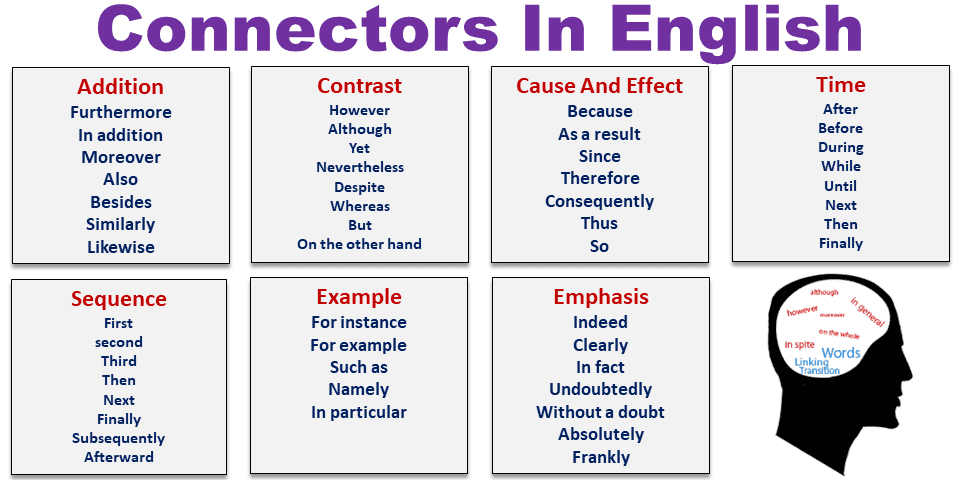
Connectors of Addition
Words and phrases that add information to what has been previously stated.
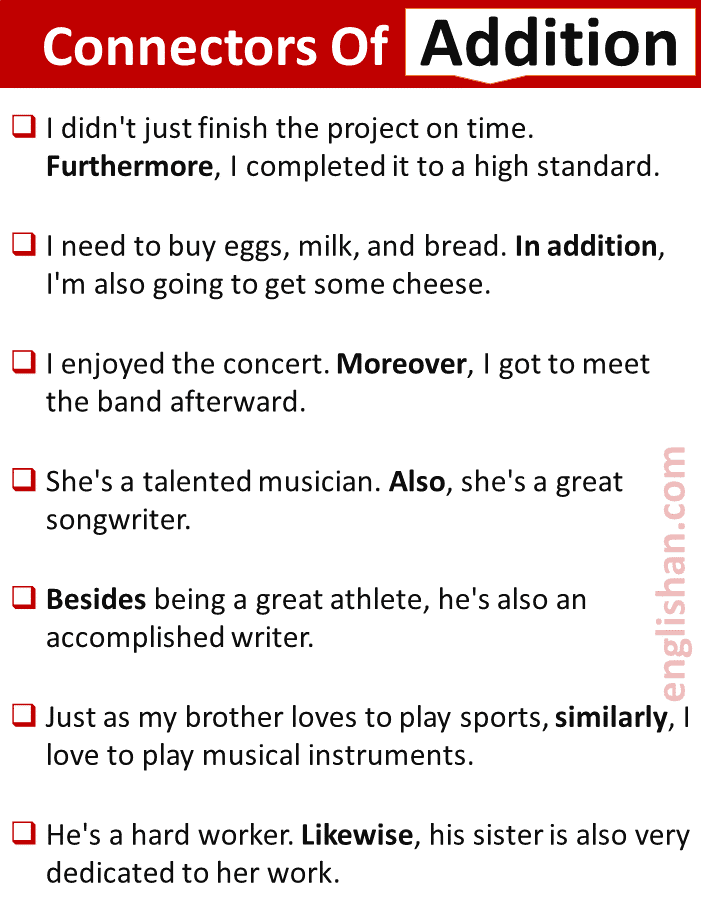
Examples: Furthermore, in addition, moreover, also, besides, similarly, likewise.
- Furthermore: adds more information or supporting evidence to what has already been said
- The book is not only well-written, but it’s also beautifully designed. Furthermore, the illustrations are stunning.
- I didn’t just finish the project on time. Furthermore, I completed it to a high standard.
- In addition: adds another item or idea to a list
- I need to buy eggs, milk, and bread. In addition, I’m also going to get some cheese.
- The company offers good benefits, such as health insurance and paid time off. In addition, they also have a retirement savings plan.
- Moreover: indicates that what is being said is in addition to something already mentioned
- The store has a great selection of shoes. Moreover, they offer free shipping on all orders.
- I enjoyed the concert. Moreover, I got to meet the band afterward.
- Also: adds more information to what has already been said
- She’s a talented musician. Also, she’s a great songwriter.
- I’m going to the grocery store. Also, I need to stop at the bank.
- Besides: means “in addition to” or “apart from”
- Besides being a great athlete, he’s also an accomplished writer.
- Besides the fact that it’s expensive, I don’t really like that restaurant.
- Similarly: means “in a similar way” or “in the same manner”
- Just as my brother loves to play sports, similarly, I love to play musical instruments.
- The company values diversity. Similarly, they also prioritize inclusion in their hiring practices.
- Likewise: means “in the same way” or “similarly”
- He’s a hard worker. Likewise, his sister is also very dedicated to her work.
- The teacher is strict with deadlines. Likewise, she expects her students to be punctual.
Connectors of Contrast
Words and phrases that show differences or contrasts between ideas.
Examples: However, although, yet, nevertheless, despite, whereas, but, on the other hand.
- However: indicates a contrast between two ideas or clauses
- I know it’s raining. However, I still want to go for a walk.
- He’s a great chef. However, his restaurant is always empty.
- Although: introduces a clause that contrasts with the main clause
- Although it’s cold outside, I’m not going to wear a coat.
- Although I’m tired, I’m going to finish this project tonight.
- Yet: indicates a contrast or unexpected outcome
- I studied hard for the test. Yet, I still failed.
- He’s a great athlete. Yet, he never seems to win any competitions.
- Nevertheless: means “in spite of that” or “however”
- I don’t really like the movie. Nevertheless, I think the acting is excellent.
- The weather was terrible. Nevertheless, we had a great time on our vacation.
- Despite: means “even though” or “regardless of”
- Despite the rain, the game still went on as planned.
- She continued to work despite feeling sick.
- Whereas: indicates a contrast between two things or ideas
- I love pizza, whereas my sister prefers sushi.
- The company’s profits increased, whereas its expenses decreased.
- But: indicates a contrast or exception to what has been said previously
- He’s a good driver, but he’s always getting into accidents.
- I love chocolate, but I try to limit how much I eat.
- On the other hand: introduces an alternative viewpoint or contrasting idea
- I don’t really like spicy food. On the other hand, my friend loves it.
- The new policy may be good for the environment, but on the other hand, it could be bad for the economy.

Connectors of Cause and Effect
Words and phrases that show a cause-and-effect relationship between ideas.
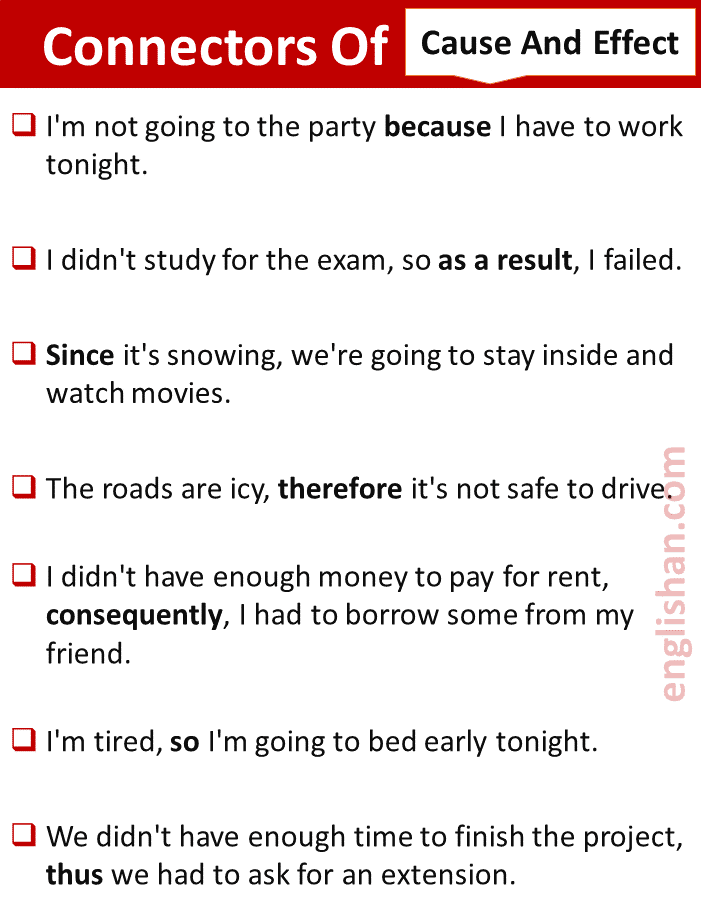
Examples: Because, as a result, since, therefore, consequently, so, thus.
- Because: introduces the reason for something
- I’m not going to the party because I have to work tonight.
- The concert was canceled because of the weather.
- As a result: indicates the outcome or consequence of something
- I didn’t study for the exam, so as a result, I failed.
- The company didn’t meet its sales targets, and as a result, it had to lay off employees.
- Since: means “because” or “as a result of”
- Since it’s snowing, we’re going to stay inside and watch movies.
- He’s been studying hard since he wants to get into a good college.
- Therefore: indicates a logical conclusion or result
- The roads are icy, therefore it’s not safe to drive.
- We didn’t have enough ingredients to make lasagna, therefore we decided to make spaghetti instead.
- Consequently: means “as a result” or “therefore”
- The company didn’t invest in new technology, and consequently, it fell behind its competitors.
- I didn’t have enough money to pay for rent, consequently, I had to borrow some from my friend.
- So: indicates a consequence or conclusion
- I’m tired, so I’m going to bed early tonight.
- The traffic was terrible, so I was late to the meeting.
- Thus: indicates a logical conclusion or result
- We didn’t have enough time to finish the project, thus we had to ask for an extension.
- The study showed that exercise reduces stress, thus regular exercise is recommended for people with high-stress levels.
Time Connectors in English
Words and phrases that show time relationships between ideas.
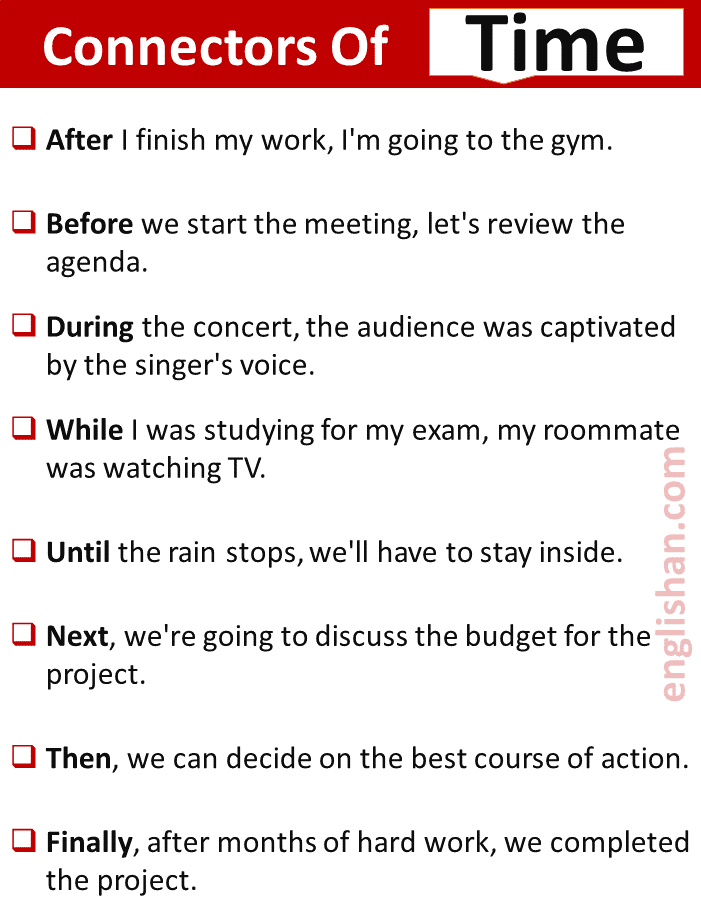
Examples: After, before, during, while, until, next, then, and finally.
- After I finish my work, I’m going to the gym.
- Before we start the meeting, let’s review the agenda.
- During the concert, the audience was captivated by the singer’s voice.
- While I was studying for my exam, my roommate was watching TV.
- Until the rain stops, we’ll have to stay inside.
- Next, we’re going to discuss the budget for the project.
- Then, we can decide on the best course of action.
- Finally, after months of hard work, we completed the project.
Sequence Connectors
Words and phrases that show the order of events.
Examples: First, second, third, then, next, finally, subsequently, and afterward.
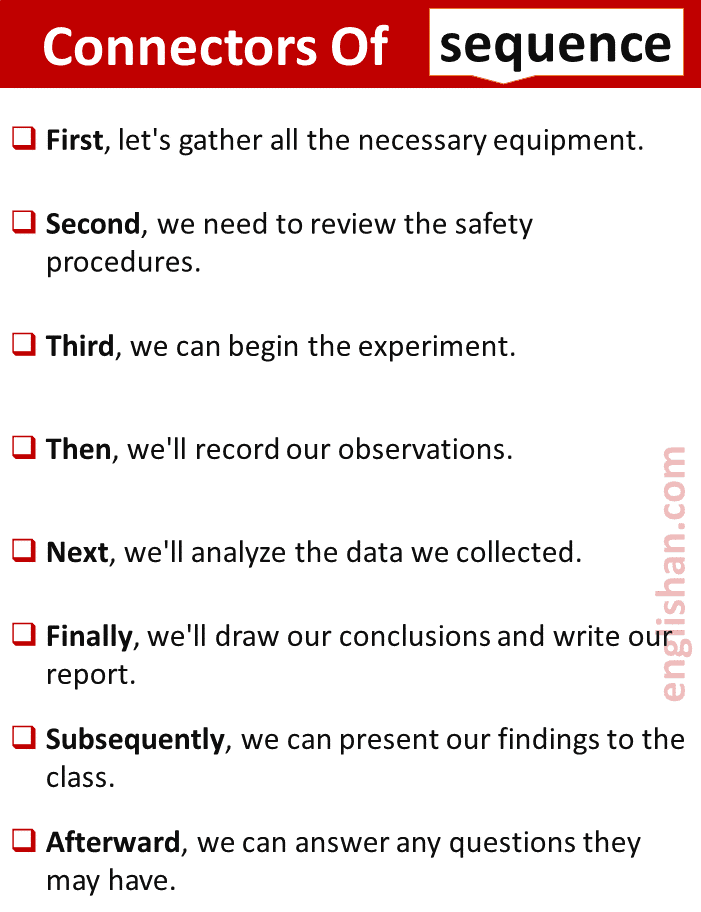
- First, let’s gather all the necessary equipment.
- Second, we need to review the safety procedures.
- Third, we can begin the experiment.
- Then, we’ll record our observations.
- Next, we’ll analyze the data we collected.
- Finally, we’ll draw our conclusions and write our report.
- Subsequently, we can present our findings to the class.
- Afterward, we can answer any questions they may have.
Examples Connectors in English
Words and phrases that provide examples to support an idea.
Examples: For instance, for example, such as, namely, in particular.
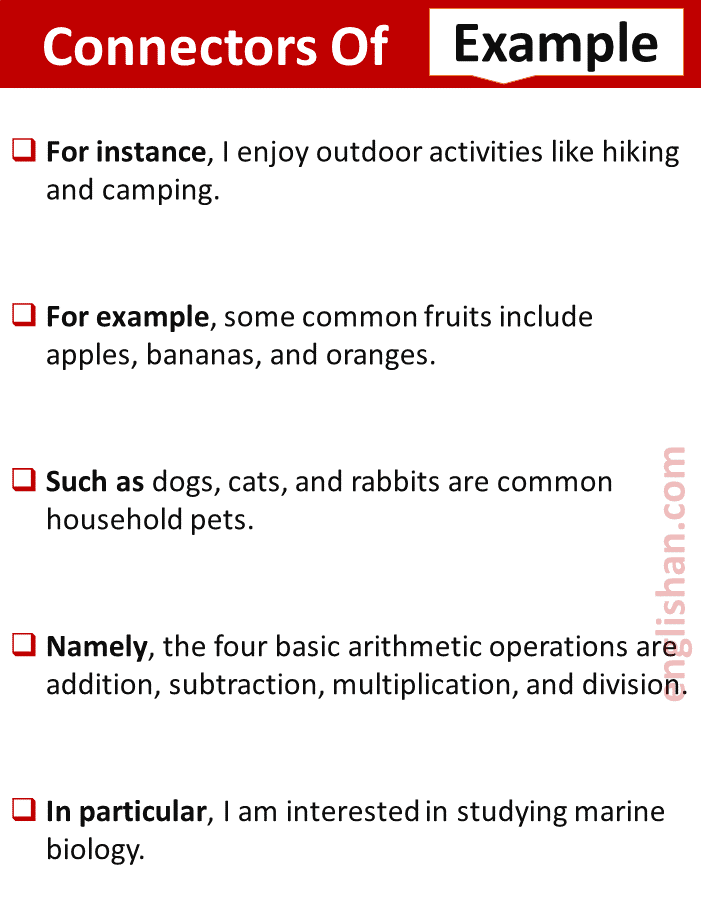
- For instance, I enjoy outdoor activities like hiking and camping.
- For example, some common fruits include apples, bananas, and oranges.
- Such as dogs, cats, and rabbits are common household pets.
- Namely, the four basic arithmetic operations are addition, subtraction, multiplication, and division.
- In particular, I am interested in studying marine biology.
Connectors of Emphasis in English
Words and phrases that emphasize a point or idea.
Examples: Indeed, certainly, in fact, without a doubt, clearly, obviously, undoubtedly.
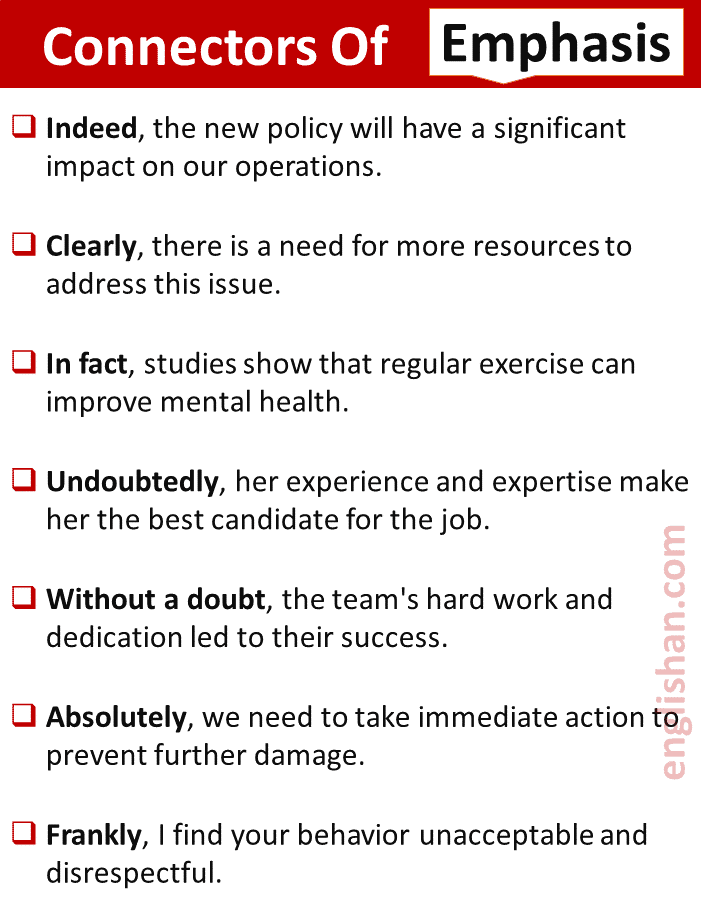
- Indeed, the new policy will have a significant impact on our operations.
- Clearly, there is a need for more resources to address this issue.
- Undoubtedly, her experience and expertise make her the best candidate for the job.
- Absolutely, we need to take immediate action to prevent further damage.
- In fact, studies show that regular exercise can improve mental health.
- Without a doubt, the team’s hard work and dedication led to their success.
- Frankly, I find your behavior unacceptable and disrespectful.
- Honestly, I have to say that I don’t agree with your decision.
- Needless to say, safety should always be our top priority.
- It goes without saying that honesty is the foundation of any successful relationship.
Using connectors in your writing or speaking can make your ideas clearer and more organized. They help to create a cohesive and logical flow of information and improve the overall effectiveness of your communication.
FAQs
Here are some easy examples of connectors in English:
1. And – I like pizza and pasta.
2. But – I want to go but I’m busy.
3. Or – Do you want tea or coffee?
4. Because – She is happy because she passed the test.
5. So – It was raining, so we stayed inside.
6. Therefore – He was sick, therefore he stayed home.
7. However – I was tired, however, I kept working.
8. Although – Although it was cold, we went outside.
9. If – If you help me, I will help you.
10. Yet – She was tired, yet she kept running.
Here are 12 logical connectors:
1. And – Adds things together.
2. But – Shows a difference.
3. Or – Gives a choice.
4. Because – Gives a reason.
5. So – Shows a result.
6. Therefore – Shows a conclusion.
7. However – Shows a different idea.
8. Although – Shows a contrast.
9. If – Shows a condition.
10. Yet – Adds an unexpected idea.
11. Meanwhile – Shows something happening at the same time.
12. In addition – Adds more information.
Simple connectors are words that link ideas together. Here are some easy examples:
1. And – Adds things together.
Example: I like apples and oranges.
2. But – Shows a difference.
Example: I am tired, but I will work.
3. Or – Gives a choice.
Example: Do you want juice or water?
4. So – Shows a result.
Example: It’s raining, so I’ll stay inside.
5. Because – Gives a reason.
Example: I’m happy because I got a gift.
Read More
- Linking Words in English
- Advanced Reading Comprehension
- Transition Words for Essays
- Adverbial Phrase
- Adverbs of Manner in English