

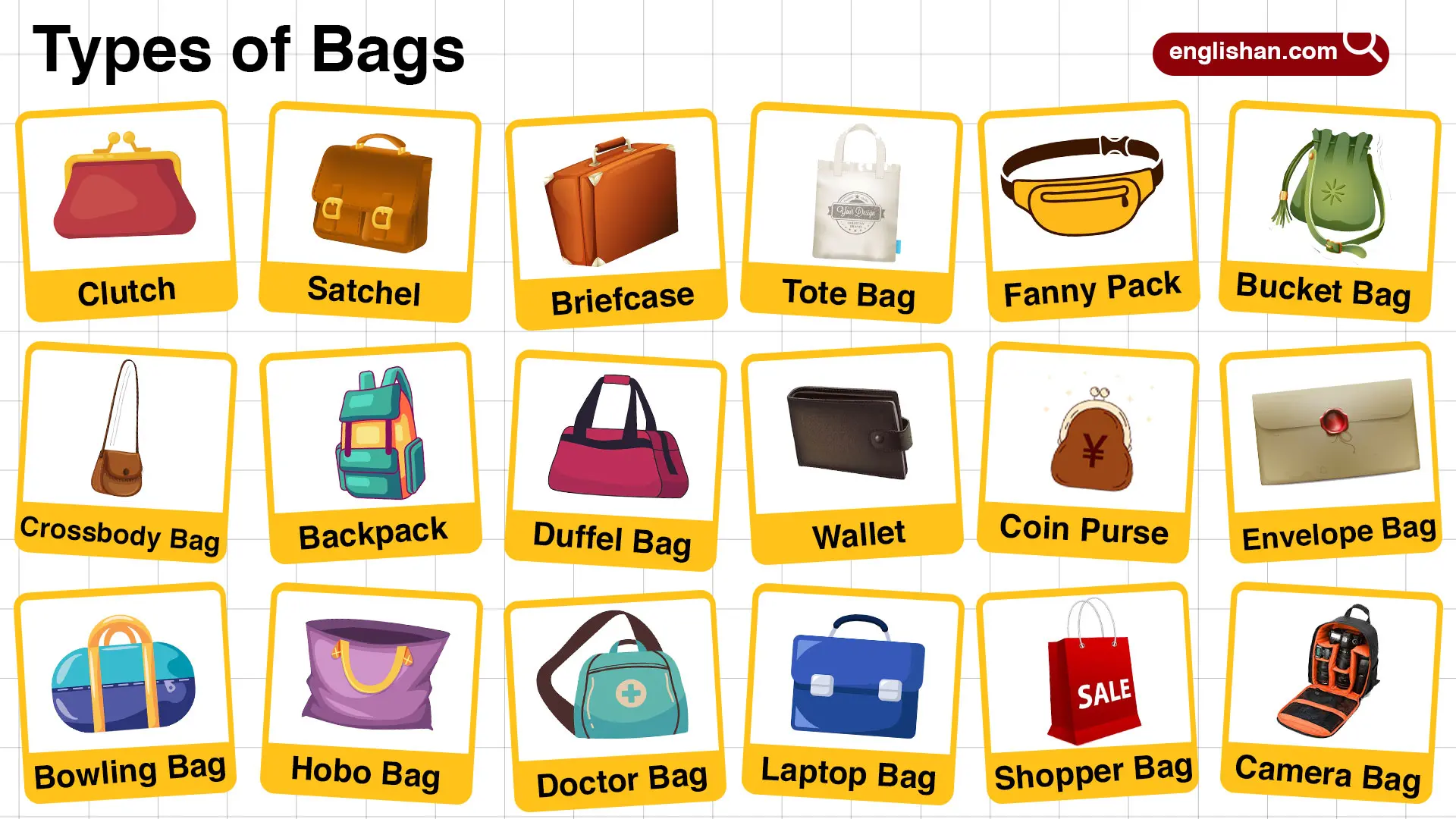
Most of us own five or six bags and can name maybe twelve. That gap says something interesting. Behind every bag shape is a story, sometimes older than you would think. The bucket bag everyone carries now started life at Louis Vuitton in 1932, designed to hold five champagne bottles. The name stuck. So did the shape.
This guide walks through 150+ types of bags by how people actually use them, from everyday totes to evening clutches to traditional styles from around the world.
Main Types of Bags at a Glance
Eight broad families cover nearly every bag made today.
| Category | Examples | Typical Material | Best For |
|---|---|---|---|
| Everyday | Tote, Crossbody, Sling, Shoulder bag | Canvas, leather, nylon | Daily carry, errands, commuting |
| Women’s handbags | Hobo, Satchel, Top handle, Bucket | Leather, PU, quilted fabric | Work, social events, daily style |
| Men’s bags | Messenger, Briefcase, Rucksack, Duffel | Leather, nylon, waxed canvas | Office, travel, daily utility |
| Travel and luggage | Rolling suitcase, Carry on, Duffel, Garment | Hardshell polycarbonate, ballistic nylon | Flights, road trips, overnight stays |
| School | Standard backpack, Laptop backpack, Rolling bag | Polyester, canvas, nylon | Books, laptops, student commutes |
| Evening purses | Clutch, Minaudière, Beaded, Chain purse | Satin, beads, metal, sequins | Weddings, formal events, nights out |
| Eco and reusable | Jute bag, Cotton tote, Recycled polyester | Jute, organic cotton, rPET | Grocery runs, replacing single use plastic |
| Specialty | Camera bag, Diaper bag, Cooler, Tool bag | Padded nylon, insulated fabric, canvas | Specific jobs, hobbies, and transport needs |
Types of Everyday Bags
Everyday bags are the ones you grab without thinking. Most people own three or four of these in rotation.
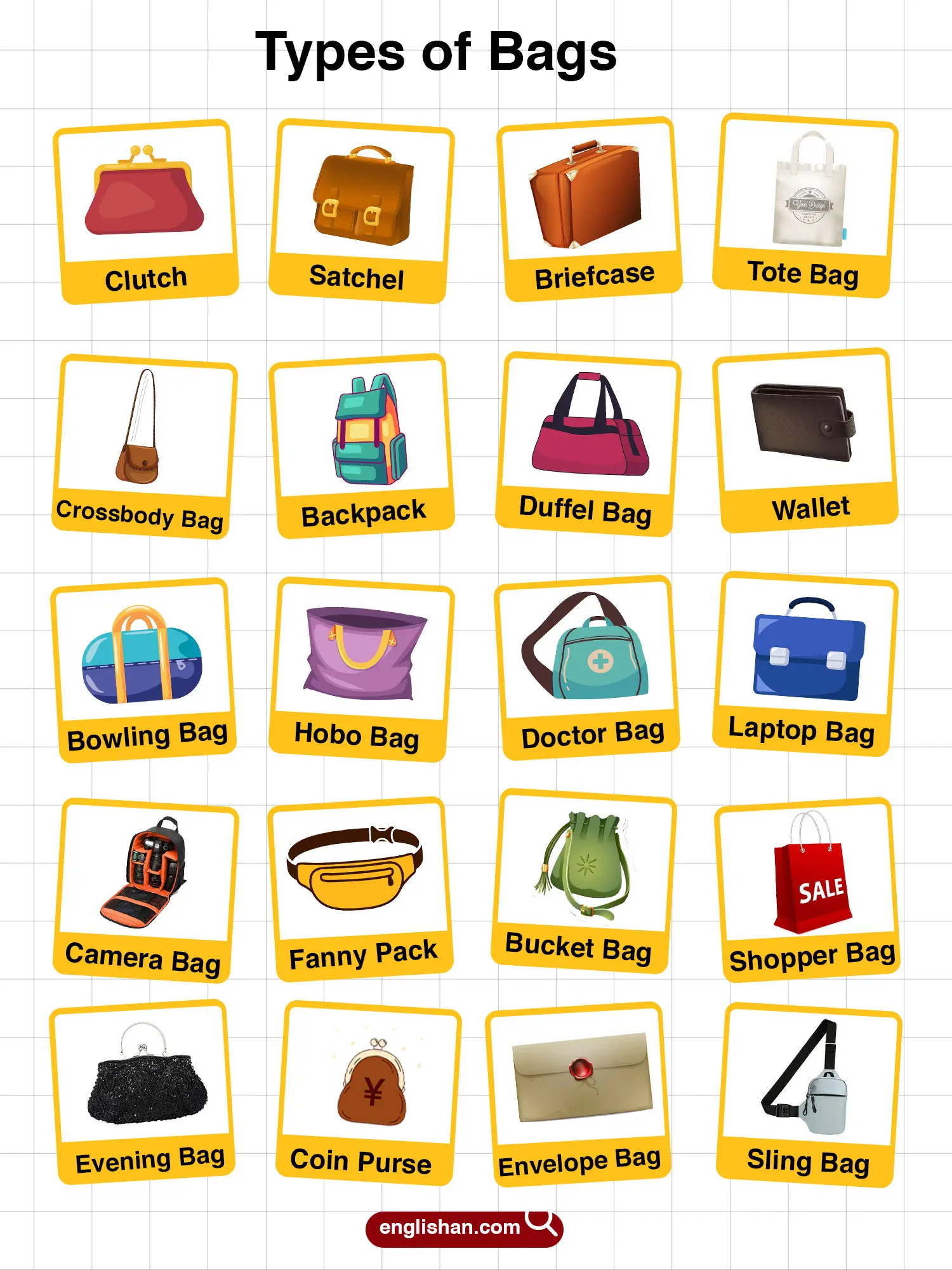
Tote bag: An open top bag with two parallel handles, usually made from canvas, cotton, or soft leather. The unofficial daily driver of carry bags, sized for a laptop, a water bottle, and groceries.
Crossbody bag: A small to medium bag with a long strap that crosses the chest, keeping the bag on the opposite hip. Structured body, zip or flap closure, and almost always worn hands free.
Sling bag: A compact single strap bag worn diagonally across the chest or back. Smaller than a crossbody, often with a front zippered pocket, and popular with travellers and cyclists.
Shoulder bag: A medium bag with one or two short straps that sit on one shoulder. Structured body, magnetic or zip closure, sized for a phone, wallet, keys, and a paperback book.
Backpack: A two strap bag worn on the back with the weight sitting across both shoulders. The most ergonomic way to carry heavier loads for longer walks.
Messenger bag: A wide flat bag with a single long strap worn crossbody, and a fold over flap closing the main compartment. Originally used by bike couriers in New York, now a common work and laptop bag.
Satchel: A structured rectangular bag with a flap and two front buckles, worn over the shoulder or in the hand. Inspired by British school satchels, now a daily favourite for books and small laptops.
Bucket bag: A deep rounded bag with a drawstring closure at the top. The drawstring cinches the opening shut and creates the bucket silhouette the bag is named for.
Fanny pack (belt bag): A small zip pouch worn around the waist or slung across the chest. Hands free, minimalist, and back in mainstream use since Gucci and Prada revived it in 2018.
Mini bag: Any handbag sized smaller than a standard clutch. Holds a phone, a card holder, and lip balm. Popularised by Jacquemus Le Chiquito in 2019 and now a full category.
Foldable bag: A packable nylon bag that folds into its own pocket when empty. Kept as a backup for extra shopping or as a travel spare.
Convertible bag: A bag designed to switch between styles, usually backpack to tote or crossbody to clutch. Hidden straps and detachable handles make the conversion possible.
Paper bag: Flat bottomed disposable bags in kraft or recycled paper, handed out at retail checkouts. Standard in Europe after single use plastic bans took effect between 2015 and 2021.
Plastic bag: Thin polyethylene shopping bags. Banned outright in more than 70 countries and taxed in many US states, which is why reusable options have moved centre stage.
Reusable shopper: A heavy duty tote in woven polypropylene, jute, or cotton canvas, designed for repeat grocery use. Many supermarkets now sell these at the checkout.
Transparent bag: A clear PVC or vinyl bag required by most NFL stadiums, NBA arenas, and major music festivals for security screening. Usually sized around 12 by 6 by 12 inches.
Types of Handbags for Women
Handbags cover the widest style range of any bag category. The silhouette, closure, and strap setup define each one more than the material does.
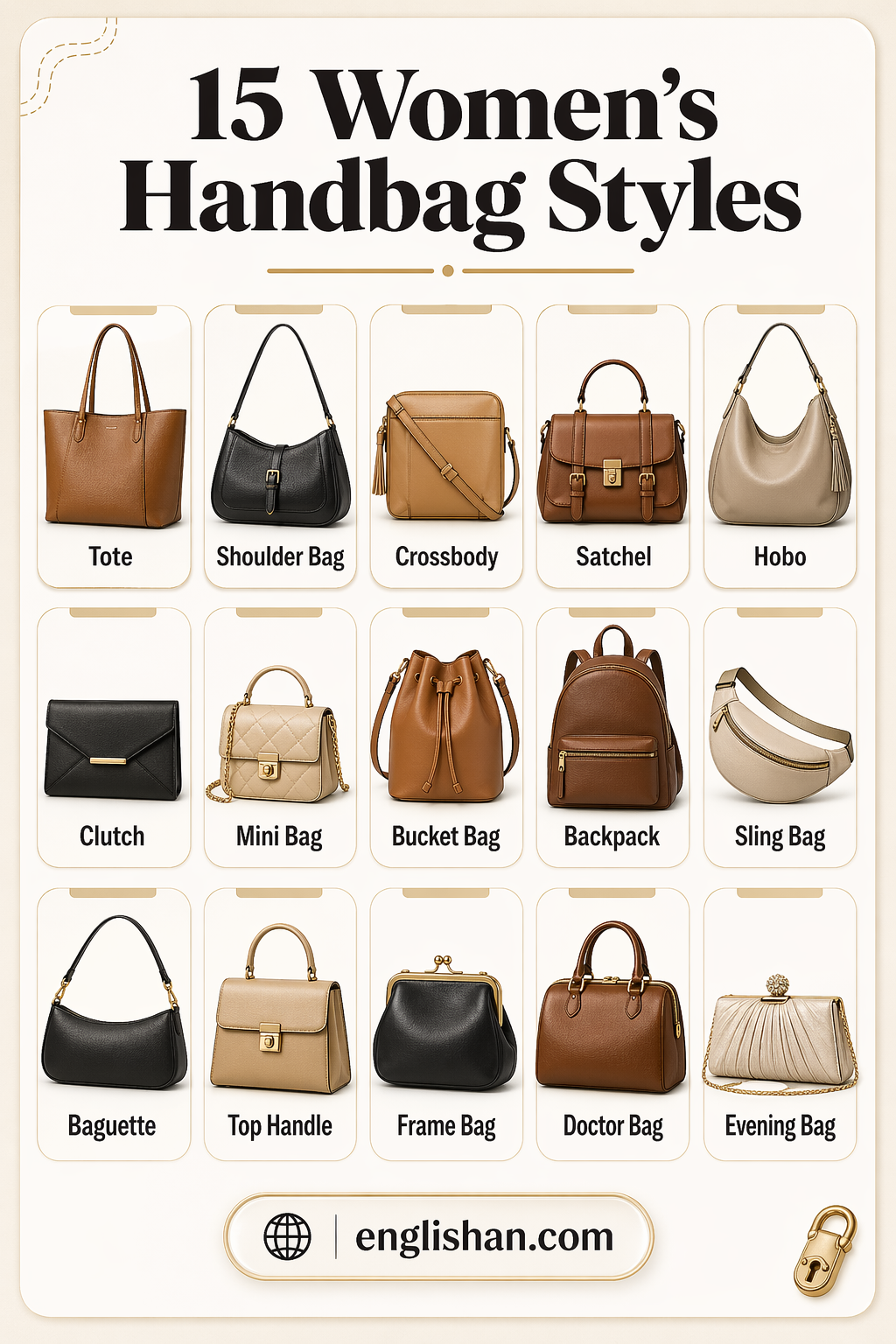
Hobo bag: A soft crescent shaped bag with a slouchy body that sags gently under weight. Single shoulder strap, usually closed with a zip or drawstring.
Quilted bag: A bag with a diamond stitched pattern across the exterior panels. The technique traces to the Chanel 2.55 introduced by Coco Chanel in February 1955.
Top handle bag: A structured bag carried by short handles held in the hand or crook of the arm. Formal, polished, and often paired with work wear or event outfits.
Box bag: A rigid rectangular or square bag that holds its shape without support. Minimal, architectural, and usually small enough to carry essentials only.
Chain strap bag: A shoulder bag with a metal chain strap, sometimes interwoven with leather. Adds formality to casual bags and is often paired with evening looks.
Drawstring bag: A soft bag closed by pulling two cords tight at the top. Casual in fabric versions, luxurious in leather.
Wristlet: A small pouch with a short loop that slides over the wrist. Large enough for a phone, cards, and a key, and usually detachable from a larger bag.
Vanity bag: A small structured case designed to carry makeup, jewellery, or travel toiletries. Hinged or zip top, with a mirror inside the lid on vintage versions.
Mini backpack: A small backpack worn as a fashion piece rather than a school or hiking bag. Often in leather, suede, or structured nylon.
Saddle bag: A curved bag shaped like a horse saddle, with a flap closing over the top. Dior reintroduced the silhouette in 1999 and again in 2018.
Doctor bag: A wide structured bag with a rigid frame and a clasp that opens into a wide mouth. Named after the carry-alls 19th century physicians used for house calls.
Bowler bag: A rounded dome shaped bag with double handles, similar in profile to a bowling bag. Chanel, Prada, and Gucci have all produced well known versions.
Baguette bag: A slim rectangular bag held under the arm like a French bread loaf. Fendi launched the first Baguette in 1997 and returned to it in 2019.
Clutch: A flat handheld bag with no strap, carried in the hand or tucked under the arm. Small enough to hold only essentials and usually reserved for formal wear.
Envelope clutch: A flat clutch shaped like a sealed envelope with a triangular flap. The most minimalist version of the evening clutch.
Croc embossed bag: A bag with a textured surface pressed to look like crocodile or alligator skin, cut from calf leather or synthetic materials.
Wallet on chain (WOC): A slim card and cash wallet fitted with a long chain strap. Originally from Chanel, now a widely copied hybrid between a wallet and an evening bag.
Types of Bags for Men
Men’s bags skew functional. Work, travel, and daily utility drive most purchases, with style decisions often built around a single signature piece.
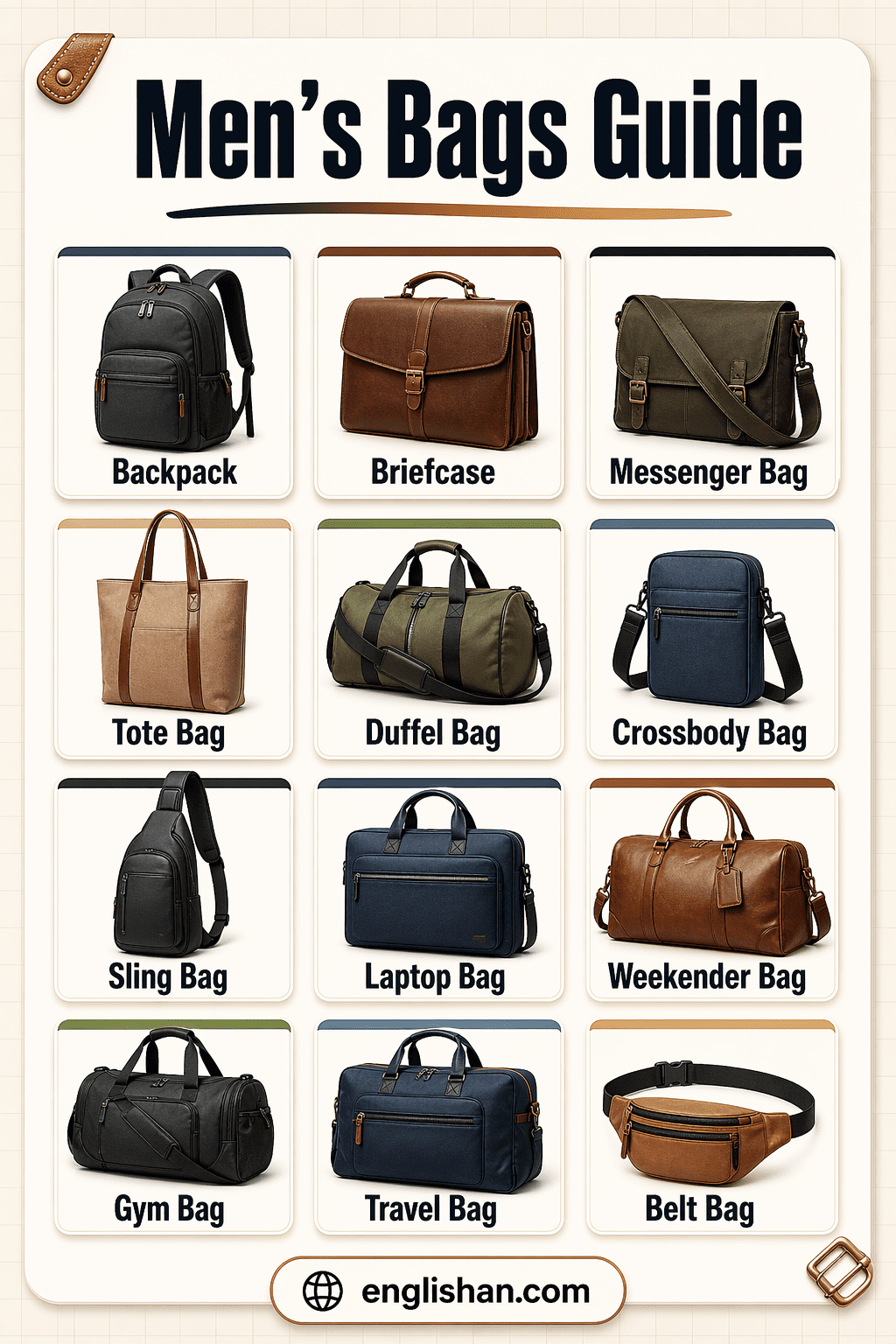
Messenger bag: A single strap flat bag worn crossbody, with a flap covering the main compartment. Sized to hold a laptop, documents, and everyday carry items.
Leather backpack: A two strap backpack in full grain or top grain leather, often with a laptop sleeve. The professional alternative to nylon school backpacks.
Briefcase: A structured rectangular hard or soft sided bag with a top handle and sometimes a shoulder strap. The standard for formal offices, law practices, and finance.
Attaché case: A thin hard sided briefcase with a metal frame and combination locks. Holds documents flat without folding and is still used in legal and diplomatic work.
Duffel bag (weekender): A cylindrical soft sided bag with a zip top, side handles, and a removable shoulder strap. Originated in Duffel, Belgium, where the coarse cloth used for the first ones was produced.
Rucksack: A larger outdoor backpack with a top flap, cinch cord, and sometimes a waist strap. Sits between a hiking pack and a daily backpack.
Tactical bag: A ruggedised backpack or sling with MOLLE webbing on the exterior for attaching extra pouches. Military origin, now used by photographers, outdoor workers, and EDC enthusiasts.
Roll top backpack: A backpack with an open top that rolls down and clips shut, making it water resistant and size adjustable. Common with cyclists and creatives.
Toiletry bag (Dopp kit): A small zip top case for razors, toothpaste, and travel toiletries. Named after Charles Doppelt, whose 1926 leather case popularised the shape.
Camera bag: A padded bag divided into movable compartments for a camera body, lenses, and accessories. Sling, shoulder, and backpack versions all exist.
Sling chest bag: A single strap bag worn across the chest, sized for a phone, wallet, and a small book. A newer category popular with men who dislike the fanny pack label.
Tablet sling: A slim sling bag sized to hold an iPad or a 10 to 13 inch tablet. Minimal padding, single front pocket.
Belt bag: A compact zip pouch clipped to the belt or worn as a crossbody. The men’s wear version of the fanny pack, often in leather or technical nylon.
Weekender tote: A wide open top tote sized for a two or three day trip. Leather or waxed canvas versions skew smart. Nylon versions lean casual.
Types of Travel Bags and Luggage
Travel bags sort mostly by size and wheels. Airline rules set the outer limits for most categories below.
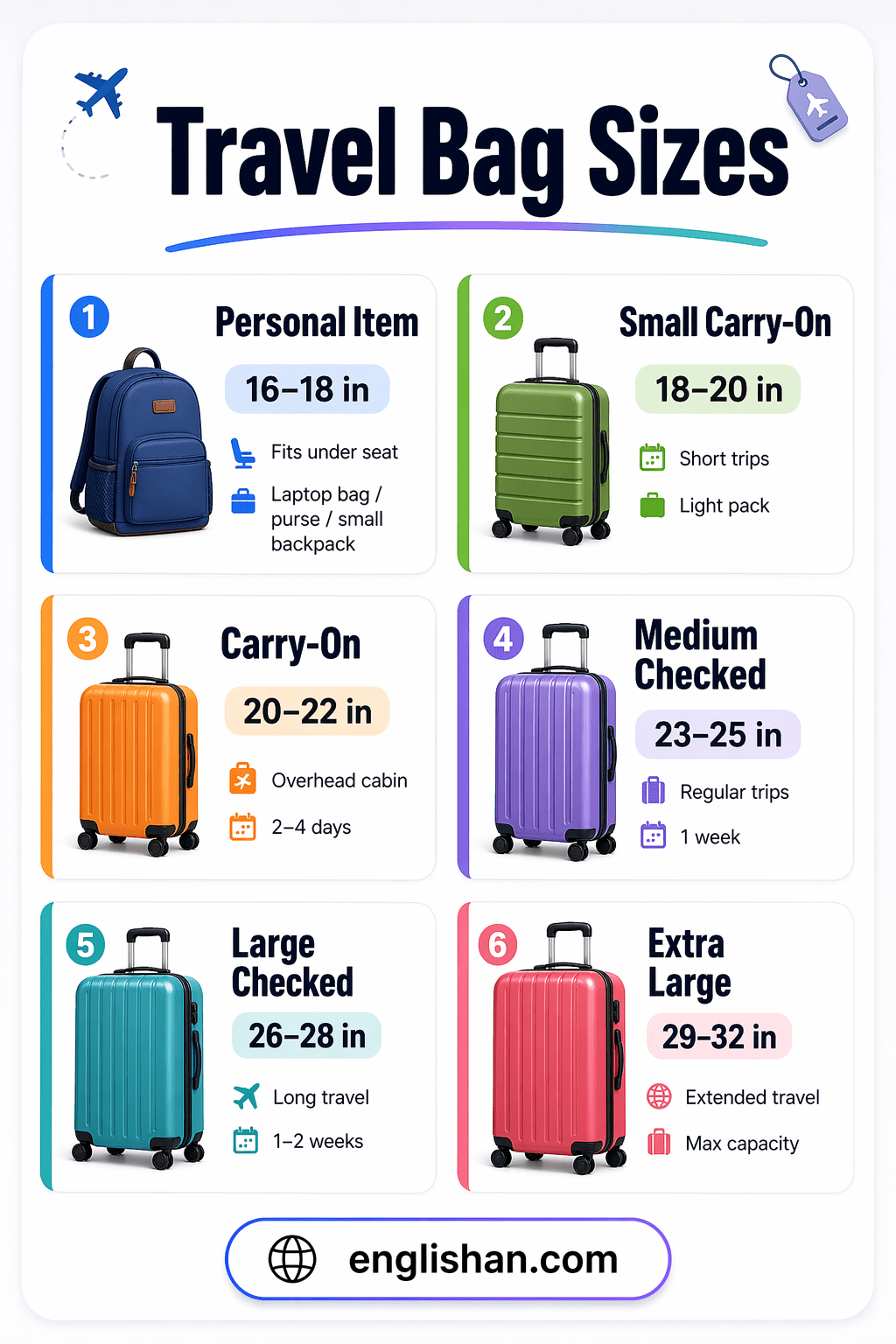
Personal item bag: A small bag that fits under the seat in front of you, usually 17 by 13 by 7 inches. Backpacks, totes, and small duffels all work as personal items.
Carry on: A wheeled or handheld bag that fits in the overhead bin, typically 22 by 14 by 9 inches for US airlines and 55 by 40 by 20 cm for most European carriers.
Rolling suitcase: A structured case on wheels with a retractable handle. Two wheel versions tilt to roll, four wheel versions roll flat.
Spinner: A four wheel suitcase where each wheel rotates independently, letting the bag roll straight at your side. Now the dominant suitcase style for flights.
Hardshell suitcase: A rigid case in polycarbonate, ABS, or aluminium. Protects fragile contents and keeps its shape. Samsonite and Rimowa are the reference brands.
Softside suitcase: A fabric covered suitcase in ballistic nylon or polyester. Lighter, more expandable, and more forgiving when overpacked.
Cabin trolley: A cabin sized two wheel or four wheel rolling bag. Sized to meet carry on rules, which vary by airline.
Checked bag: Full sized luggage over 22 inches tall, checked at the counter and loaded into the cargo hold. Usually 24 to 30 inches.
Garment bag: A long folding bag designed to carry suits, dresses, and tailored clothing without creasing. Hangs flat in a wardrobe on one side and folds in half for transport.
Wheeled duffel: A duffel bag on two or four wheels, combining soft pack flexibility with rolling convenience. Favourites with sports teams and expedition travellers.
Travel backpack: A backpack sized to carry on rules, often with clamshell opening and hidden straps. The standard bag of the budget traveller.
Overnight bag: A small soft bag sized for one night away, typically 16 to 20 inches long.
Packing cubes: Zippered fabric pouches that organise clothes inside a suitcase. Not strictly a bag, but bought with one.
Anti theft bag: A bag with slash proof straps, locking zippers, and RFID blocking lining. Pacsafe leads this category.
Toiletry roll: A flat toiletry bag that rolls up and hangs from a hook, with mesh pockets inside. Common with long haul travellers.
Luggage set: A matched group of three to five suitcases in graduated sizes, sold as a single purchase.
Types of School and Student Bags
School bags prioritise space, back comfort, and durability. Fit matters more than fashion for growing students.
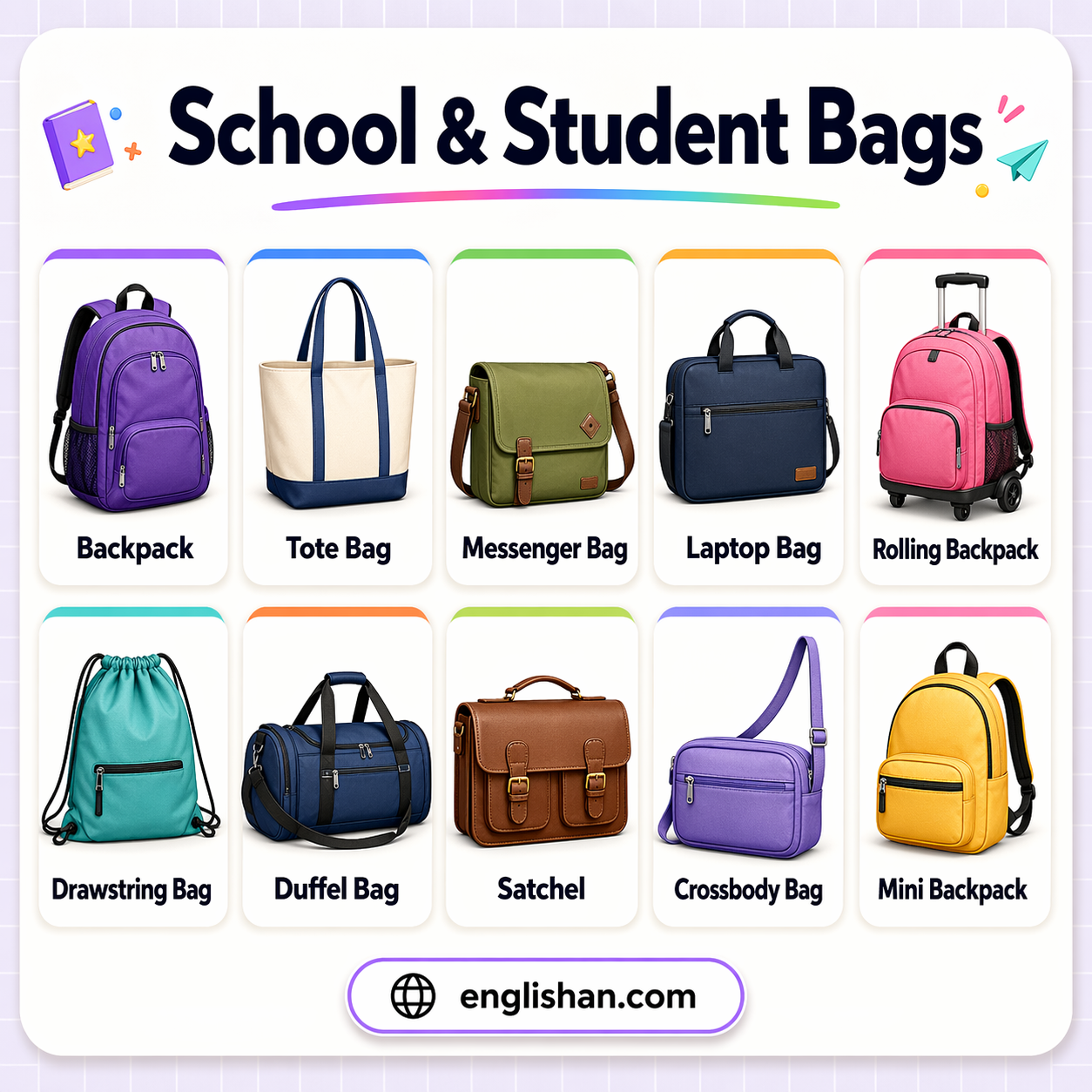
Standard backpack: A two strap backpack with a main compartment, a front pocket, and two side pockets for a water bottle and an umbrella.
Rolling school bag: A school backpack on two wheels with a retractable handle. Used by students with heavy textbook loads or back problems.
Laptop backpack: A backpack with a padded sleeve sized for a 13, 15, or 17 inch laptop. The sleeve usually sits against the back for protection.
Tech backpack: A laptop backpack with USB charging ports on the exterior and internal cable routing. Built for students who carry power banks.
Canvas backpack: A soft backpack in cotton canvas, often unlined. Light, washable, and cheaper than technical fabric versions.
Roll top school bag: A student roll top with a cinch and clip closure. The Fjällräven Kånken style falls in this family.
Sling school bag: A single strap bag for students carrying a tablet or a few folders rather than a full book load.
Book bag: A soft single compartment backpack without tech sleeves or structured panels. Used by primary school children and for light loads.
Transparent school bag: A clear PVC or mesh backpack required by many US public schools after 2018 for security purposes.
Lockable backpack: A school bag with a combination lock on the main zip. Used by boarding students and for anti theft on commutes.
Waterproof school bag: A backpack in coated fabric or welded seams, rated to shrug off rain. Common for wet climate cities like London, Seattle, and Manchester.
Chest strap backpack: A backpack with a small sternum strap to pull the shoulder straps closer, reducing shoulder fatigue on heavier loads.
Expandable backpack: A school bag with a zip gusset that adds two to four inches of capacity when opened.
Mini school bag: A small backpack sized for a lunchbox, a notebook, and a water bottle. Used by toddlers and preschoolers.
Character backpack: A kids’ backpack printed or shaped as a favourite animated character. Marvel, Disney, and Pokémon lead this market.
Types of Gym and Fitness Bags
Gym bags prioritise ventilation, shoe storage, and durability against sweat and water.
Gym duffel: A cylindrical soft bag with a zip top, two handles, and a shoulder strap. The standard gym bag shape.
Drawstring gym sack: A lightweight drawstring bag that doubles as straps when pulled over both shoulders. Cheap, light, and used for towel and gym kit.
Gym tote: A structured tote in waxed canvas or technical nylon with a separate shoe compartment. Cleaner silhouette than a duffel.
Yoga mat bag: A cylindrical bag sized to hold a rolled yoga mat, often with a small zip pocket for keys and a phone.
Sneaker bag: A duffel or cube shaped bag dedicated to carrying one or two pairs of sneakers. Common with sneakerheads and basketball players.
Weightlifting bag: A large square duffel with side pockets for chalk, wrist wraps, shoes, and a belt. Brands like 2POOD and Picsil make purpose built versions.
Boxing gear bag: A long bag sized for gloves, wraps, and skipping ropes. Usually around 24 inches long with a mesh panel for ventilation.
Types of Laptop and Work Bags
Laptop bags are about padding, sleeve size, and how the bag transitions from commute to office to meeting.
Laptop backpack: A backpack with a padded sleeve. The most common way professionals carry laptops now.
Laptop messenger: A flat crossbody bag with a padded laptop compartment under the main flap. Suits creative and tech industries.
Laptop briefcase: A structured top handle bag with a padded laptop sleeve. The traditional business option.
Laptop tote: A structured tote with a padded sleeve built into the interior. Popular with women in corporate roles.
Laptop sleeve: A zippered or envelope style case that holds only the laptop, meant to be carried inside another bag.
Portfolio case: A flat zippered case for documents, notepads, and a tablet or thin laptop. Minimal, often leather, and carried by hand.
Convertible laptop bag: A bag that switches between backpack and briefcase by rearranging hidden straps.
Hybrid laptop tote: A laptop tote that converts to a backpack or crossbody for longer commutes.
Types of Clutches and Evening Purses
Evening bags are defined by what they are made from more than by their silhouette. Most hold only a phone, a lipstick, a card, and a key.
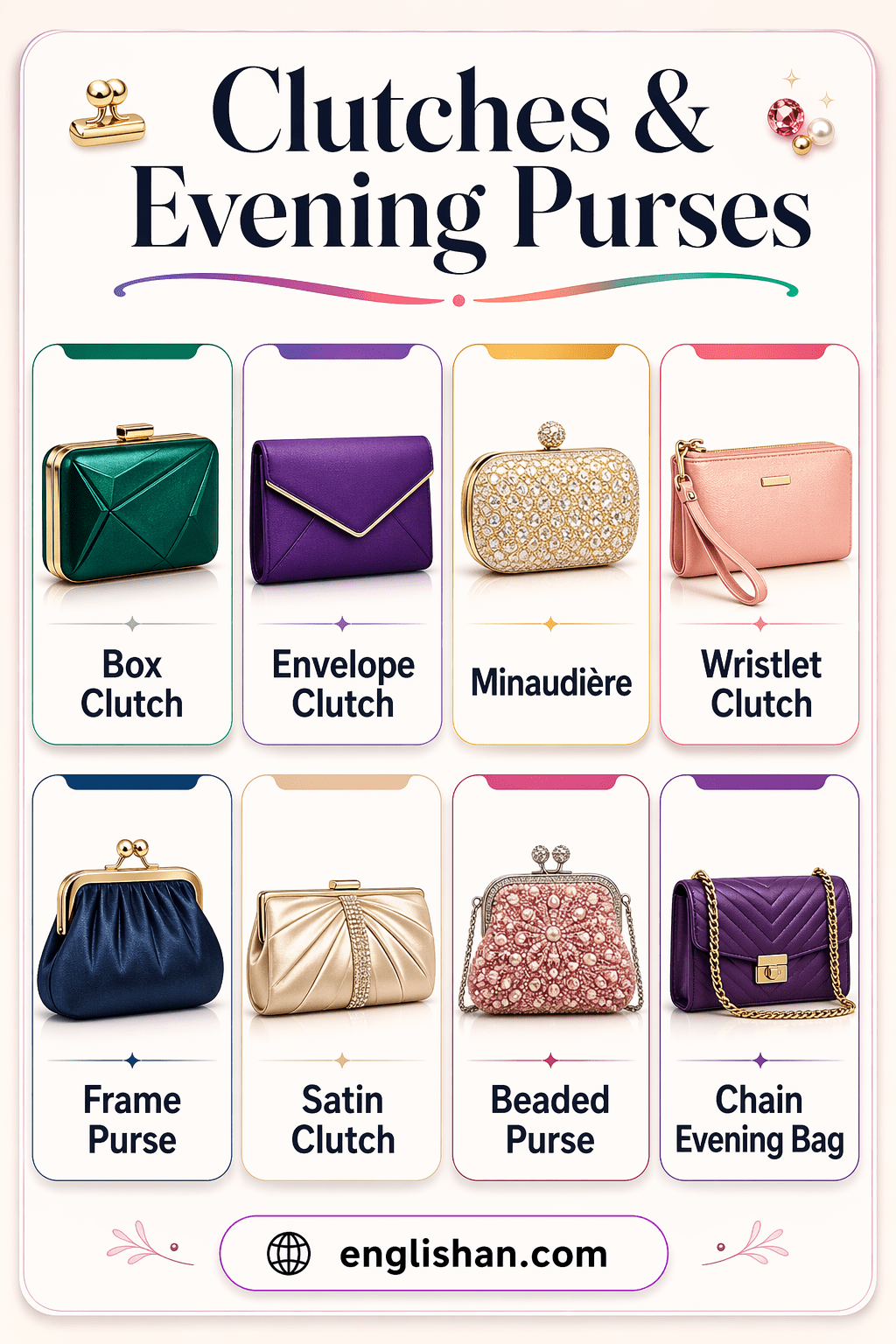
Clutch: A flat handheld bag with no strap or a small detachable chain. Small enough to hold only essentials.
Envelope clutch: A flat clutch shaped like a sealed envelope with a triangular flap closure.
Minaudière: A small rigid case, usually in metal, that opens like a jewellery box. Named after a French word for a flirtatious manner.
Box clutch: A rigid rectangular clutch with a hinged top or magnetic closure.
Beaded bag: An evening bag covered in hand sewn beads. Popular since the 1920s flapper era and still handmade in India and the Philippines.
Sequin bag: An evening bag covered in reflective sequins. Worn mostly at holiday parties and festive events.
Chain purse: A small purse with a long metal chain strap, worn across the body or on the shoulder.
Pochette: A soft rectangular flat pouch, often in leather or satin, sized between a wallet and a clutch.
Frame bag: A clutch or small bag with a visible metal frame across the top that clicks closed.
Wristlet purse: A small purse with a loop that slides over the wrist, leaving the hand free.
Feathered clutch: An evening clutch covered in ostrich, marabou, or peacock feathers. Red carpet territory.
Metallic clutch: A clutch finished in gold, silver, or rose gold metallic leather. The neutral of evening wear.
Eco Friendly and Reusable Bags
Eco bags have moved from niche to mainstream since plastic bag bans spread through Europe, North America, and parts of Asia.
Jute bag: A sturdy bag woven from jute fibre, a natural plant material. Biodegradable and widely used in Bangladesh and India.
Cotton tote: A simple tote in organic or conventional cotton canvas. The baseline reusable bag.
Recycled polyester bag (rPET): A bag made from recycled plastic bottles spun into polyester thread. Shows up in brands like Patagonia and Everlane.
Mesh produce bag: A small mesh drawstring bag for loose fruit and vegetables, replacing thin produce plastic.
Bamboo bag: A handbag or basket woven from bamboo strips. Traditional in Southeast Asia and now a summer fashion staple.
Hemp bag: A tote or backpack in woven hemp fabric. Stronger than cotton and naturally antimicrobial.
Foldable shopping tote: A packable nylon bag that folds into a pouch the size of a phone. Carried in the handbag as a plastic bag replacement.
Cork bag: A bag in cork fabric, a leather alternative made from the bark of cork oak trees. Lightweight and vegan.
Upcycled bag: A bag made from reclaimed materials, such as old sails, billboards, or rice sacks. Freitag is the best known brand in this category.
Washable paper bag: A bag in a tough fibre material that looks and creases like paper but handles water and repeated use.
Specialty and Industrial Bags
These bags exist for a specific job. Each one is its own category with little overlap elsewhere.
Diaper bag: A bag with insulated bottle pockets, a changing mat, and wipe access, sized to hold nappies, clothes, snacks, and wipes for a baby on the go.
Cooler bag: An insulated bag with a foil or foam lining that keeps contents cold for three to twelve hours.
Lunch bag: A small insulated bag sized for a lunchbox, a drink, and fruit. Standard in US and UK school kits.
Tool bag: A heavy duty bag with multiple exterior pockets for screwdrivers, pliers, and hand tools. Tradesmen and electricians carry these daily.
Pet carrier: A ventilated bag sized to carry a small dog or cat. Sherpa, backpack, and roller versions all exist, many airline approved.
Dust bag: A soft drawstring bag in cotton or flannel that ships inside a luxury handbag to protect it in storage.
Bike pannier: A waterproof bag that clips onto the rear rack of a bicycle. Sold in pairs for touring cyclists.
Motorcycle saddlebag: A leather or synthetic bag mounted to each side of a motorcycle’s rear wheel.
Golf bag: A tall cylindrical bag with dividers for clubs and pockets for balls, tees, and gloves. Stand, cart, and tour bag versions exist.
Camera bag: A padded bag with movable dividers for camera bodies, lenses, and accessories. Shoulder, sling, and backpack formats.
First aid bag: A soft bag organised with elasticated loops for bandages, tape, scissors, and medication. Medic bags are the professional version.
Dive bag: A mesh or vented duffel sized for scuba fins, a BCD, and a wetsuit.
Colostomy bag: A medical pouch attached to the abdomen to collect waste after surgery creating a stoma. Not a carry bag, included here because it is often searched under bag types.
FIBC bag (bulk bag): A flexible intermediate bulk container. A woven polypropylene sack holding half a tonne to two tonnes of industrial material.
Boxing heavy bag: A cylindrical filled bag suspended from a ceiling or stand, used for striking practice. Weighs 70 to 150 pounds.
Punching bag: A smaller version of the heavy bag, sometimes called a speed bag when mounted on a platform for timing drills.
Bean bag: A large soft furniture piece filled with polystyrene beads, used as a casual chair. Included because it is technically a bag shape.
Traditional and Cultural Bags from Around the World
Most bag guides stop at Western styles. These traditional designs have been used for centuries and many of them now cross into mainstream fashion.
Furoshiki (Japan): A square of cloth tied into a bag shape to carry goods. Used in Japan since the Nara period (710 to 784 AD) and revived for its zero waste credentials.
Azuma bukuro (Japan): A triangular cloth bag made from a single rectangle of fabric, tied at the handles. Traditional Japanese market bag.
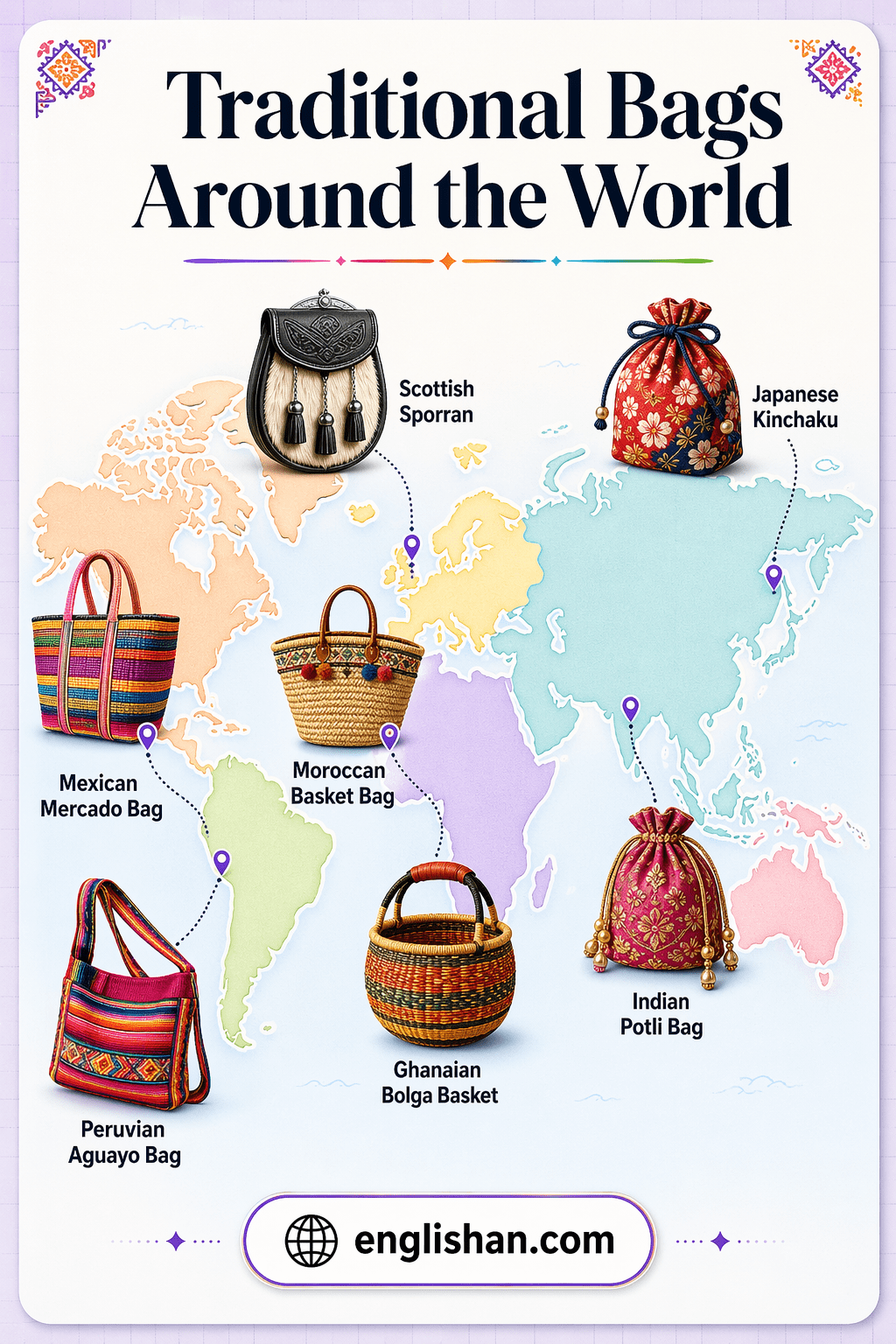
Potli (India and Pakistan): A drawstring fabric pouch gathered at the top, often embroidered with zari thread or mirror work. Carried at South Asian weddings and festivals.
Jhola (India): A loose cotton shoulder bag with an open top, historically carried by students and writers across South Asia.
Mercado bag (Mexico): A woven plastic market basket in bright primary colours, sometimes with leather handles. Now a summer beach bag staple in Europe and the US.
Molas bag (Panama): A bag featuring Mola textile panels hand stitched by the Guna people of Panama, using reverse applique.
Mochila (Colombia): A crocheted shoulder bag made by the Wayuu people of the La Guajira peninsula. Each pattern carries meaning tied to the weaver’s family.
Kiondo (Kenya): A woven basket bag made from sisal fibre, often with leather handles. Kenyan women have made kiondos for more than a thousand years.
Makheta (Botswana): A woven grass basket bag, traditionally used for carrying grain.
Moroccan leather bag: A handmade leather bag from Fez or Marrakech, often in tan or dyed colours with hand tooled patterns.
Thai straw bag: A bag woven from yan lipao vine or rattan, produced across southern Thailand. Queen Sirikit helped popularise these for global markets.
Mexican huipil bag: A bag made from recycled huipil textile, the embroidered tunic worn by indigenous Mexican women.
Musette (France): A small canvas or leather shoulder bag originally used by French soldiers. Adopted by cyclists, who pick up food and drinks in musettes during road races.
Sporran (Scotland): A small leather pouch worn at the front of a kilt. Dress sporrans include fur, tassels, and metal ornaments.
Wampum bag: A bag decorated with wampum beads made from quahog clam shells, crafted by Northeastern Woodlands Indigenous peoples of North America.
Famous Designer Bag Silhouettes
Some handbag shapes have become so iconic that the silhouette itself is now a category. These are the ones most often referenced by name.
Birkin (Hermès): A structured top handle bag introduced in 1984, reportedly inspired by a conversation between Jane Birkin and Hermès CEO Jean-Louis Dumas on a flight.
Kelly (Hermès): A trapezoid shaped top handle bag with a single flap and a turn lock. Renamed the Kelly in 1977 after Grace Kelly was photographed using one.
Speedy (Louis Vuitton): A small rounded duffel style handbag introduced in 1930. Audrey Hepburn commissioned a shorter 25 cm version that remains the most popular size today.
Neverfull (Louis Vuitton): An open top tote with adjustable side laces, launched in 2007. Comes in PM, MM, and GM sizes.
2.55 (Chanel): A quilted flap bag with a chain strap, introduced by Coco Chanel in February 1955. The name is the launch date.
Boy bag (Chanel): A more structured flap bag with a chunky chain strap, launched in 2011 and inspired by menswear.
Le Pliage (Longchamp): A foldable nylon tote with leather handles, launched in 1993. The entry level luxury shopper.
Baguette (Fendi): A slim rectangular shoulder bag introduced in 1997, later immortalised by Sex and the City.
Saddle (Dior): A curved saddle shaped bag first released in 1999 and reissued in 2018.
Jackie (Gucci): A slouchy hobo with a piston closure, named after Jackie Kennedy in 1961.
Lady Dior: A rigid top handle bag with quilted panels, introduced in 1994 and named after Princess Diana after she was photographed with one.
City bag (Balenciaga): A slouchy leather bag with tassels and braided handles, popularised in the early 2000s.
Fendi Peekaboo: A structured satchel with a turn lock and soft sides, launched in 2009.
Bottega Veneta Cabat: A woven Intrecciato leather tote, handmade from a single piece of woven leather.
Telfar Shopping Bag: A vegan leather tote launched in 2014, nicknamed the Bushwick Birkin. The first major Black owned luxury silhouette to reach cult status.
Parts of a Bag and Common Materials
Once you know the parts and materials, every bag in this guide becomes easier to compare.
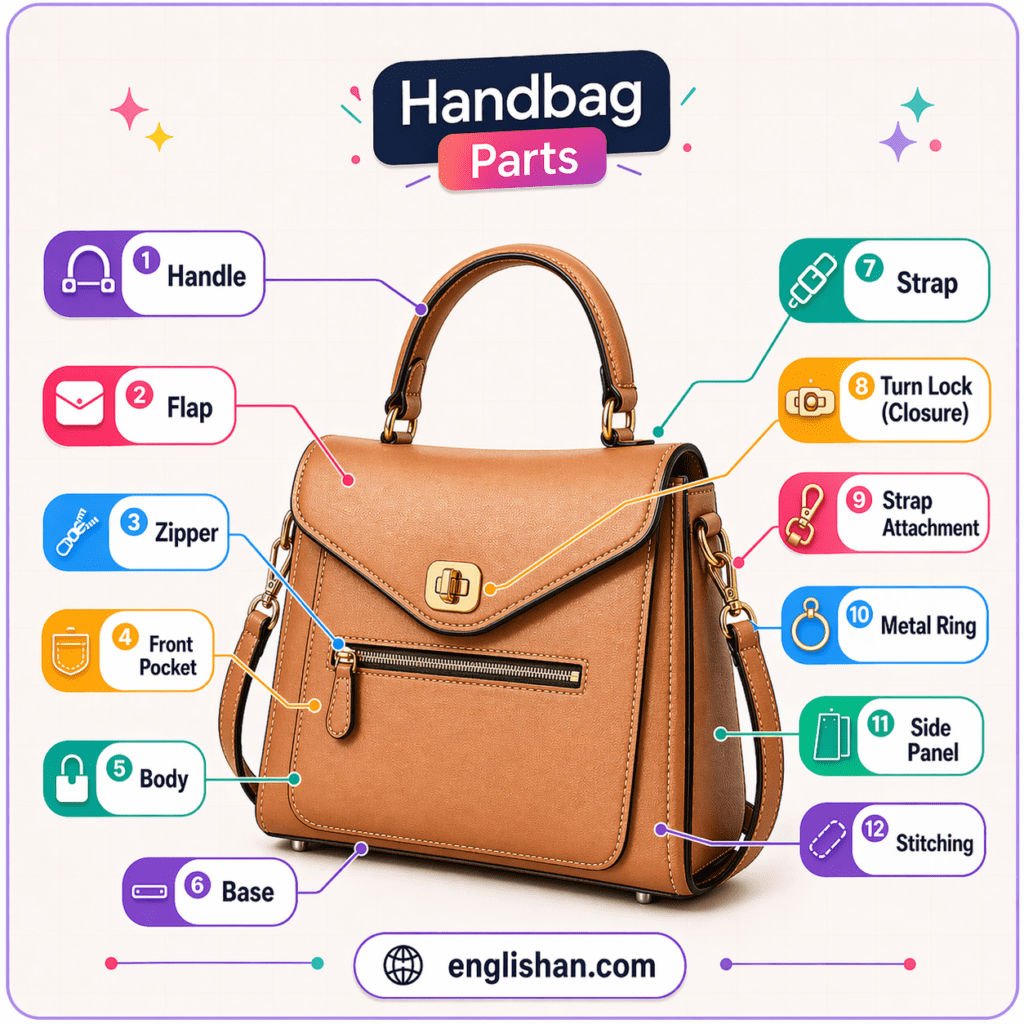
Parts of a Bag
| Part | What It Is |
|---|---|
| Handle | The short grip carried in the hand or on the forearm |
| Shoulder strap | The long strap worn over the shoulder or across the body |
| Gusset | The side panel that gives the bag depth |
| Main compartment | The largest interior space |
| Interior pocket | A smaller pocket sewn inside the lining |
| Zipper | A toothed closure, often paired with a pull tab |
| Flap | A panel that folds over the opening and closes with a magnet, snap, or buckle |
| Turn lock | A rotating metal clasp used in place of a magnetic snap |
| Lining | The fabric layer inside the bag that protects the exterior material |
| Bag feet | Small metal studs on the base that lift the bag off the floor |
| Hardware | The metal pieces (buckles, rings, zips, chains, logos) |
Common Bag Materials
| Material | Notes |
|---|---|
| Full grain leather | The top layer of the hide, durable and ages well |
| Top grain leather | Sanded and treated leather, smoother and less expensive than full grain |
| Suede | Soft napped leather made from the inner side of the hide |
| Patent leather | Leather with a glossy lacquered finish |
| PU leather | Polyurethane coated fabric that mimics leather, vegan and lower cost |
| PVC | Polyvinyl chloride, very durable and waterproof, less flexible than PU |
| Canvas | Heavy cotton or hemp weave, strong and washable |
| Nylon | Lightweight synthetic fabric, water resistant and abrasion resistant |
| Ballistic nylon | A heavier woven nylon used in military and premium luggage |
| Polyester | Durable synthetic fabric, lower cost than nylon |
| Jute | Plant fibre woven into rough sturdy cloth, biodegradable |
| Cork fabric | Made from cork oak bark, a leather alternative |
| Polycarbonate | A light, impact resistant hard plastic used in suitcases |
How to Choose the Right Bag
Three questions cover most buying decisions.
What is the bag actually for? Daily commuting asks for a shoulder bag or backpack with laptop space. A weekend trip calls for a duffel or small rolling suitcase. An evening event needs a clutch or minaudière. Forcing one bag to do all three compromises every occasion.
How long will you wear it? Loads under three pounds work fine on a shoulder bag. Above three pounds, a backpack or a crossbody spreads weight better and prevents shoulder strain. For travel days longer than four hours, anything without wheels will tire you out.
What climate and conditions? Leather needs care in heavy rain and loses shape in humidity. Canvas and cotton handle rain but stain more easily. Nylon, polyester, and coated fabrics shrug off water but look casual. Hardshell suitcases beat softside for flights that involve heavy baggage handling.
Bag Care and Storage Basics
A few habits keep bags usable for years rather than seasons.
- Empty the bag daily. Weight sitting at the base permanently stretches leather.
- Store stuffed with acid free tissue paper or a small pillow to hold shape.
- Keep leather bags out of direct sunlight. UV fades colour and dries out the material.
- Clean canvas and cotton bags in cold water on a gentle cycle. Air dry to avoid shrinking.
- Condition full grain leather every three to six months with a cream conditioner.
- Use the original dust bag for storage. It protects against scratches and dust buildup.
- Alternate bags in rotation. Daily use on a single bag wears stitching four times faster than rotation.
FAQs
There is no fixed number, but most fashion and luggage catalogs cover between 100 and 200 distinct bag types once everyday, travel, work, evening, and cultural categories are included. This guide covers 150+ across eleven families.
The tote bag is one of the most used for casual carrying and shopping.
In US English, the two words are often used interchangeably, with “purse” leaning slightly smaller. In UK English, a purse means a wallet for coins and cards, while a handbag is the larger bag that holds the purse inside.
The tote bag. Its open top, flat base, and two handle carry make it the default choice for groceries, books, laptops, and daily errands across most of the US and Europe.
They are similar. A sling bag usually has one strap and a compact body. A crossbody is more structured and used for fashion.
They are close, but not identical. A sling bag is usually smaller, with one strap worn across the chest or back, and a compact body. A crossbody bag is larger, more structured, and sits against the hip when worn.
A rolling carry on plus a personal item handles 90 percent of trips. Add a packable foldable tote for airport purchases and you cover most situations. Long outdoor travel suits a travel backpack instead.
PU (polyurethane) is softer, more flexible, and more breathable, and looks closer to real leather. PVC (polyvinyl chloride) is harder, fully waterproof, and more durable in rough conditions. PU leads in fashion, PVC leads in outdoor and wet weather use.
Standard backpacks with padded straps for younger students, laptop backpacks for high schoolers and college students, and rolling school bags for anyone carrying heavy textbooks over long distances.
Clutches, minaudières, box clutches, and beaded evening bags. All are small, hand held or lightly strapped, and designed to carry only the essentials: phone, card, lipstick, and a key.
A small rotation of four to five bags covering every major need: a daily tote, a work bag, a crossbody, a travel duffel, and an evening clutch. The minimalist’s answer to owning thirty handbags.
To protect the leather from dust, scratches, and light damage in storage. The dust bag is soft cotton or flannel and should be used every time the bag is put away for more than a day.
You May Also Like