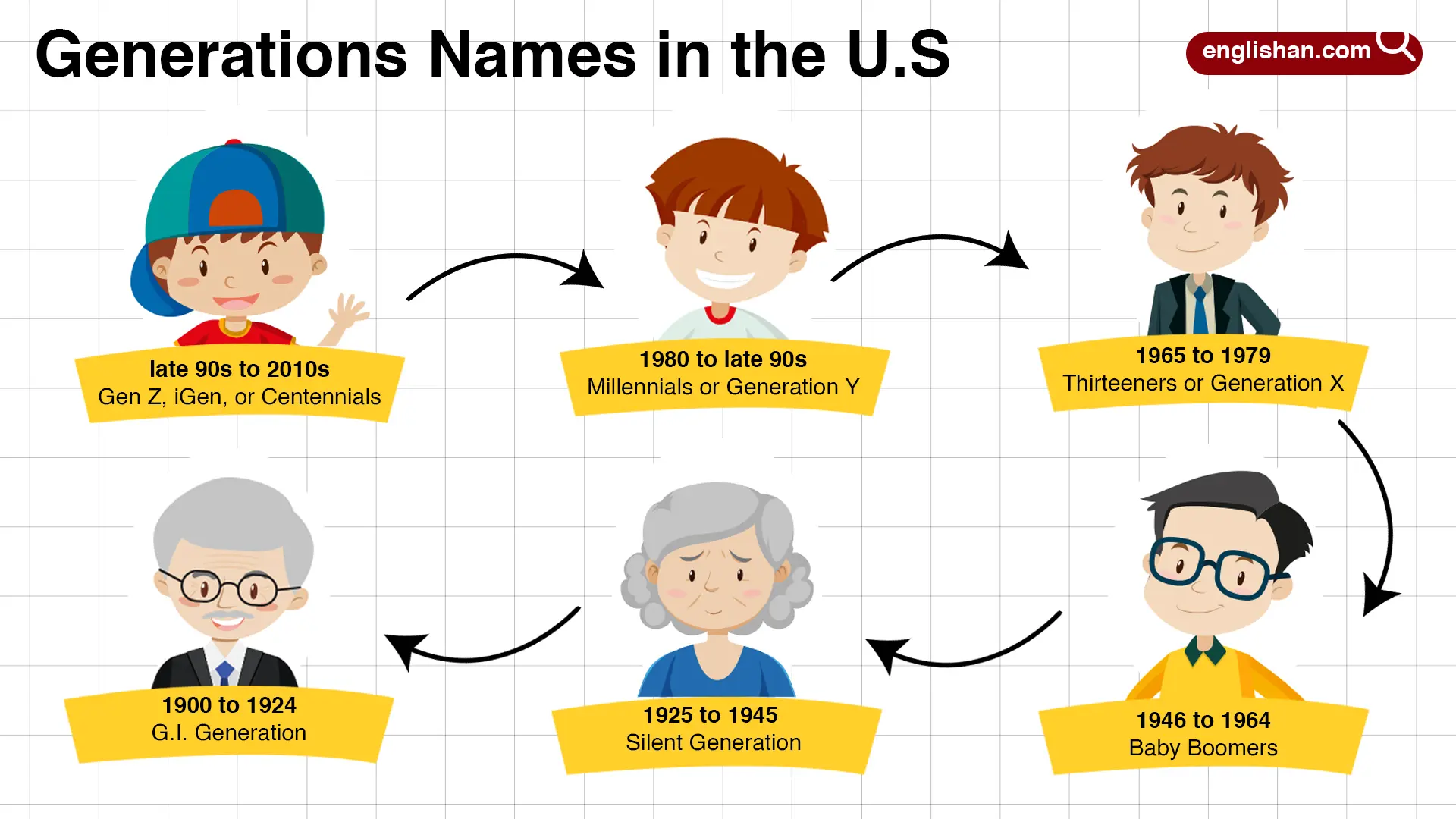
Nine main generation names divide every American birth year from 1883 to 2039. The oldest is the Lost Generation. The newest, Generation Beta, began on 1 January 2025. Each name marks a birth-year range rather than an age, so your cohort never changes even as your age does. Where those ranges start and stop depends on which research framework a source follows, and that single fact explains almost every disagreement you will meet.
Generation Names And Birth Years At A Glance
Ages update every January. These are the figures for 2026.
| Generation | Birth Years | Age In 2026 |
|---|---|---|
| Lost Generation | 1883–1900 | No living members |
| Greatest Generation | 1901–1927 | 99–125 |
| Silent Generation | 1928–1945 | 81–98 |
| Baby Boomers | 1946–1964 | 62–80 |
| Generation X | 1965–1980 | 46–61 |
| Millennials (Gen Y) | 1981–1996 | 30–45 |
| Generation Z | 1997–2012 | 14–29 |
| Generation Alpha | 2013–2024 | 2–13 |
| Generation Beta | 2025–2039 | 0–1 |
Two notes on the numbers. The Greatest Generation figure is arithmetic rather than a live headcount, since almost nobody born in the first decade of the 1900s is still alive. And these ranges follow Pew Research Center from the Silent Generation through Generation Z, with Generation Alpha starting at 2013 so that no birth year falls into two cohorts at once. That choice does real work, and it gets its own explanation further down.
How Is A Generation Defined
A generation is a group of people born within the same run of years who reach the same formative events at roughly the same age. Demographers call it a birth cohort.
Three triggers set a boundary, and a strong cohort has at least two of them:
- A measured demographic shift: a birth surge or slump visible in national birth data, which is how the Baby Boom got both its start and its end date.
- A shared formative event: a war, a recession, or an attack experienced at an age old enough to remember. Pew drew its Millennial line partly on who was old enough to understand 11 September 2001.
- A technology change during childhood: television for Boomers, the home computer for Gen X, the internet for Millennials, the smartphone for Gen Z.
Pew Research Center puts a typical generation at 15 to 18 years. That length is deliberate: short enough that members share a childhood, long enough that the group is large enough to study.
Generation Names In Order From Oldest To Youngest
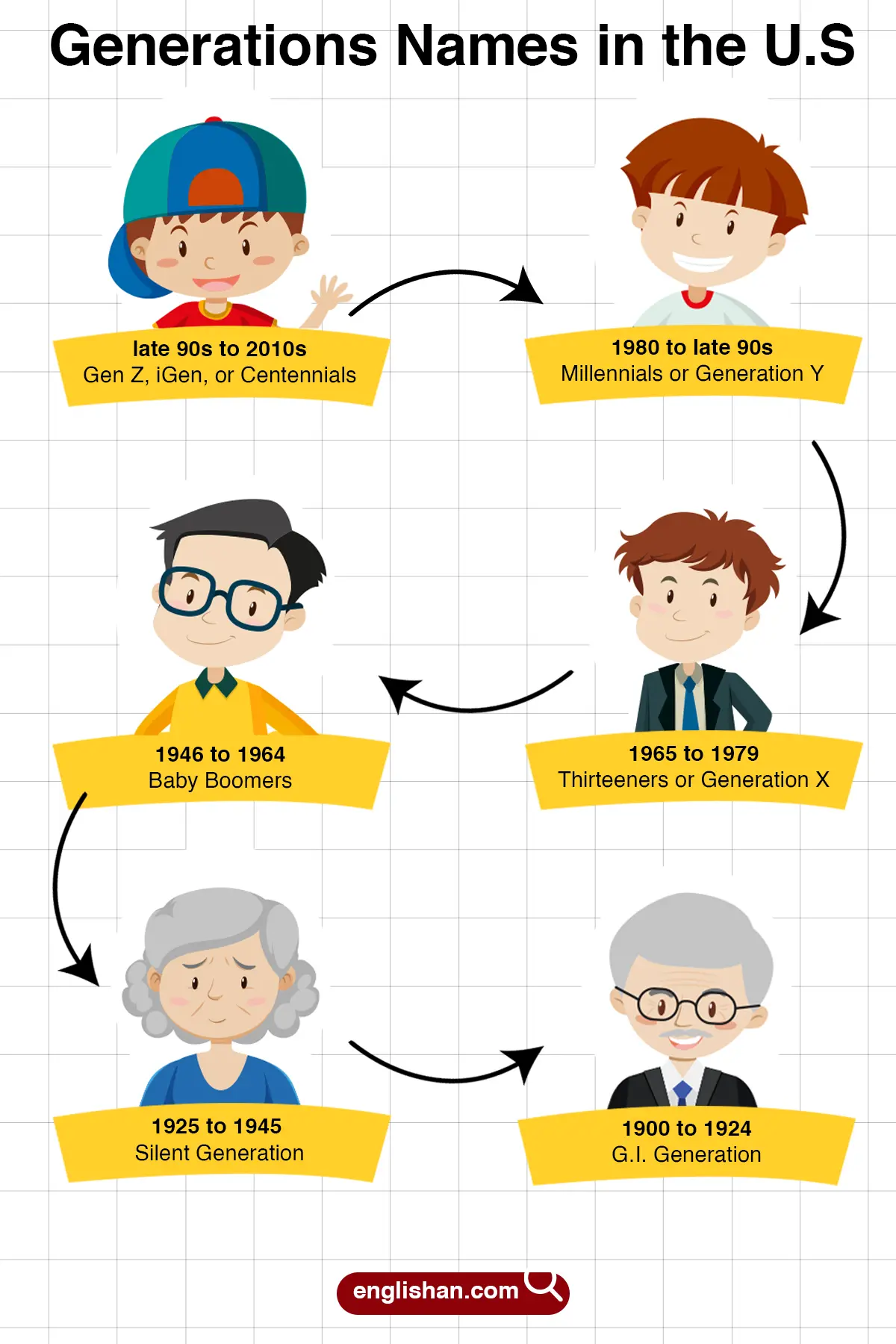
Every name comes with its birth years, the origin of the label, and what the cohort was living through.
The Lost Generation
Born 1883 to 1900: also called the World War I Generation. Gertrude Stein supplied the phrase, and Ernest Hemingway printed it as an epigraph in The Sun Also Rises in 1926, which is what carried it into general use.
They reached adulthood around the First World War and the 1918 influenza pandemic, then spent their twenties in the Jazz Age. The disillusionment in the name is literal: the writers of this cohort described a break with the certainties their parents held. No members survive.
The Greatest Generation
Born 1901 to 1927: also the G.I. Generation. General James Van Fleet used the phrase of American troops in 1953, and Tom Brokaw’s 1998 book of the same title fixed it in public use.
Childhood arrived with the Great Depression and adulthood with the Second World War, which is the sequence the name honours. The survivors are 99 and older in 2026.
The Silent Generation
Born 1928 to 1945: the label comes from a Time magazine essay in 1951, which described a cohort raised on the idea that children should be seen and not heard.
Too young for the Second World War and too old for the counterculture, they entered work during the post-war expansion and are 81 to 98 today. The stereotype of conformity fits the cohort badly at the top end: Martin Luther King Jr., Elvis Presley and Neil Armstrong were all Silents.
Baby Boomers
Born 1946 to 1964: the only cohort with an official United States government definition. The Census Bureau fixed the range on the birth surge that started in 1946 and the sharp drop in birth rates after 1964, both measurable in national birth data.
At 19 years this is the longest modern cohort, three years longer than Gen X or the Millennials, which is why market researchers routinely split it in two. Boomers are 62 to 80 in 2026, and the cohort is now fully at or past retirement age.
Generation X
Born 1965 to 1980: sixteen years, the same span Pew gives the Millennials who follow. The X meant unknown, and it was chosen precisely because nobody had a name for what this cohort was. Douglas Coupland’s 1991 novel Generation X: Tales for an Accelerated Culture fixed the label after journalists tried and failed to make “baby busters” work.
Watergate, the last decade of the Cold War, rising divorce rates and the arrival of the home computer shaped their childhood. The nickname “latchkey generation” comes from the number of them who let themselves in after school while both parents worked. In 2026 they are 46 to 61, at peak earnings, and the cohort now supporting children and ageing parents at the same time.
Millennials
Born 1981 to 1996: also Generation Y. Neil Howe and William Strauss coined “Millennials” in 1989, naming the group for the year its oldest members would reach adulthood. Pew moved the closing year to 1996 in 2018 and has held it there since.
The dates were drawn around memory. Most Millennials were between 5 and 20 when the 11 September attacks happened, old enough to register what had occurred, and between 12 and 27 during the 2008 election. Both boundaries mark experiences the next cohort does not share. Millennials are 30 to 45 in 2026 and now make up the bulk of the American workforce.
Generation Z
Born 1997 to 2012: also Zoomers, a name built by swapping the B of Boomer for a Z. Pew set the 1997 start because this cohort has little or no memory of 11 September, and because the iPhone launched in 2007, when the oldest Zoomers were 10 years old.
The name won a competition. iGeneration, Homelanders and post-Millennials were all in circulation, and Gen Z beat them through sheer repetition in the press. One detail worth knowing: Pew’s 2012 endpoint was set for one specific analysis and was never declared a permanent close, which is where the trouble in the next part begins. Gen Z is 14 to 29 in 2026.
Generation Alpha
Born 2013 to 2024: named by Mark McCrindle, an Australian social researcher who restarted the naming sequence on the Greek alphabet once the Latin one ended at Z. This is the first cohort born entirely inside the 21st century.
Their childhood has no pre-smartphone phase at all, and voice assistants have been part of it throughout, with everyday AI tools arriving for the younger half. COVID-19 disrupted the school years of the older half. Alpha is 2 to 13 in 2026. McCrindle’s own definition starts this cohort in 2010, not 2013, and that gap is the single most confusing thing about generation names right now.
Generation Beta
Born 2025 to 2039: Beta began on 1 January 2025, so this is a live cohort, not a proposal. McCrindle named it and projects that Beta will make up around 16 percent of the world population by 2035, with many members alive to see the 22nd century.
Their parents are mostly younger Millennials and older Gen Z. In 2026 the oldest Betas are turning one.
Why Gen Z And Gen Alpha Birth Years Overlap
Four different start years for Generation Alpha are in circulation right now: 2010, 2011, 2012 and 2013. All four appear on pages that look equally confident, and none of them is a mistake.
The cause is two frameworks built independently and never reconciled. Pew Research Center ended Generation Z at 2012 for one specific analysis. McCrindle Research began Generation Alpha at 2010 to keep a tidy 15-year interval across the Greek alphabet. Neither party was checking the other’s arithmetic, so births in 2010, 2011 and 2012 belong to Gen Z under one system and Generation Alpha under the other.
Here is the version that trips people up, and the version that does not:
- Generation Z runs 1997 to 2012 and Generation Alpha runs 2010 to 2024. ❌
- Generation Z runs 1997 to 2012 and Generation Alpha runs 2013 to 2024. ✅
The first line double-books three years. It shows up on a surprising number of charts because writers take Gen Z from Pew and Alpha from McCrindle without noticing the seam.
Pick one system and apply it throughout. For an American audience, Pew through Gen Z with Alpha starting in 2013 is the safer choice, because it matches the Census-anchored Boomer definition and leaves no year assigned twice. If you are working inside McCrindle’s 15-year system for a global audience, set Gen Z to end at 2009 and Alpha to start at 2010, and stay consistent. The people caught in the middle are increasingly described as Zalpha.
Why Generation Birth Years Differ By Source
Once you see the three main frameworks side by side, the disagreements stop looking random.
| Generation | Pew Research Center | McCrindle Research | U.S. Census Bureau |
|---|---|---|---|
| Baby Boomers | 1946–1964 | 1946–1964 | 1946–1964 |
| Generation X | 1965–1980 | 1965–1979 | Not defined |
| Millennials | 1981–1996 | 1980–1994 | Not defined |
| Generation Z | 1997–2012 | 1995–2009 | Not defined |
| Generation Alpha | Not defined | 2010–2024 | Not defined |
| Generation Beta | Not defined | 2025–2039 | Not defined |
Each body is doing a different job. Pew draws its lines where a shared experience changes, which is why the Millennial cutoff turns on who remembers 11 September and the Gen Z start turns on the iPhone. McCrindle applies a standardised 15-year interval, which produces neat, predictable ranges and pushes every boundary a few years earlier. The Census Bureau measures a demographic event and nothing else, which is why it has an opinion about Baby Boomers and no opinion about anyone since.
None of the three is wrong. They answer different questions.
Who Decides Generation Names
No government body names a generation. Names come from journalists, novelists, historians and research firms, and a name survives only when the public repeats it.
- Lost Generation: Gertrude Stein’s phrase, printed by Ernest Hemingway in 1926.
- Greatest Generation: used by General James Van Fleet in 1953, popularised by Tom Brokaw’s 1998 book.
- Silent Generation: from a Time magazine essay in 1951.
- Baby Boomers: from the measured birth surge, tracked by the U.S. Census Bureau.
- Generation X: fixed by Douglas Coupland’s 1991 novel.
- Millennials: coined by Neil Howe and William Strauss in 1989.
- Generation Z: carried forward alphabetically from X and Y.
- Generation Alpha and Beta: named by Mark McCrindle, restarting the sequence on the Greek alphabet.
The failures are as instructive as the winners. Journalists floated “baby busters” for the post-Boomer cohort and nobody used it. “Gen Y” was the obvious next label after X, and “Millennials” displaced it within a decade. “iGen” lost to “Gen Z” outright. A name lasts when it describes something people recognise in themselves, and when it is short enough to say out loud.
Microgenerations And Cusp Birth Years
Five sub-labels get real use, and each one describes a genuine experience the broader cohort misses.
- Boomers I: born 1946 to 1954, aged 72 to 80 in 2026. Old enough to face the Vietnam draft.
- Boomers II, also Generation Jones: born 1955 to 1964, aged 62 to 71. Young enough to have missed the draft, and with only faint memories of the 1960s their older siblings define.
- Xennials: born roughly 1977 to 1985. An analogue childhood followed by a digital adulthood, with the changeover landing during university or a first job.
- Zillennials: born roughly 1993 to 1998. Dial-up internet in primary school, smartphones by the end of secondary.
- Zalpha: born roughly 2010 to 2012. The exact stretch two frameworks assign differently, which is why the label exists at all.
None of these names comes from Pew or Census work. They earn their place by describing a real cusp rather than by being official. If you have argued with a sibling about which of you is a “proper” Millennial, this is the vocabulary for it, and the generation gap between adjacent cohorts is smaller than the one inside a single cohort’s own 16-year span.
Which Generation Names Are Official In The United States
One of the nine: Baby Boomers. The U.S. Census Bureau defines the 1946 to 1964 cohort because the birth surge is a demographic event with a measurable beginning and end in national birth data. Every other name on this timeline is a construct produced by researchers, journalists or marketers, which is exactly why the years move around.
Pew Research Center, the closest thing the United States has to an authority on the rest, has stepped back from the whole framework. In May 2023 Pew announced it would stop defaulting to standard generational labels, and would run generational analysis only where it has decades of comparable data and where it can control for age and for period effects that hit every age group at once. Pew’s stated reason: the field had filled with material sold as research that reads closer to marketing, and the diversity of thought inside a generation rivals the difference between generations.
That does not make the labels worthless. It does mean treating them as a rough conversational reference rather than as a fixed identity, and it explains why no two charts agree.
What Generation Am I By Birth Year
Your generation follows your birth year, not your current age, and it never changes. Match your birth year to a range and you have your answer for life.
Four boundary years cause almost all of the confusion:
- 1980: Generation X under Pew, Millennial under McCrindle. Both defensible.
- 1996: The last Millennial year under Pew. A great many people born in the mid-1990s describe themselves as Zillennials instead.
- 2012: The last Gen Z year under Pew, and already Generation Alpha under McCrindle. This is the Zalpha zone.
- 2024: The last Generation Alpha year. Anyone born from 1 January 2025 onward is Generation Beta.
If your birth year falls inside two frameworks, both descriptions are accurate. Name the framework you are using and the argument ends: “Gen Z by Pew’s dates” is a complete and accurate answer.
What Comes After Generation Beta
McCrindle’s Greek-alphabet sequence continues in 15-year steps once Beta closes in 2039:
- Generation Gamma: 2040 to 2054
- Generation Delta: 2055 to 2069
- Generation Epsilon: 2070 to 2084
- Generation Zeta: 2085 to 2099
These are projections, not settled names. Every label from Lost through Alpha was applied in hindsight, after the events that shaped the cohort had already happened. The cohort born in 2040 will get whatever name the 2050s decide to repeat.
How Long Is A Generation
Pew Research Center puts a typical generation at 15 to 18 years, and most modern American cohorts match it. Generation X, the Millennials and Generation Z are 16 years each. Generation Beta is 15. Generation Alpha is 12 under the 2013 start date, which is short by historical standards.
Baby Boomers is the outlier at 19 years, and that length is the reason researchers split it into Boomers I and Boomers II. Someone born in 1946 was draft-age for Vietnam and watched the moon landing as an adult. Someone born in 1964 was a toddler for both. A single label stretched across those two childhoods explains very little.
Spans have shortened over the past century for one reason: the force that defines a cohort has shifted from demographics to technology, and technology changes faster than birth rates.
FAQs
You are a Millennial under Pew Research Center’s definition, which sets 1996 as the final Millennial birth year. McCrindle Research would place you in Generation Z, since its Millennial range ends in 1994. Plenty of people born between 1993 and 1998 use the informal label Zillennial instead, which acknowledges both.
Yes. The two terms name the same cohort, born 1981 to 1996 under Pew’s definition. “Generation Y” came first as the obvious alphabetical successor to Generation X, and “Millennials,” coined by Neil Howe and William Strauss in 1989, replaced it in common use as the year 2000 approached.
Generation Beta, born from 1 January 2025 to 2039. It replaced Generation Alpha as the youngest cohort at the start of 2025. In 2026 the oldest members of Generation Beta are turning one year old.
Not formally, but the boundaries are soft enough that boundary-year births are described both ways. Someone born in 2011 is Generation Z under Pew and Generation Alpha under McCrindle, and both statements are defensible. People in this position are called cuspers, and the specific labels are Xennial, Zillennial and Zalpha depending on which boundary they straddle.
Millennials. Pew Research Center recorded them overtaking Baby Boomers as the largest American generation, and they remain ahead. Generation Z is close behind and grows through immigration rather than births, while the Boomer cohort shrinks each year.
The names get used abroad, but the years and the framing do not always follow. These ranges come out of American demographic research, and other countries adjust them or use their own: Australia calls the Silent Generation “Builders,” and Japan marks cohorts by imperial era, such as Showa and Heisei. Alpha and Beta are the most globally consistent cohorts so far, because the technology defining them arrived everywhere at once.
No generation name is official except Baby Boomers, which the U.S. Census Bureau defines. Generation Beta comes from McCrindle Research, the same firm that named Generation Alpha, and dates it 2025 to 2039. Pew Research Center has not adopted it and, since its 2023 policy change, no longer works this way.