

The parts of a xylophone are the bars, the resonator tubes, the frame, the stand, and the mallets. A mallet strikes a bar, the bar vibrates at its pitch, and the tube beneath it amplifies the tone.
An orchestral xylophone runs from the bars at the top to the stand at the base. Each part has set measurements and materials, and the instrument has a fixed range. The bars follow the keyboard layout of the piano, and mallets replace the keys and hammers. The parts of a drum set follow a different design, with a head stretched over a shell.
Parts of a Xylophone Labeled Diagram
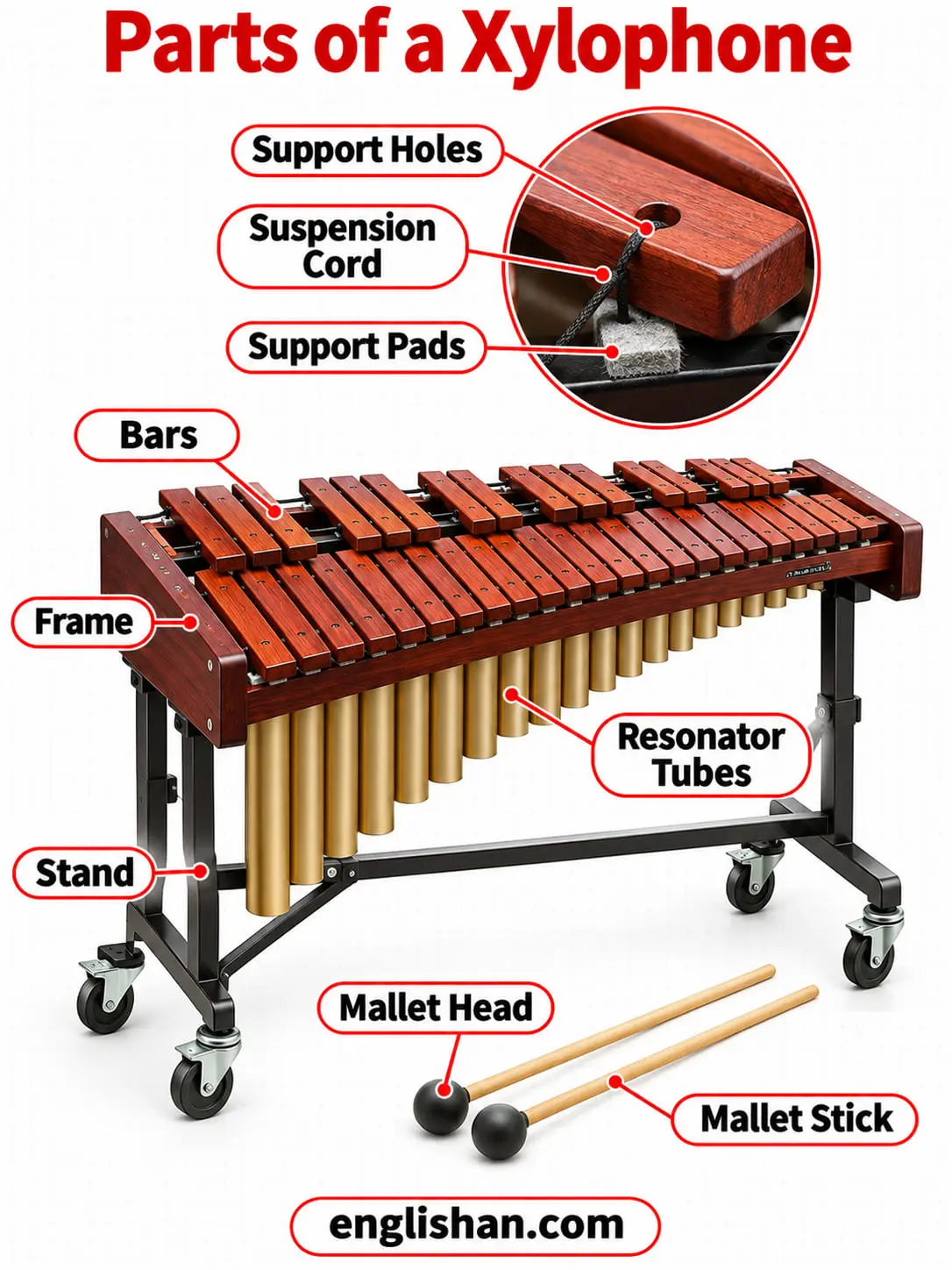
In a labeled diagram of a xylophone, the bars are at the top, in two rows like the keys of a piano. A resonator tube hangs beneath each bar. The frame surrounds the bars and the tubes, and the stand supports the frame.
| Part | Where you find it |
|---|---|
| 1. Bars | Wooden or synthetic keys arranged in two piano-like rows |
| 2. Support holes | Drilled holes at the nodal points of each bar |
| 3. Suspension cord | String threaded through the support holes |
| 4. Support pads | Felt, rubber, or wooden pads at the nodal points |
| 5. Resonator tubes | One tube mounted under each bar |
| 6. Frame | Trapezoid structure that supports the bars |
| 7. Stand | Metal base with wheels under the frame |
| 8. Mallet stick | Flexible shaft of the mallet |
| 9. Mallet head | Small round tip of the mallet that strikes the bar |
Xylophone Bar Parts
The bars are the sounding parts of a xylophone. Each bar is tuned to one pitch of a scale, and a mallet strikes it. The pitch depends on the length, the thickness, and the density of the bar. The tabla is another tuned percussion instrument, though the hands strike it rather than mallets.
Bar Layout
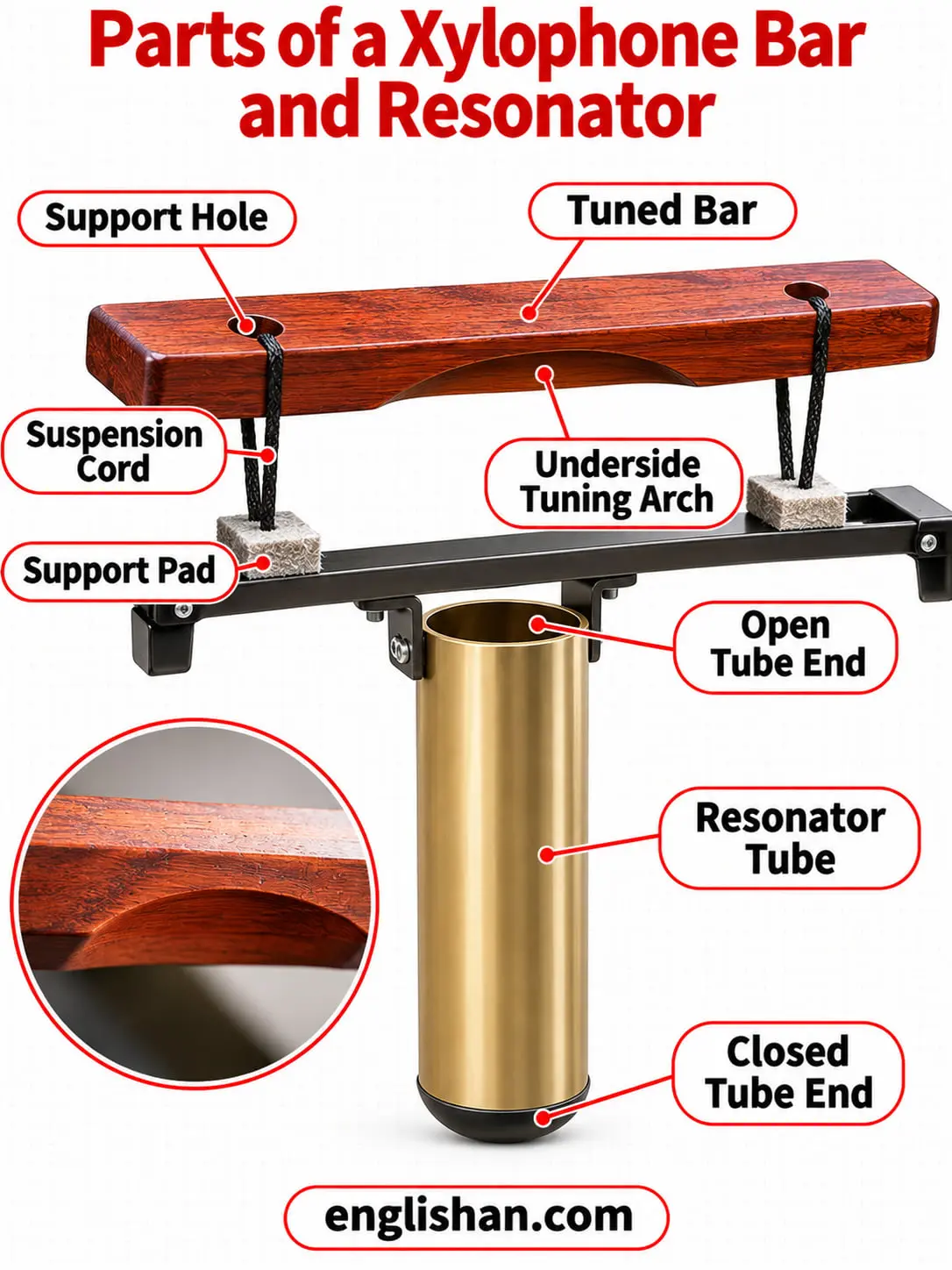
The bars are arranged in two rows, like the keys of a piano. They hang on a string threaded through holes at the nodal points. Support pads of felt, rubber, or wood are set at those points.
Bar Tuning
Makers tune a bar by removing material from its underside. They carve an arched notch in stages, checking the pitch after each cut. An orchestral xylophone is tuned to 442 Hz in equal temperament.
Xylophone Resonator Parts
The resonator tubes are the parts of a xylophone that amplify the sound. One tube is mounted under each bar, and each is sized to resonate at the pitch of its bar. A tube also softens the tone of the bar.
The tubes are aluminum, tapered to match the lengths of the bars. Each tube is open at the top and closed at the lower end by a stop. Traditional African xylophones use gourds in place of tubes.
Parts of a Xylophone Frame and Stand
The frame is the trapezoid structure that supports the bars. It is hardwood or metal, and student models use particle board. Supports are bolted to the frame, and the pads on them support the bars.
The stand is a metal base with wheels, so the instrument moves easily. Some models have lockable casters or rubber feet. More expensive models add height adjustment and a more stable stand.
Parts of a Xylophone Mallet
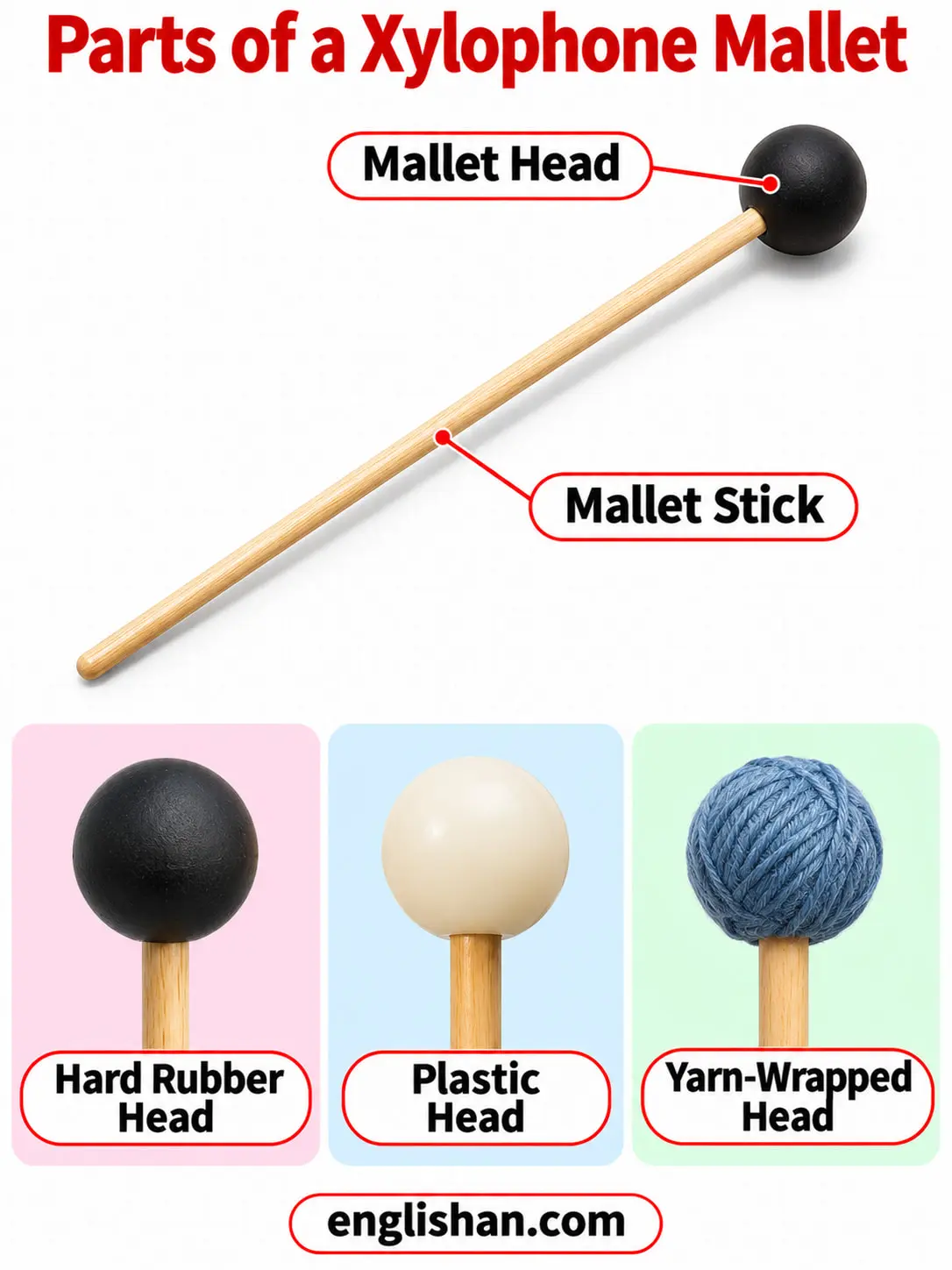
The mallets supply the energy that sets a bar vibrating. Each mallet has a stick and a head. The head deforms briefly on impact, and its material changes the tone.
Mallet Stick
The stick is a flexible shaft of bamboo, rattan, birch, or fiberglass. It measures 12 to 16 inches long.
Mallet Head
The head is a small, round tip of hard rubber, plastic, wool, or yarn. It measures 0.8 to 1.1 inches across. Harder heads brighten the tone, and softer yarn-wrapped heads darken it.
Wooden heads of rosewood, ebony, or birch give a lighter tone. A core of tightly wound cord inside the head adds durability and an even strike.
Xylophone Range and Size Parts
Orchestral xylophones come in three ranges. A three-octave instrument spans C5 to C8, a three-and-a-half-octave instrument spans F4 to C8, and a four-octave instrument spans C4 to C8. Small instruments have as little as two and a half octaves, and classroom models about one and a half.
| Part | Measurement |
|---|---|
| Bar length | 5.3 to 15 inches |
| Bar width | 1.0 to 1.8 inches |
| Bar thickness | 0.6 to 1.0 inches |
| Frame length, three octaves | 40.6 to 41.7 inches |
| Frame length, three and a half octaves | 47 to 57 inches |
| Frame width | 21.7 to 31.5 inches |
| Stand height | 32.7 to 37.4 inches |
| Weight with the stand | 49 to 79 pounds |
How the Parts of a Xylophone Work
A mallet strikes a bar, and the bar sounds as an idiophone, a body that makes sound by vibrating itself. The tube under the bar amplifies and sustains the tone.
The cord and the pads support each bar at its nodal points, where the vibration is smallest. The frame and the stand keep the bars at playing height.
Xylophone Parts and Their Materials
Each material is chosen for the tone of the bars or the strength of the frame.
Bars: Rosewood is the standard wood, with padauk, cocobolo, and Japanese birch as alternatives. Synthetic bars of fiberglass or kelon give a louder sound. Rosewood is aged about two years before it is cut.
Resonator tubes: Aluminum.
Frame: Hardwood, metal, or particle board.
Stand: Metal.
Supports: Felt, synthetic, rubber, or wooden pads at the nodal points.
Mallets: Bamboo, rattan, birch, or fiberglass sticks, with heads of hard rubber, plastic, wool, or yarn.
FAQs
The parts of a xylophone are the bars, the resonator tubes, the frame, the stand, and the mallets. The bars hang on a cord through holes at their nodal points.
The bars are also called the keys of the xylophone. They are the wooden or synthetic strips that a mallet strikes, and each is tuned to one pitch.
The resonator tubes are the metal parts of a xylophone, and they are aluminum. The stand is metal, and the frame is hardwood or metal.
The parts of a xylophone mallet are the stick, the head, and the core. The stick is a flexible shaft, and the head is a round tip of rubber, plastic, wool, or yarn.
A xylophone is made of rosewood or synthetic bars, aluminum resonator tubes, and a frame of hardwood or metal. Padauk, cocobolo, and Japanese birch are alternative woods for the bars.
An orchestral xylophone has a frame 41 inches long at three octaves and 47 to 57 inches long at three and a half octaves. The stand is 33 to 37 inches high.
You play a xylophone with mallets. Rubber, plastic, and acrylic heads suit general playing, and yarn heads give a softer effect.
A mallet strikes a bar, and the bar vibrates at its pitch. The tube under the bar amplifies and sustains the tone.
Related: