

The parts of a sitar are the gourd (tumba), the soundboard (tabli), the neck (dandi), the frets (pardas), the bridges, the strings, and the tuning pegs. The Hindustani sitar is about 4 feet long, with a rounded gourd at the base and a long hollow neck. Like the guitar, it is a plucked string instrument with frets, but its frets are movable and it has two sets of strings.
A violin is bowed, while the sitar is plucked with a wire plectrum. The harmonium and the tabla share the stage with it in Hindustani classical music.
Parts of a Sitar Labeled From the Gourd to the Pegs
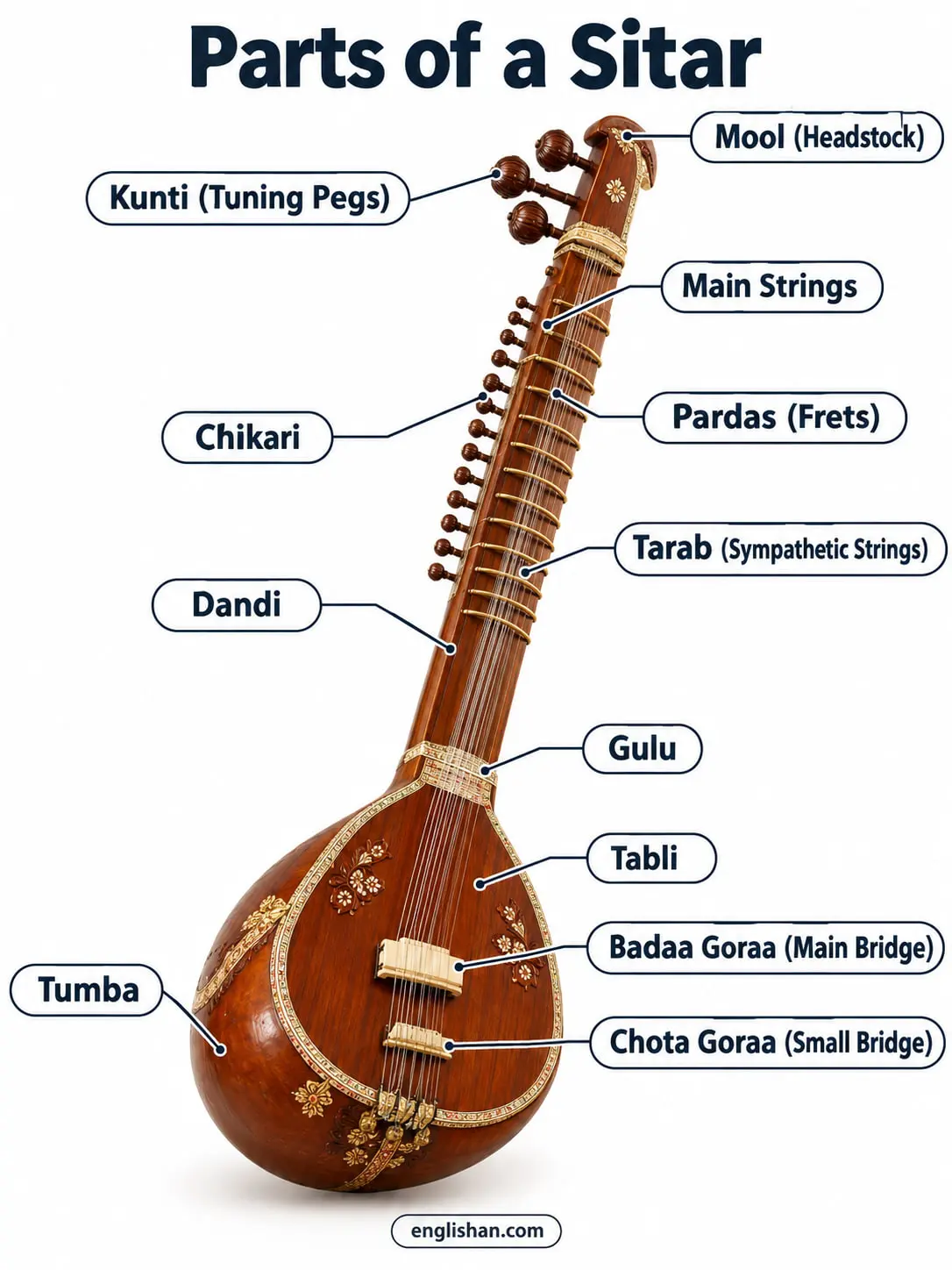
The gourd and the soundboard form the base, and the neck rises from the gourd to the headstock. The frets cross the neck, and the bridges are set on the soundboard.
| Part | Where you find it |
|---|---|
| 1. Tumba | Large dried gourd at the base of the instrument |
| 2. Tabli | Flat soundboard of toon or teak on the front of the gourd |
| 3. Neck gourd | Smaller second gourd near the top of the neck, on some sitars |
| 4. Gulu | Joint where the neck meets the gourd |
| 5. Dandi | Long hollow wooden neck |
| 6. Parda | Curved metal frets tied across the neck |
| 7. Mool | Headstock at the top of the neck |
| 8. Bone nut | Bone strip at the top of the fingerboard |
| 9. Kunti | Hardwood tuning pegs in the headstock |
| 10. Sympathetic string pegs | Small pegs along the side of the neck |
| 11. Main strings | Playing strings stretched over the frets |
| 12. Kharaj | Thick bass strings among the main strings |
| 13. Chikari | Side strings tuned as drone and rhythm strings |
| 14. Tarab | Thin sympathetic strings beneath the frets |
| 15. Tuning beads | Small beads threaded on the main strings for fine tuning |
| 16. Badaa goraa | Large bridge on the tabli for the main strings |
| 17. Chota goraa | Small bridge on the tabli for the sympathetic strings |
| 18. Jawari | Curved top of the bridge, shaped for the buzzing tone |
| 19. Mizrab | Wire plectrum worn on the index finger |
Sitar Gourd and Soundboard Parts
Among the parts of a sitar, the gourd and the soundboard are the resonating pair. They amplify the vibration of the strings.
Tumba
The tumba is a large dried gourd that forms the body of the sitar. It is round and hollow, and the neck joins it at the top. The tumba is the resonator of the instrument.
Tabli
The tabli is the flat soundboard on the front of the tumba. It is cut from toon or teak, and the bridges are set on it.
Neck Gourd
The neck gourd is a second, smaller gourd mounted near the top of the neck. Not every sitar has it, and it is fitted on instruments built in the Ravi Shankar style.
Sitar Neck and Fret Parts
The neck is the longest of the parts of a sitar. It extends from the joint at the gourd to the headstock.
Dandi
The dandi is the long hollow neck. It is made of toon or teak, and the surface that holds the frets is slightly concave. The strings extend along it from the bridges to the pegs.
Gulu
The gulu is the joint where the dandi meets the tumba.
Pardas
The pardas are the frets, curved bars of brass or bronze tied across the dandi with cord. They are movable, so the player slides them along the neck to match the notes of a raga. Models have between 16 and 22 frets.
Sitar Headstock and Tuning Peg Parts
The headstock is the top of the dandi. It bears the pegs for the main strings and the bone nut that the strings pass over.
Mool
The mool is the headstock, the curved end block at the top of the dandi. The tuning pegs are mounted in it.
Bone Nut
The bone nut is a thin strip of bone at the top of the fingerboard. The main strings pass over it before they reach the pegs.
Kunti
The kunti are the large hardwood pegs in the mool. Each main string and each chikari winds onto one kunti. Turning a peg tightens or loosens the string wound on it.
Sympathetic String Pegs
The sympathetic string pegs are smaller pegs set along the side of the dandi. They tune the tarab, one peg for each sympathetic string.
Sitar String and Plectrum Parts
The strings are the most numerous of the parts of a sitar, with 18 to 21 in two sets. The main strings are played, and the sympathetic strings vibrate in response.
Main Strings
The main strings number six or seven. They are stretched over the frets and are plucked with the mizrab. The thickest of them are the kharaj.
Kharaj
The kharaj are the thick bass strings among the main strings. They sound the low notes of the sitar.
Chikari
The chikari are the thin side strings, tuned as drone and rhythm strings. They mark the beat between the notes of the main strings.
Tarab
The tarab are the sympathetic strings, 11 to 13 thin strings stretched under the frets. They are never plucked, and they vibrate in sympathy with the main strings.
Mizrab
The mizrab is a wire plectrum worn on the index finger of the right hand. It plucks the main strings.
Sitar Bridge Parts and the Jawari
The two bridges are set on the tabli. The badaa goraa is the larger, and the chota goraa is the smaller. Both are parts of a sitar that shape the tone as well as support the strings.
Badaa Goraa
The badaa goraa is the large bridge that supports the main strings. It is cut from bone, horn, or ebony, and the top is curved.
Chota Goraa
The chota goraa is the small bridge that supports the sympathetic strings.
Jawari
The jawari is the curved top of the badaa goraa. It is shaped so the strings graze the surface, which produces the buzzing overtone that identifies the sitar.
Sitar Parts and Their Materials
The materials of the parts of a sitar come from wood, gourd, bone, and metal. The tabli and the dandi are toon or teak, and the tumba is a dried gourd. The frets are brass or bronze, and the bridge is bone, horn, or a composite. The pegs are hardwood.
Sitar Styles and Their Added Parts
Sitars built in the Ravi Shankar style have a second gourd at the top of the neck. Sitars built in the Vilayat Khan style have a single gourd. The two styles share the same core parts of a sitar.
Sitar Parts Names in English and Hindi
Sitar parts names vary by teacher and by spelling. Each part has a standard English form, and the alternates are the spellings and regional names a student meets in books and lessons.
| Part | English gloss | Alternate names |
|---|---|---|
| Tumba | Gourd resonator | Toomba |
| Tabli | Soundboard | Faceplate |
| Dandi | Neck | None |
| Parda | Fret | Pardey, pardas |
| Kunti | Tuning peg | Khunti, kilis |
| Tarab | Sympathetic string | Taraf, tarb, tarafdaar |
| Mizrab | Plectrum | Mizraab |
| Chikari | Side string | Chickaree |
| Mool | Headstock | None |
| Gulu | Neck joint | None |
Related:
FAQs
FAQs
The parts of a sitar are the tumba, the tabli, the dandi, the pardas, the mool, the pegs, the strings, the two bridges, and the mizrab. The tumba and the tabli form the body, and the dandi bears the frets.
The parts of a sitar are made of toon or teak wood, a dried gourd, brass or bronze frets, a bone or horn bridge, and hardwood pegs. The tumba is the gourd, and the tabli and the dandi are wood.
Yes, the parts of a sitar include movable frets called pardas. They are curved bars of brass or bronze tied across the neck with cord, and the player slides them to suit the raga.
A sitar has 18 to 21 strings in total. Six or seven are main strings, and the rest are sympathetic strings that vibrate in response.
The sympathetic strings, called tarab, are thin strings stretched under the frets. They are never plucked. They vibrate when the main strings sound, and they add the shimmer of the sitar.
The jawari is the curved top of the main bridge, one of the shaped parts of a sitar. Its shape lets the strings graze the surface and produces the buzzing overtone of the sitar.
The tumba is the dried gourd that forms the body of the sitar. The tabli is the flat soundboard of toon or teak on the front of the gourd, and the bridges are set on it.
