

A snowboard divides into two systems. The board runs from nose to tail and is built in layers, and the bindings hold the rider’s boots to the board through the inserts. The parts of a snowboard therefore fall into the outline of the board, the layers inside it, and the binding hardware on top.
Every part is named, located, and explained, with materials and measurements taken from Burton, Wikipedia, Snowboard Addiction, and Alpinstore. Construction terms such as sandwich, cap, camber, and sidecut describe how those parts combine, and each one is explained in turn.
Parts of a Snowboard Labeled Diagram
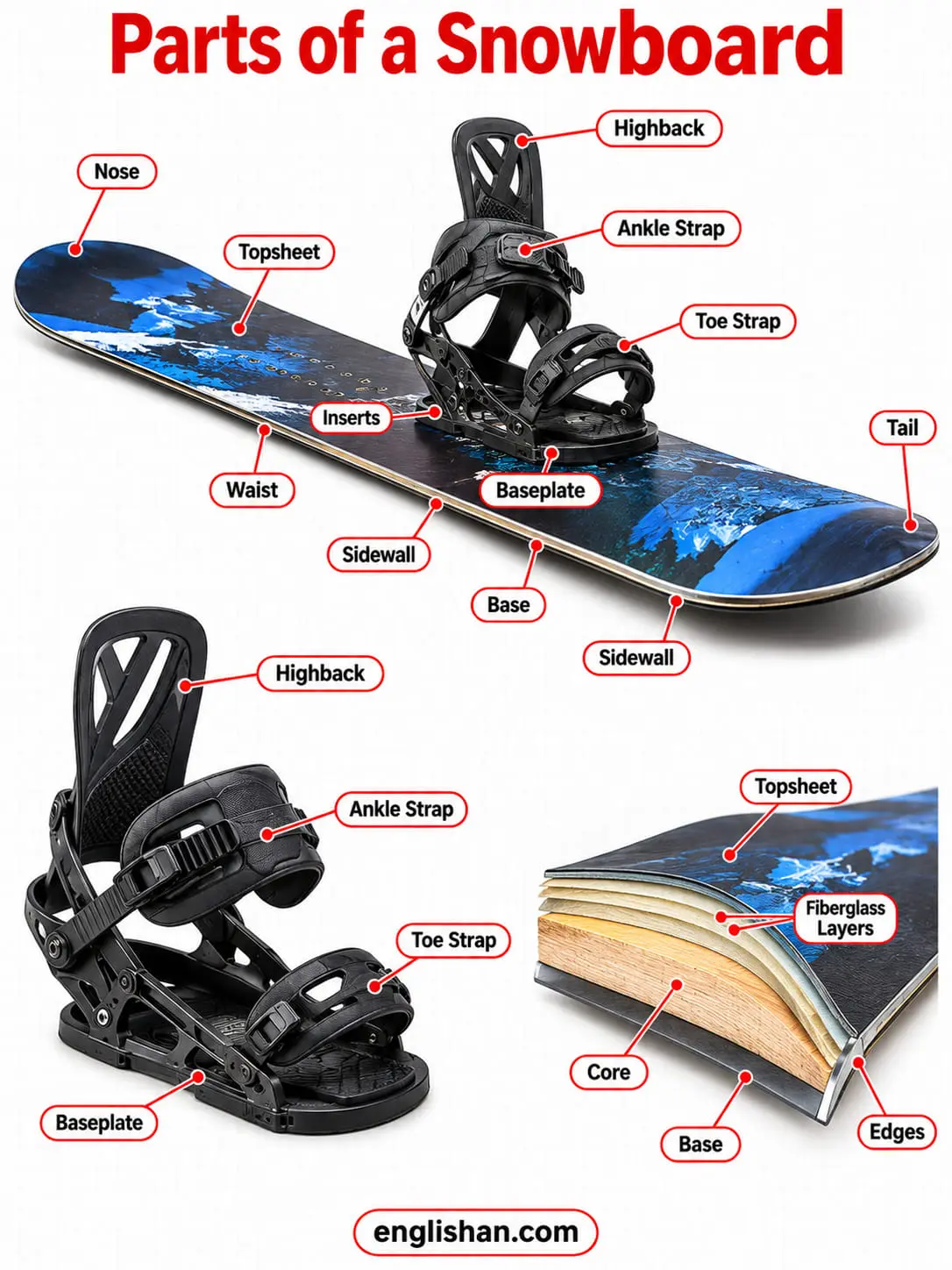
A snowboard has 14 named parts, numbered here from the front of the board to the binding straps.
| Part | Location | Function |
|---|---|---|
| 1. Nose | Front end of the board in the riding direction | Marks the front of the board, and the foot closest to it is the front foot |
| 2. Waist | Middle of the board, between the feet | Sets the width of the board under the rider’s feet |
| 3. Tail | Rear end, behind the back foot | Marks the back of the board |
| 4. Topsheet | Top surface of the board | Displays the graphics and mounts the binding hardware |
| 5. Edges | Perimeter of the base | Metal strips that grip the snow in turns |
| 6. Base | Underside of the board | Polyethylene surface that touches the snow and absorbs wax |
| 7. Sidewall | Perimeter, between the metal edge and the topsheet | Protects the core and transmits power to the edges |
| 8. Core | Center layers inside the board | Sets most of the weight, strength, and flex of the board |
| 9. Fiberglass layers | One layer on each side of the core | Set how stiff the board is along its length and when twisted |
| 10. Inserts | Center of the board, under the bindings | Receive the screws that attach the bindings |
| 11. Baseplate | Bottom of the binding, directly on the board | Connects the binding to the board and spreads the rider’s weight |
| 12. Highback | Rear of the binding, behind the calf | Supports the lower leg and transfers leg power to the board |
| 13. Ankle strap | Across the top of the ankle | Secures the ankle with a buckle and ladder |
| 14. Toe strap | Across the toes | Secures the toe of the boot with a buckle and ladder |
Two terms describe the board as a whole. The shape is the outline from nose to tail, and the profile is the curve of the base from nose to tail.
Which End of a Snowboard Is the Front
The nose and tail are the first two parts of a snowboard to identify, because the direction of travel fixes the front binding and the toe edge.
Nose
The nose, also called the tip, is the front of the board when the board faces down the mountain. The foot closest to the nose is the front foot, and it sets the rider’s stance. Directional boards set the inserts back to give a longer nose, which floats in fresh snow.
Tail
The tail is the rear end of the board, behind the back foot. A twin board is fully symmetrical, so it rides switch or regular. On a directional twin board the inserts are offset slightly toward the tail.
A regular stance puts the left foot forward and the right foot back. A goofy stance puts the right foot forward and the left foot back. Burton states that regular does not mean correct and goofy does not mean incorrect.
Burton describes three tests for finding the front foot:
- Slide test: Slide across a smooth floor in thick socks. The foot that leads the slide is read as the front foot.
- Push test: Place the heels together while someone gently pushes from behind. The foot that steps out to brace is read as the front foot.
- Stair test: Climb a flight of stairs. The foot that starts the climb and touches the first step is read as the back foot.
Parts of a Snowboard Inside the Board
Wood, fiberglass, and resin are the main materials in the inner parts of a snowboard.
Core
The core is the inner layer at the center of the board, and it provides most of the structure. It sets the weight, strength, and flex of the board. Most cores are laminated wood strips, and Burton names beech, birch, aspen, bamboo, and paulownia. Wikipedia names beech and poplar as the most common woods. Carbon, kevlar, and aluminum are the non-wood options, and foam and honeycomb cores reduce weight.
Fiberglass Layers
Fiberglass wraps the core in two layers, one on each side. The core is sandwiched between at least two of these layers. Glass fibers are woven or stitched, and the direction of the weave sets the type.
| Fiberglass type | Strand direction | Effect on the board |
|---|---|---|
| Unidirectional | One direction | High stiffness along the length of the board |
| Biaxial | Two directions at 90 degrees | Smooth, consistent flex |
| Triaxial | +45, 0, and -45 degrees | More torsional stiffness at the same weight and strength as biaxial |
Higher-end boards add carbon strands, called stringers, for stiffness and pop.
Epoxy resin
Epoxy resin bonds the fiberglass layers and holds the board together. Conventional epoxies are petroleum-based.
Sandwich and Cap Construction
Sidewall
The sidewall is the perimeter between the metal edge and the topsheet. Its outer layer is plastic or urethane, and its inner layer is rubber, aluminum, or wood that absorbs shock. Another source names ABS as the common sidewall plastic, which is durable and stiff, with urethane as the alternative.
Construction type depends on how the topsheet, fiberglass, and sidewall meet at the edge of these parts of a snowboard.
| Construction | What covers the edge of the core | Result |
|---|---|---|
| Sandwich | A sidewall between the metal edge and the topsheet | Protects the core and transmits power to the edges |
| Cap | The topsheet and fiberglass wrap over the core to the edges | Lighter board with a softer pop |
| Half-cap | A mix of the two | Light and responsive |
Sandwich construction is the industry standard. Burton notes that cap and half-cap boards are no longer common.
Snowboard Topsheet
The topsheet is the topmost layer, facing up while riding, and it shows graphics or textures. The bindings attach to it. It is made from nylon, wood, fiberglass, aluminum, polyurethane, or a composite of these. An aluminum topsheet gives stiffer torsional flex.
Parts of a Snowboard Base and Edges
Base
The base is the underside of the board that touches the snow. It is made of polyethylene, which Burton identifies as ultra-high-molecular-weight polyethylene, or P-Tex. Tiny pores absorb wax when heated and close when cold, so the wax seeps out slowly and the base needs regular waxing.
| Base type | Property |
|---|---|
| Extruded | Low cost to own and repair, less porous, and less frequent maintenance |
| Sintered | Porous, absorbs wax well, and runs faster when waxed, but is harder to repair |
| Wax-infused sintered | Highest speed and the most wax retention |
Burton adds that a number such as 5,000 on a sintered base means molecular weight, and a higher number is better.
Edges
The edges are steel strips along each side of the base that grip the snow in turns. Stainless steel gives the same performance with added rust resistance. Full-wrap edges enclose the whole board, and partial-wrap edges run only along the contact sides.
Toe edge
The toe edge is the edge under the rider’s toes.
Heel edge
The heel edge is the edge under the rider’s heels.
Wikipedia reports that edges are tuned to just less than 90 degrees and are only a couple of millimeters wide. Some boards use serrated or wavy edges, such as Magnetraction, for added grip on ice. Alpinstore ties the frontside edge to turns made facing up the slope and the backside edge to turns made facing down. The steel edges need sharpening and cleaning, so wax and edges are the parts of a snowboard that call for regular maintenance.
Sidecut and Effective Edge
Sidecut
Among the parts of a snowboard, the sidecut is the inward curve along each edge, narrower at the middle than at the nose and tail. It allows the board to turn and carve. Wikipedia gives the sidecut radius as short as 5 m (16 ft) on a child’s board and as large as 17 m (56 ft) on a racer’s board. Most boards fall between 8 and 9 m (26 to 30 ft).
Effective Edge
The effective edge is the length between the widest points of the nose and tail, measured along the sidecut. It is the part of the edge that touches the snow while riding. Signal Snowboards notes that people swap this term with running length and contact length.
Waist Width
Waist
The waist is the middle of the board, between the feet, and its width sets how wide the board is under the boots. Wikipedia reports these widths, measured at the waist.
| Use | Waist width |
|---|---|
| Most riders | 24 to 25 cm (9.4 to 9.8 in) |
| Freestyle | Up to 28 cm (11 in) |
| Alpine | 18 to 21 cm (7.1 to 8.3 in) |
| Riders with toe or heel drag | 26 cm (10 in) or more |
Alpinstore matches width to boot size in three ranges, and a boot of 250 to 255 mm (EU 41 to 43.5) fits a standard width. A boot of 255 to 260 mm (EU 44 to 45) fits a mid-wide board, and a boot over 260 mm (EU 45 and up) needs a wide board, marked with a W.
Camber and Rocker Profiles
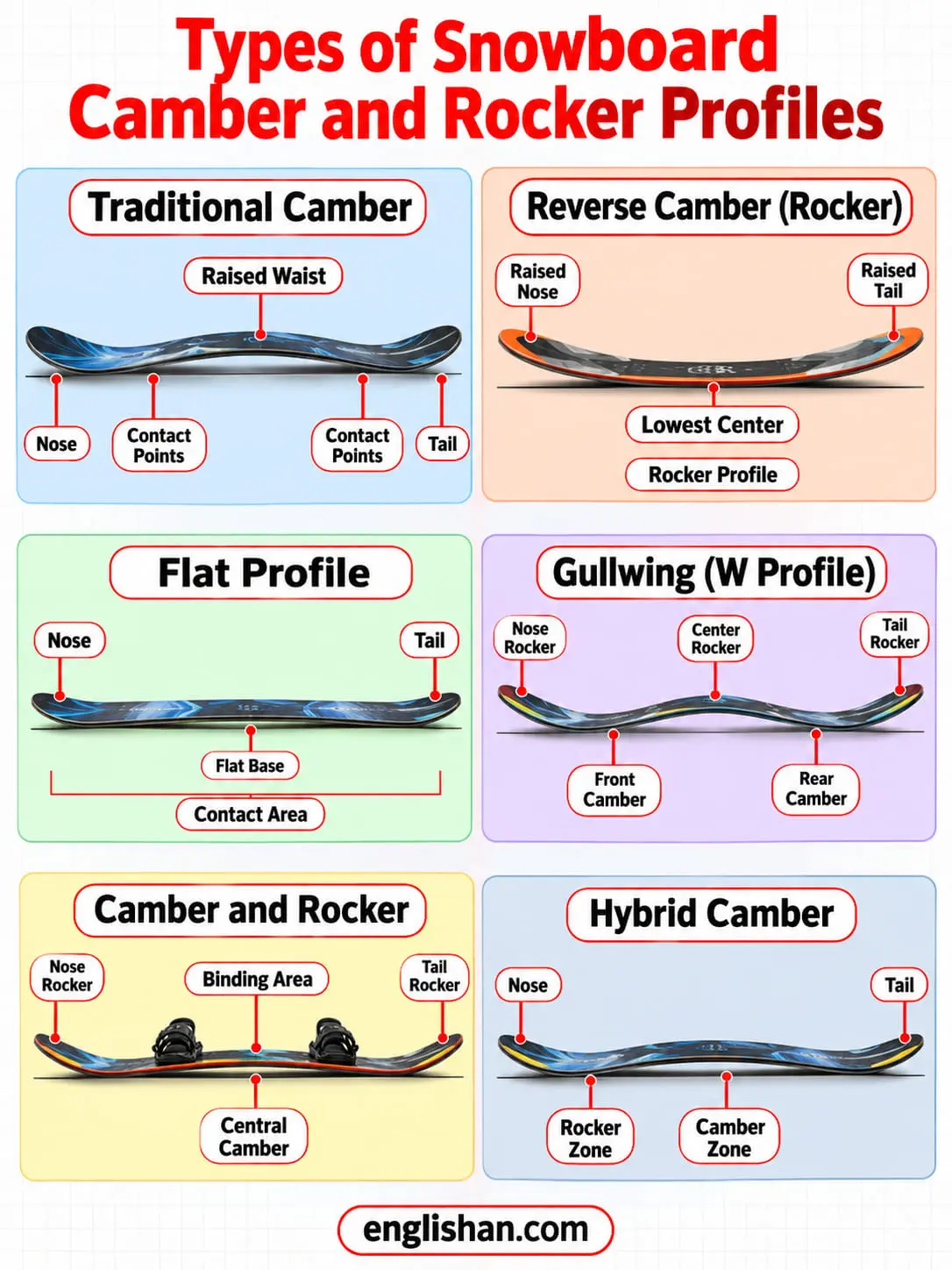
The profile is the curve of the base against the snow, and it changes where the parts of a snowboard touch the slope. Wikipedia reports that a typical board has an upward curvature of a few degrees along the effective edges.
| Profile | Shape of the base | Ride |
|---|---|---|
| Traditional camber | Touches the snow at the nose and tail, with the waist raised | Strong pop, edge hold, and stability, and the best profile for jumping |
| Reverse camber (rocker) | Both ends raised, with the lowest part in the center | Less catchy, better in powder, and harder to land jumps |
| Flat | Flat from nose to tail | Grip and stability |
| Gullwing (W) | Three rocker zones at the nose, waist, and tail | Playful and buoyant in powder |
| Camber and rocker | Rocker at the nose and tail, with camber between the inserts | Suited to freeride and all-mountain riding |
| Hybrid camber | Blends several technologies | Less aggressive than traditional camber but still responsive |
Parts of a Snowboard Binding
Bindings are the hardware that keeps the boot attached to the board, and they mount on the topsheet through the inserts. Snowboardingdays counts ten binding parts when the ankle and toe straps are treated as one pair.
Baseplate
The baseplate is the bottom part of the binding and is bolted directly to the board. It is made of aluminum or plastic, spreads the rider’s weight, and has the mounting holes.
Disc
The disc is the part of the baseplate system that attaches the binding to the board, between the two, and it lets the rider change the binding angle. Common types are 4×2 and channel systems, and the disc must match the board.
Heel cup
The heel cup is the rounded part at the back of the baseplate that holds the heel in place and keeps the foot centered. It transfers force to the heel edge and connects the baseplate to the highback. Some heel cups are adjustable.
Footbed
The footbed is the cushioned layer on the baseplate where the boot rests. It absorbs shock and is made of foam, with air cushions on some models. Canted footbeds are designed to align the ankles and knees.
Highback
The highback is the vertical piece behind the rider’s calf. It supports the lower leg, aids carving, and transfers energy from the legs to the board. Short highbacks suit freestyle, and tall highbacks give more control at speed.
Forward lean adjuster
The forward lean adjuster changes the angle of the highback and is connected to the highback on most bindings. More forward lean improves heel-side edge hold but makes tricks harder.
Ankle strap
The ankle strap crosses the top of the ankle and secures it with a buckle and ladder. It attaches to the heel cup at the back and the baseplate at the front. Most bindings have two padded straps, one at the ankle and one at the toe.
Toe strap
The toe strap crosses the toes and secures the toe of the boot with a buckle and ladder. A toe cap, which Snowboard Addiction describes, fits around the toe of the boot instead of over the top.
Buckles (ratchets)
The buckles are on the outside of the straps and tighten them. Entry-level buckles are plastic, while higher-end buckles use aluminum or magnesium. Some buckles include quick-release features for fast exits.
Tongues (ladder straps)
The tongues are thin, ridged plastic pieces that lock into the ankle and toe buckles. They hold the straps tight once the buckles close.
Sliders
The sliders are thin plastic pieces with a series of holes, like a belt, on the inner side of the binding. They connect to the straps and lengthen or shorten them.
Snowtrex rates binding flex on a scale of 1 to 10. A soft binding (1 to 4) suits freestyle and beginners, a medium binding (5 to 6) suits all-mountain riding, and a hard binding (7 to 10) suits speed and deep-snow freeriding. Binding size follows boot size, with small for men’s EU 37 to 40, medium for 40 to 44, and large for 44.5 and up.
Snowboard Bindings
Snowtrex names five binding types, and each one changes how the rider handles the parts of a snowboard binding on entry.
| Type | Straps | Entry |
|---|---|---|
| Soft | Two padded straps, with a calf highback | The highback stabilizes the calf and the two straps secure the foot |
| Flow | Two front straps joined and not opened | Highback folds down and back up for quick entry |
| Cinch | Two fixed straps opened and closed with ratchets | Highback connects with two ropes and folds away |
| Step-in | No front straps, with a calf-high highback | Two metal pins on the boot click into springs on the baseplate |
| Plate | Rigid heel bracket and a flexible toe bracket with a buckle | Used with raceboards and hard, ski-like boots, with no highback |
Inserts
The inserts are the mounting holes in the center of the board where the bindings screw in. Most inserts are steel or stainless steel. The layout of the holes is the mounting system, and Burton lists 4×4, 4×2, 3D, and The Channel.
The Channel
The Channel is Burton’s mounting system of extruded aircraft-grade aluminum. It allows nearly unlimited binding positions in width, angle, and setback. Wikipedia reports that it uses two screws on the outside edges of the binding, while most bindings attach with three or four screws in the center.
Parts of a Snowboard by Riding Style
Alpinstore groups boards by riding practice into all-mountain, freeride, freestyle, and slope. The shape of the board changes with the practice.
| Shape | Description | Suited to |
|---|---|---|
| Twin | Fully symmetrical, ridden switch or regular | Freestyle, where it is the most common shape |
| Directional twin | Symmetrical, with inserts offset slightly toward the tail | All-mountain riding |
| Directional | Inserts set back for a longer nose, which floats in fresh snow and holds speed | Freeride |
All-mountain boards are moderately long and balance grip, maneuverability, and float. Freeride boards are stiff and longer, directional, and have rocker for powder. Freestyle boards have a twin-tip profile and run slightly shorter. Slope boards need good grip and a width that keeps the toes from overhanging.
Wikipedia reports lengths of 140 to 165 cm (55 to 65 in) for most people. Children’s boards run as short as 80 cm (31 in), and alpine racing boards run as long as 215 cm (85 in).
FAQs
The parts of a snowboard are the nose, waist, tail, topsheet, edges, base, sidewall, core, fiberglass layers, and inserts. The binding adds the baseplate, highback, ankle strap, and toe strap. The labeled diagram numbers all 14.
The parts of a snowboard binding are the baseplate, disc, heel cup, footbed, highback, forward lean adjuster, straps, buckles, tongues, and sliders. Snowboardingdays counts these as ten parts. The ankle strap crosses the top of the ankle, and the toe strap crosses the toes.
The nose is the front of a snowboard when the board faces down the mountain. The foot closest to the nose is the front foot. A regular stance puts the left foot forward, and a goofy stance puts the right foot forward.
Alpinstore groups snowboards by riding practice into four types: all-mountain, freeride, freestyle, and slope. The same retailer describes three board shapes, which are twin, directional twin, and directional. Each shape fits a practice, with twin boards common in freestyle.
The effective edge is the length between the widest points of the nose and tail, measured along the sidecut. It is the part of the edge that touches the snow while riding. People also call it the running length or contact length.
The waist is the width of the board between the rider’s feet. Wikipedia reports that most riders use a waist of 24 to 25 cm (9.4 to 9.8 in). Freestyle boards run up to 28 cm (11 in), and alpine boards run 18 to 21 cm (7.1 to 8.3 in).
Related:
- Parts of a Hockey Stick
- Parts of a Golf Club
- Parts of a Baseball Bat
- Parts of a Bow and Arrow
- Parts of a Fishing Rod