

A ski is a long, narrow runner that glides over snow, and the parts of a ski fall into four groups. The shape (tip, waist, and tail) sets the outline. The profile (camber and rocker) sets how the ski bends. The layers (base, core, sidewall, and topsheet) build the body, and the binding holds the boot.
The parts of a ski named here are part of the alpine ski used on groomed runs. Cross-country, twin-tip, and telemark skis are covered where their parts differ. Each part is named, located, and explained, with materials and numbers taken from ski maker technical pages and from Wikipedia. Ski boots, poles, goggles, and lifts are separate equipment with their own parts.
Parts of a Ski Labeled Diagram
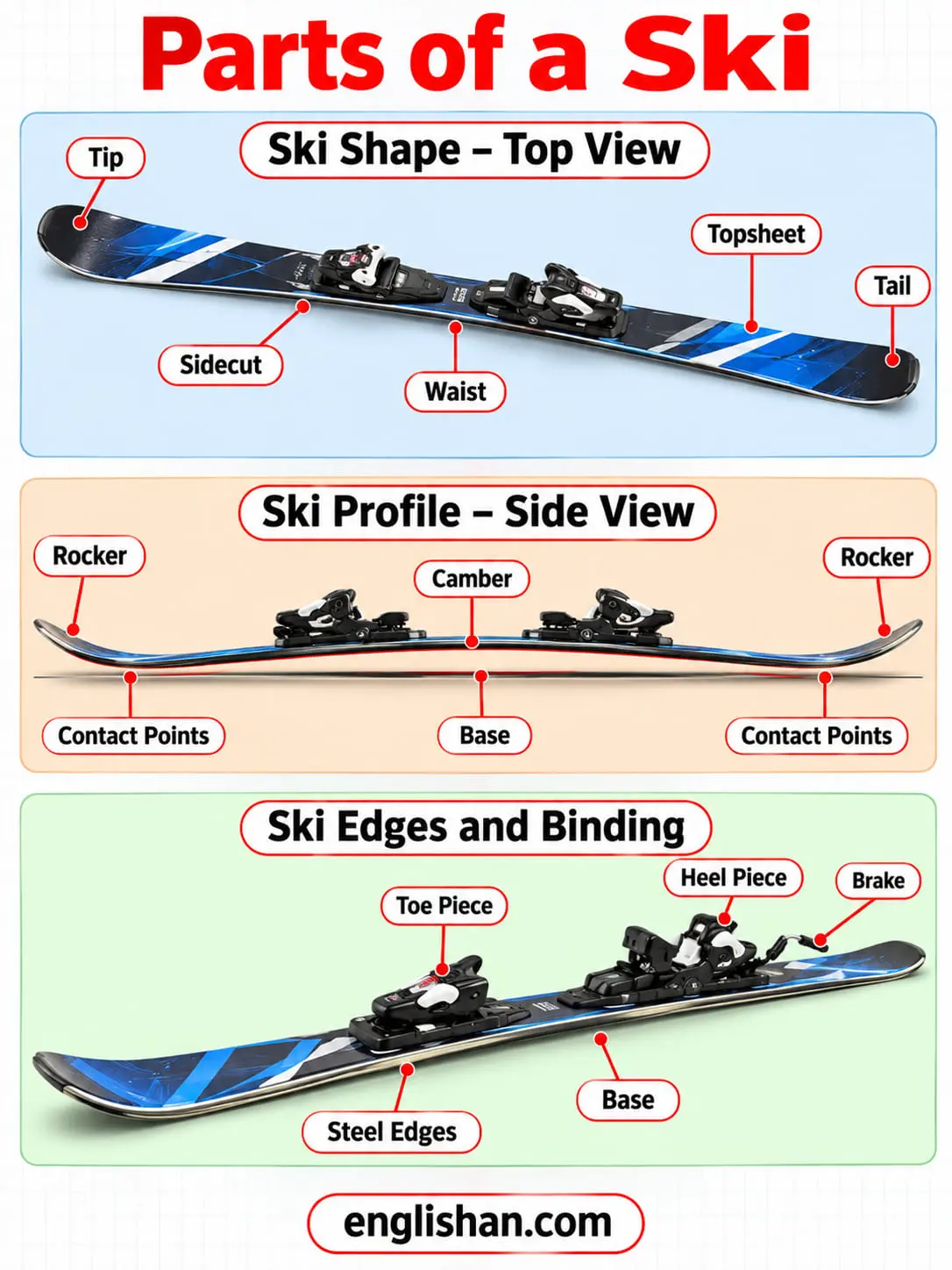
A ski has 14 named parts, numbered from the shape to the layers to the binding.
| Part | Location | Function |
|---|---|---|
| 1. Tip | Front of the ski, ahead of the toes | Curves upward so the ski rides over snow |
| 2. Waist | Middle of the ski, under the boot | Forms the narrowest part of the sidecut |
| 3. Tail | Rear of the ski, behind the heel | Finishes the ski with a straight cut or an upturned end |
| 4. Camber | Arch under the binding | Spreads the skier’s weight toward the tip and tail |
| 5. Edges | Both sides of the base | Give grip and let the skier carve a turn |
| 6. Base | Underside of the ski | Glides over snow and holds wax |
| 7. Core | Inside the ski | Forms the body of the ski and sets most of its performance |
| 8. Laminates | On both faces of the core | Control dampness, stiffness, and energy |
| 9. Sidewall | Along the sides of the core | Protects the core and the layers around it |
| 10. Topsheet | Top surface of the ski | Shields the core from water and shows the graphics |
| 11. Toe piece | Front of the binding | Holds the toe of the boot and releases it sideways |
| 12. Heel piece | Rear of the binding | Holds the heel of the boot and releases it upward |
| 13. Brake | Behind the heel piece | Stops the ski from sliding away after the boot releases |
| 14. Anti-friction device | Under the toe of the boot | Lets the boot slide out of the toe piece during a fall |
Ski Shape in Top View
Seen from the top, a ski is wider at the tip and tail than at the waist. That outline is the sidecut, and SkiMag measures it in millimeters. Three named parts of a ski form the outline.
Tip
The tip is the front of the ski, in front of the toes. Its upward curve lets the ski ride over snow, and Bikat Adventures describes the tip as the part most prone to breakage. SkiMag calls the widest point of the front the shovel.
Tail
The tail is the rear of the ski, behind the heel, and it is cut straight with rounded corners. In SkiMag’s terminology the tail is wider than the waist and narrower than the shovel. Twin-tip skis have a wide, tilted-up tail, which allows landings while facing backward.
Waist
The waist is the narrow middle of the ski between the tip and tail. Slalom skis have a narrow waist for tight turns, and powder skis have a wide waist for more float in low-density snow. Giant slalom skis are longer and wider in the midsection than slalom skis.
Sidecut
Sidecut is the curve of the outline from tip to waist to tail. A more pronounced sidecut gives sharper turns, and cross-country skis have little sidecut. Wikipedia dates the radial sidecut that changed ski performance to the Elan SCX of 1993.
Parts of a Ski in Side View
Seen from the side, the base of a ski is not flat. Its profile has two possible shapes, camber and rocker, and several skis combine both.
Camber
Camber is the upward arch in the middle of the ski, under the binding, and it leaves a gap when the ski rests on a flat floor. The camber spreads the skier’s weight toward the tip and tail, which increases the surface bearing the load. Wikipedia dates cambered skis to about 1850, when artisans in Telemark, Norway, built them.
Contact points
The contact points are the front and back parts of the ski that touch the floor when it lies flat. On some skis the edges run only between these two contact points.
Rocker
Rocker, also called reverse camber, bends the tip and tail upward. Rocker skis turn more easily in deep, heavy snow. SkiMag adds that rocker shortens the camber and reduces effective edge contact in turns.
Parts of a Ski Layer by Layer
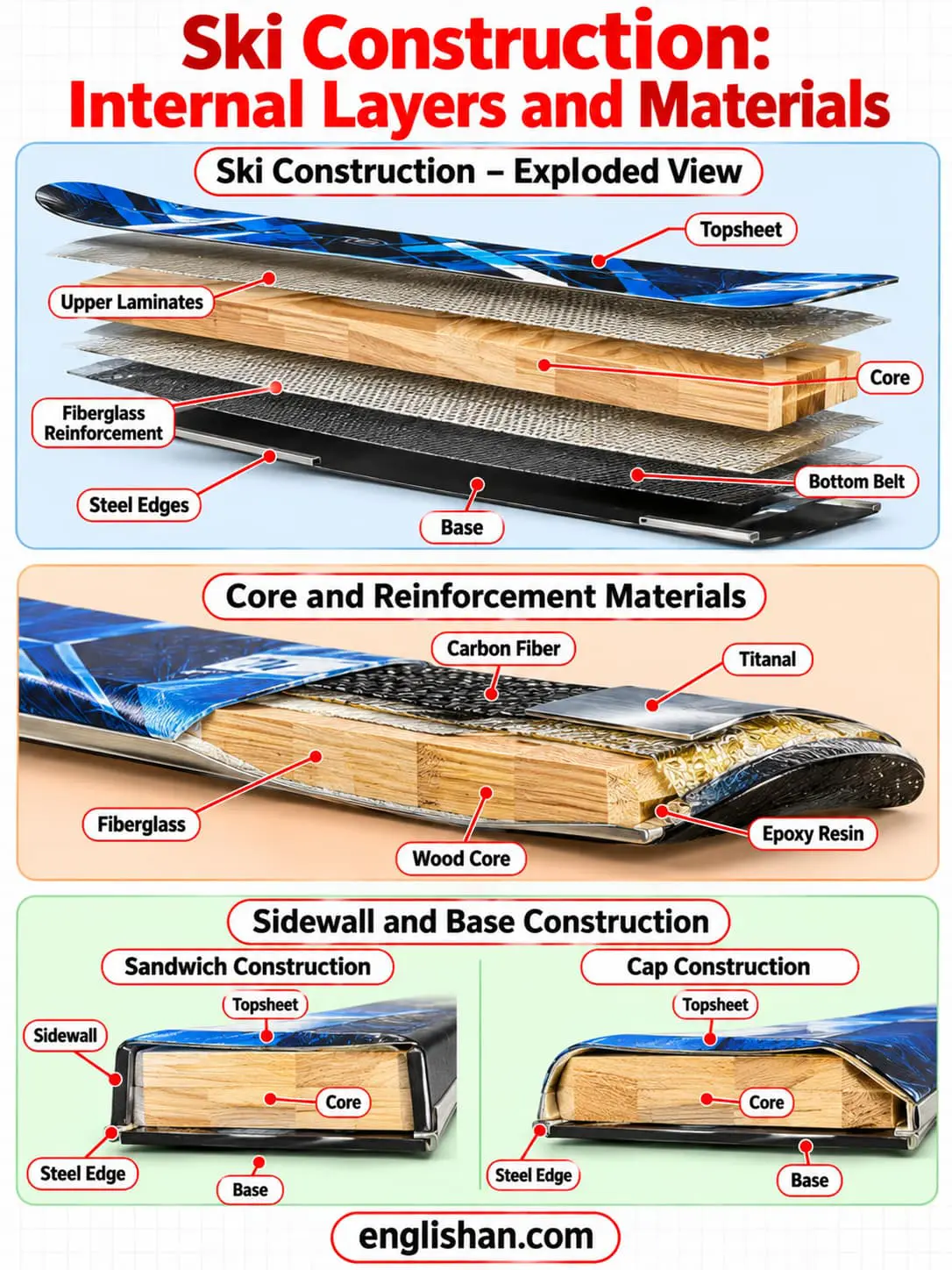
A modern alpine ski is built from stacked layers pressed together in a mold. The Snowtrex magazine lists the layers from the bottom of the mold to the top.
| Order | Layer | Role |
|---|---|---|
| 1 | Base coating | Forms the gliding surface |
| 2 | Steel edges | Give grip on the snow |
| 3 | Rubber or elastomer tape | Damps vibration |
| 4 | Bottom belt | Adds glass fiber and metal reinforcement under the core |
| 5 | Core | Forms the body of the ski |
| 6 | Upper belt | Adds reinforcement over the core |
| 7 | Print foil | Forms the topsheet with the graphics |
Snowtrex counts around 30 to 50 individual parts in one ski, processed in up to 125 work steps. A wood core uses up to 45 glued laminate layers.
Topsheet
The topsheet is the top layer of the ski, a protective surface that shields the laminates and core from damage and keeps water away from the core. SkiMag describes it as transparent plastic with graphics printed on its underside. Graphics are applied by screen print, sublimation, or direct print.
Ski Core and Laminates
The core and the laminates are the parts of a ski that set its performance, dampness, and flex.
Core
The core is the main body of the ski and the strongest influence on its performance, according to Jans. It is made from wood, foam, or both, and SkiMag adds metal, carbon, and fiberglass as further core materials. Wood cores are strips of maple, poplar, beech, ash, or aspen glued and pressed together.
Touring and foam cores
Touring skis use paulownia, bamboo, or balsa to cut weight, while mass-market, rental, and junior skis use injected polyurethane foam cores.
Laminates
Laminates are the layers on both faces of the core. A top laminate affects dampness, torsional flex, and longitudinal flex. It is made from aluminum, Titanal (an aluminum alloy), steel, carbon fiber, or Kevlar.
Base laminate
A base laminate under the core adds stiffness. It is much less common than a top laminate.
Fiberglass and carbon fiber
Fiberglass is a woven fabric set in epoxy resin, which adds responsiveness and stiffness at the cost of weight. Carbon fiber is lighter and adds more energy, but it costs more, so many brands place carbon stringers in the core instead of full layers.
The core is wood, foam, or both. The laminates are fiberglass, carbon fiber, Titanal, or Kevlar, and they control dampness and stiffness.
Sidewall and Cap Construction
Sidewall
The sidewall protects the internal layers of the ski and affects its feel. Jans names three types: vertical, cap, and a combination of the two. A vertical sidewall is cut at 90 degrees to the base.
Sidewall materials
The sidewall seals the edge of the core and adds impact durability and damping. It is made from ABS or UHMW-PE, and race skis use phenol, which is harder and stiffer.
Sandwich construction
Sandwich construction places the sidewalls next to the core. The vertical sidewall seals the edge of the core.
Cap construction
Cap construction is a style of building the ski and does not add a separate layer. The topsheet wraps over the top and down to the metal edge, so the ski has no sidewalls. It resists topsheet chipping but is less stable at speed and has less energy.
| Construction | Sidewall | Topsheet | Result |
|---|---|---|---|
| Sandwich | Placed next to the core | Lies flat over the top layers | Vertical sidewall seals the core edge |
| Cap | None | Wraps over the top and down to the metal edge | Resists topsheet chipping but is less stable at speed |
The sidewall is ABS, UHMW-PE, or phenol on race skis, and it protects the core. The topsheet is plastic with graphics printed on the underside.
Edges and Base of a Ski
The edges and the base are the parts of a ski that touch the snow.
Edges
The edges are steel strips along both sides of the base. They give grip and let the skier hold the ski on edge to complete a carved turn. Jans specifies high-carbon steel, and the Ski Monster rates commonly used steel edges at Rockwell hardness 48.
Edge coverage
Edges either wrap the full ski or run only between the tip and tail where the ski touches a flat floor. Sharper edges produce more pronounced turns, and Wikipedia dates steel edges to 1928 in Austria.
Base
The base is a polyethylene layer that holds wax and lets the ski slide on snow. It reduces suction and friction, which improves glide. SkiMag adds that the sheet is structured with microgrooves.
Base types
The Ski Monster gives a thickness of 1 to 2 mm for a UHMW-PE base. A sintered base is more porous and durable and accepts wax more easily. An extruded base is cheaper but slower, holds less wax, and wears faster.
The base is sintered or extruded UHMW-PE, which gives glide and holds wax. The edges are high-carbon steel for grip and carving.
Parts of a Ski Binding
The binding attaches the boot to the ski. Alpine skis have fixed-heel bindings, and the release settings must be adjusted to the skier’s weight and height. Jans numbers seven parts on an alpine binding, and SkatePro groups them into a toe piece and a heel piece.
| Part | Location | Function |
|---|---|---|
| Toe piece | Front of the binding | Houses the DIN spring, the adjustment, and the setting window |
| Toe lugs | Front of the binding | Clamp onto the toe lug of the boot |
| Anti-friction device | Under the toe lugs | Lets the toe lug release cleanly in a fall |
| Heel piece | Rear of the binding | Holds the heel of the boot and releases it upward |
| Heel lug | Rear of the binding | Clamps onto the heel of the boot |
| Heel lever | Rear of the binding | Opens the heel lug so the boot comes out |
| Brake | Behind the heel piece | Drops the brake blocks when the boot separates |
| Brake blocks | Beside the ski | Reach the snow and stop the ski |
Toe piece
The toe piece is the front part of the binding, and it holds the front of the boot. It houses the DIN spring, the adjustment screw, and the DIN setting window. It releases sideways, so the boot slides out in a twisting fall, and SkatePro names its horizontal wings as the parts that allow this.
Toe lugs
The toe lugs clamp onto the toe lug of the boot. They work with the anti-friction device for retention and release.
Anti-friction device
The anti-friction device is a lateral release built into the toe piece. It lets the toe lug release cleanly in a fall. Static types use low-friction plastic or Teflon, and moving types use a spring-loaded plate that moves the boot out.
Heel piece
The heel piece is the rear part of the binding, and it holds the heel of the boot. It releases upward, which frees the boot in a forward fall. It has a vertical arm, a DIN setting, and the brake.
Heel lug
The heel lug clamps onto the heel lug of the boot. It houses the DIN spring, the adjustment screw, the DIN setting window, and the forward pressure indicator.
Heel lever
The heel lever releases the heel lug so the boot comes out. It must be down to step in and goes up once the boot is locked.
Brake
The brake is part of the heel piece, and it is flush with the ski when the boot is in the binding. When the boot separates, it drops the brake blocks. The brake width must match the ski, because a brake that is too narrow does not engage.
Brake blocks
The brake blocks, also called brake arms, drop under the ski to grab snow when the boot separates. They stop the ski from sliding away.
Slalom and Giant Slalom Ski Parts
The alpine parts of a ski apply to downhill, slalom, and giant slalom skis. Other disciplines change one or more parts.
| Ski type | What changes |
|---|---|
| Slalom | Narrow waist for tight turns |
| Giant slalom | Longer ski with a wider midsection |
| Powder | Wide waist for float in low-density snow |
| Twin-tip | Wide, tilted-up tail for backward landings |
| Telemark | Binding attaches only the toe of the boot and leaves the heel free |
| Cross-country | Little sidecut, torsion box construction, and a Nordic binding such as Rottefella NNN or Salomon SNS |
| Ski jumping | Long and wide |
Skis run about 4 to 6 feet in length, according to the NC State skiing text. Snowboards have their own page, Parts of a Snowboard.
Ski Part Names
Makers and retailers name the same parts of a ski in different ways.
| Part | Other names | Source |
|---|---|---|
| Tip | Nose, shovel | Bikat Adventures, SkiMag |
| Top surface | Deck, topsheet | Bikat Adventures, SkiMag |
| Rocker | Reverse camber | Wikipedia |
| Brake blocks | Brake arms | Jans, Bikat Adventures |
| Brake | Stopper | SkatePro |
| Anti-friction device | AFD, anti-friction plate | Jans, SkatePro |
| Toe piece | Toe binding, toe cup | SkatePro, Bikat Adventures |
FAQs
The main parts of a ski are the tip, waist, tail, edges, base, core, sidewall, topsheet, and the binding with its brake. The tip is also called the nose or the shovel. Laminates cover both faces of the core in most modern skis.
A ski binding has a toe piece, a heel piece, and a brake. The toe piece holds the anti-friction device and the horizontal wings, and the heel piece holds the heel lug, the lever, and the vertical release. Each piece has a DIN setting for the release force.
A downhill ski has the same parts as other alpine skis: a tip, waist, tail, steel edges, polyethylene base, wood or foam core, sidewalls or a cap, topsheet, and a fixed-heel binding with a brake. Giant slalom skis are longer and wider in the midsection than slalom skis, which have a narrow waist for tight turns.
A cross country ski has a tip, tail, base, edges, and a binding, but it has little sidecut. Torsion box construction is common, and Nordic binding systems include Rottefella NNN and Salomon SNS. The Nordic binding differs from the alpine binding, whose brake and heel piece are part of a fixed-heel design.
The brake stops a ski from sliding down the slope after the boot releases. It is flush with the ski while the boot is in the binding, and the brake blocks drop under the ski when the boot separates. The blocks, also called brake arms, are the parts that reach the snow.
A sandwich ski has sidewalls next to the core, and a cap ski wraps the topsheet and reinforcements around the edges, so it has no sidewalls. According to the Ski Monster, cap construction resists topsheet chipping but is less stable at speed and has less energy.
Related:
- Parts of a Golf Club
- Parts of a Baseball Bat
- Parts of a Bow and Arrow
- Parts of a Kayak
- Parts of a Tent