

A treadmill moves a belt backward under the user, and every part supports that belt, drives it, or controls it. The parts of a treadmill therefore divide into three systems. The frame, deck, and belt bear the load. The motor, rollers, and incline drive produce the movement, and the console, power cord, and safety key control the machine.
Motorized treadmills use all three systems. Manual treadmills need no electricity and have no motor, so the belt moves only when the walker pushes it with their feet. Each part is named, located, and explained for motorized, manual, and curved machines.
Parts of a Treadmill Labeled Diagram
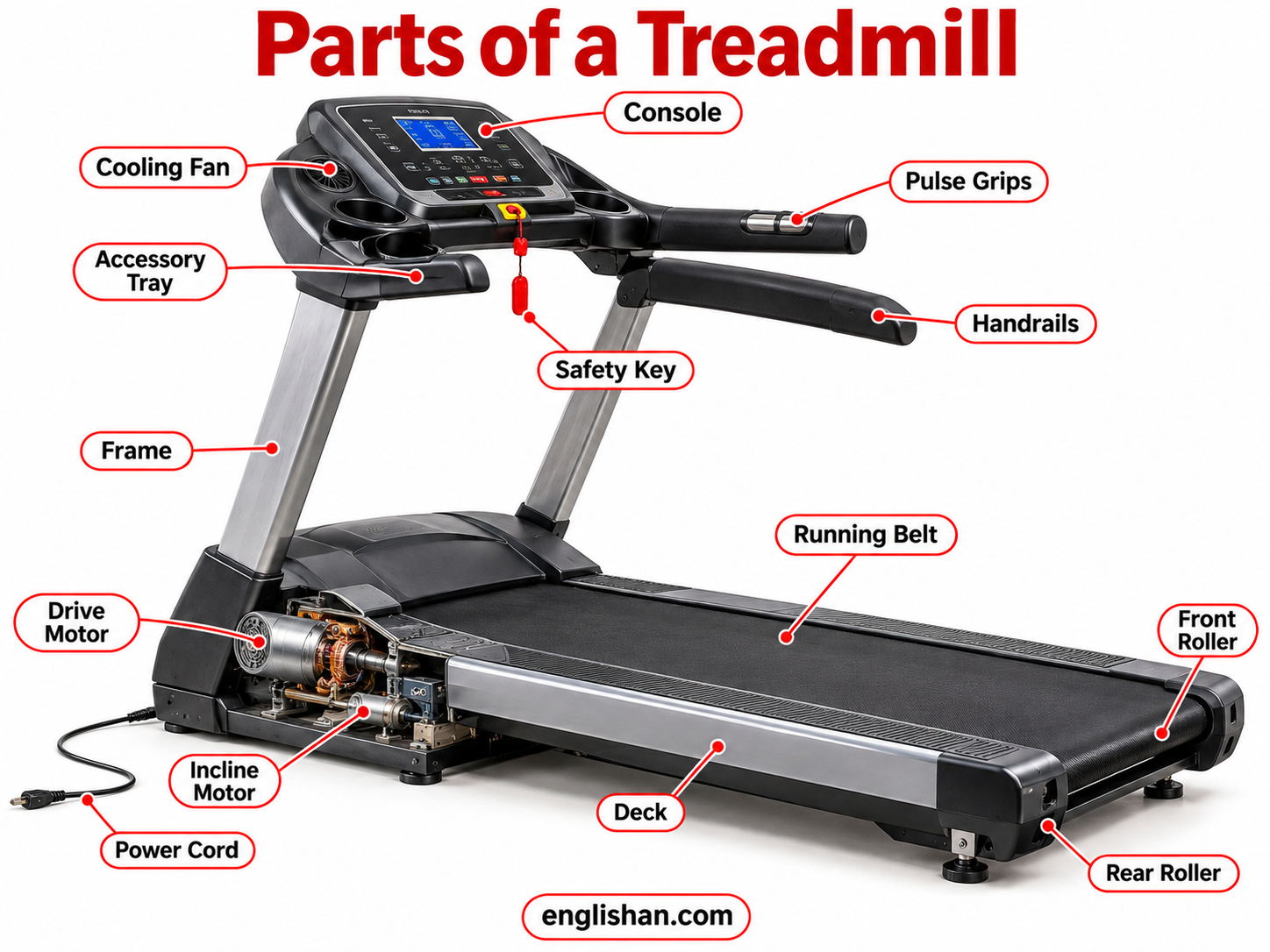
A treadmill has 14 named parts, numbered from the control end of the machine to the drive end.
| Part | Location | Function |
|---|---|---|
| 1. Console | Front of the machine | Sets speed, incline, and workout presets on an LCD or touchscreen display |
| 2. Handrails | Front and sides of the machine | Hold the pulse grips, with the console extending along them |
| 3. Pulse grips | Front and side handrails | Read the pulse and show heart rate in beats per minute |
| 4. Safety key | Clipped to the console at one end and to the user’s clothing at the other | Cuts power if the runner falls or trips |
| 5. Accessory tray | Attached to the console | Holds keys, phones, and water bottles |
| 6. Cooling fan | Around the console | Cools the user during intense workouts |
| 7. Frame | Whole machine | Supports the machine and contains the motor, deck, and belt |
| 8. Running belt | Over the deck and rollers | Moves backward at the set speed under the user |
| 9. Deck | Under the belt | Forms the base the user runs on |
| 10. Front roller | Front of the frame | Is turned by the motor and pulls the belt backward |
| 11. Rear roller | Rear of the frame | Sets belt tension through two adjuster bolts |
| 12. Drive motor | Under the motor cover, at the front end on many models | Powers the front roller through a poly-V belt |
| 13. Incline motor | Front end or center under the deck | Raises the front of the frame to simulate walking uphill |
| 14. Power cord | Outside the frame | Supplies electricity to a motorized machine from a grounded 120-volt outlet in a home |
Treadmill Motor and Drive Belt
The drive path runs through five parts in a fixed order.
- The user sets a speed on the console.
- The motor controller sends power to the drive motor.
- The motor turns the front roller through a poly-V belt at a reduction of 3:1 to 4:1.
- The front roller pulls the running belt backward over the deck.
- The rear roller keeps the belt at its set tension.
The deck lies between the upper and lower runs of the belt. Cushioning between the deck and the frame absorbs the impact of each footstrike.
Parts of a Treadmill Frame and Handrails
Frame
The frame is the steel or aluminum body that supports the machine and contains the motor, deck, and belt. Steel is heavier than aluminum. On folding models the deck lifts and locks into place for storage, and some models fold completely flat.
Handrails
The handrails run along the front and sides of the machine, and the console extends along them. They hold the pulse grips and the handles for the quick controls. An under-desk treadmill has a running deck and a step tracker, with no handrail and no LCD monitor.
Pulse grips
The pulse grips are sensors set on the front and side handrails. They read the user’s pulse and show heart rate in beats per minute on the console display.
Quick controls
Quick controls are buttons on the handles or on the lower part of the console. They adjust incline and speed mid-stride.
Slat treadmills are not foldable as a rule and need a high step-up height.
Deck Cushioning and Running Belt
Deck
The deck is the board under the belt, and it forms the base the user runs on. Budget treadmills use plywood and plastics for the deck. High-end decks use medium-density fiberboard (MDF) with a wax and resin binder, finished with a synthetic polymer coating. A commercial deck specification calls for 19 mm phenolic-coated MDF or high-pressure laminate board with a wax or PTFE coating on top. Wikipedia gives a professional fitness deck as about 150 cm (59 in) long and 50 cm (20 in) wide. It gives an athlete deck as up to 300 cm (120 in) long and up to 100 cm (39 in) wide. The commercial specification lists 1,400 to 1,600 mm (55 to 63 in) by 500 to 550 mm (20 to 22 in). Lubricant goes under the belt on the deck surface in a zig-zag pattern toward the end of the deck, on both sides of the belt and starting about a foot from the hood.
Running Belt
The running belt is the loop that moves backward over the deck and rollers at the set speed, so the user must walk or run at the belt’s speed. A belt is single-ply, two-ply, or multi-ply, and multi-ply belts add cushioning for shock absorption. A two-ply belt in a commercial specification is PVC-coated polyester, 1.8 to 2.4 mm thick, and its ends are joined with a finger splice or a welded seam. A slat belt replaces the continuous loop with individual rubberized slats. Garage Gym Reviews recommends a belt 20 inches wide and 60 inches long for tall runners, and the SOLE C80 curved treadmill has a 19 by 62 inch running surface. The belt needs silicone lubrication once every three months or after about 40 hours of use. Most treadmill lubricants are 100% silicone oil or silicone-based, the owner’s manual specifies the correct lubricant, and many new treadmills come pre-lubricated.
Deck cushioning
The deck is mounted on damping mounts that give it shock-absorbing properties. Many decks have rubber or urethane elastomer cushioning. One engineering reference describes rubber elastomer pucks of 50 to 70 Shore A hardness bonded between the deck and the frame.
Parts of a Treadmill Motor and Controller
Drive Motor
The drive motor is the part of a treadmill rated in horsepower, and it produces the mechanical power that turns the front roller. One horsepower equals 746 watts. It is under the motor cover, at the front end on many models, and it powers the front roller through a poly-V belt.
Ratings come in two forms: peak horsepower, and continuous horsepower (CHP), which is the output a motor sustains for long periods. Most home treadmills use a DC motor. High-end and gym treadmills use an AC motor, which is louder.
| Motor class | Where it is found | Published figure |
|---|---|---|
| DC permanent-magnet | Residential treadmills | 2.5 to 4.0 HP continuous duty |
| AC with variable-frequency drive | Commercial treadmills | 3 to 5 HP |
| Medical treadmill motor | Clinical testing | Around 3.3 kW (4.4 hp) |
A motor of at least 3.0 hp is recommended for running on both slat and belt treadmills.
Motor controller
The motor controller regulates the power sent to the drive motor. A pulse-width-modulated controller holds belt speed within 0.1 km/h regardless of load.
Flywheel
Some motor-driven treadmills add a flywheel to the drive.
Power cord
The power cord plugs into the wall and supplies electricity to a motorized machine. A home model uses a grounded 120-volt outlet.
Rollers and Belt Tension
Rollers are the parts of a treadmill that set belt speed and tension. They are at the front and rear of the frame, turn the belt at the set speed, and keep it centered. Solid steel is the recommended roller build. Larger, heavier rollers hold the belt better, which improves belt tension and motor life.
Front roller
The front roller, also called the drive roller, is machined steel, 60 to 75 mm in diameter. Its crowned profile of 0.3 to 0.5 mm keeps the belt centered. The motor turns it, and it pulls the belt backward.
Rear roller
The rear roller, also called the idler or tension roller, mounts in slotted brackets with two adjuster bolts. Belt tension is correct when the belt lifts 50 to 75 mm at the side edge.
Tracking adjustment
Tracking adjustment recenters a belt that has drifted to one side. It is made at the end cap of the treadmill with an Allen wrench, in a few turns. The same engineering reference sets the acceptable drift at 6 mm over 60 seconds.
Parts of a Treadmill Incline System
Among the parts of a treadmill, the lifting part raises the whole frame to simulate uphill running, and professional fitness units reach a slope of 0 to 20 percent. Some models also reverse the belt to simulate downhill loads.
Incline motor
The incline motor is a secondary motor that raises the front end of the treadmill to simulate walking uphill. Higher-quality brands place it in the middle under the deck, and some place it at the front end. An incline motor rated at 300 pounds of thrust is overloaded by a 300-pound treadmill with a 200-pound user on it.
Incline actuator
The actuator is a 12 V or 24 V DC linear unit with a stroke of 150 to 250 mm and a dynamic rating of 1,500 to 3,000 N.
Console Controls and Safety Key
Console
Of all the parts of a treadmill, the console is the one the user reads and presses. It is at the front of the machine and is the computer and entertainment center of the treadmill. It has preset buttons for speed, incline, and workouts, and it shows the readout on an LCD or touchscreen display.
Accessory tray
The accessory tray is attached to the console and holds keys, phones, and water bottles.
Cooling fan
The cooling fan is around the console and cools the user during intense workouts.
Safety Key and Fall-Stop Devices
The safety key has a magnetic attachment or a key card. One end attaches to the console and the other clips to the user’s clothing, so the key cuts power if the runner falls or trips. Removing the safety key when the treadmill is not in use prevents children from being injured by the belt.
A fall-stop safety arch connects to an electrical switch, and a harness shuts down the belt when needed.
Curved and Manual Treadmill Parts
A manual treadmill replaces the motor with the walker’s own effort. The belt moves only when the walker pushes it with their feet, and the machine passively resists the motion.
| Type | Belt | Power | Console and resistance |
|---|---|---|---|
| Motorized | Continuous belt on rollers, from single-ply to quadruple-ply | Electric motor | Speed and incline controls |
| Flat manual | Single friction belt that drags more and wears faster | None; the walker pushes the belt | No built-in resistance on most models, and a minimal console or none |
| Curved manual | Belt of interlocking rubber slats on a curved deck | None; the belt is self-powered | Bluetooth LCD console and 8 magnetic resistance levels on the SOLE C80 |
Curved decks are not compatible with continuous belts. Rubberized slats absorb impact, and a curved deck reduces it further.
FAQs
The main parts are the console, handrails, pulse grips, safety key, accessory tray, cooling fan, frame, running belt, deck, front roller, rear roller, drive motor, incline motor, and power cord. The belt, deck, and rollers bear the user, and the two motors move them.
The parts divide into three systems. The frame, deck, and belt bear the load, and the motor, rollers, and incline drive produce the movement. The console, power cord, and safety key control the machine.
The walking part is the running belt, which moves backward over the deck. The deck is the board under the belt, and it forms the base the user runs on.
The motor drive consists of the drive motor, a poly-V belt, and the front roller. The motor turns the roller through the belt at a reduction of 3:1 to 4:1, and a controller holds belt speed under load.
A manual treadmill has a frame, a deck, a belt, and rollers, with no motor because it needs no electricity. A curved model uses a slatted belt on a curved deck, and a flat model uses a single friction belt.
The belt and the deck need lubrication, applied under the belt on the deck surface. Most treadmill lubricants are silicone-based, and the interval is once every three months or after about 40 hours of use.
Related:
- Parts of a Vacuum Cleaner
- Parts of a Blender
- Parts of a Skateboard
- Parts of a Golf Club
- Parts of a Kayak