

The parts of a drill are the chuck, the trigger, the forward and reverse switch, the clutch, the motor, the handle, and the power source. The chuck holds the bit, the motor turns it, and the trigger switches the motor on and off.
The drill described is the hand-held electric drill in its cordless and corded forms. The parts of a drill bit are a different set, since the bit is the tool that the chuck holds.
Parts of a Drill Labeled Diagram
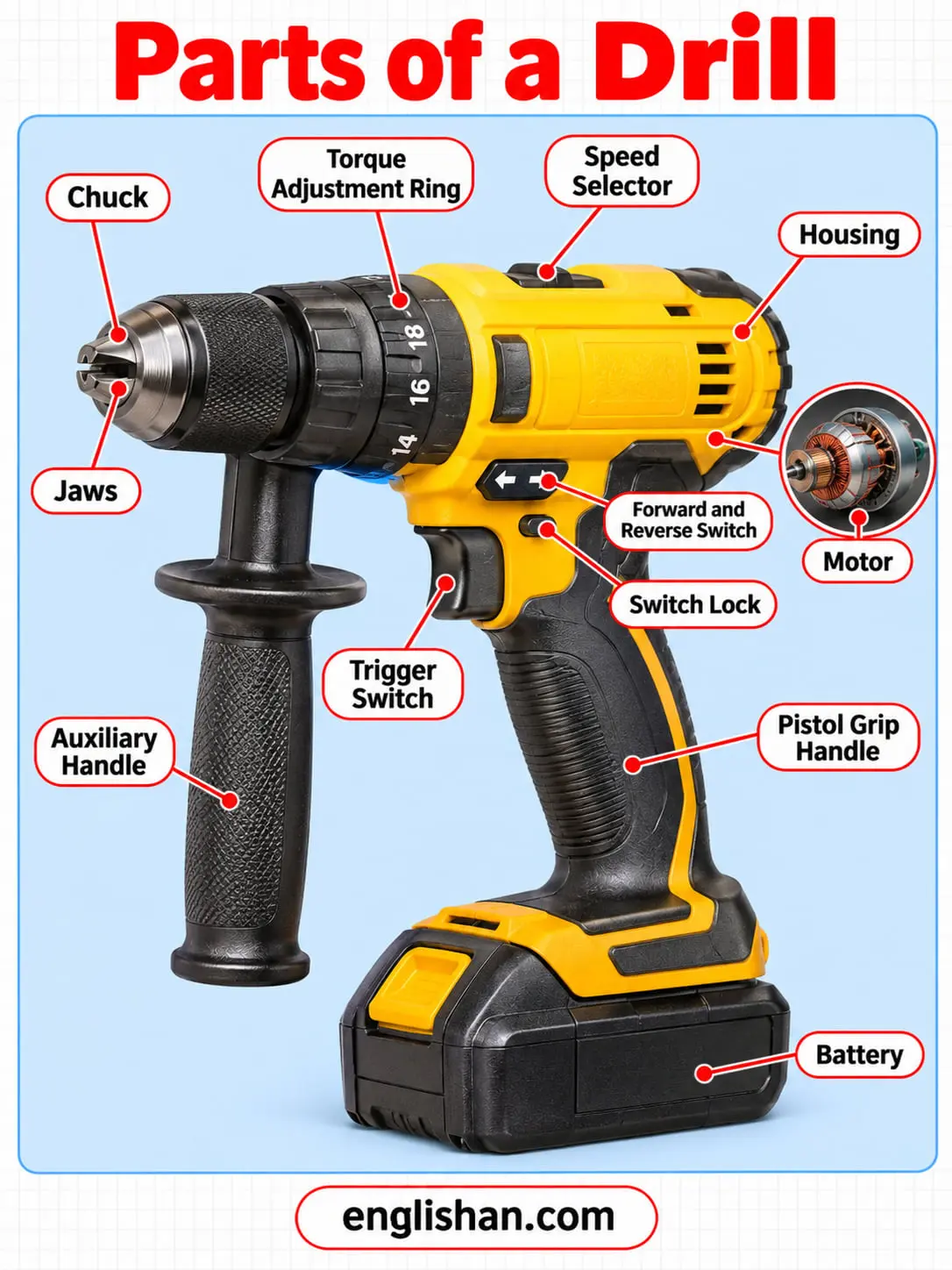
In a labeled diagram of a hand-held drill, the chuck is at the front end of the shaft, and the torque adjustment ring is at the base of the chuck. The trigger switch is in the pistol grip handle, and the cord or the battery supplies the power.
| Part | Where you find it |
|---|---|
| 1. Chuck | Front end of the shaft, holds the bit |
| 2. Jaws | Parts of the chuck that grip the bit |
| 3. Torque adjustment ring | Ring at the base of the chuck that sets the clutch level |
| 4. Trigger switch | Switch that turns the drill on and off |
| 5. Forward and reverse switch | Selector that sets the direction of rotation |
| 6. Switch lock | Lock position of the selector that stops the trigger from being pulled |
| 7. Pistol grip handle | Grip the user holds |
| 8. Auxiliary handle | Extra grip, also called the secondary hand grip |
| 9. Housing | Outer body of the drill |
| 10. Motor | Inside the body, at the top of the drill |
| 11. Cord or battery | Power source, a plug and cable or a rechargeable pack |
Parts of a Drill Chuck
The chuck is the adjustable fitting at the front end of the shaft. It holds and tightens the drill bit, so one drill takes many bits for different materials. The jaws are the parts of the chuck that grip the bit.
Keyless Chuck
A keyless chuck is found on newer drills. The bit goes directly into the spindle, and the hand tightens it with no tool. Most modern drills have a keyless chuck.
Chuck Key
The chuck key is a separate tool that loosens or tightens a keyed chuck. It is not attached to the drill, and a lost key leaves the chuck without a way to tighten the bit.
Drill Trigger and Direction Switch
The trigger switch turns the drill on and off. It is pressure-sensitive on a variable-speed drill, so light pressure gives slow speed and heavier pressure gives higher speed. The distance of the pull sets the rotation speed.
The forward and reverse switch sets the direction of rotation. Forward drives screws in and drills holes, and reverse removes screws. Many drills add a lock position that stops the trigger from being pulled.
Parts of a Drill Speed Selector and Clutch
The speed range selector is a numbered switch that sets the minimum and maximum speeds of the drill. Many drills have one.
The clutch is controlled by the torque selector, which is marked with numbers and a drill icon. When the resistance reaches the selected number, the clutch slips and clicks, which prevents over-tightening a screw. The drill icon turns the clutch off. Drills meant for driving screws have a clutch, and its purpose is to avoid damaging the slots on the screw head.
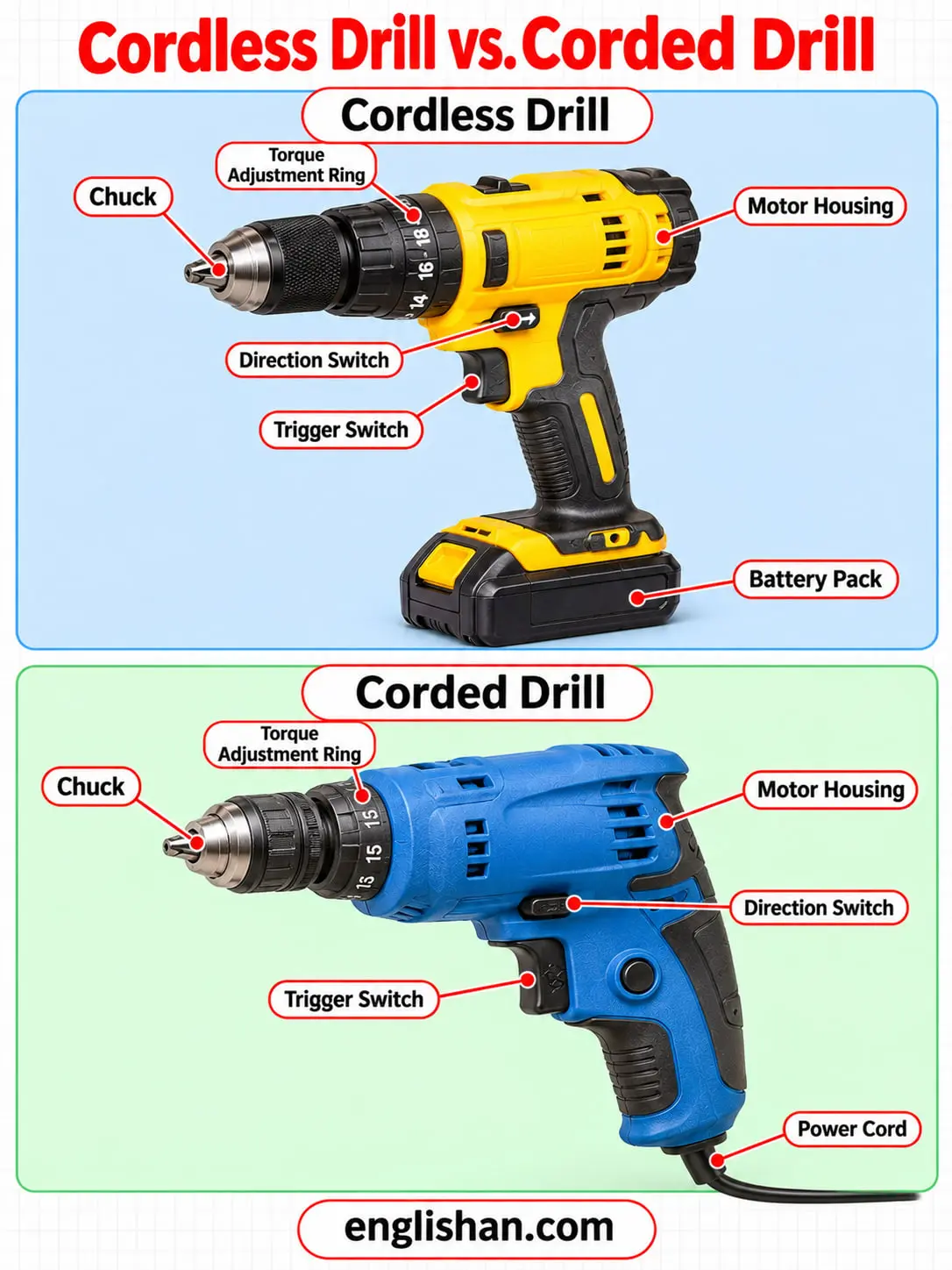
Parts of a Cordless Drill and Corded Drill
A cordless drill runs on a removable, rechargeable battery pack that snaps onto the drill. A second pack swaps in, so the work continues while the first pack recharges. The charger is needed for a cordless drill, but it is not part of the drill itself.
Early cordless drills used 7.2 volt packs. A rating of 18 volts is the most common now, and higher packs reach 24, 28, and 36 volts. Nickel-cadmium and lithium-ion packs each hold about half of the market. Lithium-ion charges faster, lasts longer, has no memory effect, and weighs less, while nickel-cadmium costs less.
A corded drill plugs into a wall outlet or an extension cord, and the amp rating shows its power. It has more power and torque than a cordless drill, but the work stays within reach of the cord. Cordless models add a keyless chuck, an LED work light, and a belt clip.
Drill Handle and Housing
The pistol grip handle is where the user holds the drill, and a rubber coating gives slip resistance and comfort.
The auxiliary handle, also called the secondary hand grip, is a second grip fitted to the drill if the drill has one. A right-angle drill has a long handle attached to the bottom of the motor, which allows work in tight spaces. The housing is the outer body, and it bears the nameplate and the warning plate.
Internal Parts of a Drill
The internal parts of a drill are the motor, the shaft, and the clutch. The motor is in the body at the top of the drill, and it spins the shaft, the chuck, and the bit. The shaft runs between the motor and the chuck.
The clutch is next to the torque adjustment ring and slips at the level set on the ring. More motor power gives more torque at the bit. Electric hammer drills are rated at 600 to 1,100 watts of input power.
Hammer Drill and Impact Drill Parts
A hammer drill adds a hammering action to the rotation. Two cam plates pulse the chuck forward and backward as the drill spins. The action is measured in blows per minute, and 10,000 or more is common. A standard hammer drill accepts 6 mm (1/4 inch) and 13 mm (1/2 inch) bits.
An impact drill has a hexagonal, collet-like chuck in place of the larger tapered chuck of a conventional drill. Impact drills work at fixed torque and speed, while most other hand-held drills have variable speed.
Drill Part Names
Makers and retailers use more than one name for several parts of a drill.
| Part | Also called |
|---|---|
| Trigger | Trigger switch |
| Forward and reverse switch | Forward/reverse/lock selector, direction selector |
| Torque selector | Clutch torque selector, torque adjustment ring |
| Speed selector | Speed range selector |
| Auxiliary handle | Secondary hand grip |
| Pistol grip handle | Grip |
| Chuck jaws | Jaw |
FAQs
FAQs
The parts of a drill are the chuck, the jaws, the trigger switch, the forward and reverse switch, the clutch, the pistol grip handle, the housing, the motor, and the cord or battery. Some drills add a speed range selector and an auxiliary handle.
The main parts of a drill are the chuck, the motor, the trigger, and the power source. The chuck holds the bit, the motor turns it, the trigger switches the motor on, and the cord or battery supplies the power.
The chuck holds the bit. It is the adjustable fitting at the front end of the shaft, and its jaws tighten around the bit. A keyless chuck tightens by hand, and a keyed chuck needs the chuck key.
A cordless drill has the chuck, the trigger switch, the forward and reverse switch, the clutch, the handle, the motor, and a removable rechargeable battery pack in place of the cord. The charger is separate from the drill. Cordless models add a keyless chuck, an LED work light, and a belt clip.
The internal parts of a drill are the motor, the shaft, and the clutch. The motor spins the shaft and the chuck, and the clutch slips at the torque level set on the selector. A hammer drill adds two cam plates that pulse the chuck.
The numbers on a drill mark the clutch torque levels and, on drills with a speed range selector, the speed range. The clutch slips and clicks when resistance reaches the chosen number, which prevents over-tightening a screw. The drill icon on the torque selector turns the clutch off.
An impact drill has a hexagonal, collet-like chuck in place of the larger tapered chuck of a conventional drill. It works at fixed torque and speed. The other parts, such as the trigger, the motor, and the power source, follow the hand-held drill layout.
Related: