

The parts of a bow and arrow are the riser, the limbs, and the string on the bow. The arrow has a shaft, a fletching, a nock, and a point. The limbs flex as the archer draws the string, and they store and release the energy that drives the arrow.
A recurve bow runs from the upper limb tip to the lower limb tip, and its arrow runs from the nock to the point. A compound bow adds cams and cables to the riser and limbs, and the lengths, the weights, and the materials differ between the two. The parts of a sword follow a different design, with a blade and a hilt.
Parts of a Bow and Arrow Labeled Diagram
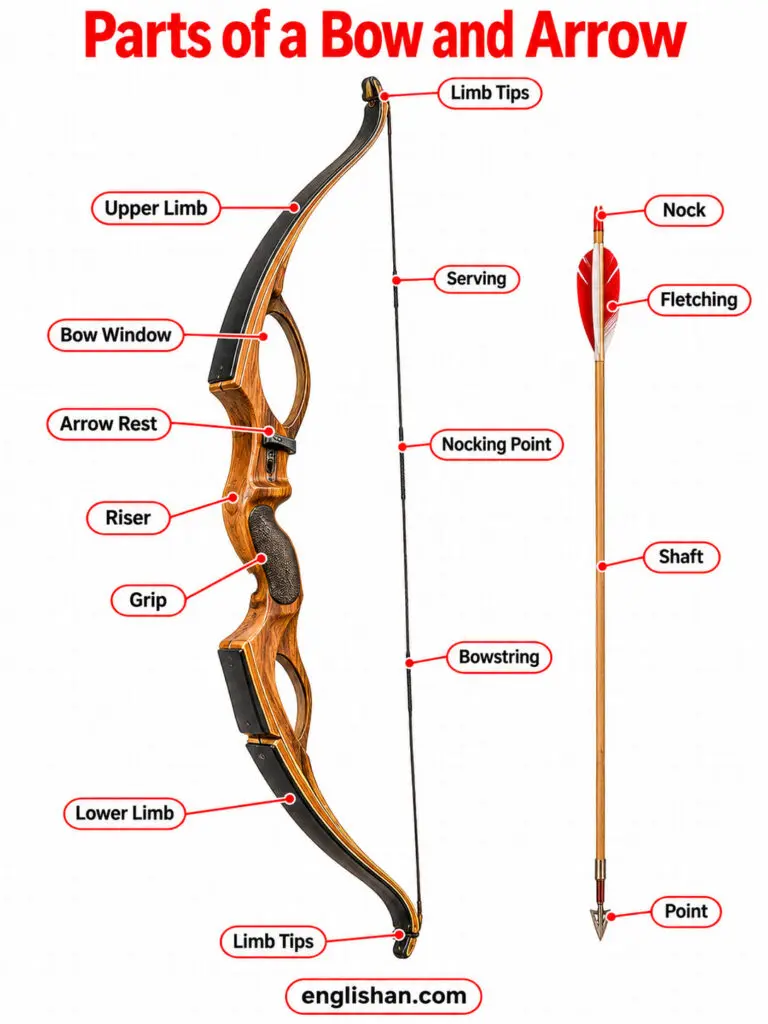
In a labeled diagram of a bow and arrow, the riser is the center of the bow. The limbs extend up and down from it, and the string connects the limb tips. The arrow lies on the rest at the grip, with the nock on the string and the point toward the target.
| Part | Where you find it |
|---|---|
| 1. Riser | Stiff central frame that the limbs extend from |
| 2. Grip | Part of the riser that the off hand grips |
| 3. Bow window | Part of the riser over the grip that contains the arrow rest |
| 4. Arrow rest | Small ledge or device that supports the arrow |
| 5. Limbs | Two flexible arms that bend when the bow is drawn |
| 6. Limb tips | Ends of the limbs, where the string attaches |
| 7. String | Bowstring that connects the limb tips |
| 8. Serving | Thread wrapped around the string where it needs protection |
| 9. Nocking point | Spot on the string where the arrow connects |
| 10. Shaft | Main body of the arrow |
| 11. Fletching | Feathers or plastic vanes near the rear of the shaft |
| 12. Nock | Slot at the rear of the arrow that fits onto the string |
| 13. Point | Tip at the front of the arrow, also called the arrowhead |
Main Parts of a Bow and Arrow
A bow has three main parts: the riser, the limbs, and the string. An arrow has four: the shaft, the fletching, the nock, and the point.
The archer pulls the string to load the limbs. The limbs store the energy of the draw, and the string transfers it to the arrow at release. The fletching stabilizes the arrow in flight, and the point strikes the target.
Parts of a Bow
The parts of a bow are the riser, the limbs, and the string. The grip, the arrow rest, and the serving are smaller parts.
Riser
The riser is the stiff central frame of the bow, also called the handle. The limbs extend from it. The grip, the arrow rest, and the bow window are the parts of the riser. Compound risers are carbon or aluminum.
Grip
The grip is the part of the riser that the off hand grips. On a compound bow, the grip is machined into the riser, or it is molded plastic or carved wood placed over the riser.
Arrow Rest
Among the parts of a bow and arrow, the arrow rest supports the arrow. It is a small ledge over the grip, and the arrow lies on it while the archer aims. The bow window is the part of the riser that contains the rest.
Limbs
The limbs are two curved, elastic arms, the upper limb and the lower limb. They flex when the bow is drawn and store and release the energy that drives the arrow. The limb pockets are the sockets where the limbs attach to the riser. The shaft of a golf club is also rated by flex, because bending stores and returns energy.
Bowstring
The bowstring connects the limb tips. The archer pulls it to load the limbs and releases it to propel the arrow.
The nocking point is the spot on the string where the arrow connects. The serving is a thread wrap that protects the string where the arrow and the fingers touch it.
Parts of an Arrow
The parts of an arrow are the shaft, the fletching, the nock, and the point. They complete the parts of a bow and arrow on the target side. The spine, the footing, and the cresting are features of the shaft.
Shaft
The shaft is the main structural element, and the other parts attach to it. Traditional shafts are wood, bamboo, or reed. Modern shafts are aluminum, carbon fiber, or fiberglass.
The spine is the stiffness of the shaft. A shaft that bends less has more spine.
Fletching
The fletching is a set of fin-like stabilizers near the rear of the shaft. Traditional fletching is feathers from geese or turkeys. Modern fletching is plastic vanes.
Fletching measures 2 to 6 inches long. Most arrows have three fletchings, and some have four or more.
Nock
The nock is a slot at the rear end of the arrow. It engages the bowstring.
Point
The point is the front of the arrow, and it decides the purpose of the arrow. Target points, small-game points, and broadheads are the three uses. Most modern heads are steel. Flint, bone, and horn were the early materials. The cutting edge of a broadhead works like the blade of a knife, which has its own parts page.
Footing and Cresting
A footed arrow has a short hardwood length near the head, joined to a softwood shaft. Cresting is rings or bands of paint applied on a cresting machine for personalization or visibility.
Compound Bow Parts
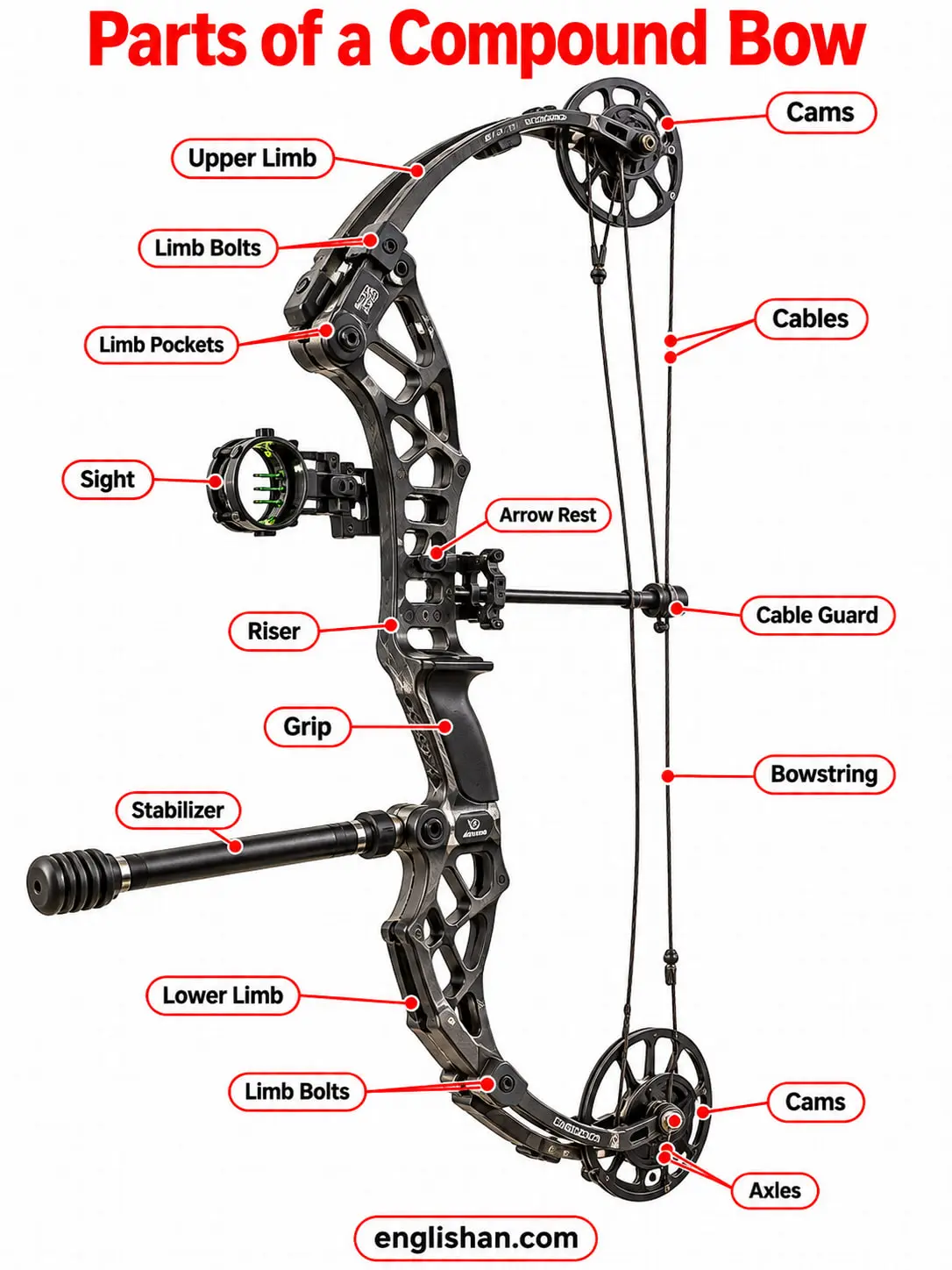
A compound bow uses pulley-like cams to give a mechanical advantage at full draw. Among the parts of a bow and arrow, the riser, the limbs, and the string remain. The cams, the cables, and the axles are added.
Cams
The cams are wheel-like parts at the top and bottom of the bow. They reduce the holding force during the draw. A cam holds 70, 80, or 85 percent of the full draw weight.
Cam modules adjust the draw length in 1/2-inch steps. Some single-cam bows use an idler wheel in place of the second cam.
Cables and String
The cables run from cam to cam through the cable guard, and they never touch the arrow. The cable slide keeps them out of the arrow path.
The shoot string is the string that launches the arrow. The D-loop on it protects the string at release and keeps the release consistent. Speed nocks near the cams help the string return tightly after the shot.
Axles and Limb Pockets
The axles are bars that connect the cams to the limbs. The limb pockets attach the limbs to the riser. The limb bolts attach the limbs and adjust the draw weight and the tiller. The limbs are carbon or fiberglass, in a single or split design.
Sight Peep Stabilizer and Quiver
The sight is a housing with pins, mounted to a bar on the riser. The peep sight is a small disc with a center hole, threaded into the string. The archer aligns the peep with the sight to aim.
The stabilizer is a rod that balances the bow and reduces noise and vibration. The string stop absorbs vibration and halts the movement of the string. A bow-mounted quiver attaches to the riser and stores extra arrows.
The rest on a compound bow is a drop-away rest or a whisker biscuit rest.
Recurve Bow Parts
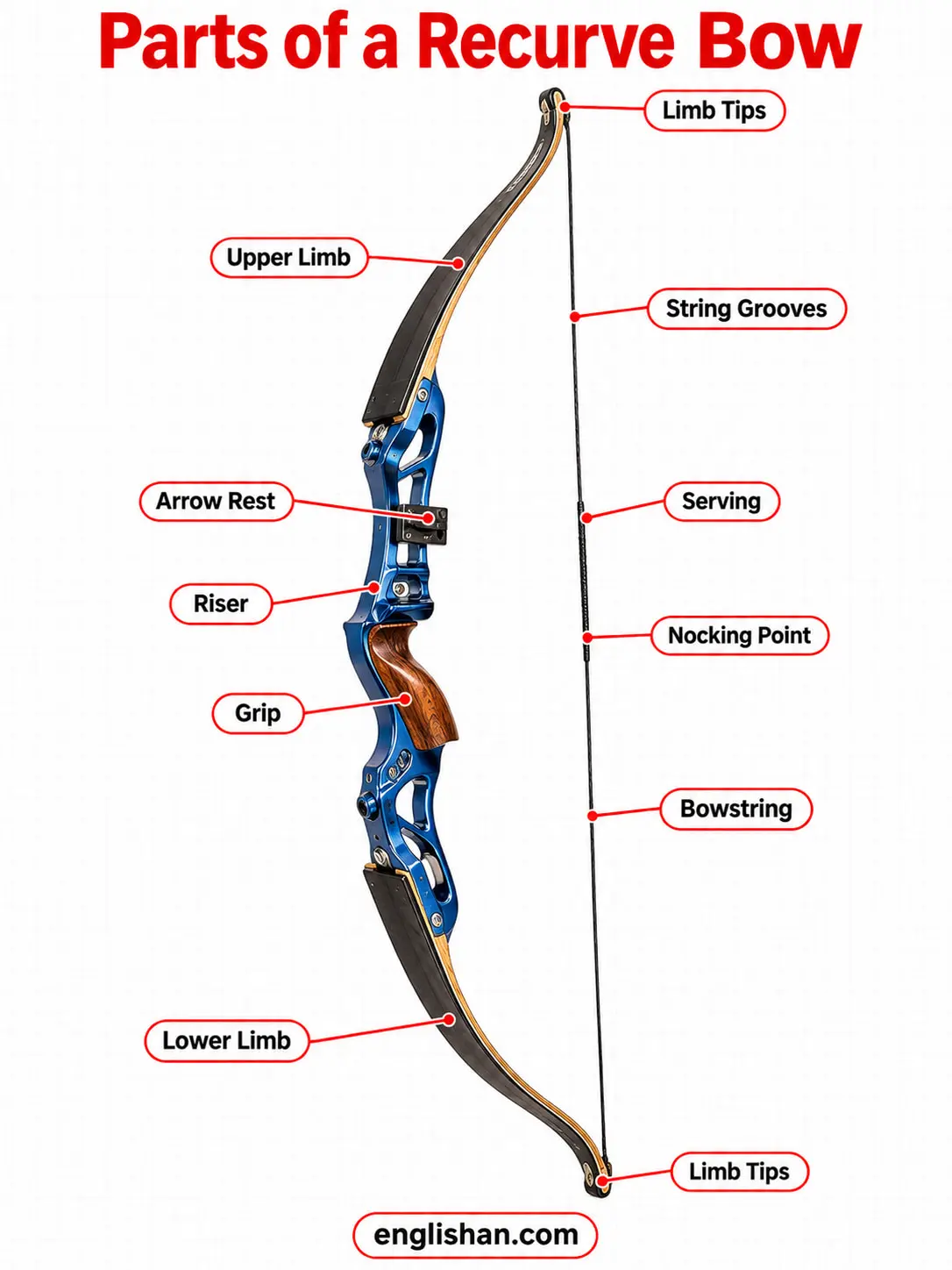
A recurve bow has limb tips that curve away from the archer. The curve adds velocity as the tips return after release. The parts of a bow and arrow gain string grooves, tiller bolts, and a shelf on a recurve.
Limb Tips and String Grooves
The limb tips are the ends of the limbs. The string grooves are the notches where the string attaches at each tip.
Tiller Bolts and Limb Pockets
The tiller bolts adjust the draw weight, the tiller height, the balance, and the arrow tuning. The lateral limb adjustment screws shift a limb sideways for tuning.
Shelf Rest and Sight Window
The shelf is the surface the arrow lies on, with or without a rest. A rest is a stick-on rest or a rest mounted in the Berger holes. The sight window is the riser cutout that allows the archer to aim and view the target.
Brace Height and AMO Length
The brace height is the distance from the grip point to the string at rest, and it is used to tune the recurve. The AMO length is the industry-standard bow length. The actual string is a few inches shorter.
Parts of a Bow and Arrow by Size and Weight
The parts of a bow and arrow vary in size by use. Most modern arrows are 30 to 38 inches long. Historical arrows ran from 18 inches to 5 feet. A longbow is a self bow, over 5 feet long, roughly the height of the archer.
Shaft weight is given in grains per inch. Multiply the length in inches by the grains per inch to get the weight in grains. A 30-inch shaft at 9.5 grains per inch weighs 285 grains, or 18 grams. A finished arrow weighs more than the shaft alone.
| Part | Measurement |
|---|---|
| Modern arrow length | 30 to 38 inches |
| Fletching length | 2 to 6 inches |
| Shaft weight at 9.5 grains per inch | 285 grains for a 30-inch shaft |
| Cam holding weight | 70, 80, or 85 percent of full draw weight |
| Cam module adjustment | 1/2-inch steps of draw length |
Draw weight is the force needed to hold the string at full draw. Draw length is the maximum distance of the string pull, and the size of the archer determines it.
Bow and Arrow Parts and Their Materials
The materials of the parts of a bow and arrow changed from wood and sinew to laminates, fiberglass, and carbon fiber.
Limbs: Wood in the past. Laminated wood, fiberglass, metals, and carbon fiber today. A composite bow combines a wood core, horn for compression, and sinew for tension.
Riser: Carbon or aluminum on compound bows. Wood on traditional bows, with yew as the wood of the English longbow.
Bowstring: Dacron or Kevlar today, with steel wire on some compound bows. Flax, silk, hemp, gut, sinew, and rawhide were the early materials.
Shaft: Wood, bamboo, aluminum, carbon fiber, or fiberglass. Port Orford cedar is the premium traditional wood.
Fletching: Feathers or plastic vanes.
Point: Steel on most modern arrows. Flint, bone, and horn on early arrows.
FAQs
The parts of a bow and arrow are the riser, the limbs, and the string on the bow. The arrow has the shaft, the fletching, the nock, and the point.
The main parts of a bow are the riser, the limbs, and the string. The riser is the stiff central frame, the limbs are the flexible arms, and the string connects the limb tips.
The parts of an arrow are the shaft, the fletching, the nock, and the point. Footing and cresting are added features on some arrows.
The arrow rest supports the arrow. It is a small ledge or device on the riser over the grip, and the arrow lies on it while the archer aims.
A compound bow has the parts of a bow plus cams, cables, axles, and a peep sight. The cams reduce the holding force at full draw.
A recurve bow has a riser, limbs with curved tips, a string, a shelf, and a rest. The tips curve away from the archer and add velocity as they return after release.
Early bows and arrows were made of wood, bamboo, horn, bone, flint, and sinew. Modern bows use laminated wood, fiberglass, metals, and carbon fiber, and modern shafts are aluminum or carbon.
Related: