

The parts of a table saw are the table, the blade, the arbor, the fence, the miter gauge, the riving knife, the blade guard, the handwheels, and the motor. The table supports the wood, and the blade protrudes through it. The fence and the miter gauge set the line of the cut.
A table saw is a stationary power saw with a circular saw blade mounted under a flat table. The parts of a circular saw are part of the handheld tool, and the parts of a hand saw are part of a blade moved by hand. The saws described are benchtop, jobsite, contractor, hybrid, cabinet, and sliding table saws.
Parts of a Table Saw Labeled Diagram
In a labeled diagram of a table saw, the table is the flat top, with the blade rising through the throat plate at its center. The fence runs front to back along the table, and the miter gauge slides in a slot beside the blade. The riving knife is behind the blade and the guard is over it, and the handwheels and the switch are on the front of the saw.
| Part | Where you find it |
|---|---|
| 1. Table | Flat surface on top of the drive |
| 2. Extension wings | Sections that widen the table on either side |
| 3. Miter slots | Grooves in the table, parallel to the blade |
| 4. Throat plate | Removable insert around the blade opening |
| 5. Blade | Circular saw blade that protrudes through the table |
| 6. Arbor | Shaft that the blade mounts on |
| 7. Rip fence | Bar that runs front to back, parallel to the blade |
| 8. Fence rails | Front and rear rails that the fence slides on |
| 9. Miter gauge | Removable guide with a bar that slides in a miter slot |
| 10. Riving knife | Thin fin directly behind the blade |
| 11. Blade guard | Clear plastic cover over the blade |
| 12. Anti-kickback pawls | Spring-loaded toothed arms on the guard or splitter assembly |
| 13. Height handwheel | Wheel that raises and lowers the blade |
| 14. Tilt handwheel | Wheel that tilts the blade for bevel cuts |
| 15. Trunnions | Supports that hold the arbor assembly and set height and tilt |
| 16. Motor | Drive unit under the table |
| 17. Switch | Power control for the motor |
| 18. Dust port | Outlet for a shop vacuum or dust collector |
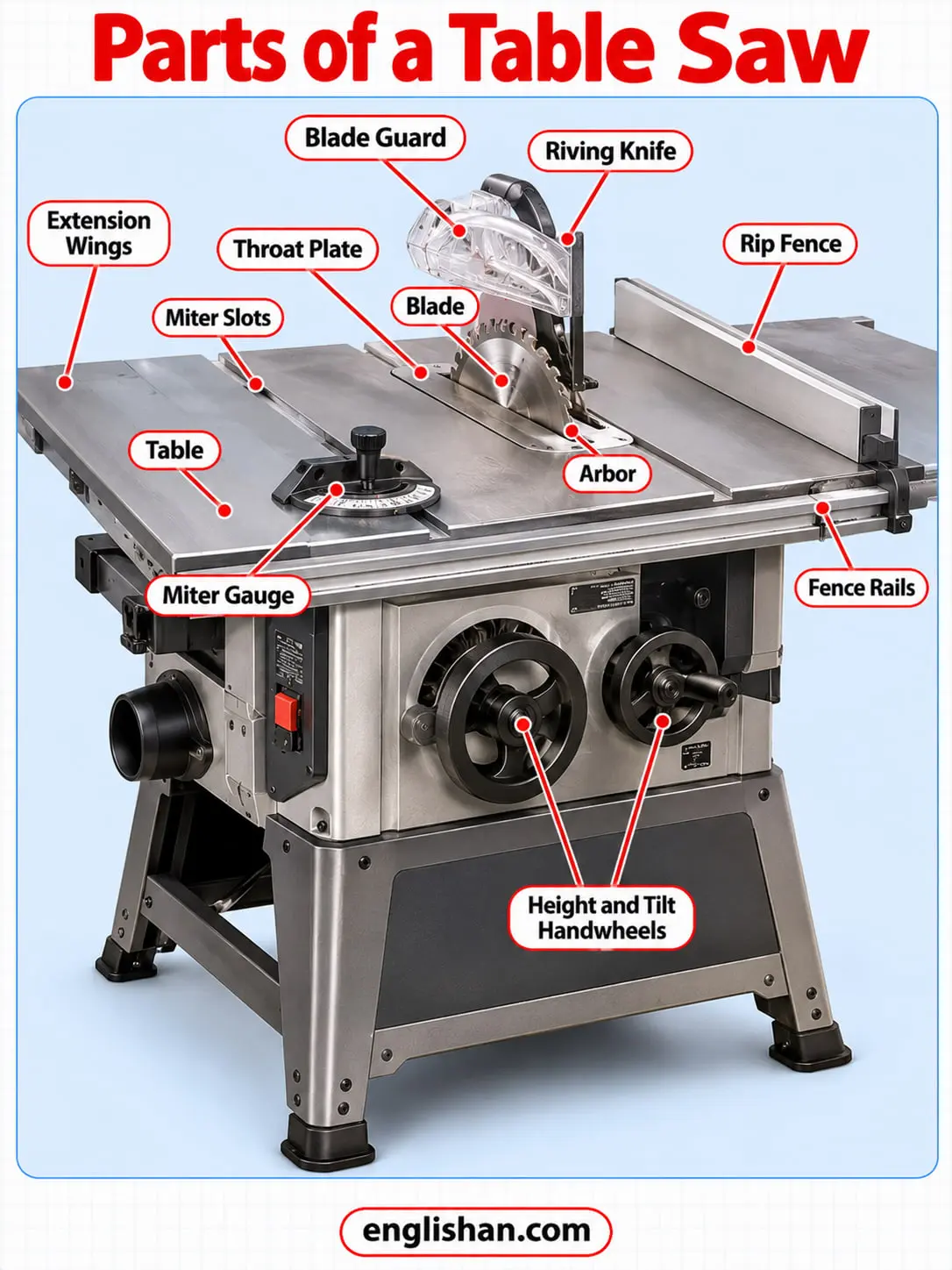
Table Saw Table and Miter Slots
The table is the flat surface on top of the drive, and it supports the material being cut. The blade protrudes through it. On a cabinet saw, the top is cast iron on a steel base.
Extension Wings
Extension wings are add-on or built-in sections that extend the work surface for wide boards, panels, and sheet goods. On a cabinet saw, a table extension increases the ripping capacity for sheet goods.
Miter Slots
The miter slots are grooves in the table, and they run parallel to the blade. They hold the miter gauge, sleds, and other accessories. Some maker manuals call them T-slots.
Throat Plate
The throat plate is a removable insert around the blade opening. It supports the workpiece close to the cut and keeps scraps from falling into the saw. A zero-clearance insert has an opening that nearly matches the width of the blade cut, which reduces tearout.
Parts of a Table Saw Blade and Arbor
The blade cuts the material, and the arbor turns it. Raising or lowering the blade sets the depth of the cut, and on many saws the blade also tilts.
Blade
The blade is a circular saw blade. A 10 inch blade is the most common size on a cabinet saw, and commercial saws take 12 or 14 inch blades. The blade protrudes through the throat plate in the table.
Arbor
The arbor is the shaft that the blade mounts on, and the motor drives it. The arbor nut tightens the blade onto the shaft. On the Ryobi RTS21, an outer blade washer is fitted against the blade beside the arbor nut.
Parts of a Table Saw Fence
The rip fence runs front to back, parallel to the blade. Its distance from the blade sets where the cut falls, and it guides rip cuts. Rip capacity is the greatest distance at which the fence sets and locks from the blade.
The fence rails are the front and rear rails that let the fence slide, lock, and stay aligned with the blade. On the Ryobi RTS21, a clamping handle locks the fence, and an indicator shows its position against a scale.
Miter Gauge
The miter gauge is a removable guide with a bar that rides in a miter slot and a head marked like a protractor. It is set at 90 degrees for square cuts and angled for miter cuts. It guides crosscuts, while the rip fence guides rip cuts.
Table Saw Handwheels and Bevel Scale
The handwheels move the blade, and they are on the front of the saw. The height handwheel raises and lowers the blade through an elevating shaft. The bevel tilt handwheel tilts the blade for angled cuts, up to 45 degrees.
A bevel scale shows the tilt angle. On the Ryobi RTS21, a lock lever on the front cabinet sets the cut angle, and a scale indicator on the front panel shows it.
Table Saw Motor and Trunnions
The motor is mounted under the table and spins the blade through the arbor. It drives the blade directly, by belt, by cable, or by gears. Benchtop and jobsite saws use universal motors, and contractor and cabinet saws use induction motors.
Trunnions are the pivots that hold the arbor assembly and lets it raise, lower, and tilt. They are mounted on the cabinet or on the table, and cabinet-mounted trunnions are easier to adjust. Sturdy trunnions keep the blade aligned.
Motor Parts
The Ryobi RTS21 motor assembly has a field assembly, an armature assembly, brushes in brush holders, a motor housing, and a rear cap. The armature rotates to drive the motor, and the brushes transfer current to it. The motor cord connects the switch to the field and armature.
Switch and Dust Port
The switch controls power to the motor. The Ryobi RTS21 uses a removable switch key that prevents unauthorized startup. The dust port connects a shop vacuum or dust collector, and cabinet saws commonly include one in the enclosed base.
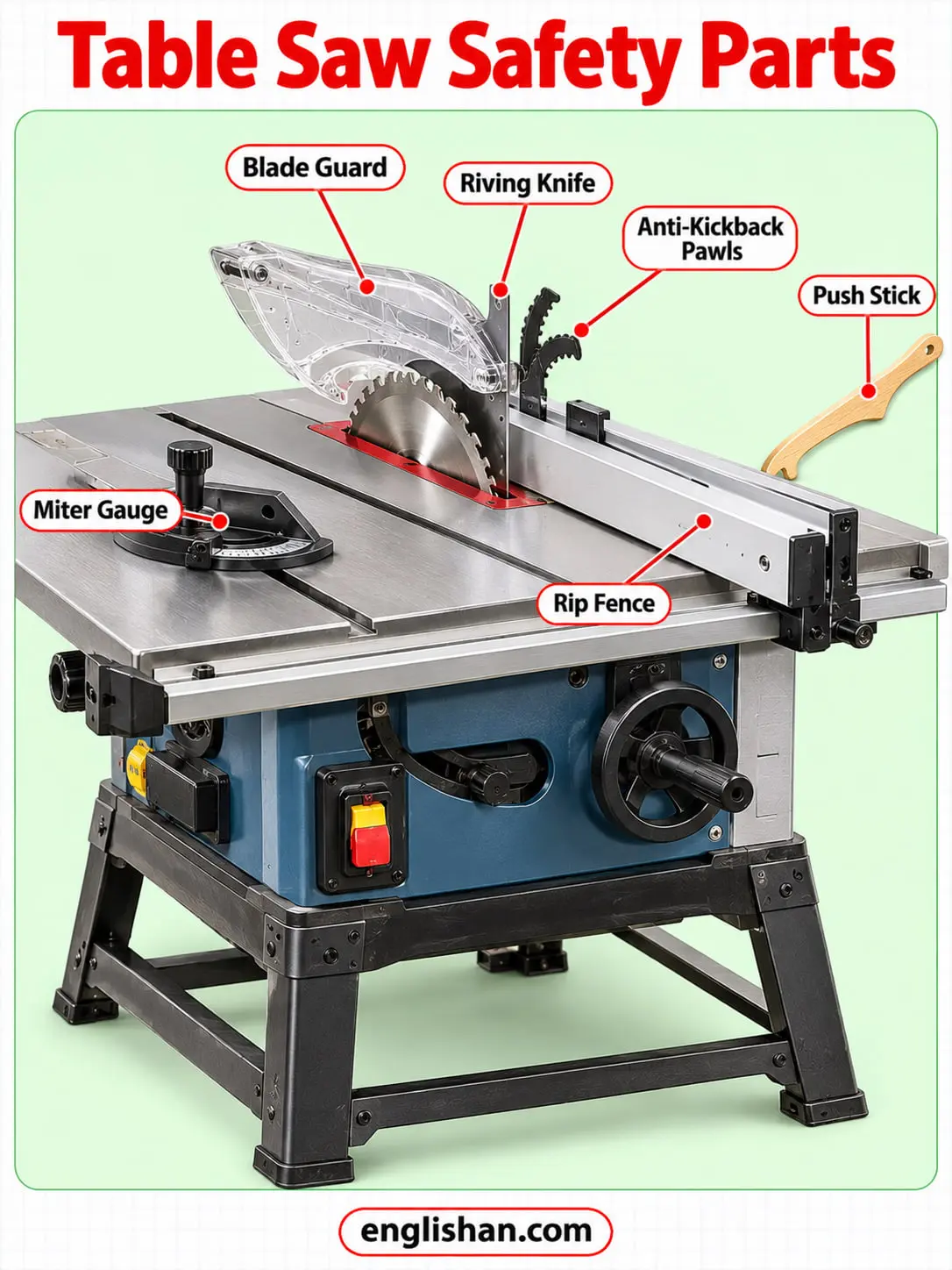
Safety Parts of a Table Saw
The safety parts of a table saw are the blade guard, the riving knife or splitter, the anti-kickback pawls, and the push stick. Kickback is the backward throw of the workpiece toward the operator.
Blade Guard
The blade guard is a cover over the blade. American saws use a clear plastic cover, and it reduces accidental contact and flying chips.
Riving Knife and Splitter
The riving knife is a vertical projection behind the blade. It is slightly narrower than the blade and aligned with it, and it keeps the cut material from rotating and pinching the blade. A splitter is a similar part that is fixed in place and not always aligned as closely with the blade. It is a pin or a fin, and it forms part of the blade guard on some saws.
Anti-Kickback Pawls
Anti-kickback pawls are spring-loaded toothed arms on the splitter or the guard assembly. They press down on the board to resist kickback.
Push Stick
A push stick is a hand-held tool that feeds small workpieces past the blade. It keeps the hand clear of the teeth.
Benchtop and Cabinet Table Saw Parts
The motor, the weight, and the base change from one type of table saw to the next, so the parts of a table saw differ with the type.
- ✅ Benchtop saw: A direct-drive universal motor powers it, and one person lifts most modern models.
- ✅ Jobsite saw: A relatively light saw with a 15 ampere universal motor, and higher-end models use gear-driven motors.
- ✅ Contractor saw: A 1 to 2 horsepower induction motor hinged off the rear drives the blade through rubber V-belts, and the saw weighs 200 to 400 pounds.
- ✅ Hybrid saw: A 1.5 or 2 horsepower motor runs on a standard 15 or 20 ampere, 120-volt circuit.
- ✅ Cabinet saw: A cast iron top on a steel base, an enclosed cabinet, and a 3 to 5 horsepower single-phase or 5 to 7.5 horsepower three-phase induction motor. It weighs 600 to 900 pounds.
- ✅ Sliding table saw: A three-phase induction motor of 2.2 to 5.2 kilowatts, or 3 to 7 horsepower.
The base is the last of the parts of a table saw to change with the type. Some bases are fixed, others fold or roll for storage and transport, and a mobile base adds wheels. The Ryobi RTS21 has a leg stand with connector brackets and linkages.
Table Saw Part Names
Makers and woodworking pages use more than one name for several parts of a table saw. The alternate names come from Wikipedia, Rockler, and the Ryobi manual page.
| Part | Also called |
|---|---|
| Rip fence | Fence |
| Throat plate | Insert, zero-clearance insert |
| Miter slots | T-slots |
| Riving knife | Splitter (a similar, fixed part) |
| Blade guard | Guard |
| Height handwheel | Blade height adjustment wheel |
| Tilt handwheel | Bevel tilt handwheel |
| Anti-kickback pawls | Pawls |
| Extension wings | Table extension |
| Switch assembly | Power switch |
FAQs
FAQs
The parts of a table saw are the table, the blade, the arbor, the rip fence, the miter gauge, and the throat plate. The riving knife, the blade guard, the anti-kickback pawls, the handwheels, the trunnions, and the motor complete the saw.
The main parts of a table saw are the table, the blade, the fence, and the miter gauge. The motor drives the blade through the arbor, and the handwheels set its height and tilt.
The safety parts of a table saw are the blade guard, the riving knife or splitter, the anti-kickback pawls, and the push stick. The guard reduces contact with the blade, and the riving knife keeps the cut from pinching the blade.
The types of table saws are the benchtop, jobsite, contractor, hybrid, cabinet, and sliding table saw. They differ in motor, weight, and base.
A table saw cuts the material that rests on its table, with the blade protruding through the table surface. The rip fence guides rip cuts, and the miter gauge guides crosscuts and miter cuts.
The parts of a table saw fence are the rip fence, the fence rails, the clamping handle, and the position indicator. The fence slides on the rails and locks in line with the blade, and the indicator shows its position against a scale.
A table saw cuts with a circular saw blade, but it is a separate machine. The blade is mounted under a flat table and rises through it. The parts of a circular saw are part of the handheld tool.
Related: