

The parts of a circular saw are the blade, the arbor, the blade guard, the shoe, the depth and bevel adjustments, the handle, the trigger, and the motor. The motor spins the blade on the arbor, the shoe rides on the material, and the trigger starts the cut.
The saw described is the portable, handheld circular saw in corded and cordless forms. The parts of a table saw are a separate set, and a hand saw cuts with a toothed blade but has no motor.
Parts of a Circular Saw Labeled Diagram
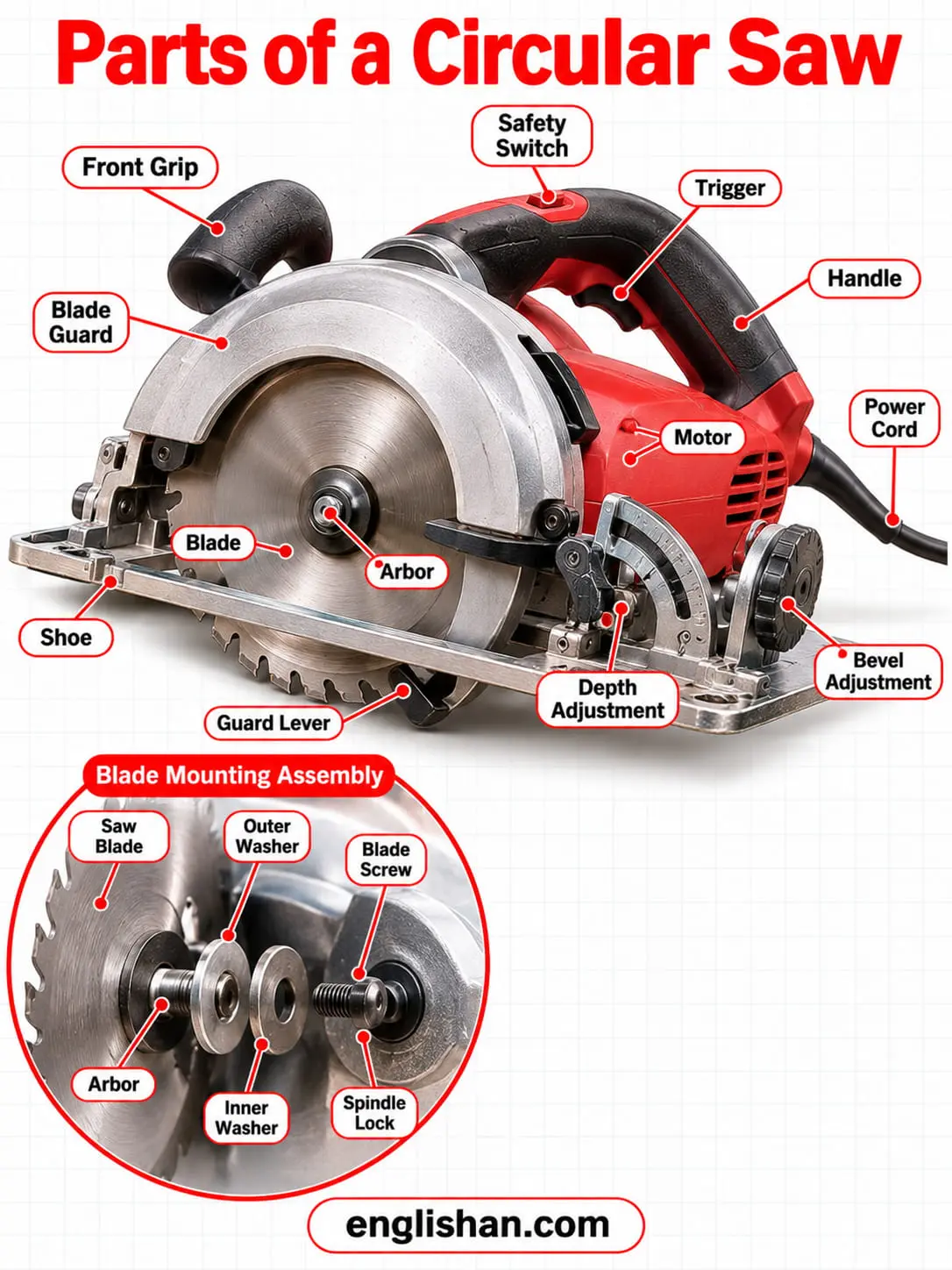
In a labeled diagram of a circular saw, the blade is at the front, and the guard covers it. The shoe is the flat plate under the body, and the handle with the trigger is at the back. The depth and bevel adjustments attach to the shoe.
| Part | Where you find it |
|---|---|
| 1. Blade | Round disc with many sharp teeth on the edge |
| 2. Arbor | Shaft that the blade spins on |
| 3. Blade guard | Spring-loaded cover that slides back as the blade meets the material |
| 4. Guard lever | Lever that moves the lower guard |
| 5. Shoe | Flat metal plate that rides on the material |
| 6. Depth adjustment | Lever or lock knob that sets how deep the blade cuts |
| 7. Bevel adjustment | Knob or lever at the front or back of the saw that tilts the shoe |
| 8. Motor | Electric drive inside the housing |
| 9. Handle | Main grip, with the trigger within reach |
| 10. Trigger | Switch that starts and stops the blade |
| 11. Safety switch | Thumb-operated lock that stops an accidental start |
| 12. Front grip | Second grip at the front for the guiding hand |
| 13. Battery or cord | Power supply of a cordless or corded saw |
Parts of a Circular Saw Blade
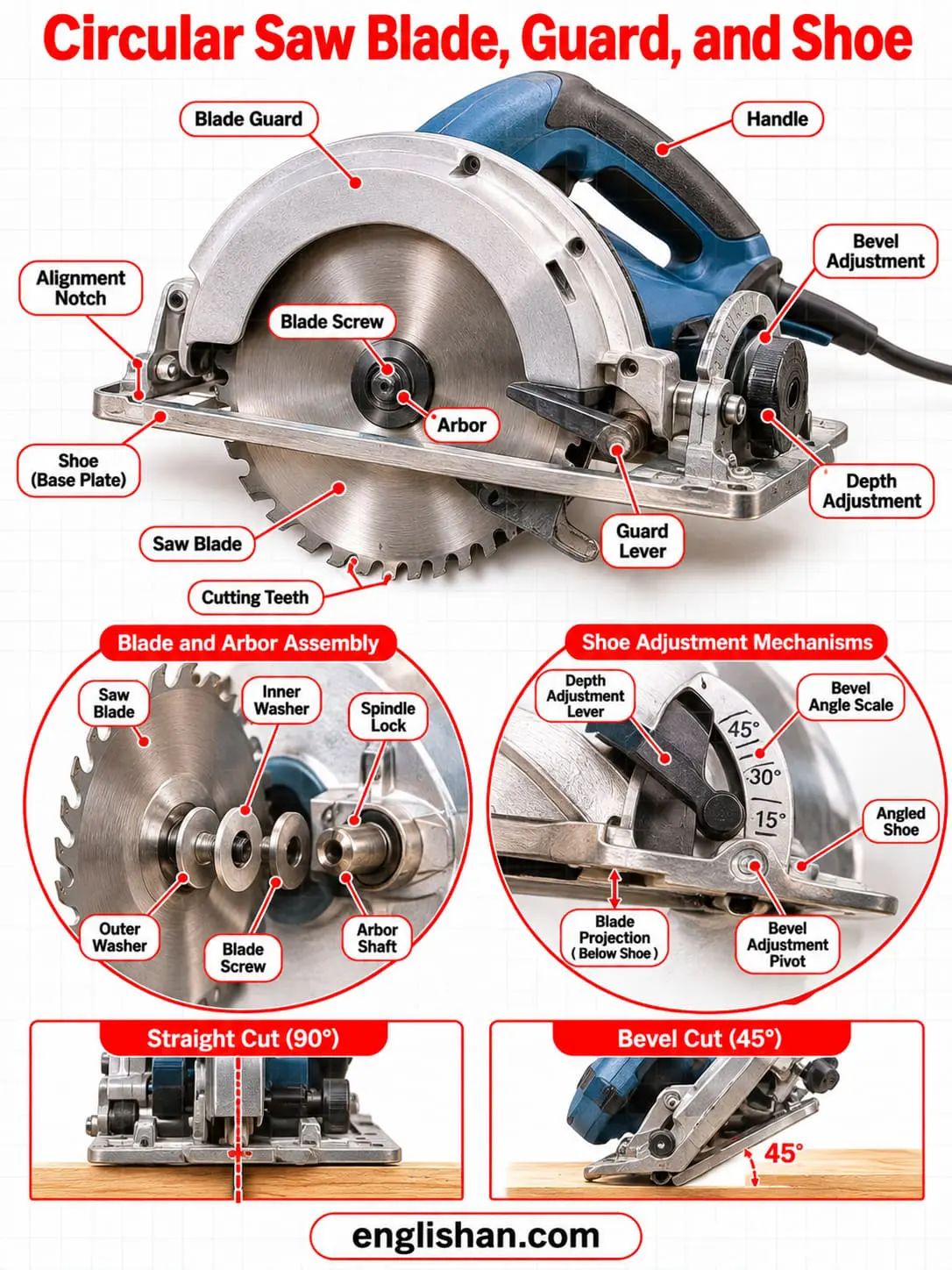
Among the parts of a circular saw, the blade is the round cutting disc with many sharp teeth. Each tooth strikes the material and cuts a small chip, and the teeth move the chip out of the cut so it does not bind the blade. The saw cuts with the teeth at the front of the blade moving upward.
Wood blades are almost always tungsten carbide tipped, and high-speed steel blades are also made. Each blade is designed for the material it cuts. Wood blades are built for rip cuts, crosscuts, or both. A rip cut runs with the grain, and a crosscut runs against it.
Blade diameter follows the saw type, and each blade is matched to its saw.
| Saw type | Blade diameter |
|---|---|
| Compact saw | 4 to 5⅜ inches |
| Track saw | 6½ inches |
| Standard handheld saw | 7¼ inches |
Both common handheld models take a 7¼ inch blade.
The blade is tungsten carbide tipped or high-speed steel.
Arbor and Blade Hardware
The arbor is the shaft that the blade spins on. A Milwaukee service manual calls the rotating shaft the spindle, and it names a spindle lock button, a spindle lock pin, a blade screw, washers, and a blade wrench as the blade hardware. The battery comes out of a cordless saw before any blade change.
Blade Guard and Guard Lever
The blade guard is a spring-loaded, retractable cover that slides over the blade. It slides out of place as soon as the blade touches the material, and it covers the blade again when the cut ends. It protects the user and the surface from the blade.
A Milwaukee service manual names an upper guard cover and a lower guard kit. The guard lever moves the lower guard. The same manual checks the guard by releasing the lever and confirming that the guard returns briskly.
Parts of a Circular Saw Shoe and Base Plate
The shoe is the flat metal plate that forms the base of the saw. It rides on the material and keeps the blade square to the cut. The shoe is aluminum, steel, or die cast, and a notch at the front of the shoe lines up the cut.
Depth Adjustment
The depth adjustment sets how far the blade extends under the shoe. It is a lever at the rear of the saw on some models and a depth lock knob on others. A shallow setting minimizes kickback.
Milwaukee’s manual sets the shoe so that the blade extends through the material by no more than ¼ inch.
Bevel Adjustment
The bevel adjustment tilts the shoe relative to the blade. It is a knob or lever at the front or the back of the saw, and it loosens to set the blade to 45 degrees or a custom angle. The shoe tilts up to 45 degrees and on some saws up to 50 degrees.
A Milwaukee service manual also names a pointer that shows the bevel angle on a scale.
Parts of a Circular Saw Handle and Trigger
The handle is the main grip at the back of the saw, and the trigger is within reach of the fingers. Pressing the trigger spins the blade up to speed at once. Releasing it stops the cut.
The safety switch, also called the trigger lock, is a thumb-activated lock found on some models. It keeps the saw from starting by accident. The front grip, also called the forward grip, is the second grip for the other hand. It guides the saw and keeps both hands away from the blade.
Circular Saw Motor and Drive
The motor is the electric drive inside the plastic and metal housing. Most circular saws run on electricity. Some run on a gasoline engine or a hydraulic motor.
In a sidewinder saw, the blade mounts directly on the motor driveshaft. Art Emmons of Porter-Cable invented the direct-drive sidewinder in 1928. In a worm-drive saw, a motor mounted at a right angle drives the blade through worm gears, which give higher torque. Edmond Michel invented the worm-drive portable saw in 1923.
A left-handed or right-handed saw is named for the side of the blade where the motor is mounted. A Milwaukee service manual names the motor housing, the armature, the field, the brush assembly, and the gearcase.
The housing is plastic and metal, and the motor runs on a cord or a rechargeable battery.
Parts of a Cordless Circular Saw
A cordless circular saw replaces the cord with a rechargeable battery. Smaller cordless saws became popular in the 2010s. The battery release frees the battery from the saw, and a UMD repair page says to remove the battery before any adjustment or blade change.
A corded saw has a cord assembly that plugs into an outlet. The remaining parts of a circular saw are the same on both forms.
Circular Saw Part Names
Makers and retailers use more than one name for several parts of a circular saw. The alternate names come from Home Depot, Bob Vila, UMD, and Milwaukee.
| Part | Also called |
|---|---|
| Shoe | Base plate, plate |
| Arbor | Spindle |
| Blade guard | Retractable blade guard |
| Safety switch | Trigger lock |
| Front grip | Forward grip |
| Depth adjustment | Depth lever, depth lock knob |
| Bevel adjustment | Bevel adjustment lever, bevel adjustment knob |
FAQs
The parts of a circular saw are the blade, the arbor, the blade guard, the shoe, the depth adjustment, the bevel adjustment, the handle, the trigger, the safety switch, the front grip, and the motor. A cordless saw adds a battery.
The main parts of a circular saw are the blade, the motor, the shoe, and the blade guard. The motor spins the blade, the shoe rides on the material, and the guard covers the blade. The trigger starts the motor.
A circular saw blade is a round disc with many sharp teeth on its edge. Each tooth cuts a small chip, and the blade mounts on the arbor. Wood blades are tungsten carbide tipped.
The flat part of a circular saw is the shoe, also called the base plate. It is the flat metal plate that rides on the material. The depth and bevel adjustments attach to the shoe.
The motor spins the blade, and the blade guard covers it. The shoe rides on the material, and the depth adjustment sets the cut depth. The bevel adjustment tilts the shoe, and the trigger starts the saw.
A portable circular saw has the same parts as the diagram: the blade, the arbor, the blade guard, the shoe, the adjustments, the handle, the trigger, and the motor. It is corded or cordless, with a cord or a battery as the power supply.
Related: