

The parts of a saw are the handle, the heel, the blade, the teeth, the back, and the toe. The teeth do the cutting, and the handle is the grip that drives the stroke.
A hand saw is a manual saw for straight cuts, also called a panel saw. Back saws add a spine, and hacksaws and coping saws add a frame. The parts of a circular saw and the parts of a table saw follow their own layouts, since those are powered machines.
Parts of a Saw Labeled Diagram
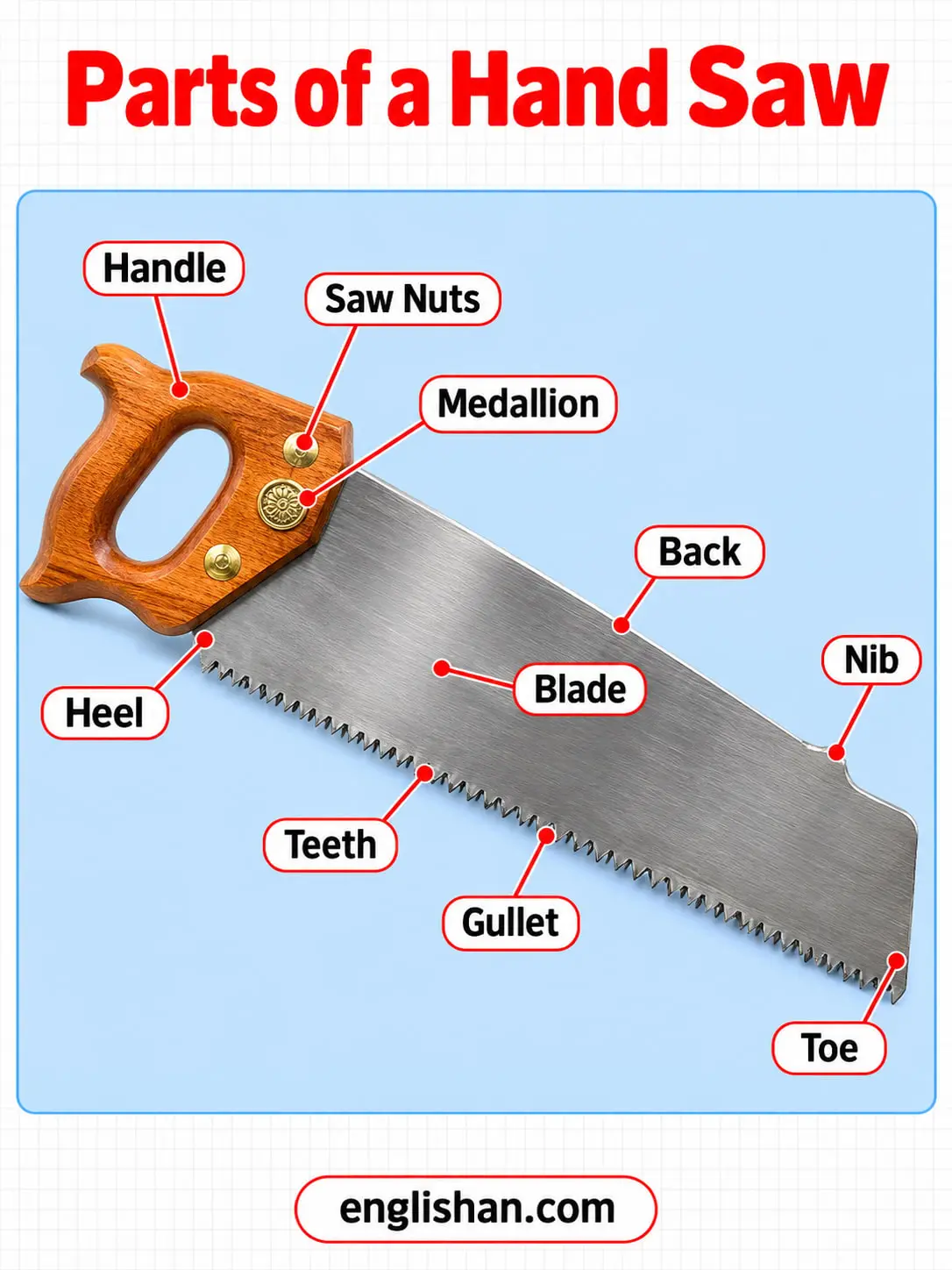
In a labeled diagram of a hand saw, the handle is at one end and the toe is at the other. The heel is the blade end nearest the handle, the teeth run along the front edge, and the back runs along the opposite edge.
| Part | Where you find it |
|---|---|
| 1. Handle | Grip at the heel end of the blade |
| 2. Saw nuts | Fasteners that hold the handle to the blade |
| 3. Medallion | Enlarged face of one saw nut |
| 4. Heel | Blade end nearest the handle |
| 5. Blade | Long, rigid steel plate that holds the teeth |
| 6. Teeth | Sharp tips along the front edge |
| 7. Gullet | Space between two teeth |
| 8. Back | Toothless edge opposite the teeth |
| 9. Toe | Blade end away from the handle |
| 10. Nib | Bump on the back near the toe of many older saws |
Parts of a Saw Blade and Teeth
Among the parts of a saw, the blade is long and rigid, with enough flex to follow a straight line. The plate is the flat sheet of steel formed into the blade, and the teeth are cut along its front edge.
The blade is thin, tough steel, and the teeth are a material harder than the wood being cut.
Teeth
The teeth are sharp tips of a material harder than the wood being cut. Crosscut teeth are shaped with a file into small knife-like edges, and they cut across the grain. Rip teeth are chisel-like, and they cut along the grain by separating the wood fibers.
Gullet
The gullet is the space between two teeth, where the sawdust is carried out of the cut. It is shaped like an equilateral triangle, and it collects the chips as the saw cuts.
Set and Kerf
Set is the bend of the teeth to both sides of the blade. It makes the cut wider than the blade and lets the blade move through the wood without binding.
The kerf is the channel the saw removes, and its width equals the blade thickness plus the set. With a 1/8 inch (3 mm) kerf, an 8-foot board cut into 1-foot pieces yields seven pieces and a last piece 7/8 inch (21 mm) short.
Tooth Angles and Points per Inch
Rake is the angle of the front face of a tooth, measured from a line perpendicular to the length of the saw. A crosscut saw has a rake of 12 to 15 degrees, and a rip saw has a rake of zero to eight degrees.
Fleam is the angle filed into the faces of crosscut teeth, which forms a knife edge that slices the wood fibers. Crosscut fleam runs from 15 to 24 degrees.
Points per inch (PPI) is the measure of tooth spacing that saw makers use. It is counted from the zero mark to the one-inch mark inclusive, so a saw has one more point than teeth per inch. A 14 PPI saw has 13 teeth per inch (TPI).
Makers stamped the spacing on the heel of a handsaw, and backsaws carried no stamp. Half-point spacings of 6½, 5½, 4½, and 3½ PPI were common on full-size handsaws. Coarser teeth cut faster and leave a rougher surface, and finer teeth cut slower and suit joinery.
A ripsaw was filed one point finer at the toe, so a 6-point ripsaw measures 6 PPI at the heel and 7 PPI at the toe. Spacing is read at the heel.
Parts of a Saw Handle and Back
Among the parts of a saw, the handle is the grip at the heel end, and the saw nuts fasten it to the blade. The heel is the rear end of the blade, partly or fully encased in the handle. The toe is the front end, and it is narrower than the heel on most saws.
The medallion is the enlarged face of one saw nut, and it bears the maker’s brand name. The close-up or let-in handle is the handle placement and shape that Disston developed in the 19th century. Applewood was the most popular handle material, and saw makers used 2,000,000 board feet of it each year in the early 1900s.
The back is the edge opposite the teeth, and it faces up in normal use. Disston introduced the skew back in 1874, a concave back that saves weight. The nib is a bump on the back of many older saws near the toe, and it is decoration.
Applewood was the most popular handle wood.
Parts of a Back Saw
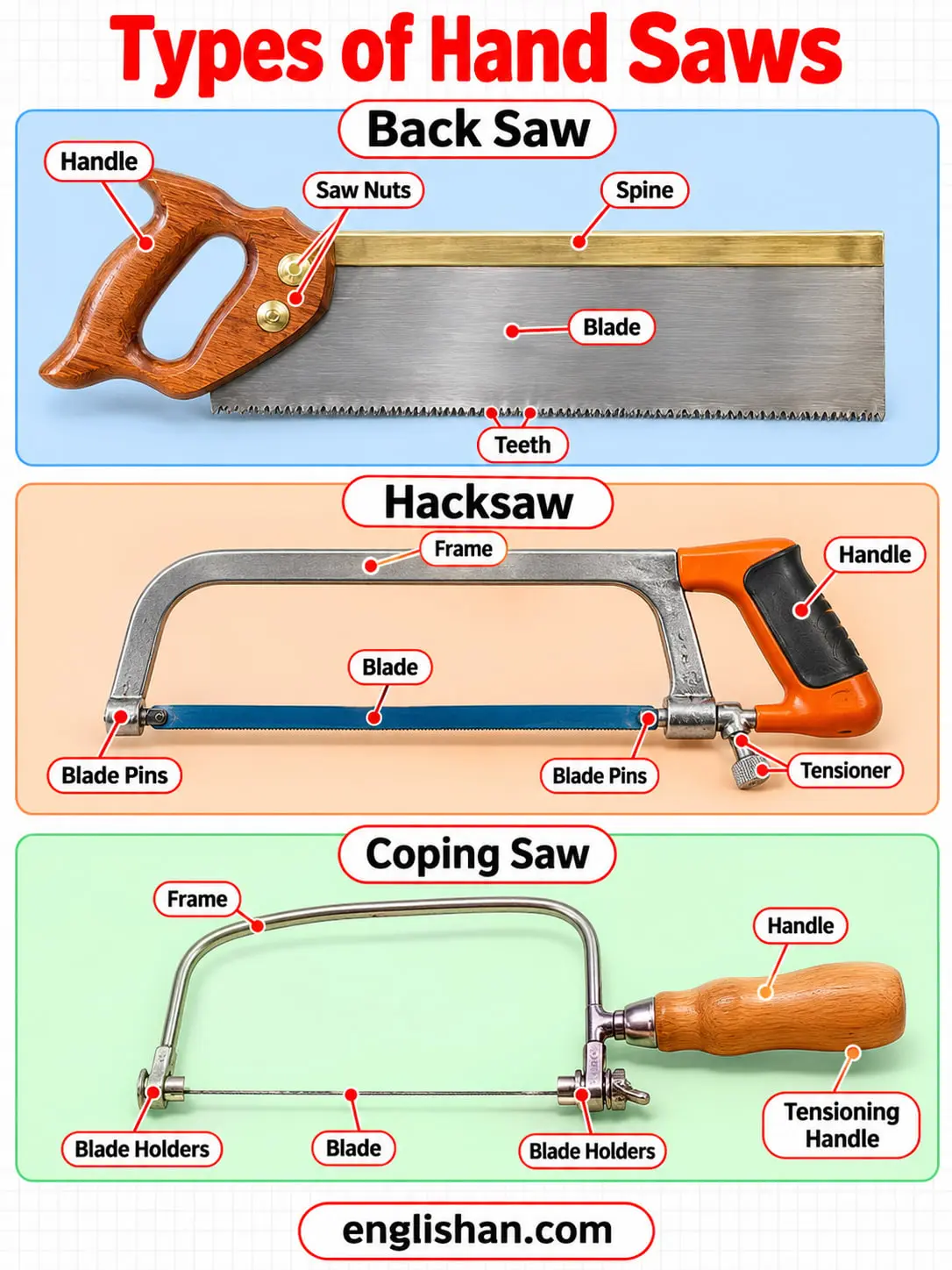
The parts of a saw gain a spine on a back saw, a thick steel or brass cap over the length of the top edge of the blade. The spine stiffens a thin blade for joinery or for cuts made with a miter box.
The teeth of a back saw are closely spaced, with little or no set. Tenon saws and dovetail saws have a pistol grip handle that is open or closed at the bottom.
- ✅ Tenon saw: 13 teeth per inch is a common size.
- ✅ Dovetail saw: 15 to 20 teeth per inch, with a blade of 6 to 10 inches.
- ✅ Carcase saw: Between a tenon saw and a dovetail saw, with a blade of 10 to 14 inches.
- ✅ Miter box saw: A blade of 20 to 30 inches (60 to 90 cm).
Backsaws range from 6 to 20 inches in blade length, and 12 inches is the most common. Miter box saws reach 30 inches in blade length.
The back saw spine is brass or steel.
Hand Saw Teeth and Back
Hand saws range from 12 to 30 inches by toothed-edge length, and 26 inches is the most common. The parts of a saw change with the type, mostly in the teeth, the back, and the frame.
| Type | What differs |
|---|---|
| Crosscut saw | Knife-edged teeth for cutting across the grain |
| Rip saw | Chisel-like teeth for cutting along the grain |
| Back saw | Thick steel or brass spine that stiffens a thin blade |
| Dovetail saw | Blade of 6 to 10 inches for intricate joints |
| Carcase saw | Blade of 10 to 14 inches |
| Sash saw | Back saw with a blade of 14 to 16 inches |
| Keyhole saw | Narrow, tapered blade for curves, also called a compass saw |
| Plywood saw | Fine teeth that reduce tearing |
| Japanese pull saw | Thin blade that cuts on the pull stroke |
| Bow saw | Narrow blade under tension in a frame, with a rotating blade |
| Hacksaw | Fine-toothed blade in a frame, for metal |
| Coping saw | Very narrow blade in a metal frame, for cutting curves in wood |
Parts of a Hacksaw
The parts of a saw change on a hacksaw, which has a frame, a blade, a handle with pins, and a tensioner. The frame is C-shaped, and it holds a narrow, disposable blade under tension.
Frame and Handle
The C-shaped frame is called a walking frame, and some frames adjust to fit different blade sizes. The handle is a pistol grip with pins that hold the blade. A screw or another tensioner keeps the thin blade under tension.
A junior hacksaw uses a half-size blade, and its pins rest in notches in the frame.
Blade and Teeth Per Inch
Each end of the blade has a mounting hole. The standard blade is 10 to 12 inches (250 to 300 mm) long, and the smallest is 6 inches (150 mm). The most common blade is 12 inches, measured from center to center between the mounting holes.
Hand blades run from 14 to 32 teeth per inch, and the cut needs at least three teeth in the material. The kerf measures 0.030 to 0.063 inch (0.75 to 1.6 mm).
The teeth face toward or away from the handle, so the cut happens on the push or the pull stroke. In normal use, with the work held in a bench vise, the blade faces forward.
Carbon steel blades were the first type. They are soft and flexible and are now obsolete except where cost is the main limit, and carbon steel is the only type for junior hacksaws. High-speed steel blades come in an all-hard form that cuts accurately but breaks easily, and a softer form that resists breakage but is less stiff. Bi-metal blades weld a high-speed steel strip on the tooth edge to a softer spine, and they have been almost universal since the 1980s.
Coping Saw Parts
A coping saw has a square, C-shaped frame of springy iron with a thin, hardened steel blade stretched between its ends. The handle attaches to the frame.
Holding pins on the blade lock into angled slots in rotatable blade holders. Partly unscrewing the handle releases the blade, which then passes through a drilled starting hole. Retightening the handle tensions the blade and locks its angle to the frame.
The blade rotates to cut on the push or the pull stroke. Rotating the blade allows sharper curves, and turning the whole frame produces gentler curves.
The coping saw frame is springy iron.
Saw Part Names
Several of the parts of a saw have more than one name in catalogs and workshops. The alternate names come from saw makers and reference works.
| Part | Also called |
|---|---|
| Blade | Plate, saw plate |
| Teeth | Points |
| Back saw | Tenon saw |
| Hand saw | Panel saw |
| Keyhole saw | Compass saw |
| Points per inch | PPI |
| Teeth per inch | TPI |
| Back saw spine | Stiffening cap |
FAQs
FAQs
The parts of a saw are the handle, the heel, the blade, the teeth, the back, and the toe. The gullet is the space between the teeth. Back saws add a spine, and hacksaws and coping saws add a frame.
A hand saw has six labeled parts: the heel, the handle, the toe, the back, the teeth, and the blade. Saw nuts, the medallion, and the nib are smaller parts of some saws. Back saws and frame saws add a spine or a frame.
The parts of a saw blade are the teeth, the gullets, the heel, the toe, and the back. Set bends the teeth to both sides, and the kerf is the channel the blade removes.
The teeth do the cutting. They are sharp tips of a material harder than the wood. Crosscut teeth cut across the grain, and rip teeth cut along it.
A tenon saw has a blade, a spine, teeth, and a handle. The spine is a brass or steel cap on the top edge that stiffens the blade. Tenon saws have a pistol grip handle, and 13 teeth per inch is a common size.
The parts of a coping saw are the frame, the blade, the handle, and the holding pins. The C-shaped frame stretches the blade, and loosening the handle rotates the blade to cut on the push or the pull stroke.
The parts of a hacksaw are the C-shaped frame, the blade, the handle with its pins, and a tensioner. The blade is 10 to 12 inches long, and 12 inches is the most common.
Related:
