

The parts of a wrench are the head, the jaws or the opening in the head, and the handle. The head grips a nut or bolt, and the handle supplies the leverage that turns it. Adjustable, socket, torque, and pipe wrenches add parts to this set.
A wrench is called a spanner in the UK, Ireland, Australia, and New Zealand, and the part names stay the same. The wrenches described are the open-end, box-end, combination, adjustable, socket, torque, and pipe wrenches. Pliers and a screwdriver are separate hand tools with their own parts.
Parts of a Wrench Labeled Diagram
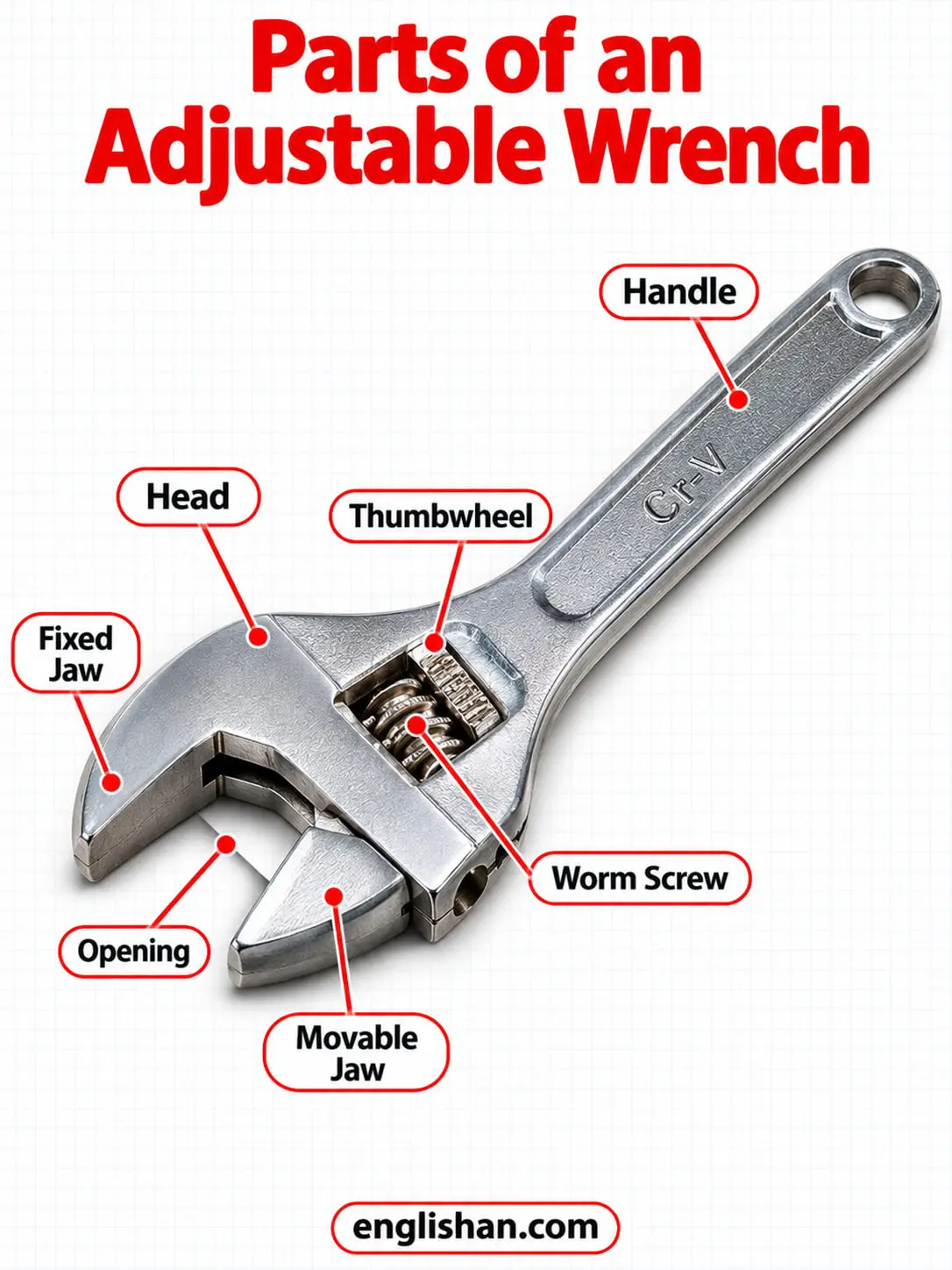
In a labeled diagram of an adjustable wrench, the head is at the top of the handle and holds both jaws. The thumbwheel is on the handle, and it drives the worm screw that moves the movable jaw. The adjustable wrench has the most named parts of a wrench, so the numbered diagram follows it.
| Part | Where you find it |
|---|---|
| 1. Handle | Grip held by the hand, where the thumbwheel is mounted |
| 2. Head | End of the wrench that contains the jaws |
| 3. Fixed jaw | Jaw that stays in place |
| 4. Movable jaw | Jaw that slides to change the gap |
| 5. Opening | Gap between the two jaws that takes the nut or bolt |
| 6. Worm screw | Screw that moves the movable jaw when turned |
| 7. Thumbwheel | Wheel on the handle that turns the worm screw |
Open End and Box End Wrench Parts
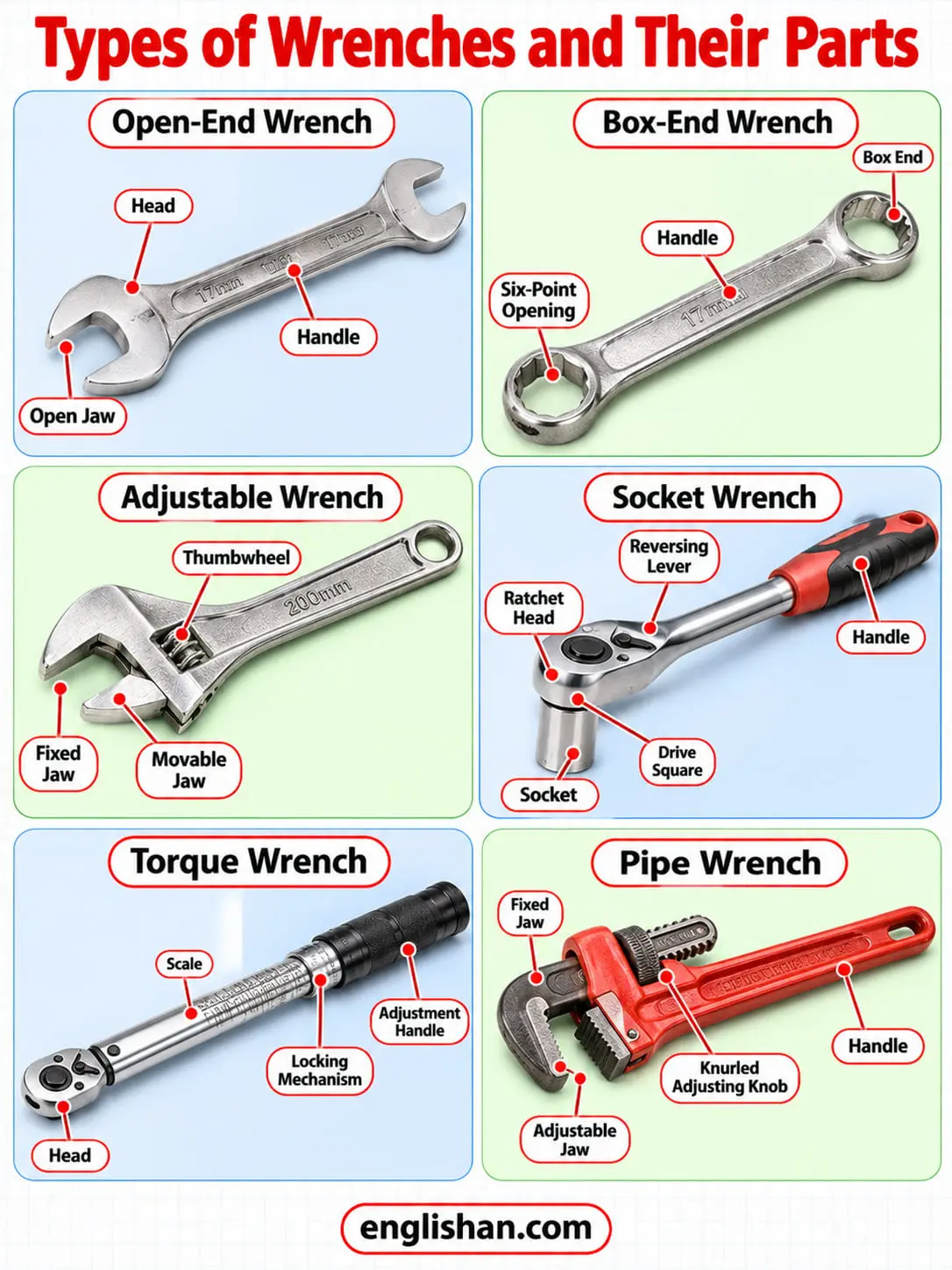
Open-end and box-end wrenches have a fixed opening in each head. Among the parts of a wrench, the opening in the head sets the type.
Higher-quality wrenches are chromium-vanadium alloy tool steel, and many are drop-forged. Makers chrome-plate many wrenches to resist corrosion and to make cleaning easier.
Open End
An open-end wrench has a U-shaped opening that grips two opposite faces of a nut or bolt. The head is angled at around 15 degrees to the axis of the handle.
Box End
A box-end wrench, also called a ring spanner, has an enclosed opening that surrounds the fastener. The recess is a six-point or twelve-point opening. A twelve-point recess fits the fastener at twice as many angles, which helps where the swing is limited.
Most box-end wrenches are sold as twelve-point, because a twelve-point wrench fits over both twelve-point and six-point bolts. Ring spanners are double-ended in many designs, with offset handles that improve access to the nut or bolt.
Combination Wrench
A combination wrench is a double-ended tool with an open end on one side and a box end on the other. Both ends fit the same size of bolt.
Parts of an Adjustable Wrench
The parts of an adjustable wrench are the handle, the head, the fixed jaw, the movable jaw, the worm screw, and the thumbwheel. In the US and Canada the tool is also called a Crescent wrench, after the Crescent Tool Company, which held the original 1915 US patent. The name became generic.
Fixed Jaw and Movable Jaw
The fixed jaw resists bending stress better than the movable jaw. The movable jaw slides in a guide slot and is supported only by the flat surfaces on either side of that slot. For this reason the jaws are angled at 15 degrees to the handle, which brings the contact surface closer to the body of the tool.
Worm Screw and Thumbwheel
Of all the parts of a wrench, the movable jaw is the one that slides. The thumbwheel turns the worm screw, and the worm screw moves the movable jaw to open or close the gap. This thumbwheel and worm-on-rack design comes from the English engineer Richard Clyburn, whose designs date to 1842 and 1843. Johan Petter Johansson of Bahco received a Swedish patent for an improved version in 1892.
Parts of a Socket Wrench
The parts of a socket wrench are the socket, the ratchet, the drive square, the reversing lever, and the handle. An extension bar is an add-on that lengthens the reach. The parts of a wrench for sockets stay the same across the drive sizes.
- ✅ Socket: A closed fitting that fits over the fastener.
- ✅ Ratchet: A reversible one-way gear with a pawl and teeth, which lets the handle pivot back and forth.
- ✅ Drive square: The square connection between the socket and the driver.
- ✅ Reversing lever: A small lever on the ratchet head that switches the wrench between tightening and loosening.
- ✅ Handle: A ratchet handle or a breaker bar, which supplies the leverage.
- ✅ Extension: A bar that attaches to the socket on one end and the ratchet on the other.
The common ratchet drives are 1/4, 3/8, 1/2, and 3/4 inch, and the 1/4, 3/8, and 1/2 inch sizes are the most widely sold. A six-point socket is the standard form for hex nuts and for most impact sockets. A twelve-point socket aligns every 30 degrees instead of every 60 degrees.
Shallow sockets suit narrow spaces. Deep sockets are used when the bolt extends up into the socket, as with exhaust clamp bolts.
Hand sockets are chrome-plated chromium-vanadium steel. Impact sockets are a thicker, tougher, more ductile alloy steel, chromium-molybdenum in most cases, with a black oxide or black phosphate finish in place of chrome. A chrome-plated socket is not suitable for an impact wrench, because standard sockets shatter under impact use.
Torque Wrench Parts
A torque wrench is a socket-drive tool that applies a set amount of torque to a fastener. Its parts are the handle, the head, the scale, and a spring or beam. Among the parts of a wrench, the spring or beam is the one that senses the torque. The handle is the lever that applies the torque, and the head holds the drive.
Click Torque Wrench Parts
A click-type torque wrench holds a ball detent against a socket with a spring. An adjustable screw thread, calibrated in torque units, sets the preload on the spring. At the preset torque the ball releases from its socket with a click. Click types are stored at their lowest setting.
Beam Torque Wrench Parts
In a beam-type torque wrench, the handle beam deflects in proportion to the force applied. A second indicator beam stays straight, and its free end points at the torque value on the scale.
Slipper Torque Wrench Parts
A slipper-type torque wrench holds a cam on the driving head with a roller. A spring, adjustable on some models, sets the holding force. When the applied torque overcomes the spring, the wrench slips and stops applying torque.
Recalibration falls due every 5,000 cycles or every 12 months, whichever comes first.
Parts of a Pipe Wrench
The parts of a pipe wrench are the handle, the adjustable jaw, and a knurled adjusting knob. The adjustable jaw has hardened serrated teeth that bite into the softer metal of the pipe. On some models two leaf springs flank the knob, one on each side and help unlock the jaw when the handle pressure is released.
The jaw has a set amount of play out of square, which lets it bind on the pipe. Forward pressure on the handle pulls the jaws tighter. Pipe wrenches are classed by handle length, from 6 inches (150 mm) to 48 inches (1,200 mm) or more.
Pipe wrenches are forged steel. Some pipe wrenches use an aluminum body to save weight, and the teeth and jaw stay steel.
Wrench Head and Grip Styles
Wrenches differ in the head, the drive, and the grip, so the parts of a wrench change with the type. These groups follow the classification used by Wikipedia.
- ✅ Common wrenches: Open-end, box-end, combination, flare-nut, ratcheting box, and spanner wrenches.
- ✅ Adjustable wrenches: Adjustable, self-adjusting, pipe, and clamp ratchet wrenches, plus locking pliers.
- ✅ Socket wrenches: Socket, L-angle socket, ratchet, torque, and crowfoot wrenches, plus the breaker bar and the speed handle.
- ✅ Keys: Allen wrenches (hex keys), Bristol spline wrenches, and Torx wrenches. An Allen wrench turns a screw with a hexagonal socket and comes in L-shaped and T-handle forms.
- ✅ Specialty wrenches: Basin, cone, spoke, strap, tap, and tuning wrenches, among others.
- ✅ Power wrenches: Impact wrenches and impact drivers.
A flare-nut wrench has a narrow opening just wide enough to slip over a tube, and it gives maximum contact on plumbing nuts.
Wrench Part Names
Several of the parts of a wrench have more than one name, and several tools do too. The alternate names come from Wikipedia and from retailer and maker pages.
| Part | Also called |
|---|---|
| Wrench | Spanner |
| Open-end wrench | Open-ended spanner |
| Box-end wrench | Ring spanner |
| Adjustable wrench | Adjustable spanner, Crescent wrench |
| Pipe wrench | Stillson wrench |
| Hex key | Allen wrench |
| Thumbwheel | Thumb screw |
FAQs
The parts of a wrench are the head, the jaws or the opening, and the handle. An adjustable wrench adds a worm screw and a thumbwheel, and a socket wrench adds a socket, a ratchet, and a drive square.
The parts of an adjustable wrench are the handle, the head, the fixed jaw, the movable jaw, the worm screw, and the thumbwheel. The thumbwheel turns the worm screw, and the worm screw moves the movable jaw.
The parts of a socket wrench are the socket, the ratchet, the drive square, the reversing lever, and the handle. An extension bar attaches between the socket and the ratchet to lengthen the reach.
The parts of a torque wrench are the handle, the head, the scale, and a spring or beam. A click-type wrench adds a ball detent and an adjustable screw thread that preloads the spring.
The parts of a pipe wrench are the handle, the adjustable jaw with hardened serrated teeth, and a knurled adjusting knob. Some models add two leaf springs beside the knob.
A wrench is made of chromium-vanadium alloy tool steel, and many are drop-forged and chrome-plated. Impact sockets use a tougher chromium-molybdenum steel, and pipe wrenches are forged steel.
A combination wrench has an open end on one side and a box end on the other. Both ends fit the same size of bolt.
Related: