

The parts of an axe divide between a steel head and a handle joined at the eye. The bit, the cheek, and the poll are the main parts of the head. The shoulder, the belly, the throat, and the knob are the main parts of the handle.
The single-bit felling axe is the standard layout, spelled ax in some US dictionaries. Fire axes, ice axes, pickaxes, tomahawks, and double-bit axes change the head or the handle. The knife and the sword have their own parts.
Parts of an Axe Labeled Diagram
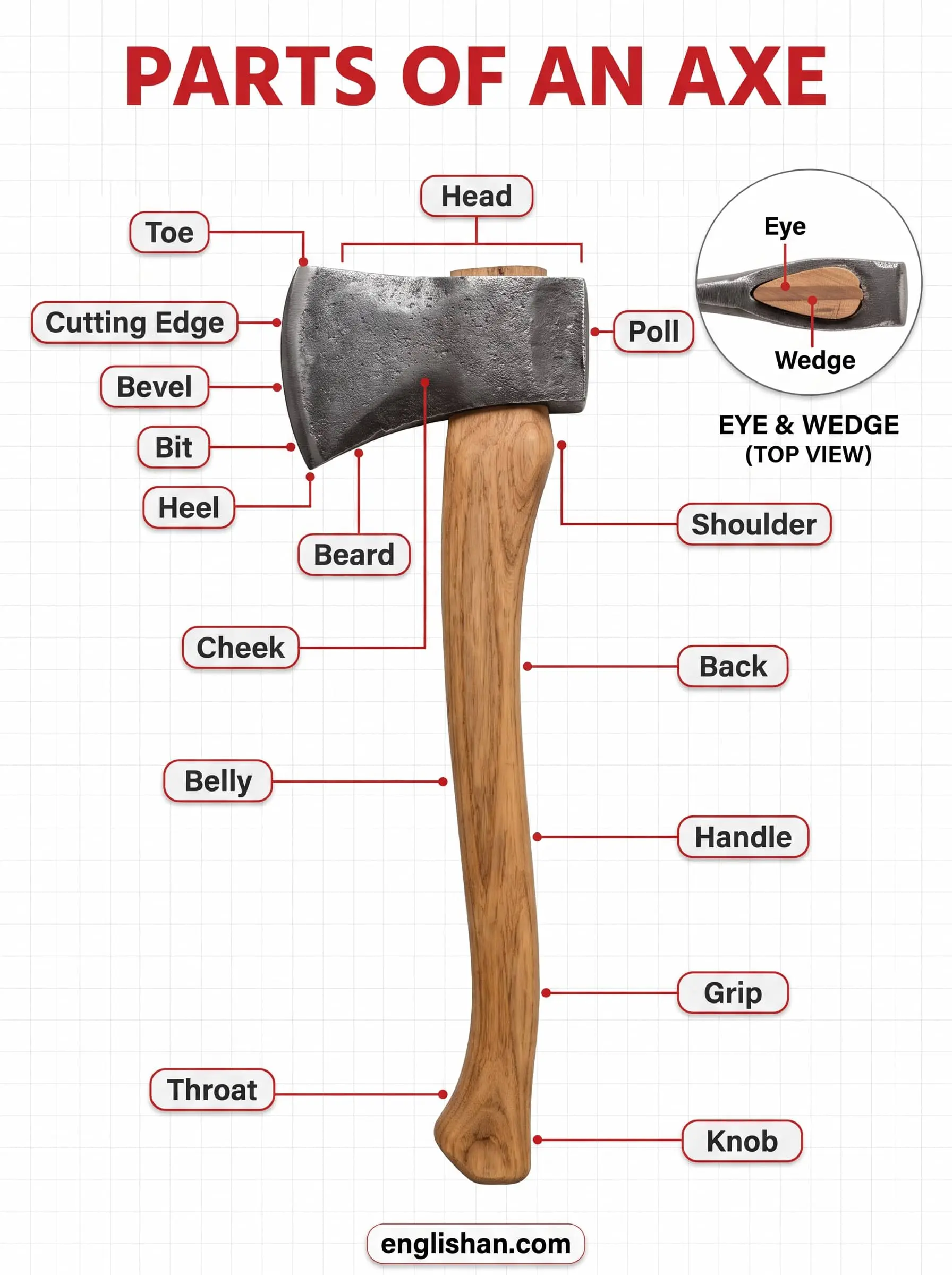
In a labeled diagram of an axe, the head is at the top and the handle extends down from it to the knob. The bit is the cutting end of the head, and the poll is the opposite end. Every part of an axe belongs to the head or the handle.
| Part | Where you find it |
|---|---|
| 1. Head | Steel part at the top of the axe, mounted on the handle |
| 2. Bit | Cutting end of the head, opposite the poll |
| 3. Bevel | Angled face of the bit that tapers toward the edge |
| 4. Cutting edge | Front line of the bit where the two bevels meet |
| 5. Toe | Upper end of the bit |
| 6. Heel | Lower end of the bit |
| 7. Beard | Curve of the bit that extends toward the handle |
| 8. Cheek | Wide flat side of the head between the bit and the poll |
| 9. Poll | End of the head opposite the bit, also called the butt |
| 10. Eye | Opening through the head where the handle fits |
| 11. Wedge | Block driven into the end of the handle inside the eye |
| 12. Handle | Wooden shaft that extends from the head to the knob, also called the haft |
| 13. Shoulder | Upper length of the handle, directly beneath the head |
| 14. Back | Upper side of the belly |
| 15. Belly | Long curved middle length of the handle |
| 16. Throat | Curve of the handle between the belly and the grip |
| 17. Grip | Lower length of the handle that the hands grasp |
| 18. Knob | Thickened end of the handle |
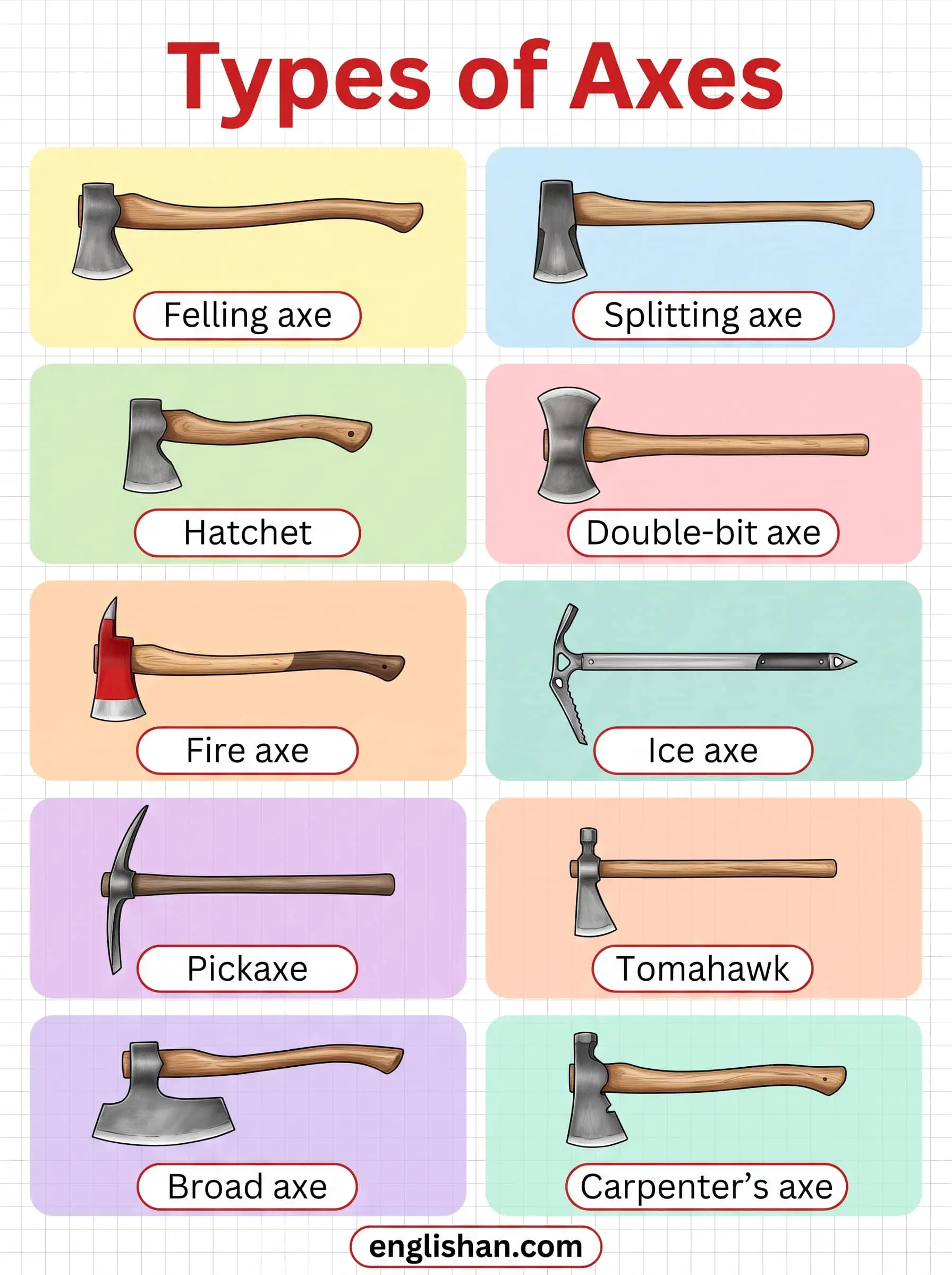
Parts of an Axe Head
The head is the steel part of the axe, made of low-carbon or high-carbon steel. The parts of an axe head are the bit, the cheek, the poll, and the eye. The wedge completes the joint with the handle.
Bit and Cutting Edge
The bit is the cutting end of the head, opposite the poll, and it does most of the chopping. Many makers call it the blade. Two bevels, the angled faces of the bit, taper to the cutting edge, which forms where the bevels meet. A primary bevel of 10 degrees and a secondary bevel of 15 to 20 degrees is a common edge.
Toe and Heel
The toe is the upper end of the bit, and the heel is the lower end. Some makers call them the upper and lower corners. The toe steers the swing, and the heel is used for carving and detail work.
Beard
The beard is the curve of the bit that extends toward the handle, beneath the head. It gives the fingers room to grip right behind the cutting edge. Broad axes and carpenter’s axes have a longer, more pronounced beard than felling and splitting axes.
Cheek
The cheek is the wide, flat, concave side of the head between the bit and the poll. It acts as a counterweight that helps control the swing. Splitting axes and mauls have fatter cheeks than felling axes.
Poll
The poll, also called the butt, is the end of the head opposite the bit. Its flat face is used for hammering. Depending on the design, the poll is also used for digging, punching, or skinning, and some polls end in a spike. The poll serves the same purpose as the face of a hammer, because both are flat striking surfaces.
Eye and Wedge
The eye is the opening through the head where the handle fits. A wooden wedge and then a smaller steel wedge are driven into the handle end inside the eye. They lock the head in place.
Axe Handle Parts
Among the parts of an axe, the handle, also called the haft or the helve, is the shaft of the axe. The handle parts of an axe run from the shoulder at the head down to the knob. The haft is traditionally hickory or ash, with the grain running straight along its length.
Shoulder and Back
The shoulder is the upper length of the handle, directly beneath the head. It includes the end that fits into the eye. A grip here gives the most control and little power, so it suits precision work. The back is the upper side of the belly.
Belly and Throat
The belly is the long curved middle length of the handle, and it balances power and control. The throat is the sharply curved stretch between the belly and the grip. A grip at the throat adds power but reduces accuracy.
Grip and Knob
The grip is the lower length of the handle that the hands grasp. The knob is the thickened end of the handle, and it stops the hand from sliding off during a swing. Makers call it the swell end, the fawn’s foot, or the scroll end, after its shape. Some knobs have a lanyard hole for storage on a nail.
Felling Axe and Splitting Axe Parts
A felling axe and a splitting axe have the same parts of an axe and differ in the wedge angle of the head. A felling axe has a shallow wedge angle that cuts across the grain. A splitting axe has a deeper wedge angle and fatter cheeks that push the wood apart.
Hatchet Parts
The parts of a hatchet match the parts of an axe on a smaller scale. A hatchet has a head with a bit, a cheek, and a poll, and a short handle. A hatchet is a small, light axe for one-handed use, especially when camping or travelling. Many hatchets have a hammer on the poll.
Parts of a Fire Axe
A fire axe is a heavy axe used by firefighters to breach doors and walls. The parts of a fire axe are the head, the handle, and a flat poll or a pick.
Fire Axe Head
The fire axe head is a 6-pound steel head with a bit on one side. The other side is a flat poll on the flathead axe and a pick on the pickhead axe.
Fire Axe Handle
The handle is a 36-inch fiberglass or wood shaft. Fiberglass resists impact and weather better than wood.
Parts of an Ice Axe
The parts of an ice axe are those of a mountaineering tool: a pick, an adze, a shaft, and a spike. It is far shorter than a felling axe, and modern ice axes span 18 to 24 inches.
Pick and Adze
The pick is the toothed, pointed end of the head, curved slightly for grip in ice. The adze is the flat, wide end opposite the pick, used to cut steps. Some axes replace the adze with a hammer.
Shaft and Spike
The shaft extends from the head to the spike, and it is straight or slightly bent. Aluminum, titanium, steel, fiberglass, and carbon composites make modern shafts. The spike, also called the ferrule, is the steel point at the base.
Leash
The leash is a nylon webbing loop that slides on a ring along the shaft and fits around the wrist.
Pickaxe Parts
Among the parts of an axe family, the pickaxe has its own. The parts of a pickaxe are the head, the pick, the adze, and the handle. The head is metal and is mounted across a longer handle.
Pick: The pick is the pointed end of the head, used for breaking and prying.
Adze: The adze is the broad, flat blade on the opposite end, used for hoeing, skimming, and chopping through roots.
Handle: The handle is about 3 feet long, traditionally ash or hickory and increasingly fiberglass.
Tomahawk Parts
The parts of a tomahawk are the head, the poll, and the shaft. Metal heads weigh 9 to 20 ounces, and the modern shaft is under 2 feet long.
Head: The head is stone or bone in early tomahawks and drop-forged alloy steel in many modern ones.
Poll: The poll is the side opposite the blade, and it has a hammer, a spike, or a plain rounded end.
Pipe bowl: The pipe bowl is carved into the poll of a pipe tomahawk, with a hollowed shaft for smoking tobacco.
Double-Bit and Battle Axe Parts
The parts of a double-bit axe include an edge on both sides of the head and no poll. A battle axe is an arm-length axe made for one or both hands, with the weight concentrated in the head for cleaving armor. A bearded axe has a long, pronounced beard that hangs under the bit.
Axe Parts and Their Materials
The materials of the parts of an axe are steel for the head and wood for the handle. Hickory and ash are the traditional handle woods. Plastic, fiberglass, and composite handles need less maintenance than wood. Earlier axe heads were stone, copper, bronze, or iron, and rawhide or birch tar lashed them to the haft.
FAQs
The parts of an axe are the head and the handle. The head has the bit, the cheek, the poll, the eye, the toe, the heel, and the beard. The handle has the shoulder, the belly, the throat, the grip, and the knob.
The parts of an axe head are the bit, the toe, the heel, the beard, the cheek, the poll, and the eye. The wedge locks the head to the handle.
The handle of an axe is called the haft, and the older word is the helve. It is a wood shaft, traditionally hickory or ash, with the shoulder at the head and the knob at the end.
The metal part of an axe is called the head. It is steel, and it contains the bit, the cheek, the poll, and the eye.
No, a hatchet is a smaller axe. It has the same parts, a head with a bit, a cheek, and a poll, but a short handle made for one hand.
Yes, ax is an accepted spelling in American English, and axe is the standard spelling in British English. Both words name the same tool and the same parts.
The parts of a fire axe are the steel head, the bit, the poll or pick, and the handle. A flathead axe has a flat poll, and a pickhead axe has a pick. The handle is 36 inches of fiberglass on most models.
Related:
- Parts of Pliers
- Parts of a Screwdriver
- Parts of a Loom
- Manual Sewing Machine Parts
- Parts of Scissors
