

The parts of a kayak are the hull, the deck, the bow, the stern, the cockpit, the seat, and the paddle. The hull is the bottom of the boat, and the deck is the top. The paddler is seated inside the cockpit of a sit-in kayak or on the deck of a sit-on-top kayak.
A sit-in kayak runs from the bow to the stern, with the paddler seated in the cockpit. A sit-on-top kayak has no cockpit, and the steering parts, the storage parts, and the paddle complete the boat. The parts of a boat share terms for the bow, the stern, and the hull. The ship is the larger vessel, with parts of its own.
Parts of a Kayak Labeled Diagram
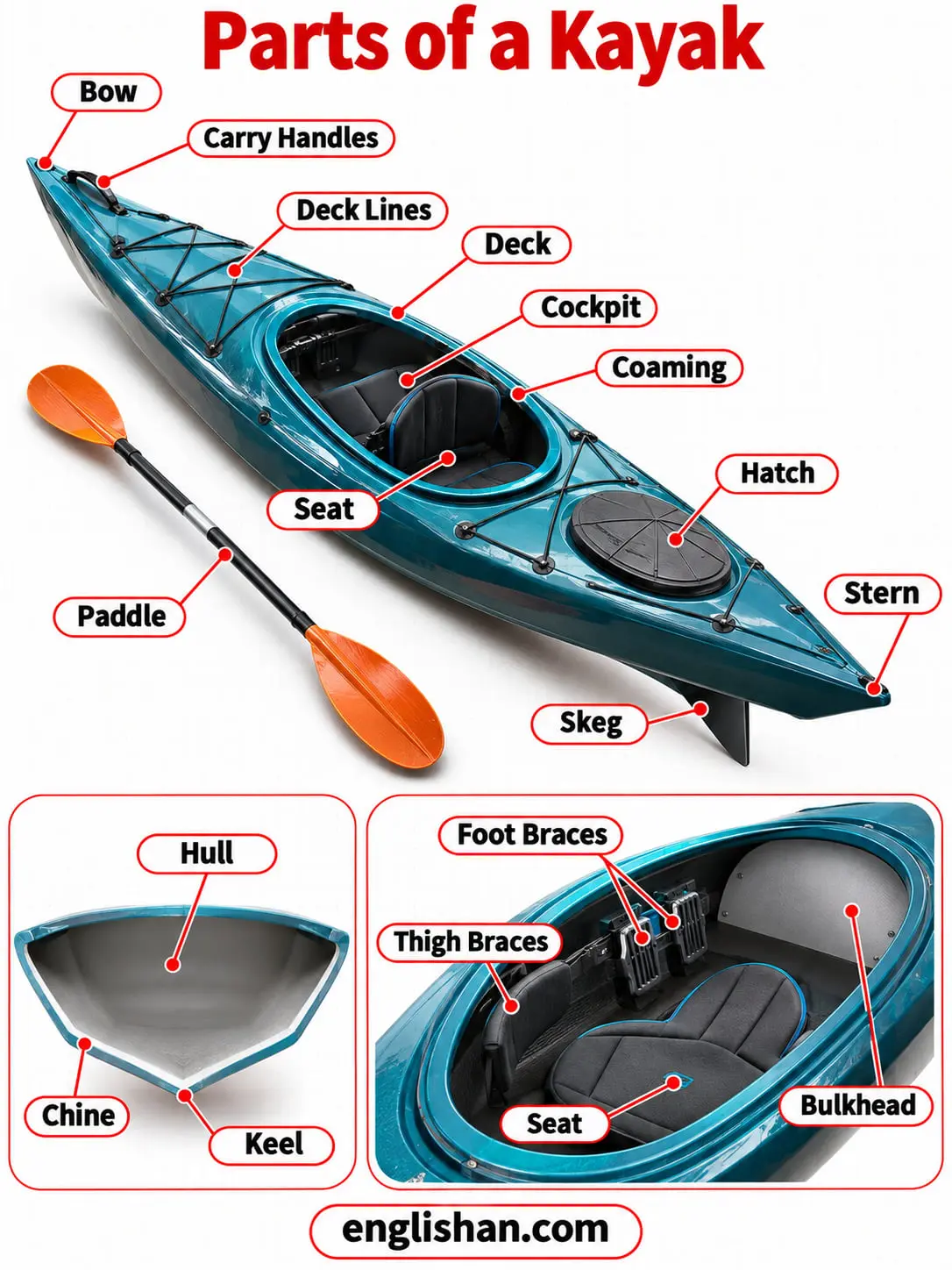
In a labeled diagram of a kayak, the bow is the front end and the stern is the rear end. The deck is the top surface, and the hull is the bottom. The cockpit is a deck opening near the center. Port is the left side and starboard is the right side.
| Part | Where you find it |
|---|---|
| 1. Bow | Front end of the kayak |
| 2. Stern | Rear end of the kayak |
| 3. Deck | Top surface of the kayak |
| 4. Hull | Bottom of the kayak |
| 5. Keel | Ridge along the center line of the hull, from bow to stern |
| 6. Chine | Edge where the side of the hull meets the bottom |
| 7. Cockpit | Opening where the paddler is seated on a sit-in kayak |
| 8. Coaming | Raised rim around the cockpit |
| 9. Seat | Platform where the paddler is seated |
| 10. Foot braces | Adjustable footrests |
| 11. Thigh braces | Contoured brackets under the deck near the cockpit |
| 12. Deck lines | Ropes on the deck for gripping and securing gear |
| 13. Carry handles | Grips at the bow and stern |
| 14. Hatch | Deck opening to a storage compartment |
| 15. Bulkhead | Internal wall between the cockpit and a gear compartment |
| 16. Skeg or rudder | Fin at the stern that keeps the kayak on course |
| 17. Paddle | Double-bladed tool that moves the kayak |
Major Parts of a Kayak
The major parts of a kayak are the bow, the stern, the deck, the hull, and the keel. Every kayak has them, and the cockpit and the seat complete the boat for the paddler.
Bow and Stern
The bow is the front of the kayak, and the stern is the rear. Length is measured from the stern to the bow. The stem is the front edge of the bow, and the gunwales are the upper sides.
The sheer is the upward curve of the bow and the stern over the waterline.
Deck
The deck is the top side of the kayak. On a sit-on-top it is the sitting surface, and on a sit-in it covers the paddler’s legs and the gear.
Hull
The hull is the bottom of the kayak, the part in the water. Hull shapes are V-shaped, round, or flat-bottomed.
Keel Chine and Rocker
The keel is the center line of the hull, running from bow to stern. It is V-shaped, rounded, or flat, and a defined keel helps the kayak track straight.
The chine is the transition between the side of the hull and the bottom. A hard chine is sharp and a soft chine is gradual. Chines add secondary stability.
The rocker is the upward curve of the keel toward the bow and the stern. More rocker turns the kayak more easily, and less rocker improves tracking.
Deck Fittings
The deck lines are ropes on the deck for grabbing, rescues, and securing gear. They are elastic or fixed. The deck elastics are small bungee cords for holding maps and bottles.
The carry handles, or toggles, are grips at the bow and the stern. A security loop is a bar or loop for locking the kayak to a rack.
Sit-In Kayak Parts
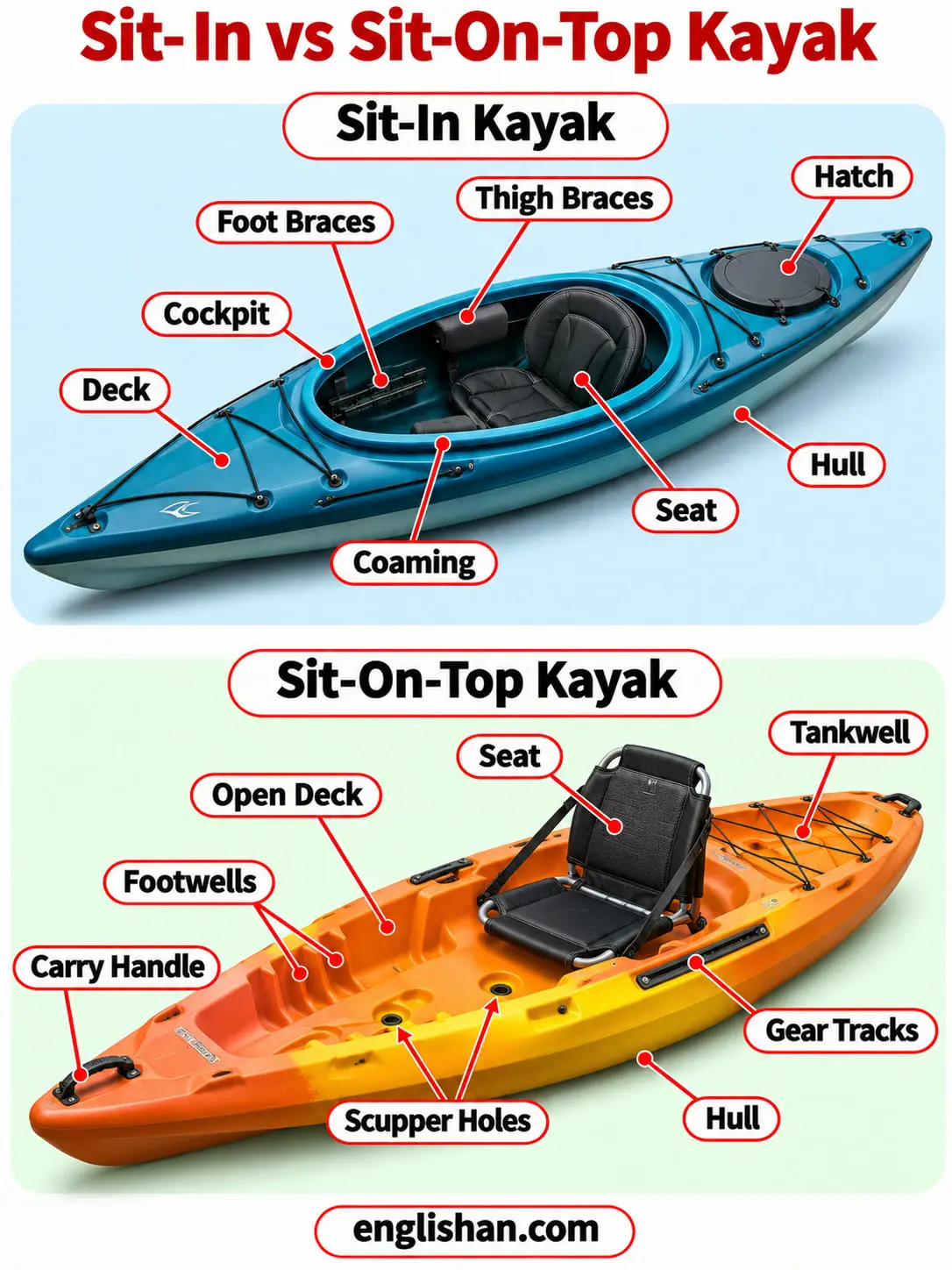
The parts of a kayak with a cockpit cut into the deck are the cockpit, the coaming, the seat, and the braces. The paddler is seated under the deck line, and these parts fit the paddler to the boat.
Cockpit and Coaming
The cockpit is the opening where the paddler is seated. A recreational kayak has a large oval cockpit. Sea and whitewater kayaks have smaller oval or round ones, and a smaller cockpit gives a more secure fit.
The coaming is the raised rim around the cockpit. The spray skirt, also called the spray deck, is a waterproof cover that fits over the coaming.
Seat and Backband
The seat is the platform where the paddler is seated, and it ranges from rigid to padded. The backband is a low backrest that supports an upright posture without limiting torso rotation. Hip pads adjust the seat width.
Foot Braces and Thigh Braces
The foot braces are adjustable footrests, and they control the rudder if the kayak has one. A bulkhead foot brace is a solid wall footrest found in whitewater kayaks.
The thigh braces are contoured brackets under the deck near the cockpit. They help the paddler grip the kayak with the thighs and knees.
Compass Recess and Rigging
The compass recess is a nook in the deck in front of the cockpit for a compass. The paddlefloat rigging is deck rigging behind the cockpit that secures a paddle for self-rescue.
Sit-On-Top Kayak Parts
The parts of a kayak without a cockpit sit on the deck. The seat is at or slightly over water level, and the deck is the sitting surface.
Scupper Holes
The scupper holes are sealed holes from the deck to the hull. They drain water that splashes across the deck. Paddlers plug them in cold water.
Footwells
The footwells are molded recesses in the deck that let the paddler choose a foot position. They come in several sizes for different heights. Some models have adjustable foot braces in place of footwells.
High-Low Seat
The high-low seat adjusts between a high position for fishing and a low position for stability in rough water.
Gear Tracks and Rod Holders
The gear tracks are metal strips near the seat for mounting accessories. The accessory rails mount rod holders and fish finders. A rod holder is a molded recess that holds the butt of a fishing rod.
The tankwell is a depressed deck space near the stern for a scuba tank, fishing crates, or drybags. A pedal drive is a propeller or flipper system powered by the legs, and it is removable for paddling.
Kayak Steering and Storage Parts
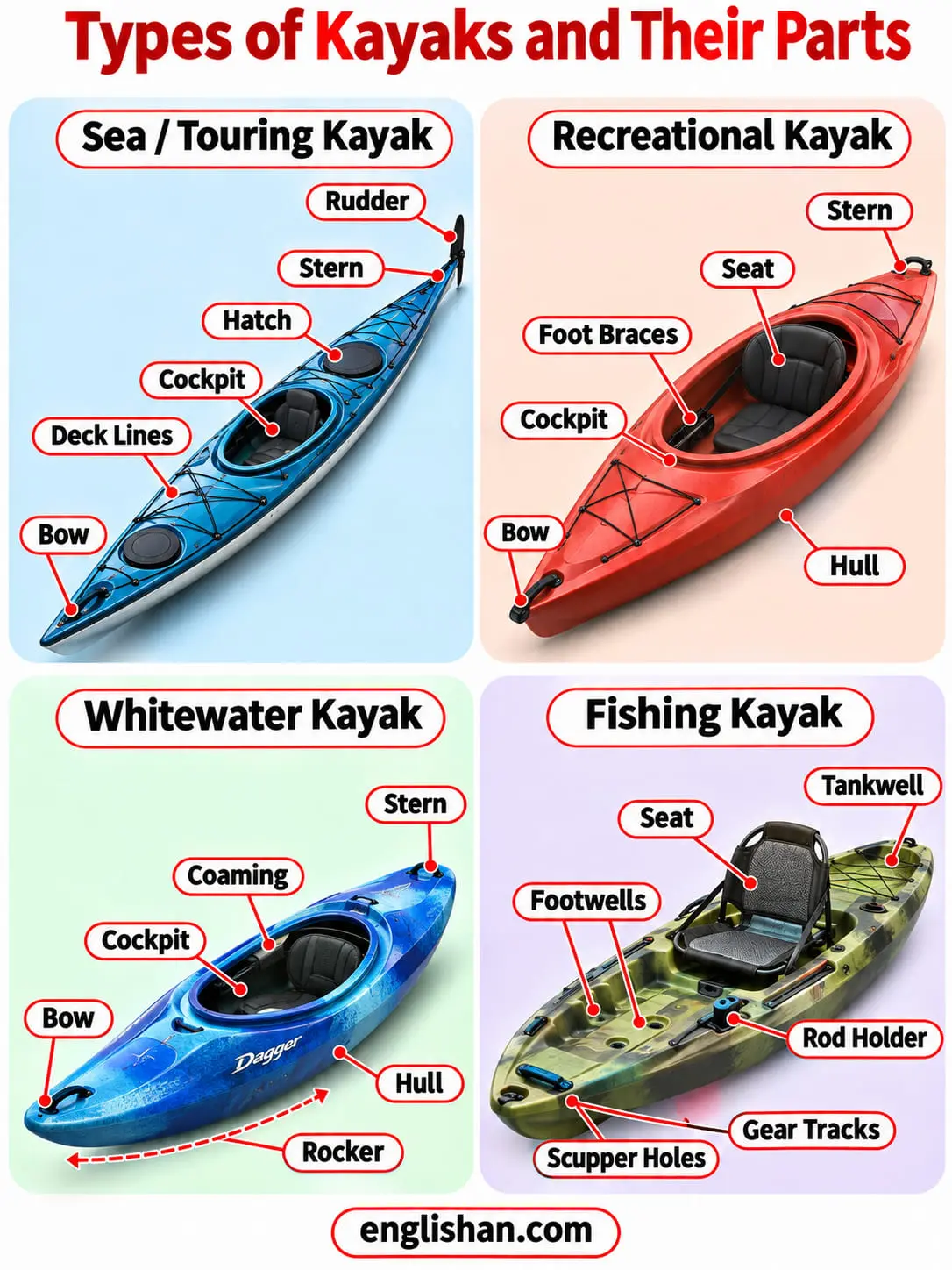
Among the parts of a kayak, the skeg and the rudder steer the boat, and the bulkheads and the hatches store gear. A sea kayak has all four.
Skeg
The skeg is a fin in a slot in the hull near the stern. It does not turn. A retractable skeg is dropped to improve tracking, and the skeg slider near the cockpit sets how far it is deployed.
Rudder
The rudder is a flat blade on the stern that steers and stabilizes the kayak. The foot braces control it, and it flips up for launching and landing. The rudder uphaul is a rope or lever near the cockpit that raises and lowers it.
Bulkhead and Hatch
The bulkheads are internal walls that separate the cockpit from the gear compartments. They give buoyancy, keep water out of the cargo space, and limit flooding.
The hatches are deck openings to the dry compartments behind the bulkheads. The covers are plastic, either hard screw-on or rubber stretch-over. A day hatch is a small compartment behind the cockpit, sealed from the main flotation chamber at the stern.
Parts of a Kayak Paddle
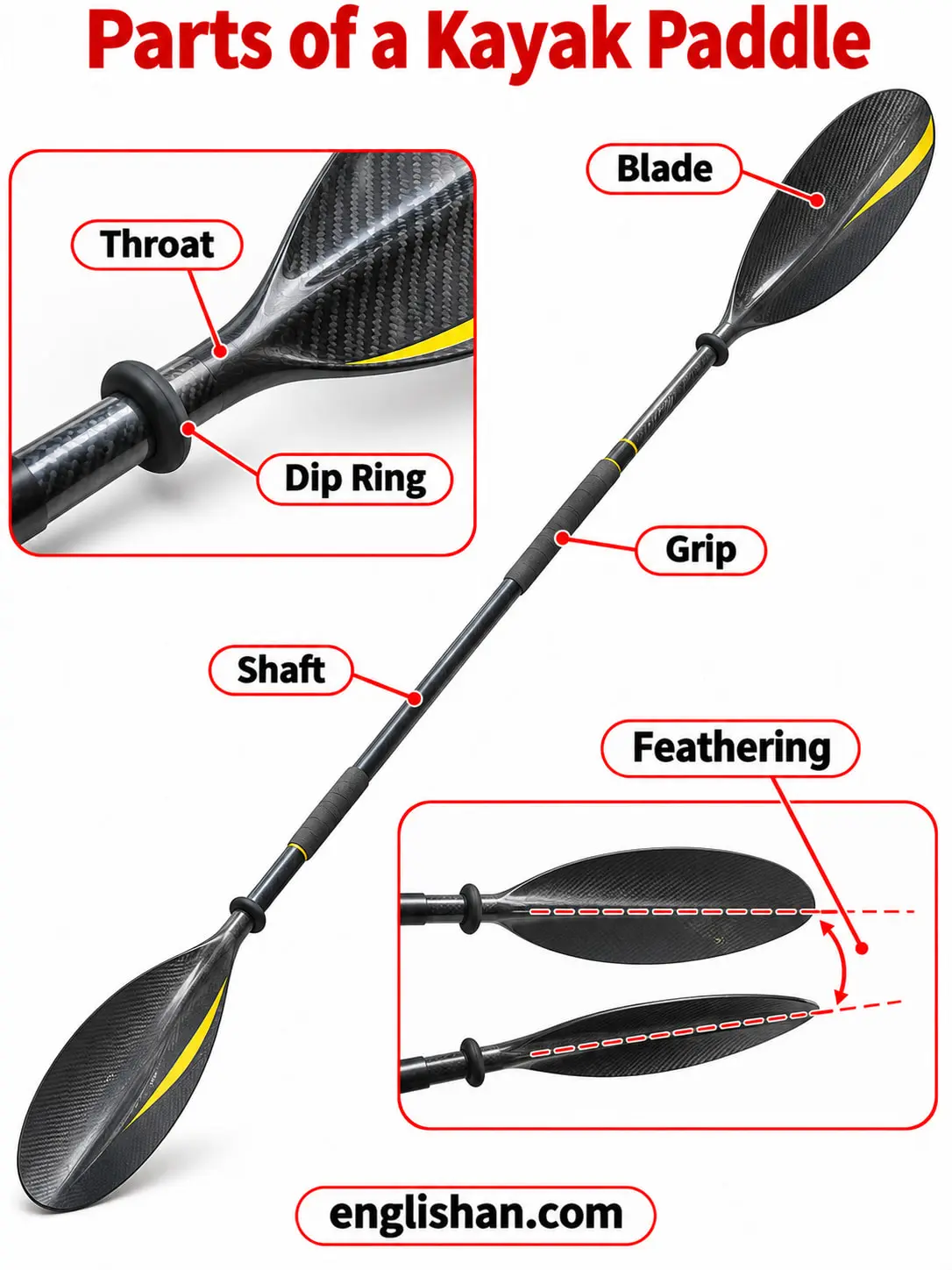
A kayak paddle has two blades. Its parts are the blades, the shaft, the grip, the throat, and the dip rings.
Blades
The blades are the ends of the paddle that catch the water and move the kayak. They are plastic, fiberglass, or carbon.
Shaft
The shaft connects the two blades. Cheaper paddles have an aluminum shaft, and pricier ones have fiberglass or carbon.
Feathering
Feathering is the angle of one blade relative to the other. It is adjustable on some paddles.
Grip
The grip is a coated or movable foam length of the shaft. It stops the hands from slipping.
Throat and Dip Rings
The throat is the point where each blade attaches to the shaft. The dip rings are rubber rings that stop water running down the shaft. They are about 1 to 1.5 inches over the throat.
Parts of a Kayak by Type and Size
The parts of a kayak change with the type of paddling. Sea, recreational, whitewater, surf, racing, and fishing kayaks are the main uses, and inflatable and folding kayaks are the portable forms.
| Kayak | Length | Width |
|---|---|---|
| Traditional | About 17 feet | 20 to 22 inches |
| Sea or touring | 16 to 19 feet | 22 to 25 inches |
| Recreational | 9 to 14 feet | 26 to 30 inches |
| Whitewater | 4 to 10 feet | Not stated |
| Playboat | 5 to 6 feet | Not stated |
| Surf ski | Up to 21 feet | 18 inches |
| Fishing | Not stated | Up to 42 inches |
Most kayaks suit paddlers of 143 to 187 pounds, and some suit down to 110 pounds. Inflatable kayaks hold less than 3 psi, and drop-stitch models hold 8 to 10 psi.
Kayak Parts and Their Materials
The materials of the parts of a kayak decide the weight, the stiffness, and the price.
Polyethylene: Rotomolded hulls are seamless and impact-resistant, though heavy. Plastic kayaks reached the market about thirty years after fiberglass.
Fiberglass: Stiffer than polyethylene and more prone to cracking. Fiberglass kayaks arrived in the 1950s.
Carbon fiber and Kevlar: High-performance and racing kayaks, bonded with epoxy or resin.
Wood: Plywood in stitch-and-glue builds, 3 to 5 millimeters thick, or strip-built cedar, pine, or redwood with fiberglass and epoxy.
Skin-on-frame: Seal skin over driftwood or whalebone in the past. Canvas or nylon over a wood frame today.
Inflatable: Hypalon, nitrilon, PVC, or polyurethane-coated cloth.
Fittings: Plastic hatch covers, metal gear tracks, and closed-cell foam, commonly EVA, for fitting shims.
FAQs
The parts of a kayak are the bow, the stern, the deck, the hull, the keel, the cockpit, the coaming, the seat, the braces, the hatches, and the paddle. A skeg or a rudder steers some models.
The main parts of a kayak are the bow, the stern, the deck, the hull, and the keel. The seat and the cockpit or footwells fit the paddler.
The parts of a kayak paddle are the two blades, the shaft, the grip, the throat, and the dip rings. Feathering is the angle between the blades.
A sit-in kayak has the cockpit, the coaming, the seat, the foot braces, and the thigh braces. Bulkheads and hatches separate the storage compartments.
Yes, on a sit-on-top kayak. The scupper holes drain water that splashes across the deck, and paddlers plug them in cold water.
A skeg is a fixed fin that is raised or lowered but does not turn. A rudder is an adjustable blade that the foot braces steer.
The coaming is the raised rim around the cockpit. A spray skirt fits over it to keep water out.
A sea kayak is a sit-in kayak with bulkheads, hatches, and a skeg or a rudder. It is 16 to 19 feet long and 22 to 25 inches wide.
Related:
