

A harp is a stringed instrument whose strings run at an angle to the soundboard and are plucked with the fingers. The parts of a harp on a concert pedal model are the soundbox, soundboard, strings, neck, tuning pegs, tuning discs, pillar, crown, foot, and seven pedals.
A pedal harp is about 1.8 meters (6 ft) tall and has 47 strings across about six and a half octaves. The parts of a harp differ between pedal and lever models only in the parts that change pitch. A lever harp is smaller and replaces the pedals with a sharping lever at each string. Lamp harps and jaw harps are different objects and are not covered here.
Parts of a Harp Labeled Diagram
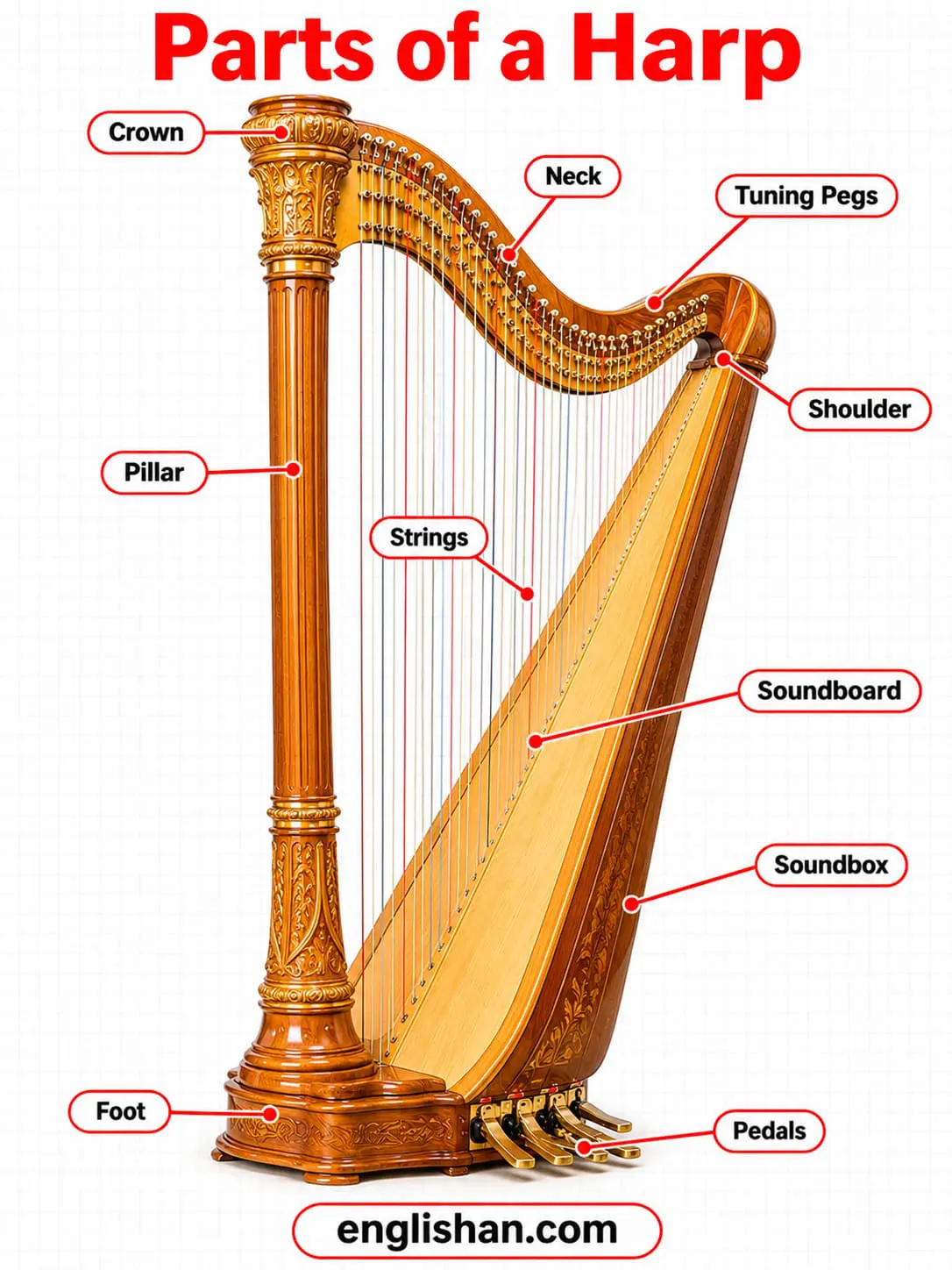
In a labeled diagram of a pedal harp, the frame forms a triangle. The soundbox is the long side nearest the player, the neck curves across the top, and the pillar is the third side. The foot at the bottom joins the soundbox to the pillar and holds the pedals.
| Part | Location | What it does |
|---|---|---|
| 1. Soundboard | Top face of the soundbox | Picks up the vibrations of the strings |
| 2. Soundbox | Hollow body on the player’s side | Amplifies the vibrations from the strings |
| 3. Strings | Between the soundboard and the neck | Pass their vibrations to the soundboard |
| 4. Neck | Curved upper section | Holds the tuning pegs and the parts that change pitch |
| 5. Tuning pegs | Along the outer edge of the neck | Turn the end of a string to set its tension |
| 6. Shoulder | Curved joint between the neck and the body | Forms the top corner of the frame and has no strings |
| 7. Pillar | Upright on the far side of the frame | Links the foot to the neck and holds the pedal rods |
| 8. Crown | Top of the pillar | Decorated piece that connects the pillar to the neck |
| 9. Foot | Base of the harp | Steadies the instrument and holds the pedals |
| 10. Pedals | On the foot | Raise a string’s pitch by a semitone or a whole tone |
Parts of a Harp Soundboard and Soundbox
The soundbox and the soundboard form the body of the harp, and every string attaches to them.
Soundbox
The soundbox is the hollow lower body of the harp, on the player’s side. It amplifies the vibrations of the strings and has five holes that project sound outward. Pedal harp bodies are wood such as maple, birch, ash, or mahogany.
Soundboard
The soundboard is the top face of the soundbox, and each string attaches to it at its lower end. It is spruce, which is lighter and more resonant than the rest of the body. Each string pulls with up to 90 pounds of force, so the soundboard bears more than 2,000 pounds across all 47 strings.
Suspension rod
The strings attach to a suspension rod set into the soundboard at a 36-degree angle. The rod keeps the strings taut and passes their vibrations into the soundboard.
Humidity, temperature, and use strain the soundboard wood. Apart from the strings, it is the part that needs repair or replacement most frequently.
Harp Strings and Color Coding
Strings
A pedal harp has 47 strings, with seven strings in every octave. The lowest strings are copper or steel-wound nylon, the next strings up are catgut, and the highest strings are nylon. Longer and thicker strings produce lower notes.
Color marks the position of each note. Every C string is red, which gives the harpist a landmark at a steep viewing angle. The F strings are black or blue, depending on the maker.
| String | Color |
|---|---|
| C | Red |
| F | Black or blue |
| D, E, G, A, and B | White |
On a lever harp, the strings match the white keys of a piano, and the C strings are red and the F strings are blue. A violin has 4 strings, so the 47 strings of a pedal harp show how much wider the range of the harp is.
Parts of a Harp Neck
Neck
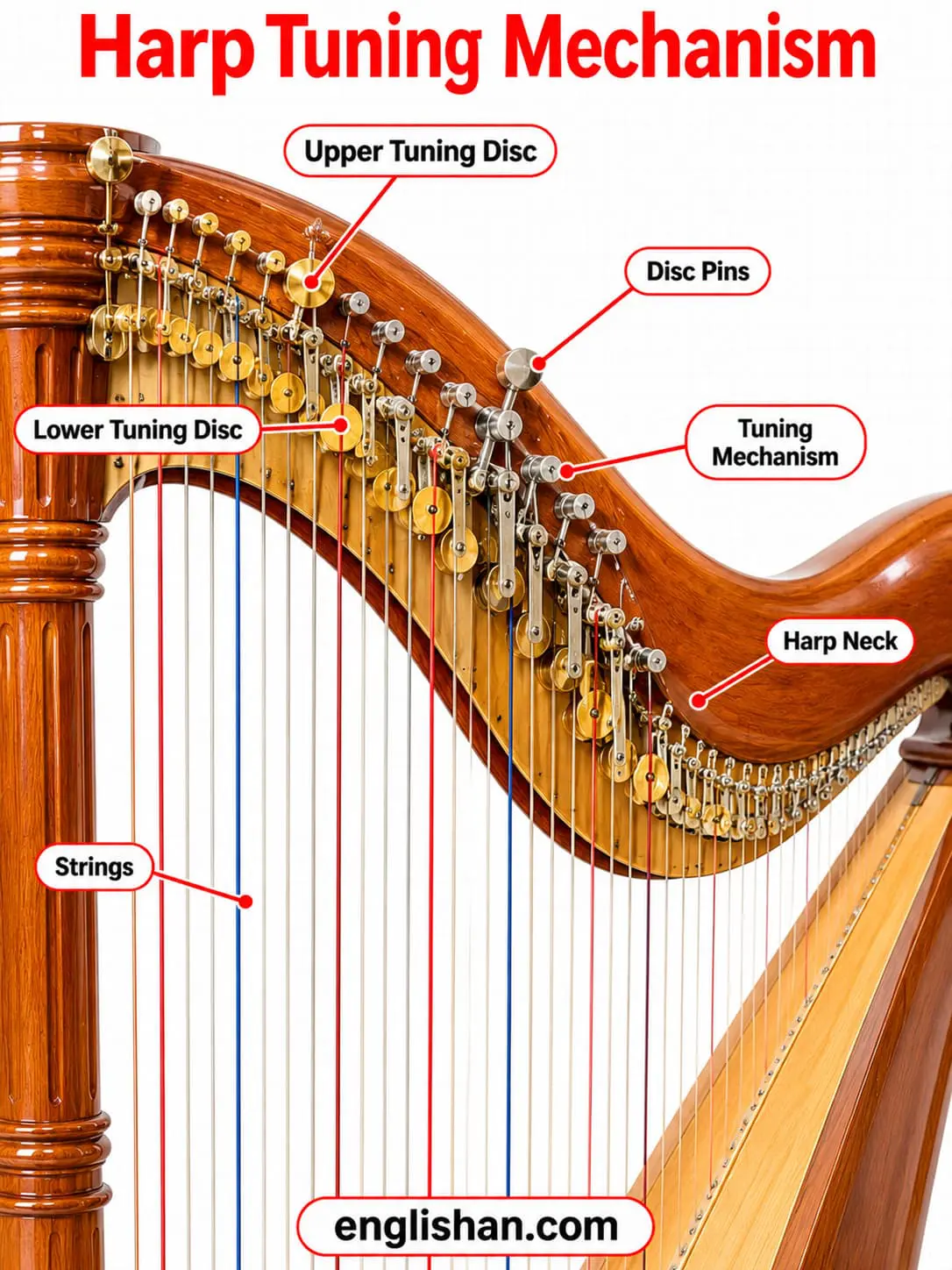
The neck is the curved upper section of the harp, and its curve is called an ogive. String length grows exponentially from the high notes to the low notes, so a straight neck would force the high strings to be thin and short and would make them break more easily. The neck of a pedal harp contains a mechanical action of more than 1,400 parts.
Tuning pegs
Tuning pegs are set along the outer edge of the neck. Each peg turns the end of one string to set its tension. The pegs are metal, are much smaller than those on other stringed instruments, and need a tuning wrench to turn.
Shoulder
The shoulder is the curved wood section where the neck meets the body, and it forms the top corner of the frame. It is less hollow and less ornate than the body and neck. It has no strings and no pitch-changing parts.
Pillar and Crown
Pillar
The pillar is the upright of the frame among the parts of a harp, and it stabilizes the instrument. A pedal harp pillar is hollow, and the pedal rods run up and down inside it. This leaves the outside free for decoration.
Crown
The crown is the decorated top of the pillar, also called the head. It connects the pillar to the neck and is carved or plain, depending on the model.
Parts of a Harp Foot and Pedals
Foot
The foot is the base that keeps the harp steady, and it holds the pedals. It is left undecorated because it takes more wear than the neck.
Pedals
A pedal harp has seven pedals on the foot, one for each note name: C, D, E, F, G, A, and B. The left foot works the D, C, and B pedals, and the right foot works the E, F, G, and A pedals. Each pedal locks into a notch, so the foot does not have to hold it in place. A rod inside the pillar transmits the movement of each pedal to the neck.
Tuning Discs and Pedal Positions
Tuning discs
Two rows of rotating discs are set on the outer edge of the neck. Each string passes between an upper disc and a lower disc, and each disc has two pegs that press against the string and shorten it. Discs for the same note name are linked, so one pedal retunes that note in every octave at once.
Every pedal has three positions. A harp in its normal state has all strings flat and is tuned in Cb major.
| Pedal position | Effect on the strings of that note name |
|---|---|
| Top | Strings sound free, so every note is flat |
| Middle | Strings sound as natural notes |
| Bottom | Strings sound as sharp notes |
The double-action system, patented by Sébastien Érard, gives each string this flat, natural, and sharp setting. Earlier single-action harps provided sharps only.
Parts of a Lever Harp
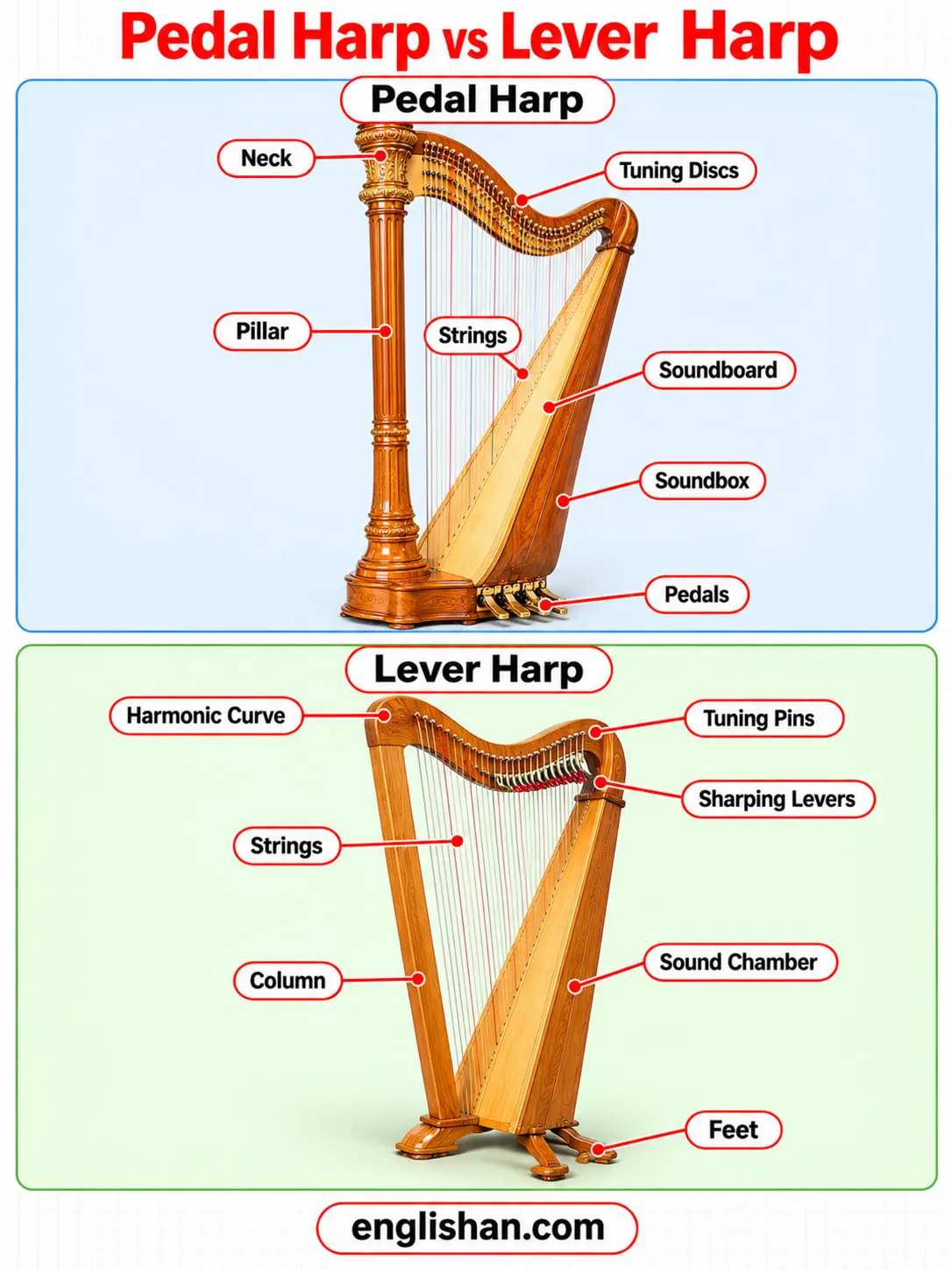
A lever harp has the same frame as a pedal harp but simpler pitch parts. Lever harps are also called Celtic, Irish, folk, or non-pedal harps. The neck of a lever harp is called the harmonic curve, and the pillar is called the column.
Sound chamber
The sound chamber is made of the sides, the soundboard, and the back. Many modern lever harps use a 3 mm soundboard of six aircraft birch layers, because solid spruce cracks more readily under string tension and humidity.
Shoulder
The shoulder of a lever harp is the joint where the neck meets the sound chamber. It is not normally glued and stays in place under the pull of the strings.
Tuning pins
Each string attaches to a tuning pin on the neck. Turning the pin with a tuning wrench raises the pitch of the string.
Sharping levers
A sharping lever is mounted on the neck beside each string. It shortens the vibrating length of the string to raise the pitch by a half step. Flats are made by tuning the open string flat.
Bridge pins
Bridge pins hold the strings at a fixed height above the neck and keep them on one plane.
Eyelets
Eyelets at the lower end of each string keep it from digging into the soundboard.
Feet
Feet support the lever harp on the floor.
Lap harps and floor harps
Lever harps have 20 to 40 strings. Floor lever harps have 29 to 36 strings, and lap harps have 22 to 26. Strings are spaced widest in the bass and narrowest in the treble.
Harp Pedals and Levers
Both models share the same parts of a harp: the soundbox, soundboard, neck, pillar, and strings. The difference is the parts that change pitch.
| Feature | Pedal harp | Lever harp |
|---|---|---|
| Pitch change | Seven pedals, each moving all strings of one note name | One lever on each string, set by hand |
| String count | 40 to 47 | 20 to 40 |
| Size | About 1.8 m (6 ft) tall | Lighter and smaller |
| Setting a sharp in play | Foot pedal, with both hands free | Hand adjustment during play |
| Common use | Orchestras | Classical, folk, jazz, blues, and pop |
Parts of a Bow Harp and Other Open Harps
A frame harp has a pillar at the long end that supports the strings. An open harp, such as an arch harp or a bow harp, has no pillar. The parts of an open harp are the neck, the resonator, and the strings.
Egyptian murals from the mid-third millennium BCE show harps without a pillar. The pillar was added in the Middle Ages to support the higher tension of more strings made from tauter materials such as brass or copper. On any harp, the lower end of each string is knotted at the soundboard, where an eyelet protects the wood on harps fitted with one.
FAQs
The parts of a harp are the soundbox, soundboard, strings, neck, tuning pegs, shoulder, pillar, crown, foot, and pedals. A lever harp replaces the pedals and discs with a sharping lever at each string. Open harps such as bow harps have no pillar.
The three main parts of a harp are the neck, the soundbox (also called the resonator), and the strings. Frame harps add a pillar to support the strings. A pedal harp divides the same structure into four sections: body, neck, pillar, and foot.
The strings are the sound source, because plucking a string sets it vibrating. The vibrations pass into the soundboard and the soundbox, which amplify the sound. The soundboard attaches to every string, so it receives the vibration of each one.
The strings are the plucked lines that run from the soundboard to the neck. A pedal harp has 47 of them, made of copper or steel-wound nylon in the bass, gut in the middle, and nylon in the treble. C strings are red, and F strings are black or blue.
No source gives one fixed count. A pedal harp divides into four sections: body, neck, pillar, and foot. Another account names three main parts: neck, soundbox, and strings. The neck of a pedal harp contains an action of more than 1,400 parts.
A plucked string vibrates, and the soundboard and soundbox amplify the vibration. On a pedal harp, a pedal moves a rod in the pillar and turns the discs in the neck. The discs press on the strings, shorten them, and raise the pitch by a semitone for each step.
A Celtic harp is a lever harp, so its parts are the neck, shoulder, pillar, sound chamber, tuning pins, bridge pins, eyelets, sharping levers, and feet. The sharping levers replace the pedals and discs of a pedal harp. Each lever raises one string by a half step.
The difference is the way the strings meet the soundboard. Harp strings rise roughly perpendicular to the soundboard, while lyres are a separate ancient instrument type that is closely related to the zither. Lyres are not true harps.
The earliest evidence comes from ancient Egypt and Sumer. Harps have been known since at least 3000 BCE, and harps excavated from the royal tombs at Ur in Sumer date to about 2500 BCE.
Related: