

The parts of a cello are the body, the neck and pegbox, the bridge and tailpiece, the endpin, four strings, and a separate bow. The body is a hollow wooden chamber that amplifies the vibration of the strings. The bow sets the strings vibrating.
An acoustic cello runs from the scroll at the top to the endpin at the base. The bow has its own parts, and a full-size cello has set measurements and materials. The cello shares its layout with the violin, scaled up, and the endpin is the largest difference. The parts of a guitar follow a different layout, with frets and a sound hole.
Parts of a Cello Labeled Diagram
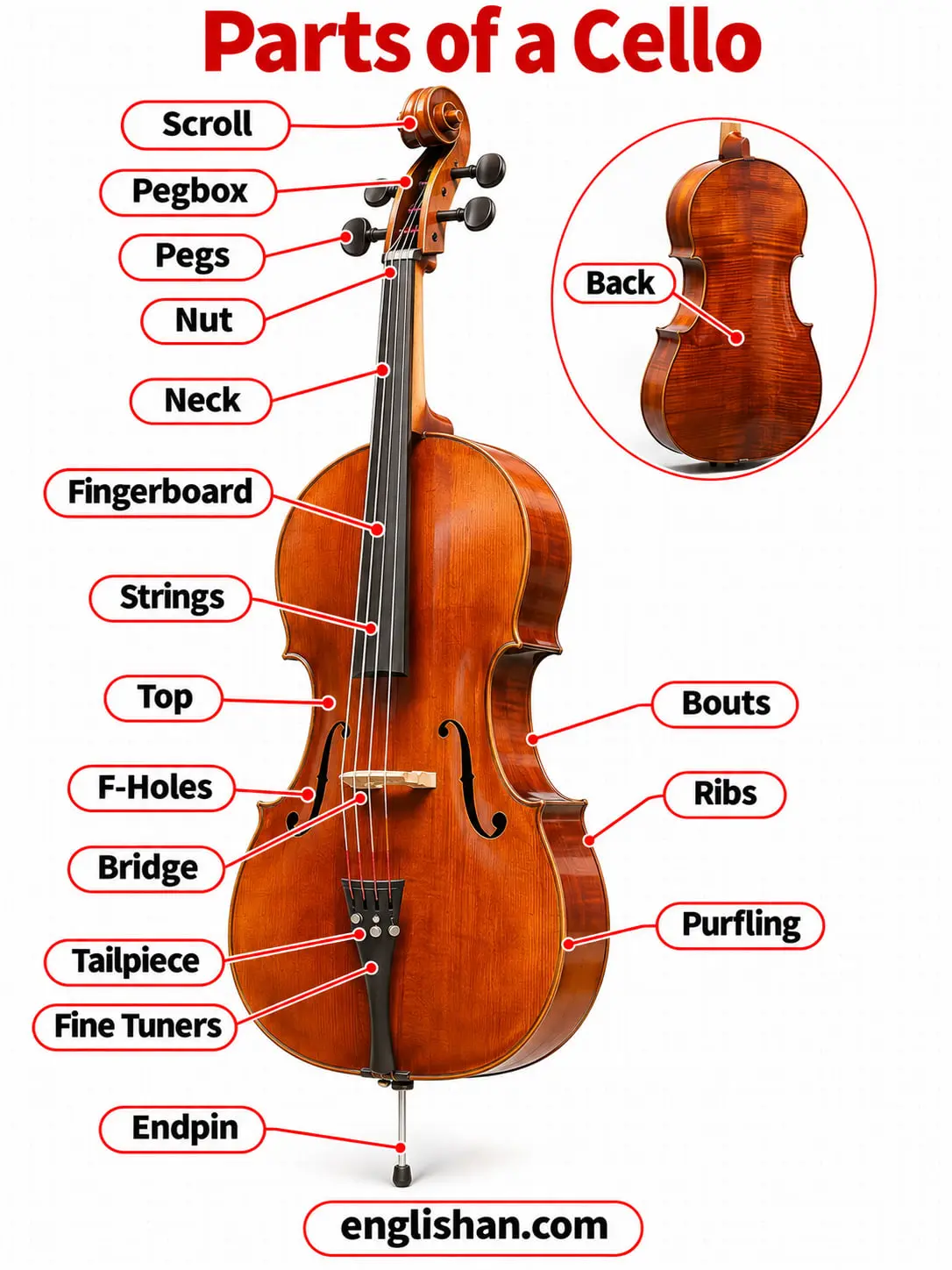
In a labeled diagram of a cello, the scroll and the pegbox are at the top of the neck. The body fills the middle. The tailpiece and the endpin are at the bottom, and the bow is a separate part.
| Part | Where you find it |
|---|---|
| 1. Scroll | Carved curl at the top of the pegbox |
| 2. Pegbox | Hollow head at the top of the neck that houses the pegs |
| 3. Pegs | Four tapered friction pegs in the sides of the pegbox |
| 4. Nut | Raised ridge at the top of the fingerboard with four string grooves |
| 5. Neck | Carved extension from the body, with a curved underside for the thumb |
| 6. Fingerboard | Ebony strip glued to the neck and extending over the body |
| 7. Strings | Four strings stretched from the pegs to the tailpiece |
| 8. Top | Spruce front plate of the body, also called the belly |
| 9. F-holes | Two f-shaped openings on either side of the bridge |
| 10. Bridge | Piece between the f-holes that lifts the strings off the top |
| 11. Bouts | Inward curves at the middle of the body |
| 12. Ribs | Curved sides that join the top and the back |
| 13. Back | Maple rear plate of the body |
| 14. Purfling | Decorative and protective border around the edges of the top and back |
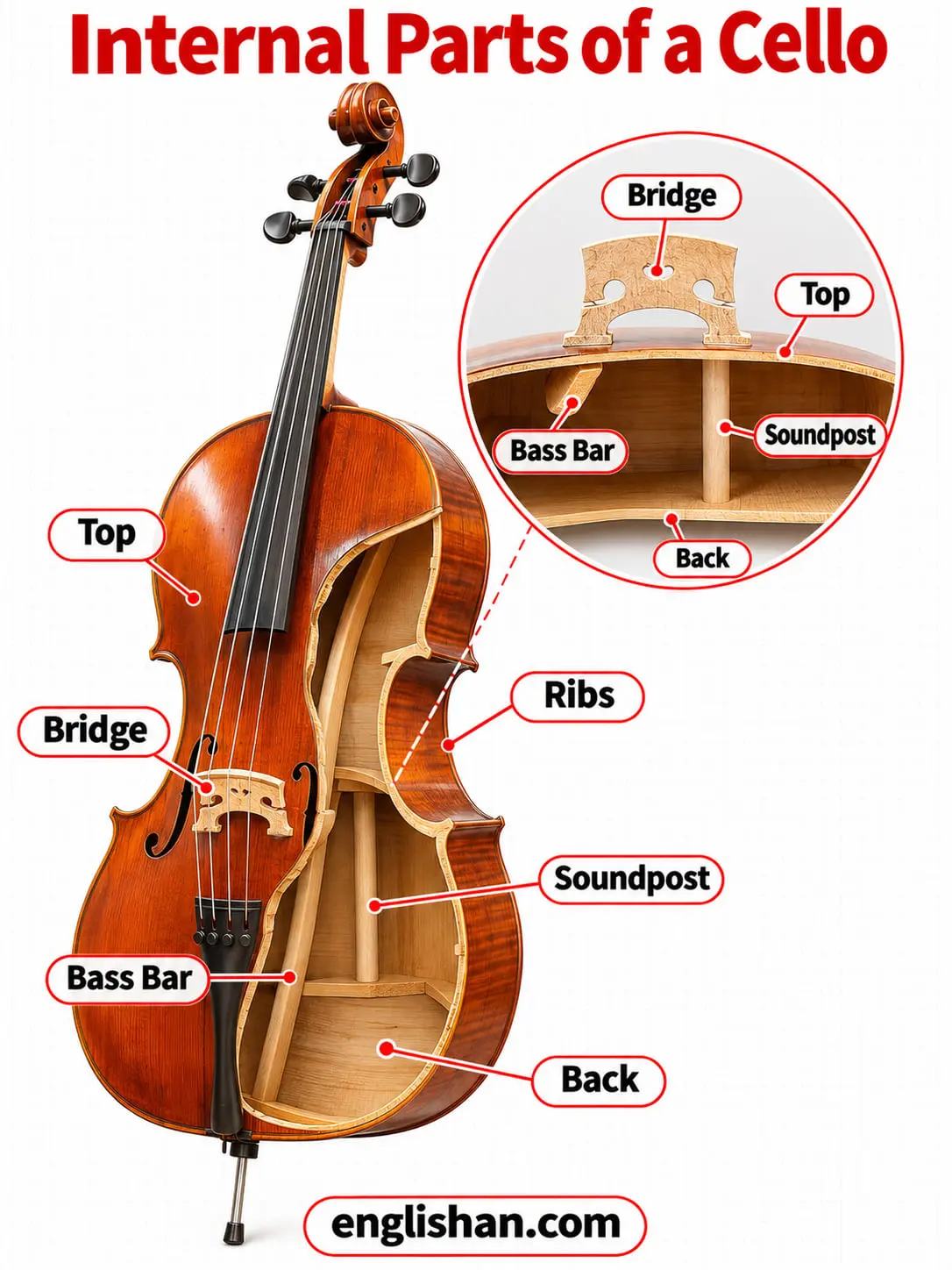
| 15. Soundpost | Wooden cylinder inside the body between the top and the back |
| 16. Bass bar | Strip glued under the top, beneath the bass foot of the bridge |
| 17. Tailpiece | Piece at the lower end of the body where the string ends attach |
| 18. Fine tuners | Small adjusters on the tailpiece that change the pitch |
| 19. Tailgut | Nylon or metal cord that anchors the tailpiece to the endpin |
| 20. Endpin | Retractable rod at the bottom of the body, also called the spike |
| 21. Bow stick | Shaped wooden shaft of the bow |
| 22. Bow hair | Horsehair stretched between the frog and the tip |
| 23. Frog | Block at the hand end of the bow that anchors the hair |
| 24. Bow screw | Screw at the frog that adjusts the tension of the hair |
| 25. Bow tip | Far end of the stick where the hair is anchored |
How Many Parts a Cello Has
The parts of a cello have no single fixed number, because reference counts divide the instrument at different levels of detail. A count of 17 names the instrument from the scroll to the endpin, and the bow adds its own parts to that total. The ukulele and the banjo are plucked instruments, so they have no bow and differ from the cello in the bridge and the strings.
The labeled diagram names 25 parts, including five parts of the bow. The four strings, the four pegs, and the two f-holes are each counted once, though every one is a set of matching pieces.
Parts of a Cello Body
The body is the hollow wooden chamber of the cello. It has a wide upper bout, a narrow middle formed by two C-bouts, and a wide lower bout. The top, the bass bar, and the soundpost act together as a diaphragm that produces sound.
Top Back and Ribs
The top, also called the belly, is the front plate of the body, and it is spruce. The back is the rear plate and is maple, though poplar or willow is used on some cellos. The back vibrates less than the top.
The ribs are the sides of the body. Makers heat the wood and bend it around forms to give the ribs their curve.
F-Holes Bouts and Purfling
The f-holes are two f-shaped openings on either side of the bridge. Air moves in and out through them as the top vibrates, and they give access to the interior.
The bouts are the inward curves at the middle of the body, and they give the bow room to move. The purfling is a decorative and protective border around the edges of the top and the back.
Internal Parts of a Cello
The internal parts of a cello are the soundpost and the bass bar. Both are fitted inside the body, and both spread the vibration of the strings across the instrument.
Soundpost
The soundpost is a round wooden cylinder wedged between the top and the back, under the treble side of the bridge. It links the two plates and passes vibration between them.
Bass Bar
The bass bar is a spruce strip glued under the top, beneath the bass foot of the bridge. It supports the top and spreads the vibration of the strings. It also strengthens the low tones.
Cello Neck and Pegbox Parts
The neck and the pegbox are the parts of a cello that set the pitch. The neck is the carved extension of the body, with a curved underside shaped for the thumb. It is maple.
The fingerboard is an ebony strip glued to the neck. It extends over the body and curves to match the bridge. The player presses the strings against it to change the pitch.
The nut is a raised ridge where the fingerboard meets the pegbox. Four grooves in the nut space the strings correctly.
The pegbox is the hollow head of the cello, and it houses four pegs. The pegs are tapered friction pegs of ebony. A player turns them to tighten or loosen a string.
The scroll is the carved curl at the end of the pegbox. It is cut from the same piece of maple as the neck and the pegbox, and other instruments of the violin family share it.
Cello Bridge and Tailpiece Parts
The bridge, the tailpiece, and the endpin are the parts of a cello that anchor the strings and support the instrument.
Bridge
The bridge is a maple piece between the f-holes. It lifts the strings off the top and passes their vibration to the top and the soundpost. String tension keeps it in place, since it is not glued.
Its upper edge is curved, which lets the player bow one string at a time. A full-size bridge is about 3.5 inches high.
Tailpiece Fine Tuners and Tailgut
The tailpiece attaches to the bottom of the body, and the ball ends of the strings pass through holes in it. It is ebony or another hardwood, and lower-cost cellos use plastic or steel.
The fine tuners are small adjusters on the tailpiece. They raise or lower the pitch by changing the tension of a string. The tailgut is a nylon or metal cord that anchors the tailpiece to the endpin.
Endpin
The endpin, also called the spike, is a retractable rod that supports the cello on the floor. It is adjustable, so the player sets the height of the instrument.
The endpin is wood, metal, or rigid carbon fiber. Adrien Servais introduced it around 1845.
Cello String Parts
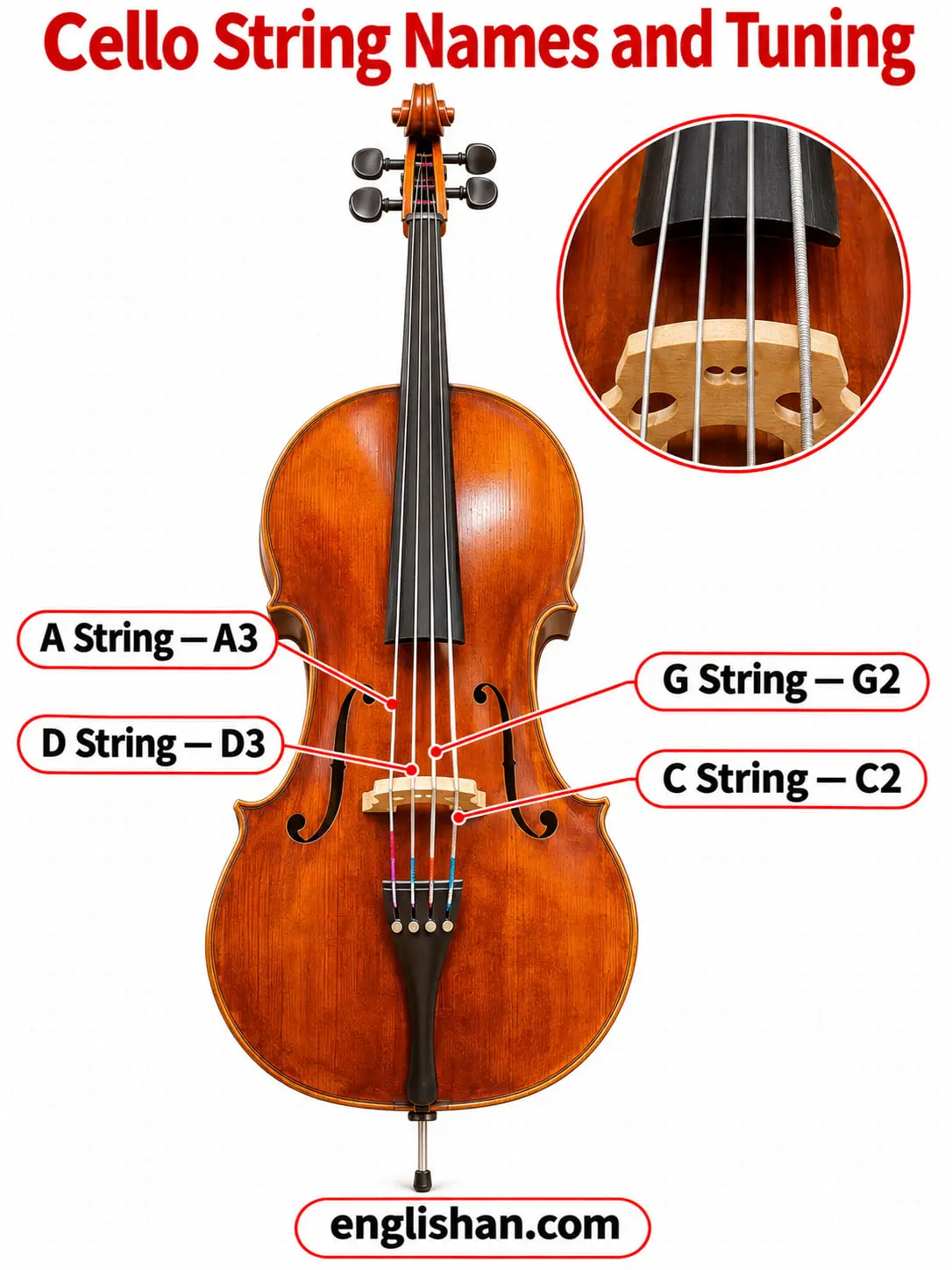
The strings are the sounding parts of a cello, and the cello has four. They are tuned in perfect fifths, and each has a ball end that passes through the tailpiece.
C String
The C string is the lowest string, tuned to C2.
G String
The G string is tuned to G2, a perfect fifth higher than the C string.
D String
The D string is tuned to D3, a perfect fifth higher than the G string.
A String
The A string is the highest string, tuned to A3. Historical strings had catgut cores. Modern strings are metal-wound with aluminum, titanium, or chromium.
Parts of a Cello Bow
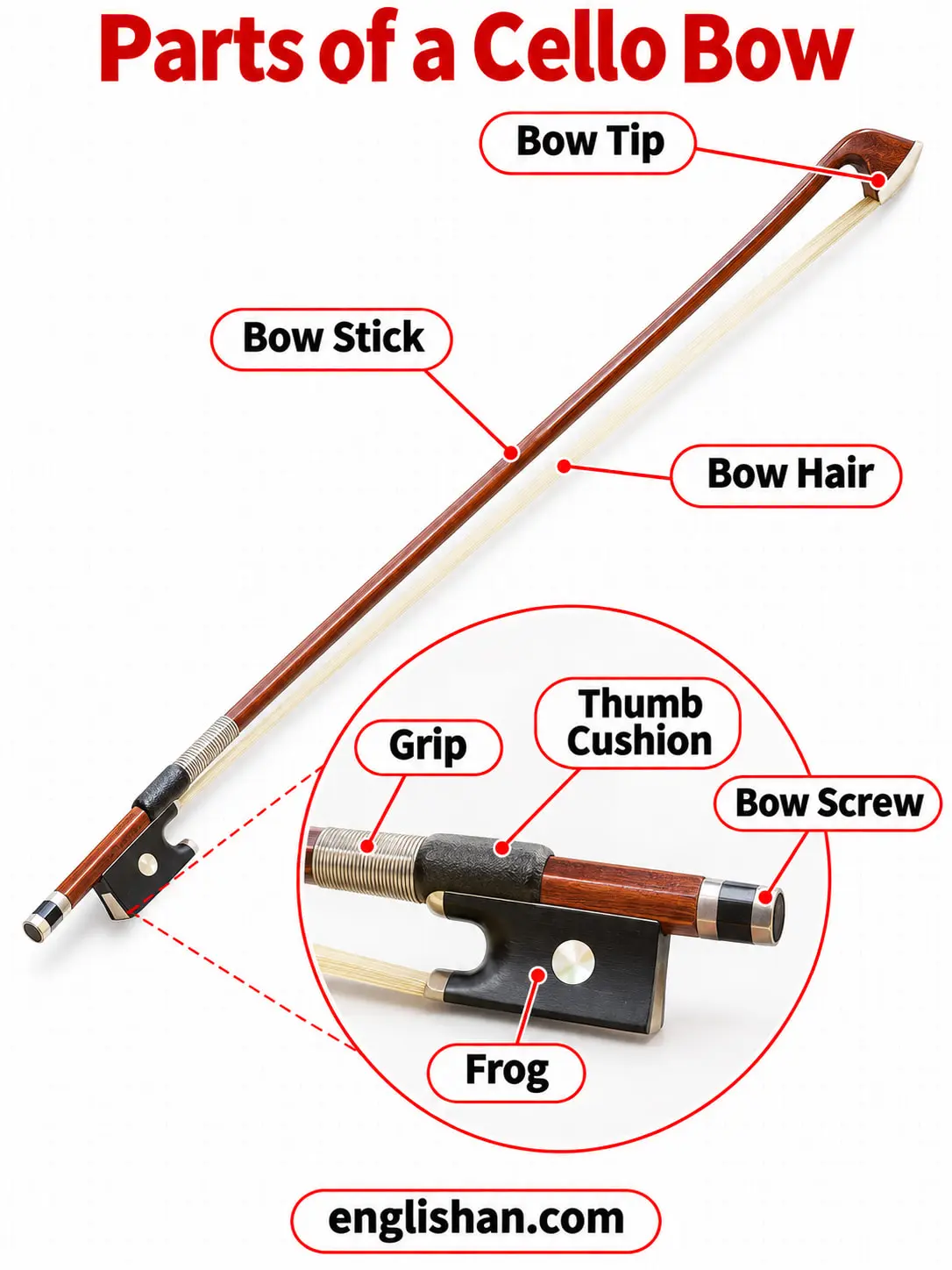
The bow draws sound from the strings, and its parts complete the parts of a cello. A cello bow is about 29 inches long. It is about 1.2 inches high and 0.6 inches wide.
A cello bow weighs about 0.35 ounces more than a viola bow.
Stick
The stick is the shaped wooden shaft of the bow. Makers heat the wood and bend it to give it a camber. Pernambuco is the traditional wood, and brazilwood is the lower-cost choice.
Pernambuco is now endangered and export-regulated. Makers turn to ipê, carbon fiber, and fiberglass instead.
Hair
The hair is a hank of horsehair stretched between the frog and the tip. Cheaper bows use synthetic hair or nylon.
Frog
The frog is the block at the hand end of the bow, and it anchors the near end of the hair. It is also called the heel, the nut, or the talon.
The frog is ebony, or ivory or tortoiseshell on some bows. A slide covers the mortise and is inlaid with mother of pearl or abalone.
Screw
The screw, also called the button, is the mechanism at the frog that adjusts the tension of the hair. Turning it moves the frog along the stick.
Grip and Thumb Cushion
The grip is a wrap of wire, silk, or whalebone near the frog. The thumb cushion is a leather or snakeskin pad on the grip.
Tip
The tip, also called the head, is the far end of the stick where the hair is anchored. A tip plate of bone, ivory, mammoth ivory, or silver covers it.
Rosin
Rosin, also called colophony, is hardened pine sap. A player applies it to the hair to increase friction with the strings. New bow hair takes 10 to 15 minutes of rosin.
Parts of a Cello by Size
Cello size is a fraction that refers to volume, not length. A full-size cello is 4/4. The fractional sizes are 15/16, 7/8, 3/4, 1/2, 1/4, 1/8, 1/10, and 1/16.
A 1/2 cello is therefore much longer than half the length of a full-size cello. Players with unusually large hands use cellos larger than 4/4.
| Measurement | Full size (4/4) |
|---|---|
| Overall height without the endpin | 47.6 inches |
| Back length | 29.7 inches |
| Upper bout width | 13.4 inches |
| Lower bout width | 17.3 inches |
| Rib depth at the shoulders | 4.9 inches |
| Rib depth at the hips | 5.0 inches |
| Bridge height | 3.5 inches |
| Scale length | About 27.5 inches |
| Endpin unit and spike | 2.2 inches |
Cello Parts and Their Materials
The materials of the parts of a cello follow the job of each part. Wood makes up the body, and metal and synthetic fibers go into the strings and the bow.
Spruce: The top and the bass bar.
Maple: The back, the neck, the pegbox, the scroll, and the bridge.
Ebony: The fingerboard, the pegs, the nut, and the frog of the bow. Other hardwoods are used for the pegs and the nut on some cellos.
Ebony or hardwood: The tailpiece, with plastic or steel on lower-cost cellos.
Laminated wood, carbon fiber, or aluminum: Cheaper cellos use laminated wood, and some bodies are carbon fiber or aluminum.
Strings: Catgut in the past. Aluminum, titanium, or chromium windings today.
Bow: Pernambuco or brazilwood for the stick, horsehair for the hair, and nickel silver, silver, or gold for the mountings.
FAQs
FAQs
The parts of a cello are the body, the neck and pegbox, the bridge and tailpiece, the endpin, four strings, and the bow. The soundpost and the bass bar are inside the body.
The count depends on the level of detail. A reference count of 17 names the instrument from the scroll to the endpin, and the bow adds its own parts to that total.
The internal parts of a cello are the soundpost and the bass bar. The soundpost is wedged between the top and the back, under the treble side of the bridge. The bass bar is a spruce strip glued under the top.
The parts of a cello bow are the stick, the hair, the frog, the screw, the grip, the thumb cushion, and the tip. Rosin on the hair creates the friction that sounds the strings.
The four strings of a cello are the C, G, D, and A strings, from lowest to highest. They are tuned in perfect fifths to C2, G2, D3, and A3.
The endpin is the retractable rod at the bottom of the cello that supports it on the floor. It is adjustable, so the player sets the height of the instrument.
The bridge is the maple piece between the f-holes that lifts the strings off the top. It passes their vibration to the top and the soundpost. String tension keeps it in place, since it is not glued.
Cello is the shortened form of violoncello, the formal name of the instrument. Both names refer to the same four-string bowed instrument.
Related: