A guitar may look like a single wooden body with strings, yet its acoustic and electric parts work together to shape tone, pitch, and sustain. When you talk about tuning, string action, or sound control, the discussion feels incomplete if names like headstock, fretboard, bridge, or pickups are unclear.
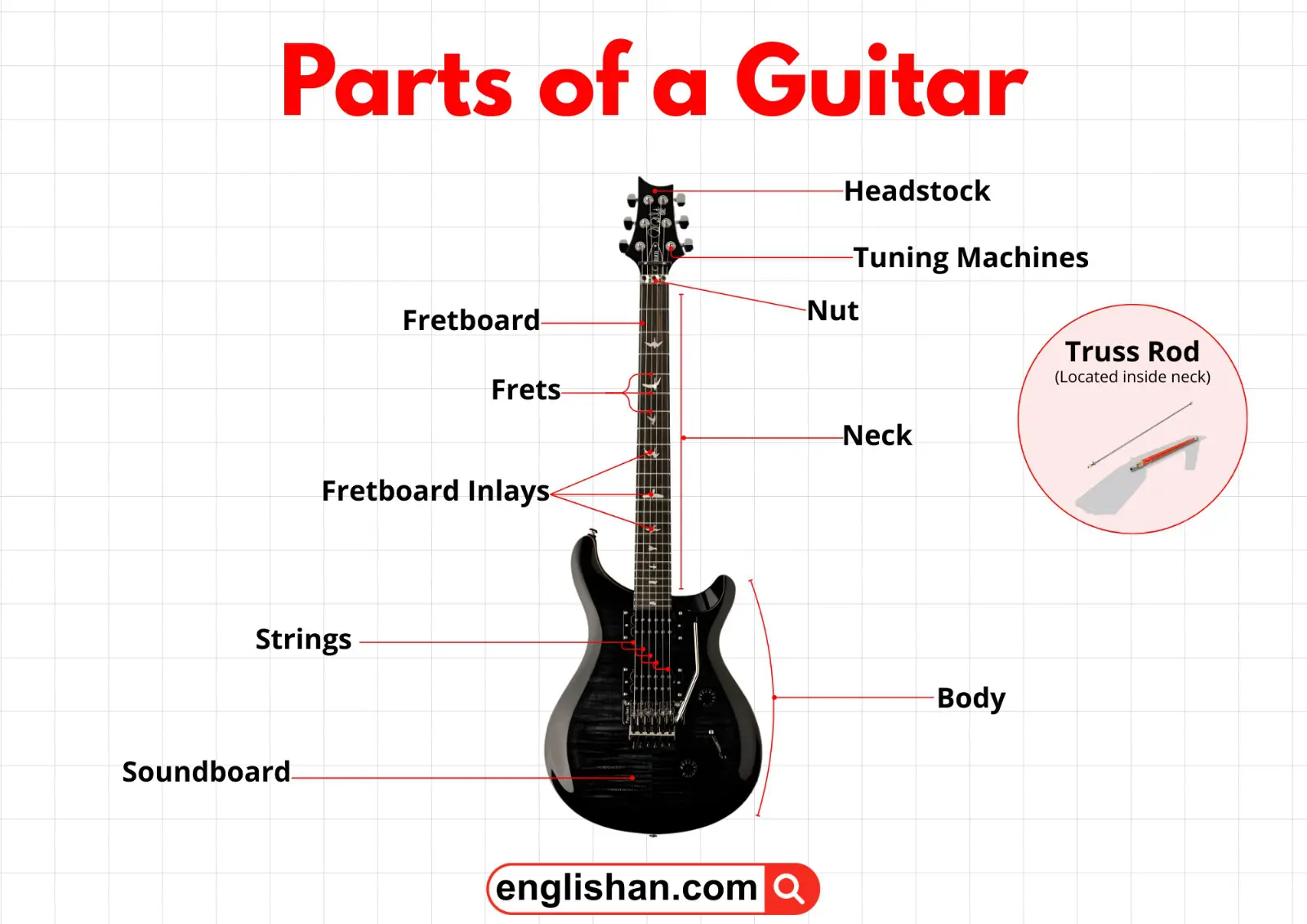
In this article, we break down the parts of a guitar using standard acoustic and electric models as reference. The coverage moves through sections such as the headstock, tuning machines, nut, neck, frets, body, sound hole, bridge, saddle, strings, and pickups where applicable. The labeled diagram below helps connect each name to its exact position.
Guitar Parts Diagram With Names
A guitar is a fretted string instrument built from three connected sections: the headstock, the neck, and the body. Each section contains parts that control tuning, pitch accuracy, string vibration, and tone production. When a string is plucked, vibration travels through the bridge into the body, while tension and pitch are managed at the opposite end. Understanding the parts by name makes it easier to connect structure with sound.
Headstock Parts Of A Guitar
The headstock manages string tension and keeps the instrument in tune. It anchors the upper ends of the strings and houses the tuning hardware that adjusts pitch.
Headstock
The headstock is the solid extension at the top of the neck that supports the tuning machines and maintains string alignment. Its rigidity helps stabilize tuning and sustain. It joins directly to the neck and forms the upper end of the instrument.
Tuning Machines
Tuning machines adjust pitch by tightening or loosening the strings. Smooth gear movement and firm resistance prevent slipping during play. Good tuning machines provide:
- Precise pitch adjustment
- Stable string tension
- Reliable tuning hold
They are mounted through the headstock, with tuning keys facing outward.
Neck Parts Of A Guitar
The neck supports string length and allows the player to form notes. Its structure affects action height, intonation, and overall playability.
Neck
The neck is the long wooden section connecting headstock to body. It must remain stable under constant string pull while staying comfortable in the hand. It determines:
- Scale length
- String spacing
- Playing feel
It attaches to the body at the neck joint.
Nut
The nut guides the strings from the headstock onto the fretboard. It controls spacing and initial string height, which influence tuning stability and clarity. Proper nut shaping ensures:
- Even string alignment
- Clean open notes
- Reduced friction
It forms the boundary between headstock and fretboard.
Fretboard
The fretboard is the flat playing surface attached to the front of the neck. It supports the frets and provides the area where notes are pressed. It contributes to:
- Smooth finger movement
- Accurate pitch positioning
- Consistent tone response
It runs along the top of the neck.
Frets
Frets are thin metal strips embedded across the fretboard. Pressing a string behind a fret shortens its vibrating length and raises pitch. Correct fret installation ensures:
- Accurate note spacing
- Clear tone
- Proper intonation
They span the fretboard at measured intervals.
Fretboard Inlays
Fretboard inlays serve as position markers. They help players identify fret locations quickly during performance. Inlays improve:
- Visual reference
- Fast movement across positions
They are set into the fretboard between selected frets.
Truss Rod
The truss rod is a metal reinforcement rod inside the neck. It adjusts neck relief, balancing string tension against neck curvature. Proper adjustment maintains:
- Comfortable string height
- Reduced fret buzz
- Structural stability
Access is typically provided near the headstock or the neck joint.
Body Parts Of A Guitar
The body shapes resonance and influences tonal character. It receives string vibration from the bridge and either amplifies it acoustically or supports electronic conversion.
Body
The body is the main sound chamber in an acoustic guitar or the solid tone platform in an electric guitar. It affects:
- Resonance
- Sustain
- Overall tonal color
It connects directly to the neck at the neck joint.
Soundboard
The soundboard is the primary vibrating surface of an acoustic guitar. It reacts to string energy transmitted through the bridge. A responsive soundboard enhances:
- Projection
- Clarity
- Dynamic range
It forms the front face of the acoustic body.
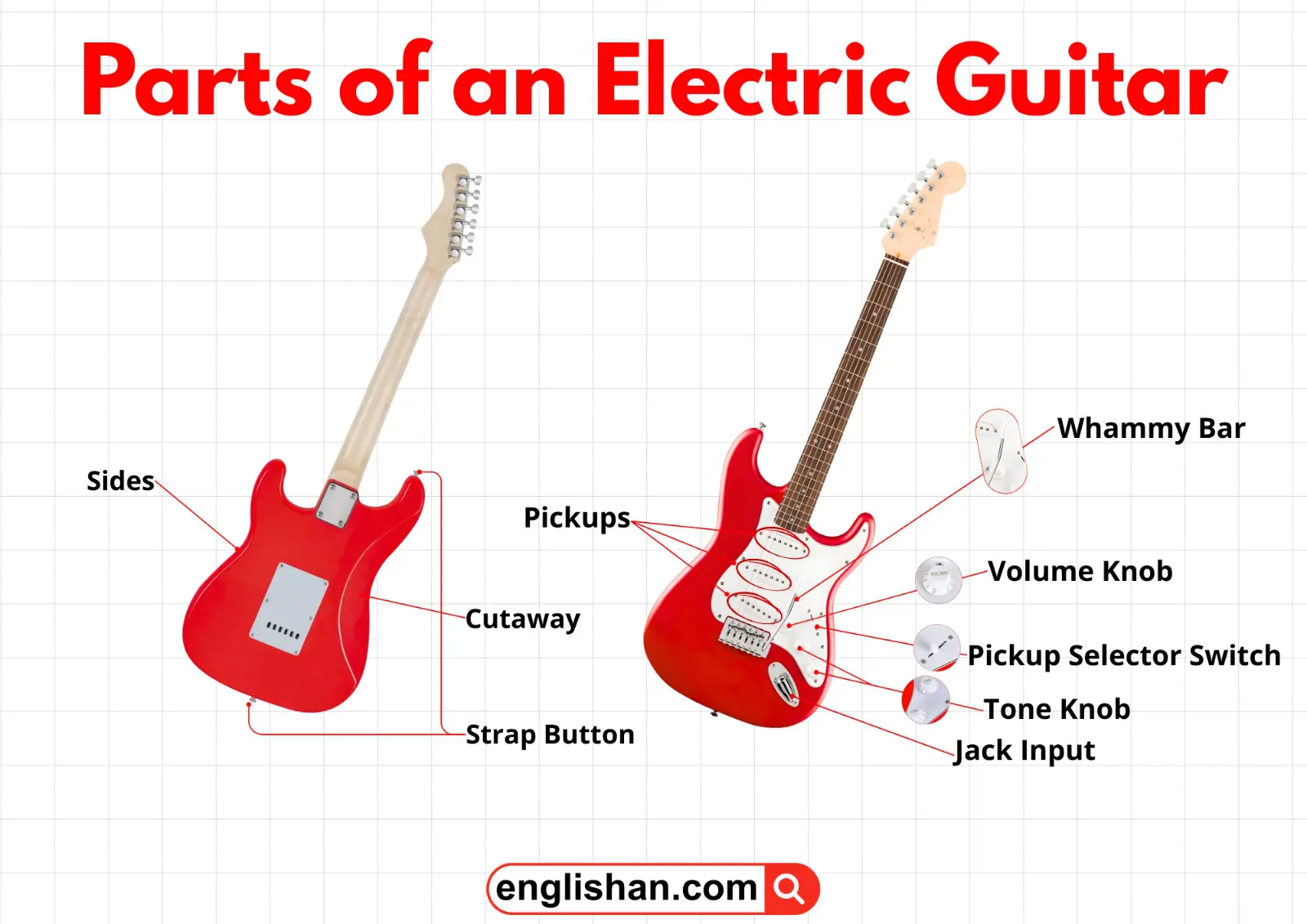
Back And Sides
The back and sides enclose the body chamber and reflect internal sound waves. Their material and construction influence:
- Warmth or brightness
- Depth of tone
- Resonance balance
They surround the body cavity behind and beside the soundboard.
Cutaway
A cutaway reshapes the upper portion of the body near the neck joint. It improves access to higher frets and expands playing range.
Strap Button
Strap buttons anchor a strap for standing performance. They provide secure support during play and are fastened to the outer body surface.
Acoustic Guitar Parts
Acoustic models rely on natural resonance and airflow.
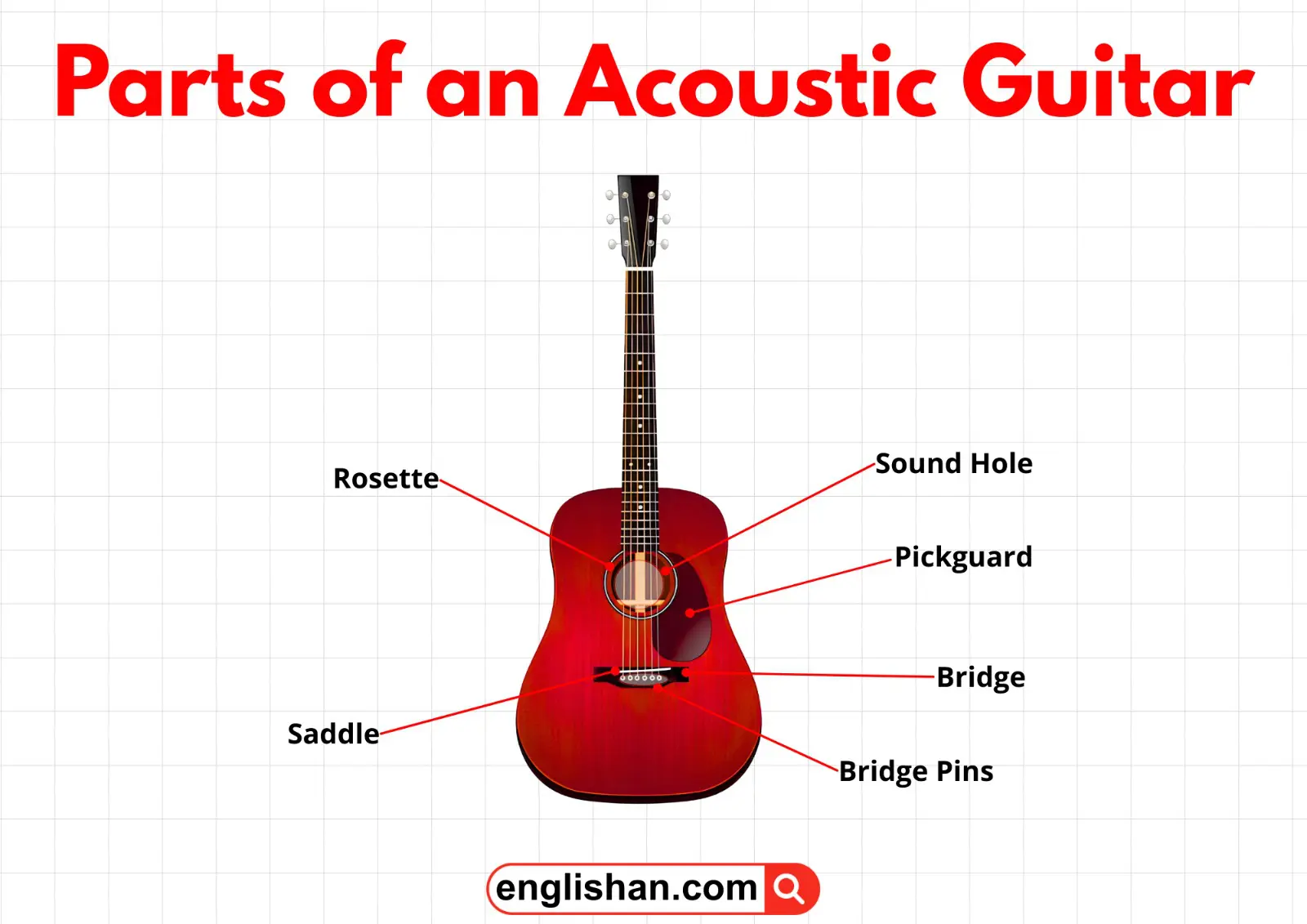
Sound Hole
The sound hole allows air movement from inside the body chamber. It supports:
- Resonance release
- Sound projection
It is formed in the center of the soundboard.
Rosette
The rosette reinforces the sound hole edge and adds decorative detail. It protects the soundboard from cracking around the opening.
Pickguard
The pickguard shields the soundboard from pick wear. It prevents surface damage caused by repeated strumming and is attached below the sound hole.
Bridge Pins
Bridge pins secure string ends inside the bridge. They ensure firm anchoring and efficient vibration transfer into the body.
Bridge And String Parts
These parts manage string anchoring and vibration transfer.
Strings
Strings produce sound through vibration. Their gauge and material influence:
- Pitch
- Tone brightness
- Sustain
They extend from the tuning machines to the bridge.
Bridge
The bridge anchors the lower ends of the strings and transfers vibration to the body. It supports:
- String stability
- Resonance transmission
It is fixed to the body surface.
Saddle
The saddle determines string height and contact point. It influences:
- Intonation accuracy
- Tone clarity
- Action feel
It rests in a slot along the top of the bridge.
Electric Guitar Parts
Electric guitars use magnetic components to convert vibration into signal.
Pickups
Pickups detect string vibration using magnetic fields. They convert motion into electrical signal for amplification. Pickup design affects:
- Output level
- Tone character
- Noise response
They are installed beneath the strings on the body.
Pickup Selector Switch
The pickup selector switch controls which pickups are active. It allows tonal variation and signal blending during performance.
Volume Knob
The volume knob regulates output level sent to the amplifier.
Tone Knob
The tone knob adjusts frequency response, shaping brightness and warmth.
Whammy Bar
The whammy bar alters string tension temporarily, creating pitch modulation effects. It connects to the bridge assembly.
Jack Input
The jack input provides the output connection to an amplifier. It transmits the electrical signal generated by the pickups and is mounted on the body edge.
Guitar Key Takeaways
A guitar functions as a coordinated system where the headstock controls tuning, the neck defines pitch positions, and the body shapes resonance. Strings transfer vibration through the bridge and saddle into the body, while acoustic designs project sound naturally and electric models convert vibration into amplified signal. Though designs vary, all guitar parts work together to produce controlled musical tone and consistent playability.
You May Also Like
Parts of a Guitar Quiz
Parts of a Guitar
What are the metal strips across the neck called?
Pressing behind a fret shortens the string to a fixed pitch.
Frets set the pitch; the fingerboard carries them.
The frets had worn flat under the third string.
What is the piece holding the strings against the body?
The bridge anchors the strings and transfers their vibration to the top.
Nut at the top of the string, bridge at the bottom.
A bridge pin had worked loose.
Name the part.
The slotted piece at the top of the neck that spaces the strings is the ___.
The nut sets string height and spacing at the headstock end.
A badly cut nut makes the first few frets play sharp.
A bone nut replaced the plastic one.
What is the adjustable steel rod inside the neck called?
It counteracts string tension and sets the neck's slight curve.
The truss rod controls relief, which is the tiny bow in the neck.
A quarter turn of the truss rod cured the buzz.
What are the geared pegs on the headstock called?
Also called machine heads or tuners, they wind the string to pitch.
Machine heads tension, frets divide, pickups listen.
One tuning machine slipped and dropped the string flat.
What does a pickup on an electric guitar do?
A magnet and coil sense the steel string moving above them.
Pickup senses, amplifier boosts, speaker sounds.
The bridge pickup gave a brighter tone.
Turn on JavaScript for the interactive quiz. The full practice set is shown above.