

Four strings stretch over the hollow wooden body of a violin and sound under a horsehair bow. The parts of a violin are named along that body, from the scroll at the head to the tailpiece at the foot.
The bow has parts of its own, named apart from the instrument. In a labeled front view, each part of the violin has one fixed position from head to foot.
Parts of a Violin Labeled in a Front View
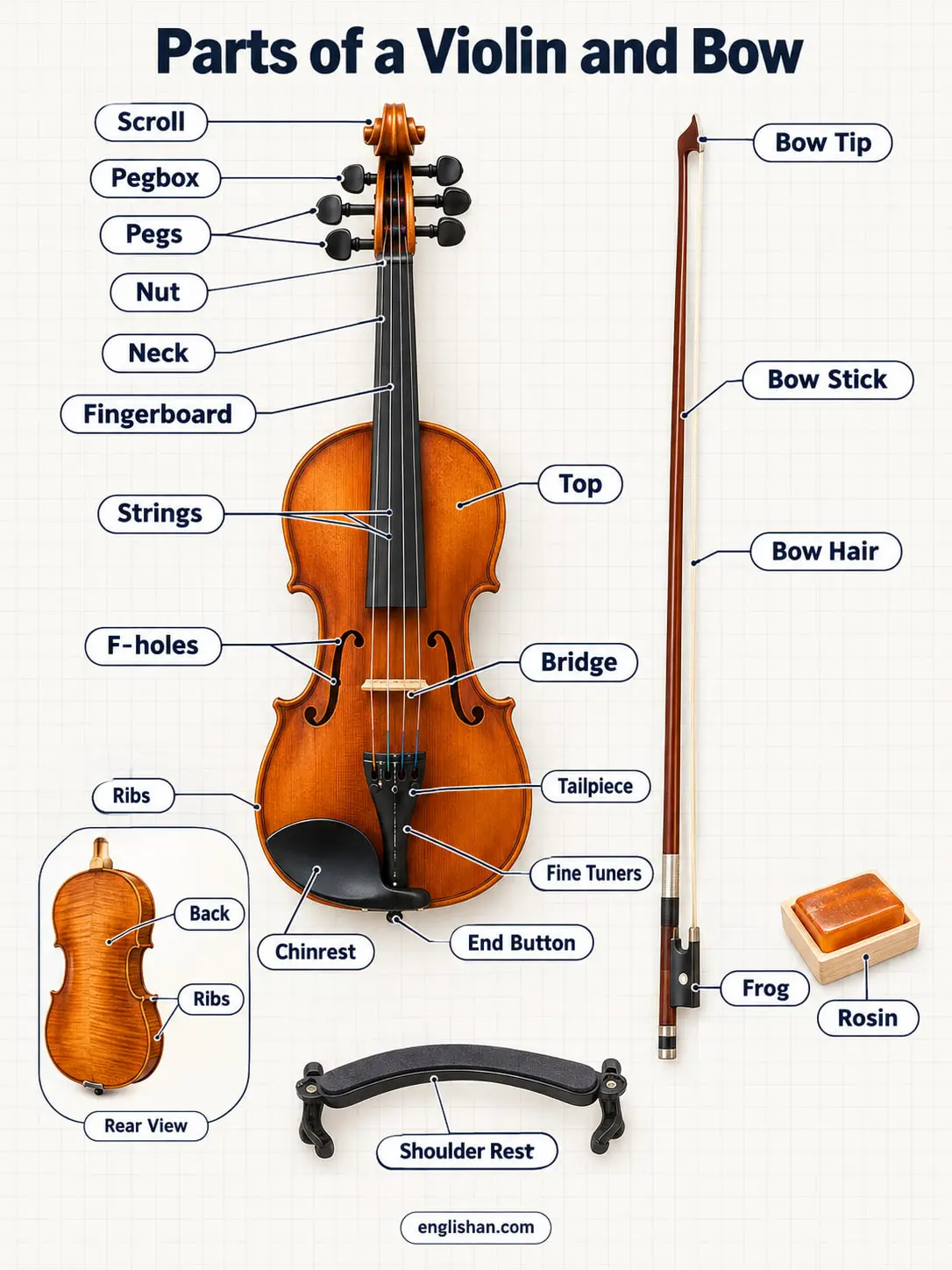
In a front view, the scroll caps the head, the fingerboard extends along the neck, and two f-holes are cut into the top. The bridge is fitted between the f-holes, and the strings are anchored at the tailpiece. The bow is a separate piece with its own stick, frog, hair, and tip. These are the parts of a violin, or the parts of a fiddle, as luthiers name them.
| Part | Where you find it |
|---|---|
| 1. Scroll | Carved spiral at the top of the neck |
| 2. Pegbox | Hollow box under the scroll |
| 3. Pegs | Four wooden knobs set in the pegbox |
| 4. Nut | Raised ridge between the pegbox and the fingerboard |
| 5. Neck | Rounded maple shaft between the pegbox and the body |
| 6. Fingerboard | Black ebony strip glued to the neck |
| 7. Strings | Four strings stretched from the pegs to the tailpiece |
| 8. Top | Spruce front plate of the body |
| 9. F-holes | Two f-shaped openings in the top |
| 10. Bridge | Arched maple piece between the f-holes |
| 11. Ribs | Curved maple sides of the body |
| 12. Back | Maple plate behind the body |
| 13. Tailpiece | Flared ebony piece at the foot of the strings |
| 14. End button | Round knob at the bottom of the body |
| 15. Chinrest | Cup-shaped plate left of the tailpiece |
| 16. Bow stick | Slim wooden shaft of the bow |
| 17. Frog | Ebony block at the held end of the bow |
| 18. Bow hair | Horsehair ribbon stretched along the stick |
| 19. Bow tip | Reinforced head at the far end of the bow |
| 20. Shoulder rest | Curved bar clamped to the back |
| 21. Rosin | Amber block of resin for the bow hair |
Violin Head Parts
The head is the top end of the violin, and these parts of a violin set the tuning.
Scroll
The scroll is a carved spiral of maple at the very top of the violin, shaped like a rolled sheet of paper. It is decorative, and the carving of the curl identifies the maker. Scroll, pegbox, and neck are cut from one block of wood.
Pegbox
The pegbox is the hollow box under the scroll, with two side walls drilled for the pegs. Its open front exposes the pegs for turning, and the walls narrow slightly toward the scroll.
Pegs
Pegs are four tapered knobs of ebony, rosewood, or boxwood, pushed into holes in the pegbox walls. Each string winds around one peg, and a turn of the peg changes its pitch.
Nut
The nut is a raised ridge of ebony between the pegbox and the fingerboard. Four grooves cut into it space the strings and set their height at the top of the neck.
Violin Neck Parts
The neck joins the head to the body, and the parts of a violin along it are the neck, the fingerboard, and the strings.
Neck
The neck is a rounded maple shaft between the pegbox and the body. Its smooth, curved back fits the left hand. The neck is glued into a mortise at the top of the body.
Fingerboard
The fingerboard is a long black strip of ebony glued to the front of the neck. Fingers press the strings against it to shorten their sounding length. Unlike the fretboard of a guitar, it has no frets.
Strings
A violin has four strings tuned to G, D, A, and E from lowest to highest. They are made of gut, synthetic core, or steel core. The three lower strings are wound with metal wire.
Violin Body Parts
The body is a hollow wooden box of two arched plates joined by ribs, and these parts of a violin shape the tone. A full-size body measures about 14 inches long.
Top
The top, also called the belly, is the front plate of the body, carved from spruce into an arch. A line of purfling, a strip of black-and-white wood inlaid near the edge, protects the plate from cracks. The top works as a soundboard, the same name given to the large wooden board inside a piano.
F-Holes
F-holes are two f-shaped openings cut through the top, one on each side of the bridge. They release the sound of the body. A luthier sets the sound post through one of them.
Ribs and Back
The ribs are thin strips of maple bent into the curved sides, with a narrow waist at the middle. The back is a maple plate, arched like the top and glued to the ribs.
Bridge
The bridge is a thin arched piece of maple between the f-holes, held in place by string pressure instead of glue. Four notches in its curved top space the strings. It transmits string vibration to the top.
Sound Post and Bass Bar
Two spruce parts are inside the body, and the sound post is the one a luthier adjusts. It is a small round rod wedged between the top and the back, under the treble foot of the bridge. The bass bar is a spruce strip glued to the underside of the top, under the bass foot.
Violin Tailpiece and Chinrest Parts
The foot of the violin holds the anchoring parts of a violin, and the chinrest is fitted beside them.
Tailpiece
The tailpiece is a flared piece of ebony, rosewood, or boxwood at the foot of the strings, with four holes for the string ends. A loop of gut or nylon cord, the tailgut, anchors it to the end button.
Fine Tuners
Fine tuners are small metal screws fitted to the tailpiece, one for each string. A turn of a screw moves the pitch by a small step, so the string is tuned without touching the pegs.
End Button
The end button is a round ebony knob set in the bottom block of the body at the foot. The tailgut loops around it.
Chinrest
The chinrest is a cup-shaped plate of ebony, plastic, or boxwood, clamped to the edge of the top on the left of the tailpiece. Two metal brackets with a barrel screw tighten it to the body.
Violin Bow Parts
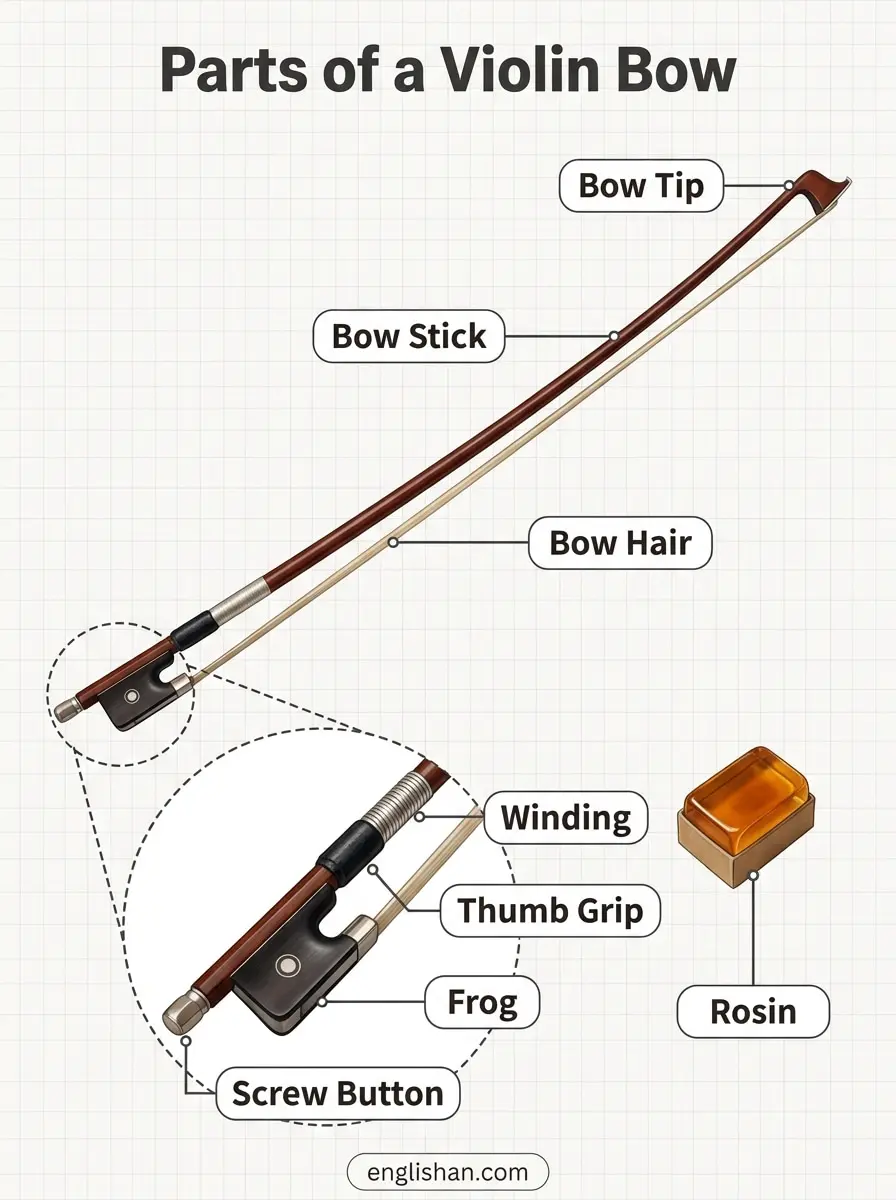
The bow is a separate piece about 29 inches long on a full-size violin. Its parts are named from the held end to the far end.
Bow Stick
The stick is a slim shaft of pernambuco wood or carbon fiber that tapers from the frog to the tip. The stick is octagonal near the frog and round near the tip.
Bow Hair
Bow hair is a flat ribbon of white horsehair stretched between the tip and the frog. Rosin rubbed into it roughens the hair so it grips the strings.
Frog and Screw
The frog is a block of ebony at the held end of the bow that anchors the hair. A screw button at its end turns a screw that slides the frog along the stick, tightening or loosening the hair. A mother-of-pearl circle inlaid in its side is the eye.
Bow Tip
The tip is the pointed head at the far end of the stick, faced with a thin plate of bone or metal. The hair is fastened behind the plate.
Grip and Winding
The thumb grip is a small leather wrap at the frog end of the stick. The winding is a coil of silver wire or thread nearer the tip, which guards the stick against the fingers.
Violin Accessory Parts
Accessory parts of a violin are added to the instrument or the bow rather than built into them.
Shoulder Rest
A shoulder rest is a curved bar of plastic, wood, or metal with padded feet. It clamps to the back of the violin on the left side and fills the gap between the back and the player’s shoulder.
Rosin
Rosin is a hard amber block of tree resin in a small cloth or wooden case. It is rubbed along the bow hair before playing.
Related:
FAQs
FAQs
The parts of a violin are the scroll, pegbox, pegs, neck, fingerboard, strings, top, f-holes, bridge, ribs, back, tailpiece, end button, and chinrest. The bow adds a stick, hair, frog, and tip. A fiddle has the same parts.
The main parts of a violin are the head, the neck, and the body. The head is the scroll and pegbox. The neck has the fingerboard and strings, and the body is the box of top, back, ribs, and f-holes.
A violin bow has a stick, a ribbon of horsehair, a frog with a screw, a tip, a thumb grip, and a winding. The frog is at the held end and the tip is at the far end.
A violin has 15 named parts, and its bow has four more. The shoulder rest and the rosin are two accessory parts added to them.
The scroll decorates the head, the pegs tune the strings, the bridge raises them over the top, and the f-holes release the sound. The sound post links the top to the back. The tailpiece anchors the strings, and the chinrest steadies the jaw.
The accessory parts of a violin are the shoulder rest and the rosin. The shoulder rest clamps to the back of the violin, and the rosin is rubbed on the bow hair.
The parts of a fiddle are the same as the parts of a violin, with the same scroll, neck, bridge, and tailpiece. The two names describe one instrument, and the difference is the style of music.