

The parts of a roller coaster follow the route of the train, because the ride is one closed circuit that starts and ends at the loading station. The train leaves the station and climbs a lift hill or accelerates in a launch. The track then guides it through drops, hills, and loops, and brake runs return it to the platform.
Roller coasters are divided into steel and wooden types, with hybrids combining both materials. The vast majority of coasters operating today are steel. The parts are the same in every type, while the track, the supports, and the inversions differ with the material.
Parts of a Roller Coaster Labeled Diagram
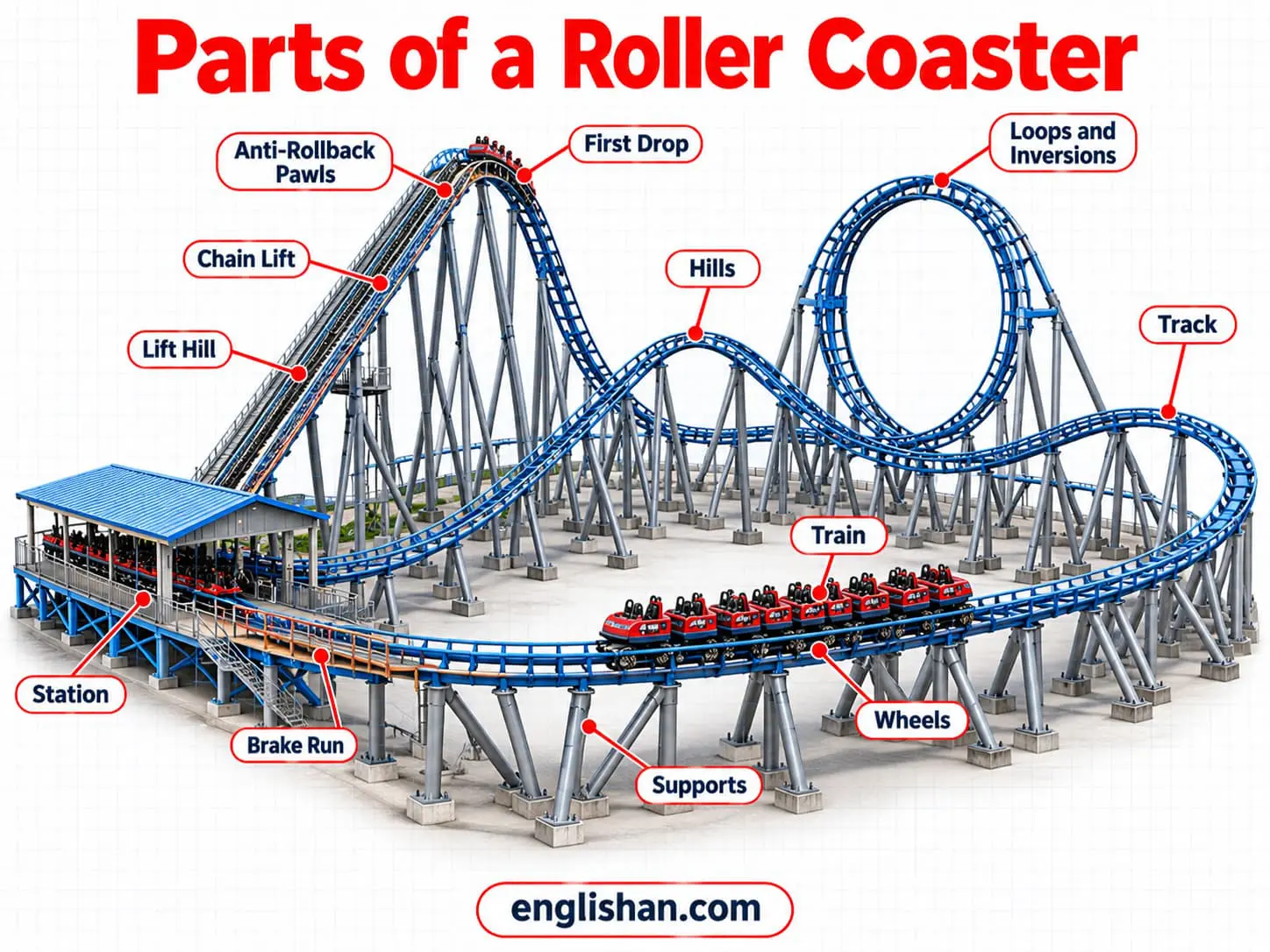
A labeled diagram of a roller coaster traces one full circuit of the track. The numbered rows run in the order the train passes each part.
| Part | Position on the circuit | Role |
|---|---|---|
| 1. Station | Start and end of the circuit | Platform where riders board and exit |
| 2. Lift hill | First climb after the station | Chain or cable pulls the train to the top |
| 3. Anti-rollback pawls | Beside the lift chain | Stop the train from rolling backward |
| 4. Drops and hills | After the lift | Convert the height of the lift into speed |
| 5. Loops and inversions | Mid-circuit | Turn riders upside down on steel coasters |
| 6. Track | Whole circuit | Rails that the wheels run on |
| 7. Supports | Under the track | Footings, columns, and beams that hold the track off the ground |
| 8. Train | On the track | Open cars coupled in a single line |
| 9. Wheels | Under and beside each car | Road, side friction, and upstop wheels |
| 10. Restraints | Each seat | Padded bars or belts that hold the rider in place |
| 11. Brake run | End of the circuit | Brakes that slow or stop the train |
| 12. Block zones | Along the circuit | Track zones that keep trains apart |
Station and Loading Platform
The station is one of the parts of a roller coaster that every circuit passes at both the start and the end. Four parts are part of it: the platform, the dispatch sensors, the transfer track, and the loading layout.
Station
The station is the platform where riders board and leave the train. Every circuit begins and ends there, so the train departs from and returns to the same loading station. The average coaster runs two trains, with one loading while the other runs the course.
Proximity sensors
Proximity sensors check whether the restraints are locked. The train does not leave the station unless every restraint is locked. Under the block system, the train also stays at the platform until the next block is empty.
Transfer track
The transfer track is a movable stretch of track that moves trains or cars on and off the circuit. Most larger coasters have one.
Dual loading station
A dual loading station loads two trains at once. Racing coasters use it, and so do layouts with switch tracks.
Parts of a Roller Coaster Lift Hill
Lift hill
The lift hill is the first hill, and a machine pulls the train up it. After release, the car rolls freely along the track without any external mechanical assistance. The potential energy of the train peaks at the top of the lift hill and converts to kinetic energy on the descent.
Chain and Cable Lifts
Chain lift
The chain lift is the most traditional way to get a coaster moving. The chain hooks under the train cars and pulls them up the hill.
Cable lift
The cable lift is a lighter and faster alternative to the chain lift. Skyrush at Hersheypark uses a cable lift.
Kiddie and junior lift hills
Kiddie coasters have lift hills under 25 feet (7.6 m). Junior models have lift hills up to 45 feet (14 m).
Anti-Rollback Pawls
Anti-rollback pawls
Pivoting pawls form the anti-rollback system of the lift hill. If the train disconnects from the chain, the pawls engage and stop the train from falling back down. The clack heard on the climb comes from the anti-rollback dogs striking metal teeth beside the chain.
Pre-drop
A pre-drop, also called a tester hill or trick hill, is a small hill after the lift. It reduces tension on the lift before the train is released.
Launch Systems
Some coasters replace the lift hill with a launch, which accelerates the train quickly instead of pulling it up a hill. Four launch types are in use.
Linear motor launch
A linear induction motor (LIM) or linear synchronous motor (LSM) launch places motors along both sides of the track, and some installations use more than 200 motors. The motors create a magnetic field that attracts the metal fins on the sides of the train and sends it forward.
Hydraulic launch
A catch car in a center trough connects to the train, and a launch motor drives a cable loop that pulls the catch car. Only about two thirds of the track is usable for launching. Formula Rossa accelerates the train to a top speed of 240 km/h (150 mph) in approximately 5 seconds.
Friction wheel launch
A series of high-speed drive tires propels the train in sequence. The Incredible Hulk Coaster at Islands of Adventure uses this launch.
Flywheel launch
A flywheel launch uses stored rotational energy, which an electric motor builds up. Schwarzkopf introduced it on his second-generation shuttle loops, and Montezooma’s Revenge at Knott’s Berry Farm was the first.
Drops and Hills
Drops and hills are the parts of a roller coaster that turn the height of the lift into speed.
Drop
The drop is the descent after a climb, where the potential energy built up on the lift hill converts to kinetic energy. The first drop follows the lift hill.
Hills
After the first drop, the train climbs the next hill. Friction between the car and the track removes energy from the train throughout the circuit, and this loss eventually stops the ride.
Camelback
A camelback is a hump-shaped hill on a straight line. It lifts riders out of their seats and creates weightlessness, so it is also called an airtime hill.
Double down
A double down is a drop followed immediately by a second drop.
Double up
A double up is a hill that starts to crest, flattens, and then climbs again.
Bunny hops
Bunny hops are a series of small, short hills near the end of the circuit. They create brief bursts of airtime.
Holding brake
A holding brake pauses a dive coaster at the top of the first drop. The train is held briefly before release.
Loops and Inversions
Loops and inversions are the parts of a roller coaster that turn riders upside down. Steel coasters are smoother than wooden ones and include these track features.
Inversion
An inversion turns riders upside down. Inverting coasters rely on the forces of the ride, along with the restraints, to keep riders in place.
Vertical loop
A vertical loop is a continuous, upward-sloping stretch of track that completes a 360-degree turn. It inverts riders halfway through, and its shape is oval or teardrop.
Non-inverting loop
A non-inverting loop is a vertical loop with a twist on the way up. Riders are right side up at the top.
Corkscrew
A corkscrew is a helix-shaped turn that rotates riders 360 degrees perpendicular to the track. Riders face forward throughout.
Helix
A helix is a spiral of track that exceeds 360 degrees. It climbs or descends.
Banked curve
A banked curve is a turn with the track tilted to reduce lateral g-forces on riders.
Overbanked curve
An overbanked curve is tilted 90 degrees or more, commonly 100 to 120 degrees on large steel coasters.
Horseshoe
A horseshoe is a high-banked 180-degree turnaround.
Top hat
A top hat is a 90-degree ascent followed by a 90-degree descent. The train leaves in the direction it entered.
Parts of a Roller Coaster Track
Track
The track is the pair of rails that the cars run along, built as a complete circuit that returns to the loading station. Wooden and steel coasters build it differently.
Wooden track
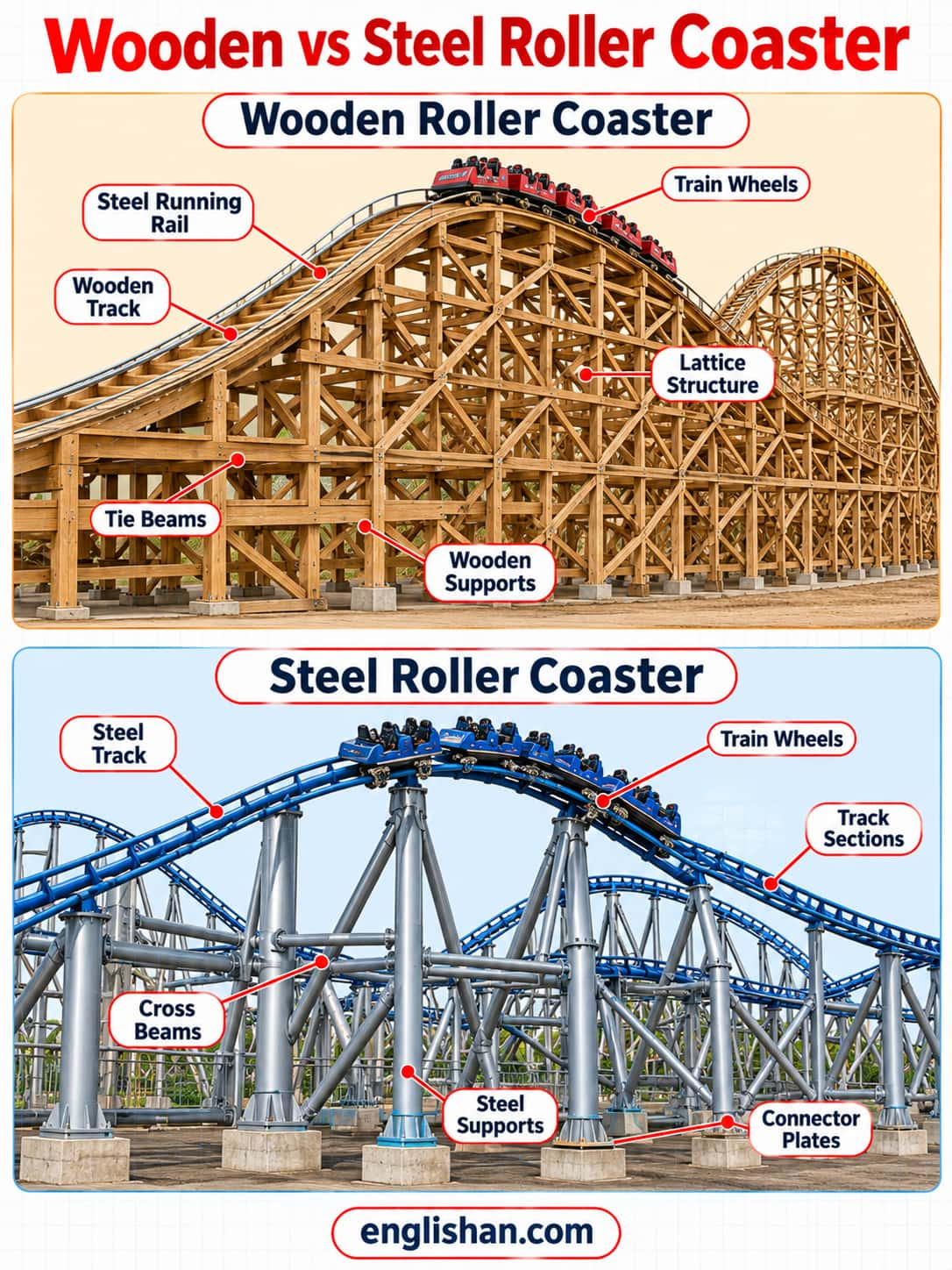
A wooden coaster uses thin laminates of wood stacked together, with a flat steel rail on top. A lattice or truss supports the track.
Steel track
A steel coaster uses tubular steel, I-beam, or box section running rails. The first permanent tubular steel track ran on the Matterhorn Bobsleds at Disneyland in 1959.
Track sections
Steel track arrives at the site in pieces. Crews connect the pieces and bolt or weld them to the support structure.
Fan curve
A fan curve is a wooden-coaster curve reinforced with spokes that radiate from a central point.
Crossover
A crossover is a stretch of track that passes over or under another stretch. It is found on wooden coasters.
Support Structure and Footings
The support structure is the frame that holds the track off the ground. Builders design it around the rider type, the g-forces, and the energy the train uses.
Supports
The supports are the columns and beams that sustain the track. Assembly runs from the bottom up: foundation, frame, track, lift or launch system, safety systems, brakes, train cars, and test runs.
Footings
Crews dig the footing holes with an excavator and fill them with concrete poured into wooden forms. In sandy soil, wooden piles are driven into the ground as the foundation instead.
Connector plates
Connector plates attach to the foundation and link it to the support beams.
Columns and cross beams
The frame adds cross beams between the support columns, similar to the superstructure of a skyscraper. Cranes lower the lower sections onto the connector plates, and wooden beams brace them while the upper sections go up.
Tie beams
On wooden coasters, tie beams connect and strengthen each pair of columns.
Parts of a Roller Coaster Train
Train
A roller coaster train is two or more carts coupled together. The carts connect in a line and follow one another along the track, the same arrangement that railway cars form in a train. Most roller coaster trains have no motor, and gravity moves them after the lift hill or launch. Powered coasters use one or more motors instead.
Cart
A cart, also called a car, is one vehicle of the train. Each cart seats one to eight or more passengers, depending on the design.
Coupling joints
Specialized joints couple the carts together in a single line.
Seat
The seat is the rider’s position in the cart. The over-the-shoulder restraint attaches to the top of the seat, and the lap bar attaches to the floor or the side of the train.
Fins
Metal fins under the cars slide into the track brakes. Linear motor launches also act on fins on the sides of the train.
Roller Coaster Train Wheels
Most roller coaster wheels are made of polyurethane. Three wheel types among the parts of a roller coaster train lock the train to the track and prevent derailment.
Road wheel
The road wheel rides on top of the track.
Side friction wheel
The side friction wheel rides on the side of the track and keeps the train on the track through turns. It mounts outside or inside the track, and outside mounting is more common.
Upstop wheel
The upstop wheel rides under the track and prevents the train from lifting off. It is also called an underfriction, uplift, or underlocking wheel.
Wheel placement
Wheels are placed between carts and at the front or rear of the train. Wooden coasters use wheels with wide lips to prevent derailment.
Parts of a Roller Coaster Restraint System
Four restraint types are in use: over-the-shoulder, lap bar, vest, and seat belt.
Lap bar
A lap bar is a padded bar that swings backward or sideways into the rider’s lap. It is more common on coasters without inversions.
Over-the-shoulder restraint
An over-the-shoulder restraint is a U-shaped padded bar mounted to the top of each seat that swings down onto the rider. Inverted, floorless, dive, and flying coasters almost always use it.
Seat belt
Most modern coasters also fit a lap seat belt as a secondary safety device.
Restraint locks
Every restraint uses two locks, one on each side, so one lock backs up the other.
Hydraulic lock
A hydraulic lock uses a piston and fluid. An electrical signal from the operator releases it.
Ratcheting lock
A ratcheting lock uses a toothed gear and a pawl. An electrical signal moves the pawl out of the way.
Parts of a Roller Coaster Brake System
The brakes are the parts of a roller coaster that slow and stop the train.
Brake run
A brake run is a flat stretch of track with brakes installed. It is placed before the station entrance and controls loading and dispatching. A brake run at the end of the circuit is the most common way to stop a train that returns to the station.
Block brake
A block brake stops the train completely. It works within the block system.
Trim brake
A trim brake is placed somewhere on the track, such as the ascent of an airtime hill. It slows the train without stopping it, and some operators add trim brakes after construction to manage g-forces and speed.
Mid-course brake run
A mid-course brake run is a multi-brake stretch partway through the circuit that slows or stops the train. It is a block brake in multi-train operation.
Fin brake
Fins under the cars slide into clamps on the track. The brake is fail-safe and closes if power fails.
Magnetic brake
A magnetic brake slows the train without touching it. It works alongside fin brakes.
Launch brake
A launch brake stops a train that launches too slowly on a hydraulic launch. The train rolls back and resets.
Splashdown
A splashdown is a stretch where the vehicle hits water. The water also helps slow the train.
Block Zones and Control Sensors
Block zones
Block zones are the parts of a roller coaster that keep trains apart. If a train enters an occupied block, the brakes in all the blocks engage. A coaster has one more block zone than it has trains, so three trains need four block zones and one zone is always empty.
Track sensors
Track sensors report the position of each train to the control system. The sensors are extremely sensitive and show error codes even when the ride is fine.
Programmable logic controller
The programmable logic controller (PLC) receives the sensor reports. Most coasters have two PLCs for redundancy.
Brake clamp sensors
Sensors near the fin brake clamps trigger the clamps to squeeze the fins.
Roller Coaster Track and Supports
The parts of a roller coaster differ between wooden and steel types in three places: the track, the supports, and the ride.
| Part | Wooden coaster | Steel coaster |
|---|---|---|
| Track | Stacked laminates of wood with a flat steel rail on top | Tubular steel, I-beam, or box section rails |
| Supports | Wooden columns joined by tie beams, with a lattice or truss under the track | Steel columns and cross beams made in a factory and assembled on site |
| Ride | Wide-lipped wheels guard against derailment | Smoother ride, with inversions |
Hybrid coasters pair a steel track with a wooden support structure. The Cyclone (1927) at Luna Park reverses that pairing, with a wood track and a steel structure.
FAQs
The parts are the station, lift hill, track, supports, train, wheels, restraints, and brakes. The vehicle is a train made of coupled cars, which some sources call carts. The track features include drops, hills, loops, and curves.
The main parts are the track, the supports, the train, the lift or launch system, the brakes, and the restraints. The track guides the train, and the supports hold the track off the ground. The lift or launch supplies the energy, and the brakes and restraints control the ride and protect riders.
A roller coaster car has a seat, a restraint, and wheel assemblies. The wheel assemblies are road wheels on top of the track, side friction wheels beside it, and upstop wheels under it. Some cars also have fins under the body that slide into the track brakes.
The seat is part of a car, also called a cart, and the restraint attaches to it. Over-the-shoulder bars mount to the top of each seat, while lap bars attach to the floor or the side of the train. One car holds one to eight or more passengers.
The first part is the station, where the train starts the circuit. The first climb after the station is the lift hill, which takes the train to its highest point. Launched coasters replace the lift hill with a launch system.
Magnetic brakes and linear motor launches rely on magnets. A magnetic brake slows the train without touching it, alongside fin brakes. A linear motor launch creates a magnetic field that attracts the metal fins on the train and sends it forward.
The train moves fastest where the track is lowest after a climb, because the potential energy stored at the top of the lift hill has converted into kinetic energy. Friction between the car and the track then removes energy for the rest of the circuit. A hydraulic launch such as Formula Rossa reaches 240 km/h (150 mph) in approximately 5 seconds.
The circular part is the vertical loop. It is a continuous, upward-sloping stretch of track that completes a 360-degree turn and inverts riders halfway through. The loop is oval or teardrop in shape.
Inversions take riders upside down. The vertical loop and the corkscrew are two inversions, and steel coasters are the type that turns riders upside down. The restraints, together with the forces of the ride, keep riders in their seats.
One documented cause is the sensor system. The sensors are extremely sensitive and show error codes even when the ride is fine. A train also stays in the station until every restraint is locked and the next block is empty, so a fault in either check holds the ride.
Related: