A window works as two nested frames. The outer one is fixed into the wall, and the inner one, the sash, moves inside it with the glass unit held in its middle. Both are built from lengths of wood, vinyl, or aluminum, which the trade calls members.
Everything else on the window fastens it shut, closes the gaps, drains the rain, or finishes the joint where the frame meets the wall. Name those parts of a window correctly and a glazier’s quote stops being guesswork, since replacement sashes, balances, and glass units are all ordered by part.
The names below follow a double-hung window, the most common style in American homes.
Parts of a Window Diagram With Names
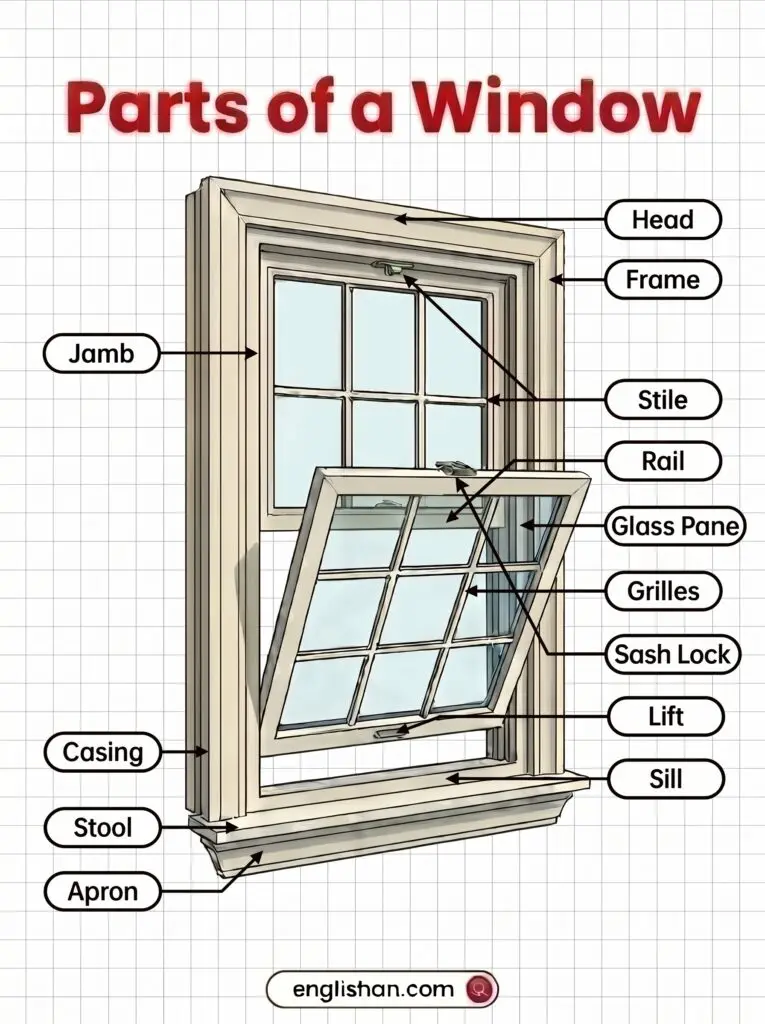
What are the parts of a window called? The frame is made of the head jamb across the top, a side jamb on each edge, and the sill along the bottom. Inside it, the sash is built from two stiles and two rails around the glass. Fitted around both are the hardware, the weatherstripping, the screen, and the trim that finishes the opening inside and out.
| Part | Location |
|---|---|
| 1. Head jamb | Top horizontal member of the frame |
| 2. Side jambs | Vertical members on the left and right |
| 3. Sill | Bottom member of the frame, sloped outward |
| 4. Sash | Framed panel that holds the glass |
| 5. Stiles | Vertical sides of the sash |
| 6. Top rail | Horizontal top of the sash |
| 7. Bottom rail | Horizontal base of the sash |
| 8. Check rail | Where the two sashes overlap at mid-height |
| 9. Glass pane | Sheet of glass inside the sash |
| 10. Glass spacer | Strip between the panes, at the glass edge |
| 11. Glazing bead | Strip holding the glass in the sash |
| 12. Sash lock | Center of the check rail |
| 13. Keeper | Facing half of the lock, on the upper sash |
| 14. Lift handle | Underside of the bottom rail |
| 15. Balances | Hidden inside the side jambs |
| 16. Tilt latches | Both ends of the sash top rail |
| 17. Weatherstripping | Between sash and jamb, all around |
| 18. Weep holes | Exterior face of the sill |
| 19. Screen | Outside the sash, in its own frame |
| 20. Grilles | Across the face of the glass |
| 21. Mullion | Joint between two window units |
| 22. Interior casing | Trim around the frame inside the room |
| 23. Stool | Interior shelf across the bottom |
| 24. Apron | Trim under the stool |
| 25. Brick mould | Exterior trim around the frame |
| 26. Drip cap | Flashing above the head, outside |
Parts of a Window Frame
The frame is the fixed outer shell fastened into the wall opening. It never moves once the window is installed. Three members form it, and a few smaller parts tie it to the wall and drain the rain that reaches it.
Head Jamb
The head jamb runs across the top of the frame, and an upper sash closes against it. Manuals shorten the name to head. A head jamb and a window head mean the same part, and both side jambs fasten to its ends to square the frame.
Side Jambs
The side jambs drop from the ends of the head jamb, and the sash slides against them. On a hung window, each inner face is grooved into a track. A hollow pocket lies behind it. That pocket holds the balances, the tilt shoes the sash pivots on, and the safety stops.
A casement window uses its side jambs differently, since the hinges and the operating arm fasten there instead.
Window Sill
The sill closes the bottom of the frame. It is the only member built with a slope. That slope runs outward, so rain drains away from the wall rather than pooling against the bottom rail of the sash. A vinyl or aluminum sill is hollow, with drainage channels molded inside it. In British English the same part is called the cill.
Jamb Extension
A jamb extension adds a flat strip to the inside edge of the frame. It reaches from the inner edge of the frame to the finished surface of the interior wall, a gap that opens whenever the wall is thicker than the window. Factory extensions arrive attached, and site-built ones are cut by a finish carpenter. Thick plaster applied right up to the frame removes the need for one.
Weep Holes
Weep holes are the small drainage slots cut through the exterior face of that sill. Rain driven past the outer weatherstrip travels down inside the hollow sill and escapes through them. Paint, dead insects, and dirt plug them over time, and a plugged weep hole backs water up into the frame. On many vinyl windows a small plastic flap hangs over each slot, letting water out while swinging shut against the wind.
Nailing Fin
The nailing fin is a thin lip of vinyl or metal around the outside of the frame, also called a mounting flange. Nails or screws driven through it fasten the window to the sheathing, the board layer under the siding. Together with the flashing and the house wrap behind the siding, it keeps wind and rain out of the wall. Replacement windows made for existing openings have no fin.
Parts of a Window Sash
Inside the frame is the part that actually moves. Four members form the sash around the glass, and each one takes a different name depending on which way it runs.
Window Sash
Which part of a window is the sash? The sash is the panel that carries the glass and moves inside the fixed frame. Double-hung windows contain two sashes that slide vertically. A slider moves its sashes sideways, and a casement swings a single sash outward. A picture window has no sash at all, since its glass is set straight into the frame.
Sash Stiles
The stiles are the two vertical members at the left and right edges of the sash. Each one rides in a jamb track, with a weatherstrip along its outer face. Safety stops screw into the stiles of the upper sash on a double-hung window, which limits how far the lower sash rises.
Top Rail and Bottom Rail
Rails run horizontally across the sash, one at the top and one at the base. The bottom rail meets the sill when the window is shut, and the lift handle is mounted on it. On vinyl windows, the corners are heat-welded into one solid joint. Traditional wood sashes are cut with a mortise and tenon joint, where a tongue on the rail fits a matching socket in the stile.
Check Rail
On a double-hung window, the check rail is the horizontal joint where the bottom rail of the upper sash meets the top rail of the lower sash. Those two rails overlap at about waist height, which is why the sash lock is mounted there. Manuals know the joint as the meeting rail. A single-hung window has the same joint even though only its lower sash moves.
Window Glass and Glazing Parts
Glazing is the trade name for the glass in a window, and for the parts that grip it and weatherproof it. Modern windows use two or three panes rather than one.
Glass Pane
A pane is one sheet of glass, and the trade also names a single pane a lite. Old windows had one pane and nothing else. Two are standard now, and a third pane turns up in cold climates and in windows chosen to cut street noise.
Insulated Glass Unit
The insulated glass unit, shortened to IGU, is the sealed sandwich of panes, spacers, and gas that drops into the sash as one part. Argon or krypton gas replaces the air in the gap between the panes, since both are denser than air and slow heat transfer. Once that edge seal fails, moisture creeps into the gap and the glass fogs from the inside.
A fogged IGU is replaced as a unit, and the sash and frame stay in place.
Glass Spacer
The spacer follows the edge of the glass between the panes, setting the width of that gas gap and holding the seal. An aluminum spacer conducts heat straight across the glass edge, which leaves that edge cold enough to collect condensation. Warm-edge spacers of foam or silicone replaced aluminum on most new windows for that reason.
A drying agent inside the spacer, called a desiccant, soaks up the moisture trapped there during assembly.
Low-E Coating
Low-E is short for low emissivity, a term for how readily a surface radiates heat. The coating itself is a metal layer laid on one glass face, far too thin for the eye to catch. It reflects heat back toward the side it came from while letting daylight through.
In hot climates it goes on the outer pane to turn away summer sun, and in cold climates on the inner pane to keep room heat indoors.
Glazing Bead
The glazing bead is the strip of vinyl, wood, or aluminum that clamps the glass unit into the sash. It snaps into a groove around the inner edge, and it lifts out whenever the glass is replaced. Older wood windows use glazing putty in that position instead of a bead.
Window Hardware Parts
Hardware means the moving metal on a window: the parts that lock it, lift it, prop it open, or limit how far it opens. Most of it is mounted on the sash, and the rest hides inside the jambs.
Sash Lock and Keeper
The sash lock is a rotating cam mounted at the center of the check rail on a hung window. Turning the lever draws the cam against the keeper, the fixed catch screwed to the facing sash. That pull squeezes the two sashes together and flattens the weatherstrip between them, so the joint tightens as it locks. A casement has no meeting rail to lock at, so its lock is a lever mounted along the stile instead.
Lift Handle
You raise the lower sash by the lift handle, mounted under the bottom rail or recessed into its face. On a slider, the same grip turns vertical and moves to the stile. Parts lists name it the sash lift.
Sash Balances
The balances are spring mechanisms hidden inside the side jambs, and they take the weight of a hung sash. Their upward pull lets a heavy sash hang wherever you leave it instead of dropping shut. Older windows carried a cast iron weight on a cord over a pulley, and modern ones run on a coil spring or a small pulley system.
A sash that slides down on its own has a broken balance.
Tilt Latch
Two sliding catches sit at the ends of the sash top rail. These tilt latches release the sash on a tilt-in window. Push both toward the center, and the sash comes free of its tracks and pivots into the room. That is how the outer face of an upper-floor window gets cleaned without a ladder. At the base, the sash turns on a sash tilt pin, known also as a cam pivot.
Crank Handle
A crank handle, named the operating handle in catalogs, opens a casement or awning window. Turning it drives a gear that pushes the sash outward, and turning it back pulls the sash into the frame. The handle folds flat against the frame so a blind or curtain clears it.
Operating Arm
The operating arm is a hinged steel bar linking the frame to the sash on casement, awning, and hopper windows. It transfers the turn of the crank into the swing of the sash, and it holds the sash steady at whatever angle you leave it. Catalogs list the arm and its gearbox together as the operator.
Window Opening Control Device
A window opening control device, shortened to WOCD, limits a sash to a narrow opening until someone releases it deliberately. Building codes require one on windows mounted low above the floor and high above the ground outside. Under the standard, the device restricts the opening to 4 inches, releases only after two separate actions, and resets by itself when the window shuts.
Safety stops screwed to the upper sash stiles do similar work on older windows without meeting that code.
Window Sealing and Screen Parts
These parts close the gaps around a shut sash and keep insects out of an open one.
Window Weatherstripping
The weatherstripping is a flexible strip of silicone, rubber, vinyl, or foam, pressed between the sash and the frame wherever they meet. Restored wood windows carry a springy brass leaf in that position instead. Where a hung sash slides rather than closes, the strip becomes a pile strip, a row of dense bristles that seals against a moving edge. Flattened weatherstripping lets drafts through, and a replacement strip is cut from a roll to the length needed.
Window Screen
A window screen is a mesh panel of fiberglass or aluminum wire, stretched across a light frame of its own. It blocks insects and leaves while air passes through it. On a hung window it reaches across only the half that opens, clipping into a channel on the exterior face of the frame. A screen is no barrier against a fall, and it takes no weight at all.
Screen Frame
That mesh is held under tension by the screen frame, a rim of aluminum or spring steel. A thin rubber cord, the spline, presses into a groove around the rim and traps the mesh edge. Rolling that cord back out with a spline tool is how a torn screen is replaced.
Window Grilles, Muntins, and Mullions
Three similar names describe three different parts, and the wrong one in a supplier order brings back the wrong part.
Window Grilles
Grilles are the decorative bars laid across the face of the glass, and they give the look of separate panes. Removable grilles clip onto the sash and lift off for cleaning. Grilles between the glass, shortened to GBG, sit inside the IGU where dust never reaches them. Simulated divided lite bars, or SDL, are glued to both glass surfaces for a closer match to a true divided window.
Muntin Bars
Muntins are the slim structural bars that grip genuinely separate panes of glass inside one sash. Windows before the middle of the nineteenth century were built this way, because large sheets of glass were fragile and costly. A window built with real muntins today is described as an authentic divided lite.
A muntin grips real glass in place, while a grille only copies the look of one over a single sheet.
Window Mullion
A mullion joins two complete window units into one opening, standing vertically between them. On a bay window, mullions stand at the angles where the three units meet. A mullion carrying the weight of the wall above is built heavier and called a mull post.
Window Trim Parts
Trim finishes the joint between the window frame and the wall, hiding the rough edge left by the installers. Inside the room the trim is decorative, while the exterior pieces also shed water.
Interior Casing
On the room side, interior casing surrounds the frame as moulding, in shapes from flat boards to colonial patterns. It conceals the packing shims and insulation squeezed between the frame and the wall studs.
Window Stool
The stool sits below the casing as the flat interior shelf across the bottom of the window, the ledge a row of plant pots rests on. Everyday speech calls it the windowsill, while the true sill is the sloped exterior member beneath it. A stool is cut with horns, the short ends that project past the casing on each side.
Window Apron
Under the stool, against the wall, a flat trim board, the apron, closes the gap below the shelf and supports its front edge. Leave the apron off, and the drywall edge shows underneath.
Brick Mould
Brick mould wraps the frame outside as a thick exterior casing, named for the brick it traditionally met. It closes the joint between the frame and the cladding, whether brick, siding, or stucco. Factories fit it to many windows before delivery.
Drip Cap
The drip cap is formed metal or vinyl flashing fitted above the head of the window, known also as head flashing. Water running down the wall meets its outward bend and drops away from the casing. Without one, that water tracks behind the trim and rots the framing.
Stop Moulding
Stop mouldings are the narrow strips that keep each sash in its own track. Three of them line a traditional double-hung window: the inside stop against the room, the parting stop between the two sashes, and the blind stop at the outer edge. Removing the inside stop is the first step when a wood sash comes out for repair.
FAQs
Q1. What are the parts of a window called?
The parts of a window are the frame, the sash, and the glass, plus the hardware, seals, and trim around them. The frame is built from the head jamb, side jambs, and sill. The sash is built from stiles and rails, and the glass unit fits inside it.
Q2. What are the 5 parts of a window?
The five parts named in most lists are the frame, the sash, the glass, the sill, and the hardware. A few lists replace hardware with the spacer between the glass panes. Every list starts with the frame and the sash, since the frame supports the sash and the sash supports the glass.
Q3. Which part of a window is the sash?
The sash is the framed panel holding the glass, and it is the part that moves when you open the window. On a double-hung window, the two sashes slide up and down inside the side jambs. The sash has parts of its own: stiles at the sides, rails at the top and bottom.
Q4. Which part of a window is the windowsill?
Everyday speech calls the flat interior shelf the windowsill, though its trade name is the stool. The true sill is the bottom member of the outer frame, and it slopes outward to shed rain. Ask a supplier for a sill and you receive the exterior part.
Q5. What is the difference between a mullion and a muntin?
A mullion joins two whole window units, while a muntin divides the glass inside one sash. Mullions are structural members standing between units, and muntins are slim bars between individual panes. Grilles copy the look of muntins over a single sheet of glass.
Q6. What are the parts of a double hung window?
A double-hung window has two sashes that both slide vertically inside the same frame. Along with the frame and sash parts, it has a check rail where the sashes overlap and a sash lock at that joint. Balances hide inside the side jambs, and tilt latches fit each top rail. Single-hung windows share these parts, but their upper sash is fixed.
Q7. What parts of a window can be replaced?
Most parts of a window are replaceable on their own: the glass unit, the balances, the sash lock, the weatherstripping, the screen mesh, and the crank handle. A fogged insulated glass unit is swapped without touching the frame. Rot in the frame or the sill is the fault that ends repair, and the whole window then comes out.
You May Also Like
- Parts of a Lawn Mower
- Parts of a Grill
- Parts of a Fountain
- Parts of a Microphone
- Parts of Headphones
Parts of a Window Quiz
Parts of a Window
What is a single sheet of glass in a window called?
Double glazing means two panes with a gap between them.
Pane is glass; sash is the frame around it.
A stone cracked the outer pane.
What is the ledge at the bottom of a window called?
The sill sheds water away from the wall below.
Sill below, lintel above.
A plant sat on the window sill.
Name the part.
The vertical bar dividing a window into sections is called a ___.
A mullion divides vertically; a transom divides horizontally.
Mullion stands up, transom lies across.
A stone mullion split the window in two.
In a sash window, what does the sash do?
Counterweights in the frame balance it so it stays where it is put.
The sash is the moving frame, not the fitting.
The lower sash had swollen and would not lift.
What are the thin strips dividing panes into small squares called?
Also called muntins, they hold several small panes within one sash.
Glazing bars sit inside the sash and carry glass.
The glazing bars needed repainting.
What is a window set into a sloping roof, with its own small roof, called?
A dormer projects out from the roof slope and stands vertically.
Dormer stands out; skylight lies flush.
Two dormers broke the line of the roof.
Turn on JavaScript for the interactive quiz. The full practice set is shown above.