

The parts of a drill bit are the shank, the body, and the point. The drill grips the shank, the flutes lift chips out of the hole, and the lips at the point cut the material.
A twist drill bit is the standard bit for metal, wood, and plastic, and its parts run in order from the shank to the point. Wood, masonry, and step bits change several parts and are covered further down. The chuck and the motor are part of the drill, which has its own page.
Parts of a Drill Bit Labeled Diagram
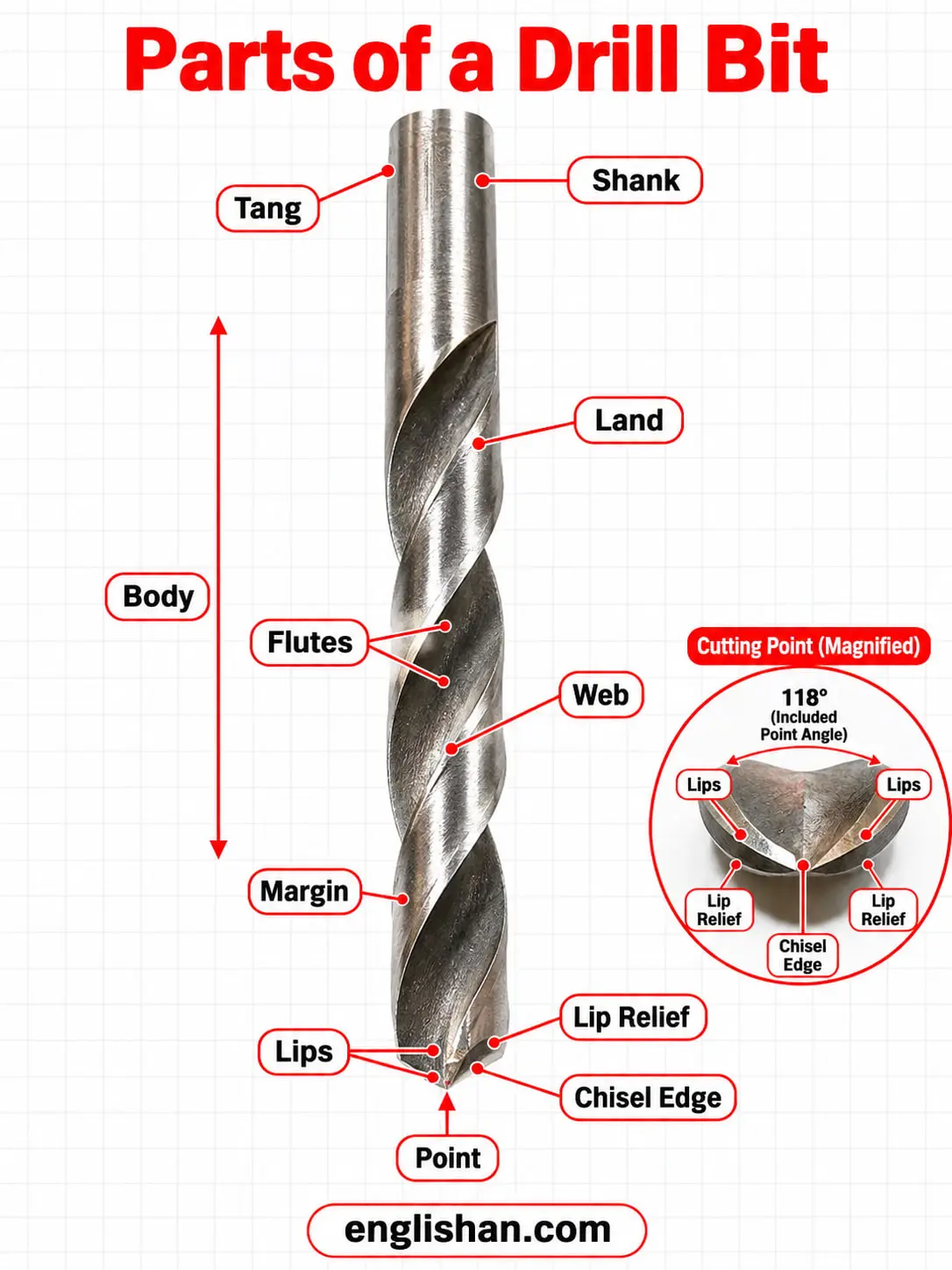
In a labeled diagram of a twist drill bit, the shank is at the top and the flutes spiral down the body. The lips and the chisel edge meet at the point at the bottom.
| Part | Where you find it |
|---|---|
| 1. Shank | Driving end held by the drill |
| 2. Tang | Tab on a tapered shank that fits the spindle slot |
| 3. Body | Length between the shank and the point |
| 4. Flutes | Spiral grooves cut along the body |
| 5. Land | Raised band left on the body after the flutes are cut |
| 6. Margin | Short portion of the land that keeps the full diameter |
| 7. Web | Central core that connects the lands |
| 8. Lips | Primary cutting edges at the point |
| 9. Lip relief | Clearance ground behind each lip |
| 10. Chisel edge | Edge at the center of the point, along the web |
| 11. Point | Cutting end where the lips and chisel edge meet |
Drill Bit Shank and Tang
The shank is the upper end of the bit, and the drill grasps it in the chuck. Most consumer bits have a straight shank. Heavy-duty industrial bits have a tapered shank, such as a Morse taper.
A tapered shank ends in a tang, which fits the slot of the spindle so the machine drives the bit and the operator removes it. A trade text pairs taper shanks with larger drills and straight shanks with smaller ones, with parallel shanks available under 13 mm. Some bits have hex shanks or quick-release shanks, and SDS shanks let a bit slide in the chuck of a hammer drill while it hammers. Some spade bits have flats on the shank that stop the bit from slipping in the chuck.
Parts of a Drill Bit Body
The body is the length between the shank and the point. Among the parts of a drill bit, it holds the flutes, the land, the margin, and the web.
Low-carbon steel bits cost little and cut wood only. High-carbon steel lasts longer but loses temper if overheated, and high-speed steel resists heat better. Cobalt steel cuts stainless steel and is more brittle than high-speed steel. Tungsten carbide is extremely hard but brittle, and polycrystalline diamond is a layer about 0.5 mm (0.020 in) thick that is not used on ferrous metals.
Flutes
The flutes are helical grooves along the body. They are an Archimedean screw that lifts swarf out of the hole, and they bring cutting fluid toward the cutting edge. A fast spiral has compact flutes and suits high feed rates and heavy chip removal. A low spiral has elongated flutes and suits aluminum and copper, which gall or clog. Straight flutes with no twist suit copper and brass because they dig in less.
Land and Margin
The land is the part of the body that remains after the flutes are cut, and it is set slightly back from the outside diameter to provide clearance. The margin is the short portion of the land that is not cut away, and it keeps the full diameter of the bit. The height of the step from the margin to the land is the body diameter clearance. The size of the bit is measured across the lands.
Web
The web is the central portion of the body that connects the two lands. It thickens toward the shank.
Parts of a Drill Bit Point and Cutting Edges
The point is the cutting end of the bit. A trade text lists the dead center, the lips, and the heel as its parts.
Coatings extend the life of the cutting edges. Black oxide adds heat resistance, lubricity, and corrosion resistance. Titanium nitride extends cutting life three times or more, and titanium aluminum nitride extends it five times or more. Titanium carbon nitride outperforms titanium nitride.
Lips and Lip Relief
The lips are the primary cutting edges, and they run from the center of the point to the outer edge. Lip relief is the angle between the face of the cut material and the flank of the lip. It supports the cutting edge, and a greater angle cuts more aggressively under the same pressure. Excess relief causes binding, wear, and eventual failure. A trade text gives a lip clearance of mostly 8 degrees.
Chisel Edge
The chisel edge is the edge ground on the point along the web, and it joins the two lips. A brad point bit replaces the straight chisel of the twist bit with a spur.
Point Angle
The point angle is the included angle between the two lips. A 118 degree angle is the most common and works in wood, metal, plastic, and most other materials. A 90 degree angle is more aggressive and self-starting, so it suits very soft plastics, but it wears rapidly in hard materials. A 150 degree angle suits steels and other tougher materials and needs a starter hole.
Drill Bit Point Angle
The point angle, the helix angle, and the lip relief of a drill bit change with the material being drilled. The helix angle is the angle that the leading edge of the land makes with the axis of the bit. A trade text gives 27½ degrees as the standard helix angle.
| Material | Point angle | Helix angle | Lip relief |
|---|---|---|---|
| Aluminum | 90 to 135 degrees | 32 to 48 degrees | 12 to 26 degrees |
| Brass | 90 to 118 degrees | 0 to 20 degrees | 12 to 26 degrees |
| Cast iron | 90 to 118 degrees | 24 to 32 degrees | 7 to 20 degrees |
| Mild steel and stainless steel | 118 to 135 degrees | 24 to 32 degrees | 7 to 24 degrees |
| Plastics | 60 to 90 degrees | 0 to 20 degrees | 12 to 26 degrees |
Parts of a Wood Drill Bit
The parts of a wood drill bit differ from the twist bit at the point and the cutting edges. The shank, the body, and the flutes of a brad point bit match the twist bit.
- ✅ Brad point bit: Has a sharp center spur and sharp outer corners, and it drills holes of 3 to 16 mm (0.12 to 0.63 in).
- ✅ Spade bit: Has a flat blade for rough boring in wood, in sizes of 6 to 36 mm (1/4 to 1 1/2 in).
- ✅ Forstner bit: Drills flat-bottomed holes in wood, in sizes of 8 to 50 mm (0.3 to 2.0 in), and sawtooth versions reach 100 mm.
Masonry and Step Bits
A masonry bit drills holes of 3 to 40 mm and is used with hammer drills. Larger diameters call for core bits. SDS shanks fit the chucks of hammer drills.
A step bit, also called a unibit, is roughly conical with a stairstep profile. One step bit drills a range of hole sizes.
Drill Bit Part Names
Makers and trade texts use more than one name for several parts of a drill bit.
| Part | Also called |
|---|---|
| Lips | Cutting edges |
| Lip relief | Lip clearance, lip angle |
| Point angle | Included angle |
| Land and margin | Land/margin |
| Step bit | Unibit |
| Twist drill bit | Twist drill |
FAQs
The parts of a drill bit are the shank, the tang, the body, the flutes, the land, the margin, the web, the lips, the chisel edge, and the point. The shank is the driving end, and the lips at the point do the cutting.
The three main parts of a drill bit are the shank, the body, and the point. The shank is the end the drill holds, the body is the length between the shank and the point, and the point is the cutting end.
The cutting part of a drill bit is the lips, which are the primary cutting edges at the point. They run from the center of the point to the outer edge.
The spiral part of a drill bit is the flutes, the helical grooves cut along the body. They lift chips out of the hole and bring cutting fluid toward the cutting edge.
The smooth part of a drill bit is the shank, the end that the drill grips. It is straight on most consumer bits and tapered on heavy-duty bits.
The bottom part of a drill bit is the point, where the two lips meet at the chisel edge. The point angle is the included angle between the lips, and 118 degrees is the most common.
A drill bit is made of low-carbon steel, high-carbon steel, high-speed steel, cobalt steel, tungsten carbide, or polycrystalline diamond. Coatings such as black oxide and titanium nitride are added to extend the life of the cutting edges.
Related: