

The parts of a bell are the canons, the crown, the shoulder, the waist, the sound bow, the lip, and the mouth, with a clapper inside. The body is one casting of bell metal, and the clapper strikes the sound bow to sound the note.
A church bell has parts from the headstock at the top to the lip at the rim. Tower bells and carillon bells are made of the same parts. A handbell has a different set: a handle, a casting, a clapper, and a spring.
Parts of a Bell Labeled Diagram
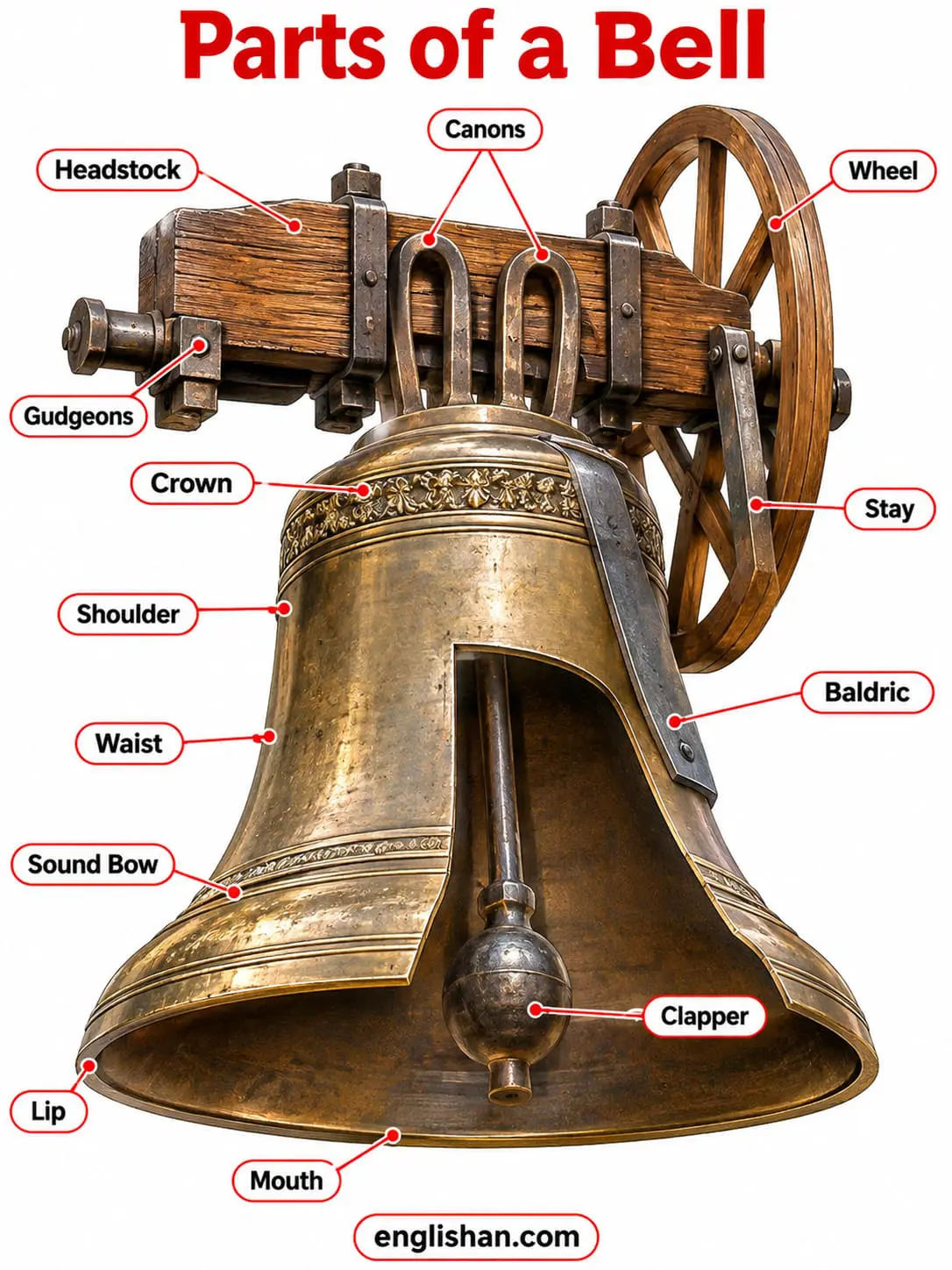
In a labeled diagram of a church bell, the headstock is at the top, and the canons connect it to the crown. The shoulder, the waist, and the sound bow follow down the side of the body, and the lip and the mouth are at the bottom. The clapper hangs inside.
| Part | Where you find it |
|---|---|
| 1. Headstock | Wood or metal beam that supports the bell, also called the yoke |
| 2. Canons | Suspension loops cast onto the crown |
| 3. Crown | Top of the bell, between the canons and the shoulder |
| 4. Shoulder | Upper sides of the bell, under the crown |
| 5. Waist | Middle sides of the bell, where the radius increases |
| 6. Sound bow | Thick part of the wall that the clapper strikes |
| 7. Lip | Lowest edge of the bell |
| 8. Mouth | Open bottom of the bell, bordered by the lip |
| 9. Clapper | Free-swinging metal piece inside the bell |
| 10. Baldric | U-shaped strap that suspends the clapper on early bells |
| 11. Gudgeons | Steel shafts on the headstock that form the axle |
| 12. Wheel | Circular wooden part on the headstock that holds the rope |
| 13. Stay | Wooden bar that stops the bell at its point of balance |
Parts of a Bell Body
The body is the cast metal resonator, and it holds seven of the parts of a bell, from the crown to the mouth. The canons are cast onto the crown as part of the same piece.
The body is bell metal, a bronze alloy of copper and tin with 20 to 23 percent tin. Large bells are about 80 percent copper and 20 percent tin, and brass and iron have also been used for large bells.
Crown and Canons
The crown is the top of the bell, between the canons and the shoulder. The canons are the suspension loops that attach the bell to the headstock, and they are also called the ear of the bell.
Older bells have an argent, a central boss on the crown around which the canons are grouped.
Shoulder and Waist
The shoulder is the upper side of the bell, under the crown. It forms a smooth curve and bears inscriptions or designs on many bells. The waist is the middle side, where the radius increases from the shoulder and the bell flares outward.
Sound Bow
The sound bow is the thick part of the bell against which the clapper strikes. On a church bell its thickness is one thirteenth of the bell’s diameter. The thickness lets the wall withstand repeated strikes.
A bell hung dead does not swing, and a hammer sounds it by hitting the sound bow. The strike point is a spot on the sound bow, and it is the point where the clapper or the hammer meets the bell.
Lip and Mouth
The lip is the lowest edge of the bell and surrounds the mouth. The mouth is the circular opening at the bottom, and the sound leaves the bell through it. Large bells are cast mouth downwards, and bells rung full circle start with the mouth uppermost.
Bell Clapper and Baldric
Among the parts of a bell, the clapper is the free-swinging piece of metal inside the body, and it is also called the tongue. It is a metal shaft that ends in a solid sphere, and the sphere strikes the sound bow. The upper arm of the shaft, over the pivot, is the flight.
On a bell with a crown staple, the staple bolt supports the clapper. Some bells have a separate clapper staple with its own nut on top of the headstock.
The baldric is a U-shaped metal strap with a leather lining. Early bells used it to suspend the clapper, and ringing sources also spell it baldrick.
The clapper ball is cast iron, with bronze on some heritage bells. The baldric is a metal strap with a leather lining.
Bell Headstock and Ringing Parts
The headstock is the beam that supports the bell, and it holds the fittings that let the parts of a bell swing. The wheel, the stay, and the gudgeons are attached to it. A bell that swings is mounted on a headstock, and a bell hung dead is fixed.
Headstock and Gudgeons
Timber was the traditional headstock material, and elm was frequently chosen for its durability. Metal headstocks, cast iron or fabricated steel, have been the most common choice since the early 20th century. A hollow cast iron headstock in box form has a high rigidity for its weight.
The gudgeons are the steel shafts fixed to the headstock. They fit into the bearings, and they form the axle about which the bell rotates. The bearings are the load-bearing assembly that lets the bell swing with minimal friction.
The headstock is elm or other timber, cast iron, or fabricated steel.
Wheel and Stay
The wheel is a circular wooden part attached to the headstock, and the bell rope is tied to it. The stay is a wooden bar attached to the headstock. Under normal use it stops the bell from moving beyond the point of balance when the bell is set.
The wheel and stay are wood.
Twiddle Pin
A twiddle pin is a threaded pin on either side of a metal headstock. It is screwed in until it contacts the clapper staple, and it adjusts the clapper position.
Parts of a Hand Bell
The parts of a bell change with its size and use, and a handbell has four. The handle is the part the ringer grips. It is traditionally leather and is now plastic on many handbells, and it is slightly flexible.
The casting is the bell body that the clapper strikes. The clapper is mounted on a hinge inside the bell, and on English handbells it moves back and forth in a single direction. Traditional English handbells have a leather clapper head and a rigid shaft, so the bell is held mouth up.
The spring holds the clapper away from the casting after the strike, so the bell rings freely. A handbell weighs from 7 ounces to 18 pounds.
The handbell handle is leather or plastic.
Bell Mouth Shoulder and Strike Point
A bell is measured at the mouth, the shoulder, and the strike point. The mouth diameter is the widest reading across the opening. The shoulder measurement is the inside diameter at the top of the bell.
The height of the strike point is measured from the lip, and the diameter is taken at that height. The inside height runs from the lip to the ceiling of the bell.
The clapper ball is about one ninth of the mouth diameter. A mouth 1.0 meter (39 inches) wide takes a ball about 110 millimeters (4.3 inches) across. Cast iron is the standard ball material, and some heritage bells use bronze.
Bell Part Names
Several parts of a bell have a second name in bellringing and foundry use.
| Part | Also called |
|---|---|
| Canons | Ear |
| Crown | Head |
| Headstock | Yoke |
| Clapper | Tongue |
| Baldric | Baldrick |
| Sound bow | Soundbow |
FAQs
The parts of a bell are the canons, the crown, the shoulder, the waist, the sound bow, the lip, the mouth, and the clapper. A church bell also has a headstock, gudgeons, a wheel, and a stay. The clapper strikes the sound bow to sound the note.
The parts of a church bell are the headstock, canons, crown, shoulder, waist, sound bow, lip, mouth, and clapper. The wheel, the stay, and the gudgeons are attached to the headstock. The baldric suspends the clapper on early bells.
The inside of a bell is the hollow of the body, and the clapper hangs in it. The clapper is a free-swinging piece of metal, also called the tongue. It strikes the sound bow.
The middle part of a bell is the waist. It is the middle side of the body, where the radius increases from the shoulder and the bell flares outward.
The end of a bell is the lip, the lowest edge of the body. The lip surrounds the mouth, the circular opening at the bottom where the sound leaves the bell.
The parts of a hand bell are the handle, the casting, the clapper, and the spring. The ringer grips the handle, and the clapper strikes the casting. The spring holds the clapper away from the casting after the strike.
The ringing part of a bell is the clapper, which strikes the sound bow. The wheel is the part that holds the bell rope. The bell rope is tied to the wheel on the headstock.
Related: