

The parts of a ukulele are the body, the neck, the headstock, the bridge, and four strings. The body is a hollow wooden soundbox that amplifies the strings. The neck has the fretboard and the frets, and the headstock has the tuners.
An acoustic ukulele runs from the headstock to the bridge. The internal parts, the acoustic-electric fittings, and the measurements of each size from soprano to baritone complete the instrument. The parts of a guitar follow the same layout with six strings and a larger body. The banjo replaces the wooden body with a drum-like head.
Parts of a Ukulele Labeled Diagram
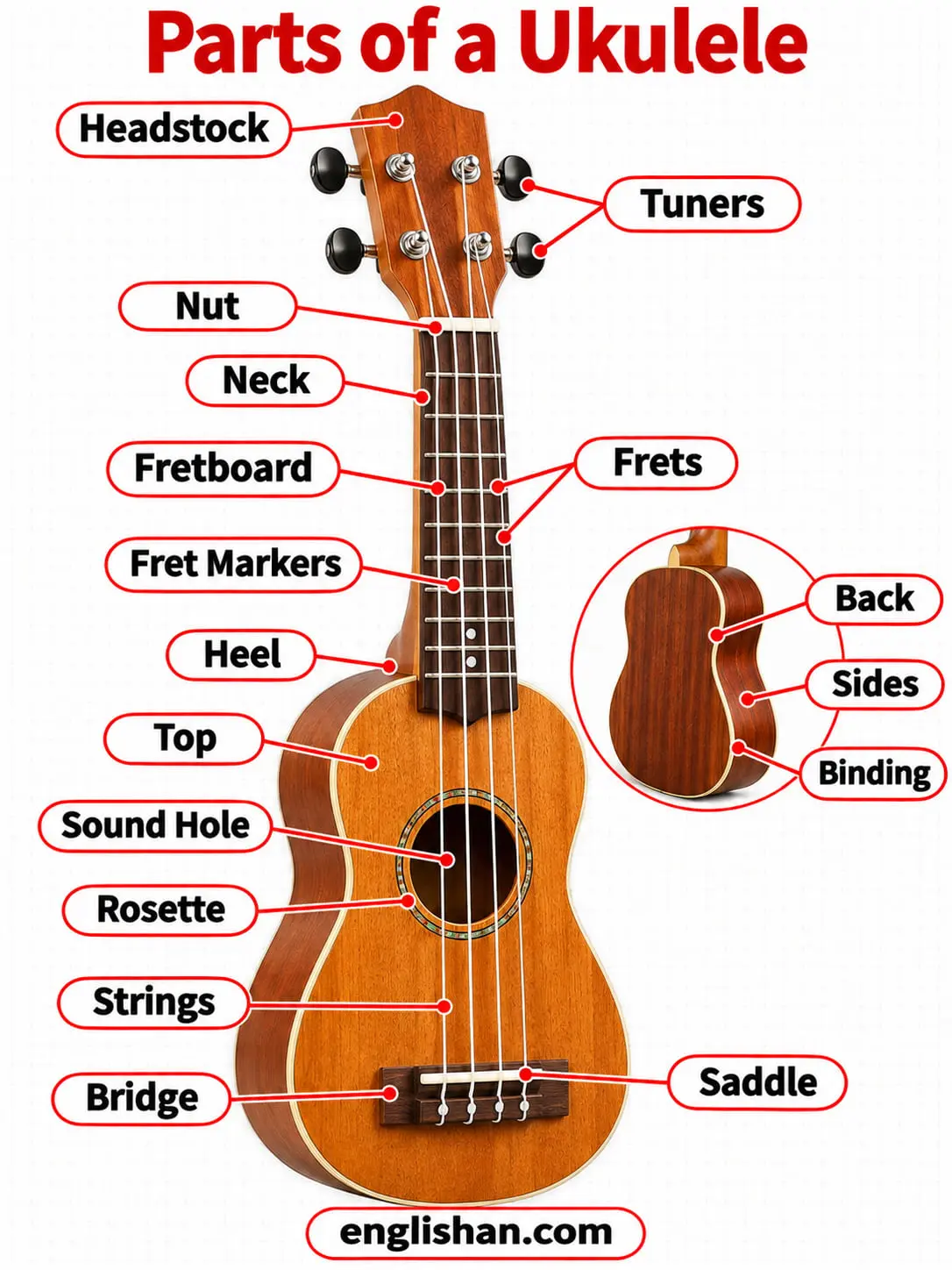
In a labeled diagram of a ukulele, the headstock is at the top and the neck extends down from it. The body is at the bottom, with the sound hole at the center and the bridge nearer the lower edge.
| Part | Where you find it |
|---|---|
| 1. Headstock | End of the neck that houses the tuners |
| 2. Tuners | Four machine heads on the headstock that set the pitch of each string |
| 3. Nut | Slotted strip at the top of the fretboard that spaces the strings |
| 4. Neck | Wooden length that the fretting hand grips |
| 5. Fretboard | Wood strip glued to the neck that has the frets set into it |
| 6. Frets | Metal wires set into the fretboard at fixed intervals |
| 7. Fret markers | Dots or inlays at frets 5, 7, 10, and 12 |
| 8. Heel | Joint where the neck meets the body |
| 9. Top | Soundboard on the front of the body |
| 10. Sound hole | Circular opening in the top |
| 11. Rosette | Decorative ring around the sound hole |
| 12. Back | Body plate opposite the top |
| 13. Sides | Curved wood strips that join the top to the back |
| 14. Binding | Thin strips along the edges where the body plates meet |
| 15. Bridge | Wood strip glued to the top where the strings attach |
| 16. Saddle | Strip set into the bridge that supports the strings |
| 17. Strings | Four strings from the tuners to the bridge |
How Many Parts a Ukulele Has
The parts of a ukulele have no single fixed number, because reference counts divide the instrument at different levels of detail. A count of three names the headstock, the neck, and the body. The violin and the cello are bowed instruments, so their parts include a bow and omit frets.
A longer count adds the tuners, the nut, the fretboard, the frets, the bridge, the saddle, the sound hole, and the strings. The labeled diagram names 17 parts, and the internal parts bring the total higher.
Parts of a Ukulele Body
The body is the wooden soundbox of the ukulele. It has an upper bout and a lower bout, and the double-bout outline is the most common shape. A larger body makes a louder ukulele.
Top and Soundboard
The top, also called the soundboard, is the front plate of the body. It vibrates to create sound and supports the bridge. Spruce is the soundboard wood on some cheaper models.
Back and Sides
The back is the plate opposite the top, and it is a harder wood on many ukuleles. The sides are the strips of wood that give the body its shape and depth. They are the same wood as the back on most ukuleles.
Sound Hole and Rosette
The sound hole is the circular opening in the top. It releases the sound from the body. The rosette is a decorative ring around the sound hole that also adds strength.
Binding
The binding is a set of thin strips along the edges where the body plates meet. It gives a color contrast and protects the edges. Some makers call it purfling.
Ukulele Internal Parts
The internal parts of a ukulele are the bracing, the kerfing, and the label. They are fitted inside the body and are visible through the sound hole.
Bracing: Thin wooden strips that reinforce the top and the back and resist warping.
Kerfing: Perforated wooden strips bent inside the sides. They add a gluing surface and sturdiness.
Label: A paper label inside the sound hole. It lists the maker, the model, the date, and the serial number.
Ukulele Bridge and Saddle Parts
The bridge and the saddle transfer the vibration of the strings to the top. The strings tie to the bridge at the lower end of the body and pass over the saddle toward the neck.
The bridge is a wooden strip glued to the soundboard, and the wood is rosewood or ebony. The saddle is a removable strip set into the bridge. It sets the string height over the fretboard and is plastic or bone.
Parts of a Ukulele Neck
The neck is the length of the ukulele that the fretting hand grips. It is mahogany, maple, koa, rosewood, ebony, or wenge, and cheaper models use plastic.
Fretboard and Frets
The fretboard is a wood strip glued to the neck, and it is rosewood or ebony. Frets are metal wires set into slots in the fretboard. Each fret shortens the vibrating length of a string to raise its pitch.
The frets are stainless steel or an alloy of copper, nickel, and zinc. The fret count depends on the size, from 10 to 12 on a pocket ukulele to 18 to 21 on a baritone.
Fret Markers
Fret markers are dots or inlays that show the position of the fingers on the neck. They are placed at frets 5, 7, 10, and 12. They are plastic, wood, mother of pearl, or abalone.
Nut
The nut is a slotted strip at the top of the fretboard. It sets the height, the spacing, and the break angle of the strings. Bone, Tusq, Corian, plastic, graphite, and brass are the nut materials.
Heel
The heel is the deepest part of the neck, where it joins the body. It is glued to the body, and many ukuleles have a strap button on it.
Parts of a Ukulele Headstock and Tuners
The headstock is the end of the neck, and it houses the tuners. It is a standard or a slotted style. The brand logo is on the front of the headstock.
Tuners
The tuners are machine heads that raise or lower the pitch of a string. A ukulele has four, set two on each side or four in a line. Geared tuners are common on laminate ukuleles, and friction tuners are fitted to pricier models.
Tuning Peg and Tuning Post
The tuning peg is the part that the player turns. The tuning post is the cylinder that the string winds around.
Ukulele String Parts
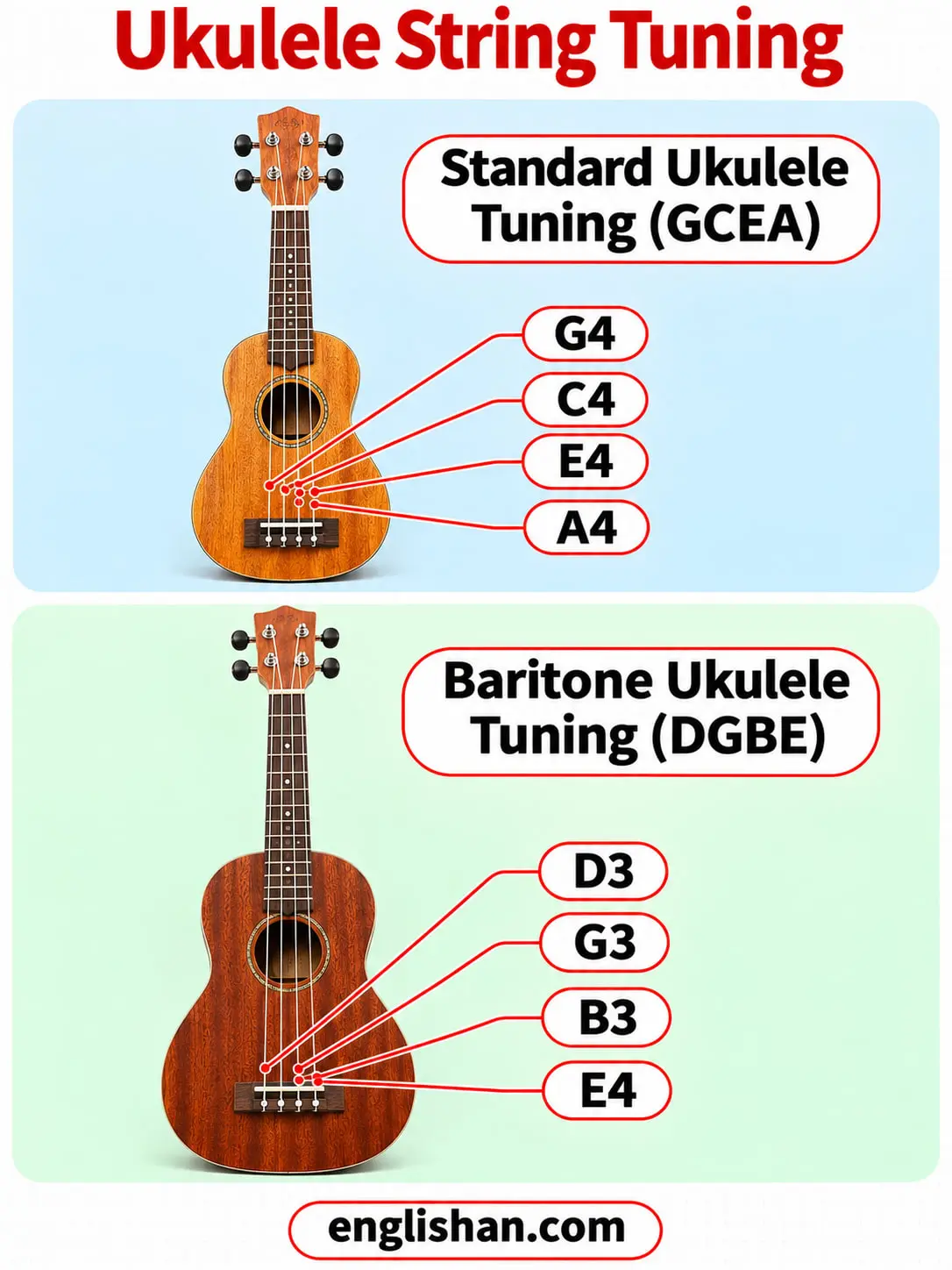
A ukulele has four strings, and some models pair them into courses. Each string is tuned to a different pitch. Standard tuning on a soprano is G4, C4, E4, and A4, written GCEA.
The G string is higher than the C string, a layout called reentrant tuning. A baritone ukulele is tuned to D3, G3, B3, and E4, written DGBE, like the top four strings of a guitar.
Modern strings are nylon, fluorocarbon, or synthetic gut. Wound strings have a nylon core wound with aluminum or silver-plated copper. The first strings were catgut.
Parts of a Ukulele by Size
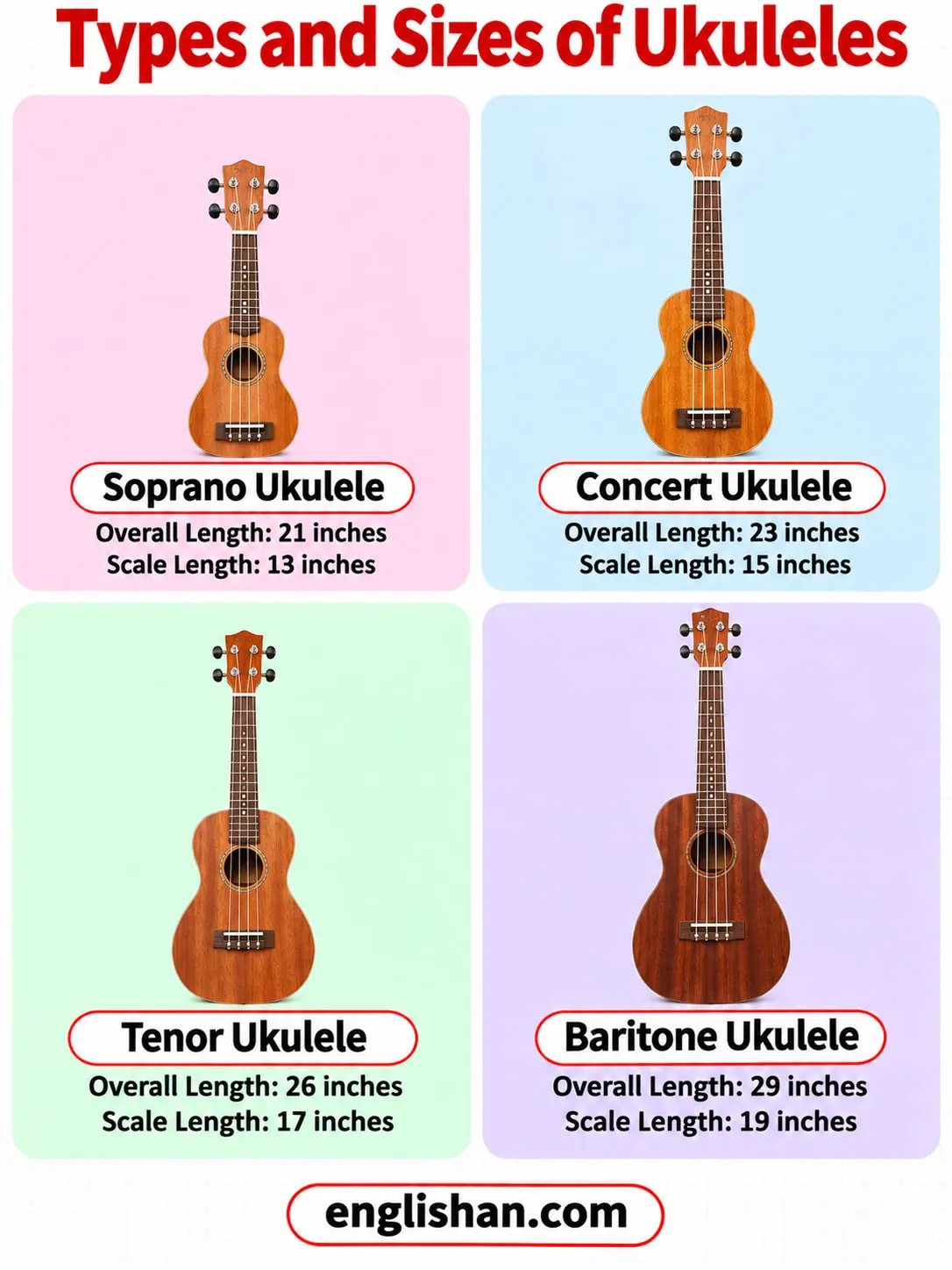
The parts of a ukulele are the same on every size, and the measurements grow with the size. The soprano is the standard size, and the baritone is the largest of the four everyday sizes.
| Size | Body length | Scale length | Frets |
|---|---|---|---|
| 16 inches | 11 inches | 10 to 12 | |
| Soprano | 21 inches | 13 inches | 12 to 15 |
| Concert | 23 inches | 15 inches | 15 to 18 |
| Tenor | 26 inches | 17 inches | 17 to 19 |
| Baritone | 29 inches | 19 inches | 18 to 21 |
| Bass | 30 inches | 20 inches | 16 to 18 |
| Contrabass | 32 inches | 21 inches | 16 |
Acoustic-Electric Ukulele Parts
An acoustic-electric ukulele adds fittings to the acoustic parts. The electronics are a pickup and an output system with an equalizer panel for amplification.
The cutaway is a removed part of the body that gives access to the higher frets. The pickup jack is a side-mounted socket on the lower body for a cable, and it doubles as a strap button on many models. A sound port is a side opening on the upper bout that lets the player hear the instrument.
Ukulele Parts and Their Materials
The materials of the parts of a ukulele vary with the price. Solid wood bodies are costlier than laminated ones.
Koa: The traditional body wood. It is an acacia native to Hawaii.
Mahogany: The body wood of more expensive solid hardwood ukuleles.
Spruce: The soundboard wood on some cheaper laminated models.
Rosewood and ebony: The fretboard and the bridge.
Bone and plastic: The saddle, with bone, Tusq, Corian, graphite, and brass for the nut.
Strings: Nylon, fluorocarbon, or synthetic gut.
FAQs
The parts of a ukulele are the body, the neck, the headstock, the bridge, and four strings. The body has the top, the back, the sides, and the sound hole. The neck has the fretboard, the frets, and the nut.
The count depends on the level of detail. A count of three names the headstock, the neck, and the body. A longer count names 17 parts from the tuners to the saddle.
The strings attach to the bridge at the lower end of the body. At the other end, each string winds around a tuning post on the headstock. The strings pass over the saddle and the nut between the bridge and the tuning post.
No, each string is tuned to a different pitch. Standard tuning is G4, C4, E4, and A4, and the strings are nylon, fluorocarbon, or synthetic gut. Some models pair the strings into courses.
The parts of a ukulele body are the top, the back, the sides, the sound hole, the rosette, and the binding. Inside the body are the bracing, the kerfing, and the label.
The bridge and the saddle are the two parts of a ukulele bridge. The bridge is a wooden strip glued to the top, and the saddle is the removable strip set into it.
The parts of a ukulele neck are the fretboard, the frets, the fret markers, the nut, and the heel. The fretboard is glued to the neck, and the heel joins the neck to the body.
A baritone ukulele has the same parts as the smaller sizes. It has a 29 inch body, a 19 inch scale length, and 18 to 21 frets, and it is tuned to DGBE.
Related:
