

The parts of a windmill depend on the machine the wind drives. A corn mill turns millstones through sails, a windshaft, and a train of gears. A farm windmill lifts water through a bladed wheel and a pump rod. A wind turbine makes electricity with a rotor and a generator.
Sources name the parts of a windmill at different levels of detail. The Danish Windmill site names eight visible parts of a corn mill, and Brixton Windmill defines more than 35 terms in its glossary. A water-pumping windmill has about nine, according to the University of Twente’s WOT pages.
Parts of a Windmill Labeled Diagram
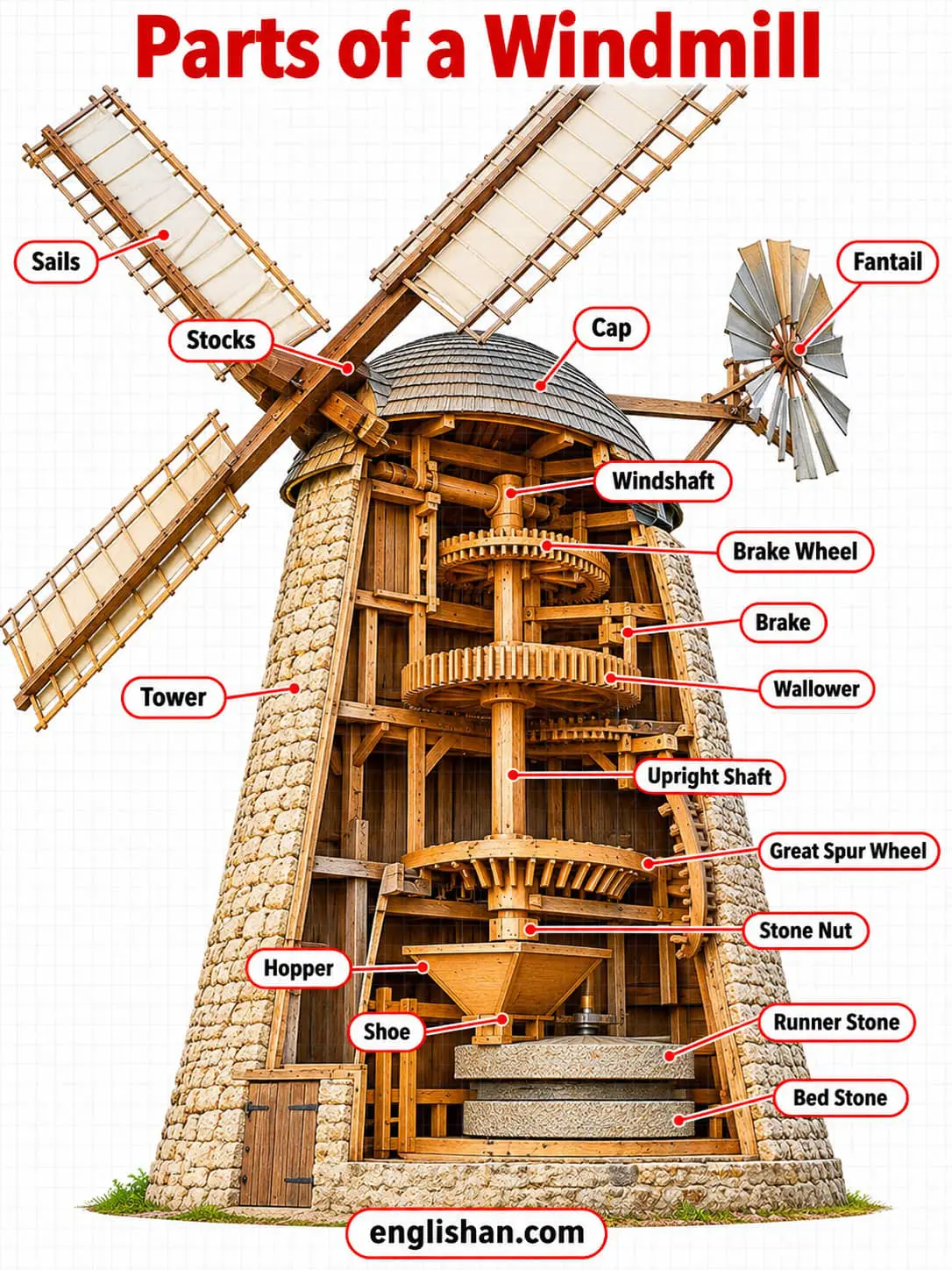
A labeled diagram of a tower mill shows the sails on the cap at the top. The windshaft and brake wheel are inside the cap, and the gears run down the center of the mill to the millstones. The numbered rows follow that route from the sails to the grain.
| Part | Connects to | Function |
|---|---|---|
| 1. Sails | Stocks and windshaft | Catch the wind and turn the windshaft |
| 2. Cap | Tower curb | Turns the sails into the wind and houses the brake |
| 3. Fantail | Cap | Turns the cap automatically to face the wind |
| 4. Tower | Cap | Supports the cap and the machinery inside |
| 5. Windshaft | Sails and brake wheel | Bears the sails and the brake wheel |
| 6. Brake | Brake wheel | Stops the sails when the miller pulls a lever |
| 7. Brake wheel | Wallower | Drives the wallower with teeth on the side of its rim |
| 8. Wallower | Upright shaft | Turns the first gear on the vertical shaft |
| 9. Upright shaft | Great spur wheel | Passes power down from the wallower |
| 10. Great spur wheel | Stone nuts | Drives one or more stone nuts |
| 11. Stone nut | Quant | Transmits power to the shaft of a millstone |
| 12. Runner stone | Bed stone | Turns on the bed stone to grind grain |
| 13. Bed stone | Vat | Forms the fixed lower millstone |
| 14. Hopper | Shoe | Stores grain and feeds the stones |
Windmill Post Mill and Tower Mill Parts
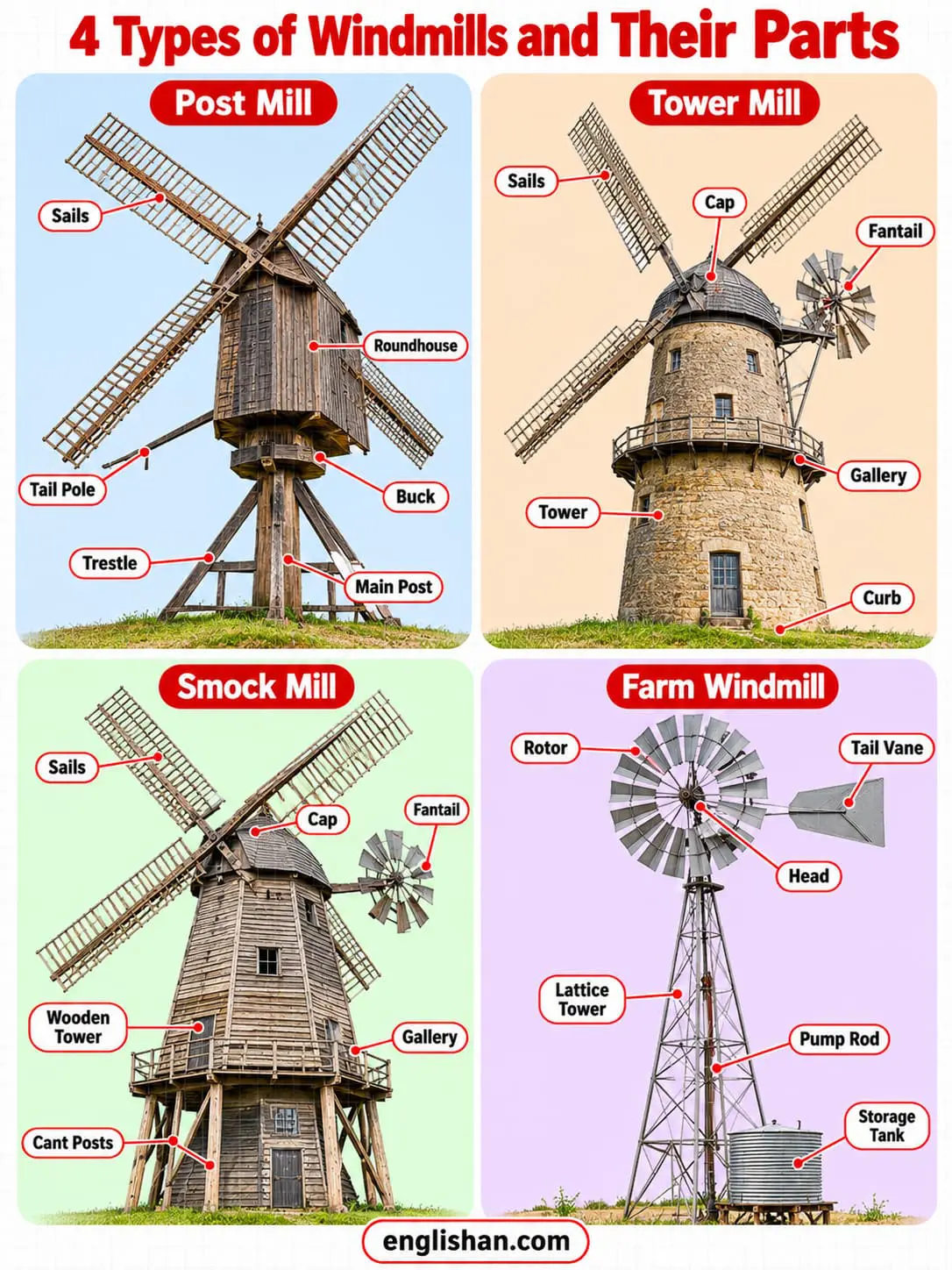
Every windmill must face its sails into the wind, and the type of mill depends on which of the moving parts of a windmill turns. A post mill turns its whole body. A tower mill or a smock mill turns only the cap. A farm windmill turns its head.
| Type | What turns | Build |
|---|---|---|
| Post mill | The whole body, called the buck | Wooden body on a large upright post |
| Tower mill | The cap | Brick or stone tower |
| Smock mill | The cap | Wooden mill with a rotating cap |
| Farm windmill | The head with the rotor and tail vane | Lattice tower of wood or steel |
Masonry tower mills were introduced by the end of the 13th century. Because only the cap turns, the tower is much taller, which allows longer sails that work in low winds. Tower mills cost more to build than post mills. The post mill was the most common type in Europe until the 19th century.
Windmill Sails
The sail parts of a windmill are the sails, the stocks that hold them, and the two ends of each sail, the heel and the tip.
Sails
The sails are the large arms that catch the wind and start the turning. Most windmills have four sails, and five, six, or eight were built mainly in Great Britain. An even number lets a mill keep running with a damaged sail, because the miller removes that sail and the opposite one and the mill stays balanced.
Stocks
A stock is the arm that projects from the top of the mill and holds a sail frame. The cap of a tower mill holds the stocks and the sails.
Heel
The heel is the part of a sail closest to the windshaft.
Tip
The tip is the part of a sail farthest from the windshaft.
The sources describe four sail designs:
- Common sails: a lattice frame with sailcloth spread over it. Brixton Windmill calls this the oldest and most powerful sail type, and the miller sets the amount of cloth.
- Jib sails: a triangle of cloth wound round a spar, found in Mediterranean countries.
- Patent sails: William Cubitt’s 1807 design replaced the cloth with connected shutters, spring-loaded so they adjust to wind speed. Opening the shutters to let a strong gust through is called spilling the wind, and the mill need not stop for the adjustment.
- Berton sails: longitudinal wooden slats, devised by Pierre-Théophile Berton in France, that the miller opens while the mill turns.
Parts of a Windmill Cap and Tower
The cap and the tower are the structural parts of a windmill that hold the sails and the machinery. Only the cap rotates on a tower mill.
Cap and Curb
Cap
The cap is the rotating wooden roof at the top of a tower mill or smock mill. It turns the sails into the wind, houses the brake, and holds the stocks and sails. Winches or gearing inside the cap, or a winch on a tail pole outside the mill, turn the cap. In a severe storm, quartering turns the cap 90 degrees away from the wind.
Curb
The curb is a metal rim with rollers on top of the tower. It supports the cap on the tower.
Centring wheels
Centring wheels are metal wheels that hold the cap in position on the curb.
Fantail
The fantail is a small windmill set at right angles to the sails at the rear of the cap. Wind on the fantail turns the cap automatically, so the sails keep facing the wind. The English engineer Edmund Lee invented it in 1745. It is common in Great Britain, Denmark, Germany, and English-speaking former British Empire countries, and rare elsewhere.
Tower and Gallery
Tower
The tower is the brick or stone body of a tower mill, and only the cap on top of it rotates. The floors inside it hold the grain, the stones, and the gears, and the base floor is where grain was stored.
Gallery
The gallery is a deck around the outside of the mill, present in some mills. It gives access to the sails for repairs.
Cant posts
A smock mill has a wooden tower, and an octagonal wooden tower has eight cant posts, one at each corner.
Parts of a Windmill Drive Train
The drive train is the set of parts of a windmill that move power from the sails to the stones. It starts at the windshaft near the top of the mill and ends at the stone nuts near the floor.
Windshaft and Canister
Windshaft
The windshaft is the horizontal axle at the top of the mill that bears the sails. It is made of wood, of wood with a cast iron poll end where the sails are mounted, or entirely of cast iron. In a smock mill or tower mill, it also bears the brake wheel, and in a post mill it bears a head wheel and a tail wheel in its place.
Canister
The canister is an iron fitting that joins the sail timbers to the windshaft.
Neck
The neck is the end of the windshaft closer to the sails.
Collar
The collar is the bearing on the front end of the windshaft that prevents wear.
Half-bearing
The half-bearing is a block of stone or metal on which the neck of the windshaft rests.
Brake Wheel and Brake
Brake wheel
The brake wheel is fitted on the windshaft between the front and rear bearings, near the top of the mill, and the sails turn it directly. Teeth on the side of its rim drive the wallower.
Brake
The brake runs around the outside of the brake wheel rim. Pulling a lever linked to the brake wheel applies it and stops the sails.
Wallower and Upright Shaft
Wallower
The wallower is the horizontal gear on the top end of the upright shaft. The brake wheel’s teeth drive it, so it is the first gear on the vertical shaft.
Upright shaft
The upright shaft is the central vertical shaft that passes power from the wallower down to the great spur wheel.
Great Spur Wheel and Stone Nuts
Great spur wheel
The great spur wheel is a large cog lower on the upright shaft. It drives one or more stone nuts.
Stone nut
A stone nut is a small cog on the quant that transmits power from the great spur wheel to a millstone.
Quant
The quant is the shaft that turns a runner stone.
When the gears are on the floor beneath the stones, the mill is called under-driven.
Windmill Millstones and Hopper
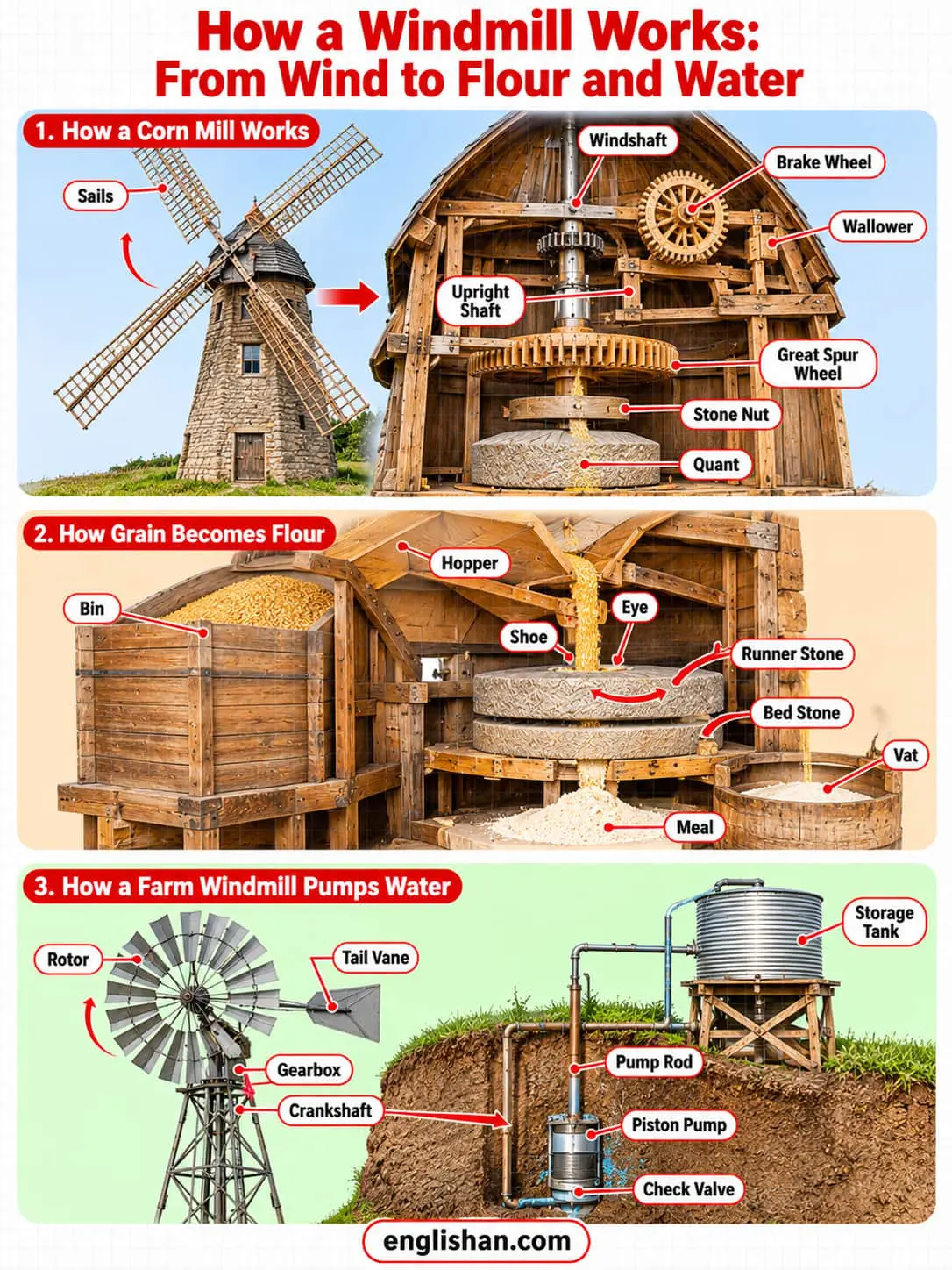
Ten milling parts of a windmill handle the grain between the bin and the flour. The runner stone turns over the bed stone, and a wooden casing called the vat encloses both.
| Step | Part | Role |
|---|---|---|
| 1 | Bin | Holds the grain before milling |
| 2 | Hopper | Funnel that stores the grain and feeds the stones |
| 3 | Shoe | Moves the grain from the hopper into the eye |
| 4 | Eye | Central hole in the runner stone where the grain enters |
| 5 | Runner and bed stones | Grind the grain as the runner turns over the bed stone |
| 6 | Meal | Grain after grinding |
Bin
The bin is a container for grain on the third floor.
Hopper
The hopper is a large funnel that stores grain and feeds it to the stones.
Shoe
The shoe feeds grain from the hopper into the eye of the runner stone.
Eye
The eye is the central hole in the runner stone where grain is poured in.
Runner stone
The runner stone is the top millstone. It turns over the bed stone to grind the grain.
Bed stone
The bed stone is the fixed bottom millstone under the runner stone. Mills have two or three pairs of stones per run.
Vat
The vat is the wooden casing that encloses the millstones.
Governors
Governors are spinning balls that change the gap between the stones as the wind speed changes.
Tentering gear
Tentering gear is a set of levers that raise or lower the runner stone to change the fineness of the flour.
Sack hoist
The sack hoist is a wind-powered hoist that lifts grain sacks to the top of the mill.
Stone dressing means cutting grooves into the grinding surface of a stone to catch the grain. French burrstone is made of small stone pieces set in plaster, and millstone grit comes from places such as the Derbyshire Peak District.
Parts of a Post Mill
Most parts of a windmill are the same in a post mill, but the whole body turns on one post.
Buck
The buck, or body, is balanced on a large upright post, so it turns to face the wind. It holds all the milling machinery.
Post
The post is the large upright support that balances the buck. In early sunken post mills it was buried in an earth mound. A hollow-post mill has a hollowed post that holds the drive shaft, and the Netherlands used hollow-post mills to drain wetlands from the early 15th century.
Trestle
The trestle is the wooden support used in later post mills in place of the buried post.
Roundhouse
The roundhouse is a structure that surrounds the trestle on some mills, for protection and storage.
Tail pole
Many post mills have a tail pole, which bears a fantail.
Head wheel and tail wheel
Some post mills drive the stone nuts directly from a head wheel or a tail wheel instead of using a spur wheel. Both wheels are mounted on the windshaft.
Parts of a Farm Windmill That Pumps Water
A farm windmill is a windpump, and the parts of a windmill built for pumping differ from those of a corn mill. Its rotor drives a piston pump instead of millstones. Wikipedia describes a multi-bladed windpump on a lattice tower of wood or steel.
| Part | Function |
|---|---|
| Tower | Supports the head |
| Head | Holds the rotor, the tail vane, and the security system |
| Rotor | Wheel of 8 to 24 blades that gives the high torque a piston pump needs |
| Tail vane | Keeps the rotor facing the wind |
| Security system | Side vane or angled vane that turns the rotor out of the wind at high wind speeds |
| Gearbox and crankshaft | Convert the rotary motion into up-and-down piston strokes |
| Pump rod | Transmits the strokes down to the pump in the well |
| Piston pump | Lifts the water |
| Check valve | Opens and closes with water pressure to fill the pump chamber |
| Transmission | Adds torque for pumping water from deep boreholes |
| Storage tank | Holds water for windless periods |
Tower
The tower is a lattice of wood or steel that supports the head.
Head
The head holds the rotor, the tail vane, and the security system.
Rotor
The rotor is a wheel of 8 to 24 blades that gives the high torque a piston pump needs. More blades mean slower rotation. A 16 ft (4.8 m) multi-bladed rotor lifts up to 1,600 US gallons per hour to 100 ft in a 15 to 20 mph wind.
Tail vane
The tail vane, called the main vane by the University of Twente, keeps the rotor facing the wind. This lets the mill work from different directions.
Security system
The security system is a side vane, or an angled vane with an off-center top. It turns the rotor out of the wind at high wind speeds.
Gearbox and crankshaft
The gearbox and crankshaft convert the rotary motion of the rotor into up-and-down piston strokes. The gearbox houses the gears, the pump rod connection, and an oil reservoir, and it needs an oil change about once a year.
Pump rod
The pump rod is a long rod that the gearbox drives to pump water from an underground well. It transmits the strokes down to the pump cylinder, and pumping too fast buckles it.
Piston pump
The piston pump is the typical pump for a water-pumping mill. It needs about three times as much torque to start as to keep running.
Check valve
The check valve opens and closes with water pressure to fill the pump chamber.
Transmission
The transmission is optional. It adds torque, which allows water to be pumped from deep boreholes.
Storage tank
The storage tank holds water as a buffer for windless periods. It must be sealed if the water is for drinking.
Windmill and Wind Turbine Rotors
The parts of a windmill and the parts of a turbine share a rotor that turns in the wind. They differ in what the rotation drives.
| Feature | Corn mill | Farm windmill | Wind turbine |
|---|---|---|---|
| Main job | Grinds grain | Pumps water | Generates electricity |
| Blades | Four sails on most mills | 8 to 24 blades | Only a few blades |
| Power goes to | Millstones through gears | Piston pump through a crankshaft | Generator built into the head |
A turbine needs few blades because its generator needs high rotation speed and little torque. A farm windmill needs many blades for the opposite reason. The best multi-bladed rotors reach about 30 percent efficiency, and modern turbine rotors exceed 40 percent. Nacelle, gearbox, and yaw system are described in parts of a wind turbine.
FAQs
The parts of a traditional windmill are the sails, cap, tower, windshaft, brake wheel, wallower, upright shaft, great spur wheel, stone nut, and millstones. A farm windmill has a rotor, tail vane, gearbox, pump rod, and tower instead. Which names apply depends on whether the windmill grinds grain or pumps water.
The main parts of a corn mill are the sails, the cap, the windshaft, the brake wheel, the gears, and the millstones. The Danish Windmill site adds the hopper and the sack hoist. Together these eight parts take the wind from the sails to the grain.
The count depends on the source. The Danish Windmill site names eight visible parts of a corn mill. The University of Twente describes about nine parts for a water-pumping windmill, and the Brixton Windmill glossary defines more than 35 terms.
The sails, the windshaft, the brake wheel, the wallower, the upright shaft, the great spur wheel, the stone nuts, and the runner stone all turn in a corn mill. In a farm windmill, the rotor and the crankshaft turn. The tower and the bed stone stay fixed.
Wind turns the sails and the windshaft. The brake wheel on the windshaft drives the wallower, and the wallower turns the upright shaft. The great spur wheel on that shaft drives the stone nuts, and the stone nuts turn the runner stone against the bed stone to grind grain.
A water-pumping windmill has a tower, a head, a rotor of 8 to 24 blades, a tail vane, and a security system. Its gearbox and crankshaft turn the rotation into piston strokes. A pump rod passes the strokes to the pump, and a storage tank holds the water.
No part of a traditional windmill measures the wind. The fantail on a tower mill and the tail vane on a farm windmill turn the sails to face the wind instead. The fantail turns the cap, and the tail vane keeps the rotor aligned.
Dutch windmills include post mills, tower mills, and hollow-post drainage mills. A tower mill has sails on stocks, a rotating cap, a windshaft, and a brake wheel. The Netherlands had about 10,000 windmills around 1850, and about 1,000 remain.
Two named parts start with V. The vane is the tail of a farm windmill, which keeps the sails facing the wind. The vat is the wooden casing that encloses the millstones in a corn mill.
A windmill drives machinery directly, while a wind turbine drives a generator. A corn mill has millstones, a farm windmill has a pump, and a turbine has a generator in its head. Most corn mills have four sails and farm windmills have 8 to 24 blades, while turbine rotors have only a few.
Related:
