

In a gasoline chainsaw, the engine turns a clutch, the clutch turns a sprocket, and the sprocket drives the chain around the guide bar. The parts of a chainsaw are grouped around that drive line: the cutting attachment at the front, the power head behind it, and the handles and safety devices that control it.
An electric chainsaw replaces the two-stroke engine with a motor that runs on a battery or a power cord. The guide bar, the chain, the handles, and the safety devices are the same on both types.
Parts of a Chainsaw Labeled Diagram
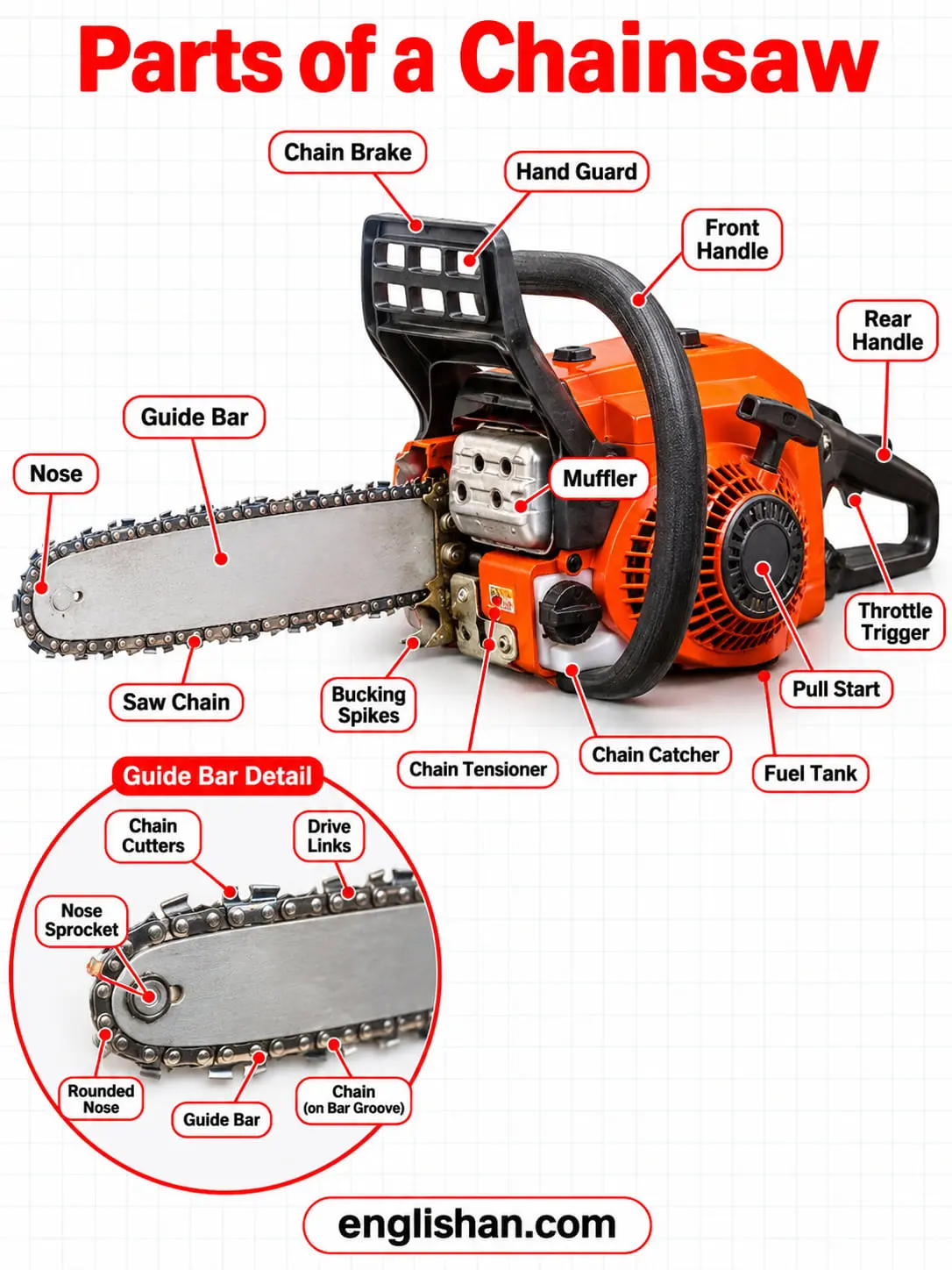
A labeled diagram of a gasoline chainsaw shows the guide bar and chain at the front, with the nose at the bar tip and the hand guard behind the bar. The front handle holds the front of the saw, and the rear handle holds the back. The engine, the fuel tank, the oil reservoir, and the pull start make up the power head.
| Part | Function |
|---|---|
| 1. Guide bar | Supports the chain and guides it around the bar |
| 2. Nose | Front end of the bar, where the nose sprocket is mounted |
| 3. Saw chain | Riveted cutting chain that does the cutting |
| 4. Chain tensioner | Screw or wheel that sets the chain tension |
| 5. Chain catcher | Hook that stops a chain that breaks or derails |
| 6. Hand guard | Shield for the front hand that activates the chain brake |
| 7. Chain brake | Stops the chain during kickback |
| 8. Front handle | Holds the front of the saw |
| 9. Rear handle | Holds the back of the saw |
| 10. Throttle and interlock | Controls chain speed; the interlock blocks accidental activation |
| 11. Bucking spikes | Metal spikes that hold the saw steady against wood |
| 12. Muffler | Reduces exhaust noise |
| 13. Pull start | Cord that starts a gas engine |
| 14. Fuel tank | Holds the gasoline and oil mixture |
| 15. Oil reservoir | Holds the bar and chain oil |
Chainsaw Guide Bar and Tensioner
The guide bar is an elongated bar with a round end, made of wear-resistant alloy steel. Its length runs from 40 to 90 cm (15.5 to 35.5 in), and an edge slot holds and guides the chain.
Solid and Laminated Chainsaw Guide Bar
Laminated bars are lighter than solid bars. Solid bars suit professional use, and many have an exchangeable nose. Safety bars are laminated bars with a small nose sprocket, and they are fitted to consumer saws.
Nose and Nose Sprocket
The nose is the front end of the bar. The nose sprocket at the tip wears faster than the bar itself. Sawyers cut under the nose, since cutting at the nose or over it causes kickback.
Chain Tensioner
The tensioner is operated by a screw or a manual wheel. It mounts either on the side of the saw under the exhaust or inside the clutch cover. Some saws add a tool-free tensioning knob.
A chain set too tight cannot spin fast enough, and a chain set too loose falls off the bar. The oil pump outlet must also line up with the hole in the bar so that oil reaches the chain.
Parts of a Chainsaw Chain
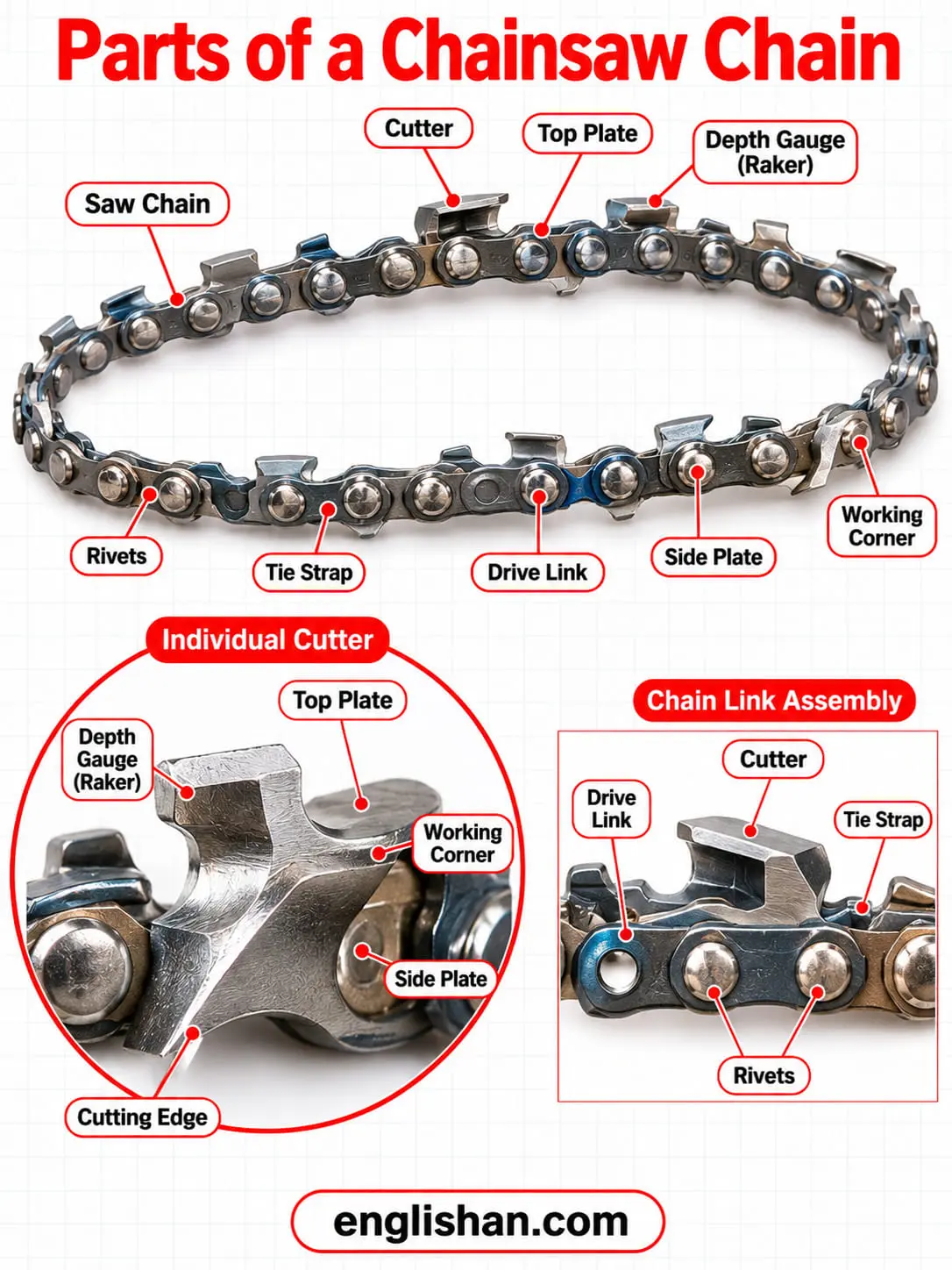
A saw chain is made of riveted metal sections, like a bicycle chain without rollers. The cutting teeth are chromium-plated steel tabs, and left-handed and right-handed teeth alternate along the chain.
Chainsaw Cutter Top Plate and Side Plate
Each cutter is a tooth with three named surfaces. The top plate drops toward the rear and tapers in width, which sets the clearance angle. The side plate cuts the chip off the side of the wood, and the working corner, also called the cutting corner, carves out the chip.
Depth Gauge
The depth gauge, also called the raker, is in front of each cutter and limits how deep the tooth cuts. Its height is about 0.5 mm (0.025 in).
Drive Link
The drive link is a flat metal finger on the inside of the chain loop. It keeps the chain on the bar, moves oil along the bar, and engages the sprocket that delivers engine power.
Tie Strap and Rivets
Tie straps separate the cutters from each other. Each tie strap links a drive link to a cutter, and special rivets let the links move. The rivets hold all of the steel links together.
Tooth Shapes and Layouts
A full chisel tooth has a square corner between the side plate and the working corner. It cuts with lower resistance, and professionals favor it, but it needs precise sharpening. A semi-chisel tooth has a rounded corner, resists dirt better, and is easier to resharpen. A chipper tooth has a full radius over the cutting portion.
A full complement chain alternates one cutter with one drive link. A skip chain puts two drive links between cutters, which gives one third fewer cutting teeth and suits bars of 24 inches or longer. Tungsten carbide chains are used where soil contaminates the cut, such as in roots.
Pitch and Gauge
| Measure | What it describes | Standard sizes |
|---|---|---|
| Pitch | Average distance between two rivets | 0.325, 0.375, and 0.404 in |
| Gauge | Thickness of the drive links | 0.043, 0.050, 0.058, 0.063, and 0.080 in |
A 3/4 in pitch is used on harvesters.
Parts of a Chainsaw Clutch and Sprocket
The clutch is a centrifugal clutch. It expands as the engine speeds up and engages a drum, and the sprocket mounts on that drum. The sprocket is fixed or exchangeable, and the drive links of the chain engage it.
At idle speed, 2,500 to 2,700 rpm, the clutch stays disengaged and the chain does not move. The clutch also protects the engine when the chain stalls in wood and protects the operator during kickback.
Chainsaw Safety Parts
The safety devices among the parts of a chainsaw act on the chain, the throttle, and the operator’s hands. Each device blocks a specific hazard: kickback, a broken chain, accidental acceleration, vibration, noise, or sparks.
Chain Brake and Hand Guard
The chain brake stops the chain when the sawyer’s hand or the inertia of kickback activates it. It tensions a band around the clutch drum and halts the chain within milliseconds. The hand guard activates the brake and keeps the sawyer’s hand from touching the chain, and the activator is forward of the upper handle.
Chain Catcher
The chain catcher is an aluminum hook between the saw body and the clutch cover. It reduces the risk of the chain contacting the sawyer if the chain breaks or derails. A guard on the rear handle also protects the hand when the chain derails.
Throttle Interlock
The throttle interlock prevents the throttle from being activated by accident. The throttle works only after the operator holds the interlock down.
Anti-Vibration System
The anti-vibration system is a set of springs or rubber buffers between the engine and the handles. It decouples the handles from the engine and the bar, and it reduces the vibration that reaches the sawyer’s hands.
Muffler and Spark Arrester
The muffler reduces exhaust noise on gasoline models. The spark arrester prevents hot sparks from leaving the muffler.
Parts of a Chainsaw Engine
A gasoline chainsaw uses a two-stroke single-cylinder engine, with a displacement of 30 to 120 cc. Two-stroke engines suit chainsaws for their power-to-weight ratio and their simplicity.
Fuel and Air Parts
The carburetor controls the fuel intake of the engine. Modern gasoline saws use a diaphragm carburetor, which draws fuel by the pressure changes in the crankcase. Early carburetors with a gravity-fed float chamber stalled when the saw was tilted. The air filter keeps sawdust and dirt out of the engine, and it needs cleaning from time to time.
The choke valve helps the engine start by adjusting the mix of air and fuel. Most chainsaws also have adjustment screws marked H and L. The L screw sets the air and fuel mixture at low rpm, and H applies to heavy cutting. A T mark labels the idle setting. A summer and winter shutter controls the airflow in and out of the engine.
Ignition and Starting Parts
The spark plug ignites the fuel in the engine. The pull start, also called the recoil start, rope start, or rewind start, is a cord that turns the engine over. The decompression valve releases compression from the combustion chamber during starting.
The flywheel regulates engine speed and helps cool the motor so that it does not overheat.
Chainsaw Handles and Throttle
The front handle, also called the handlebar, holds the front of the saw. The rear handle, also called the throttle handle, holds the back of the saw. The throttle controls chain speed. On a gasoline saw it controls the fuel the engine receives, and on an electric saw it controls the current from the battery.
Bucking spikes, also called bumper spikes or dogs, are metal spikes where the bar meets the engine. They hold the saw steady against wood and let the sawyer dig the saw into a log for a straighter cut. Most chainsaws now weigh 4 to 5 kg (9 to 11 lb), and heavy-duty models weigh 7 to 9 kg.
Chainsaw Fuel and Oil Tanks
A gasoline chainsaw has two tanks. The fuel tank holds gasoline mixed with two-stroke oil, at 2 percent (1:50) for most modern gasoline saws. The oil reservoir holds the bar and chain oil.
The oil pump sends bar oil through a small hole in the bar to the chain. The oil system is unsealed, so oil is thrown off during use. Reservoirs are sized to lose half their oil for every tank of fuel, so the oil is refilled at every refueling.
Parts of an Electric Chainsaw
The parts of an electric chainsaw differ from a gasoline saw in the power source: a motor replaces the engine, and a power switch replaces the pull start. Corded models run on a power cord. Cordless models use a battery, which takes the place of the fuel tank, and a brushless motor.
The throttle on an electric saw controls the current from the battery. There is no carburetor, choke, primer bulb, or pull start. A battery lasts about 45 minutes to 1 hour.
Stihl built the first electric chainsaw in 1926. Corded saws were sold to the public from the 1960s, cordless lithium-battery saws emerged in the late 2010s, and Husqvarna and Stihl began making full-size electric log-cutting saws in the early 2020s.
Chainsaw Part Names
Makers and sawyers use more than one name for several parts of a chainsaw.
| Part | Also called |
|---|---|
| Guide bar | Bar |
| Bucking spikes | Bumper spikes, dogs |
| Pull start | Pull cord, recoil start, rope start, rewind start |
| Depth gauge | Raker |
| Saw chain | Cutting chain |
| Throttle interlock | Throttle lock |
| Front handle | Handlebar |
| Rear handle | Throttle handle |
| Chainsaw | Chain saw |
FAQs
The parts of a chainsaw are the guide bar, the chain, the tensioner, the clutch and sprocket, the handles and throttle, the engine, and the fuel and oil tanks. The safety devices are the chain brake, hand guard, chain catcher, throttle interlock, anti-vibration system, and muffler.
The parts of a chainsaw chain are the cutters, the depth gauges, the drive links, the tie straps, and the rivets. Each cutter has a top plate, a side plate, and a working corner. Pitch and gauge are the two measurements that identify a chain.
The cutter, the tooth on the chain, does the cutting. Its working corner carves out the wood chip, and its side plate cuts the chip off the side of the wood. The depth gauge in front of each cutter limits how deep the tooth cuts.
A chainsaw bar has an edge slot that guides the chain, a rounded nose, and an oil hole that receives bar oil from the oil pump. The nose on some bars has a small sprocket. Laminated, solid, and safety bars are the three bar types.
The safety parts of a chainsaw are the chain brake, the hand guard, the chain catcher, the throttle interlock, the bucking spikes, the anti-vibration system, the muffler, and the spark arrester. The brake stops the chain during kickback, and the catcher reduces the risk if the chain breaks. The interlock prevents accidental throttle activation.
The part that you pull is the pull cord, also called the recoil start, rope start, or rewind start. It turns the engine over to start a gasoline chainsaw. Electric chainsaws have no pull cord.
H and L mark two adjustment screws. The L screw sets the air and fuel mixture at low rpm, and the H setting applies to heavy cutting. A T mark labels the idle setting.
An electric chainsaw has a motor, a power switch, a throttle, and a battery or a power cord. It shares the guide bar, chain, handles, and safety devices with a gasoline saw. It has no carburetor, choke, or pull start.
The inside parts of a gasoline chainsaw are the two-stroke engine, the flywheel, the carburetor, the air filter, the spark plug, the decompression valve, and the clutch. The oil pump sends bar oil to the chain. In an electric chainsaw, a motor replaces the engine parts.
Related: