

The parts of a banjo are the neck, the pot, and the strings. The neck has the headstock, the fingerboard, and the frets. The pot is a round body with a rim, a head, a tone ring, and a bridge.
A five-string banjo runs from the headstock at the top of the neck to the tailpiece on the pot. The pot carries the head, the tone ring, and the bridge, and a resonator banjo adds a resonator to the back of the pot. The guitar and the ukulele have wooden soundboxes instead of a pot with a stretched head.
Parts of a Banjo Labeled Diagram
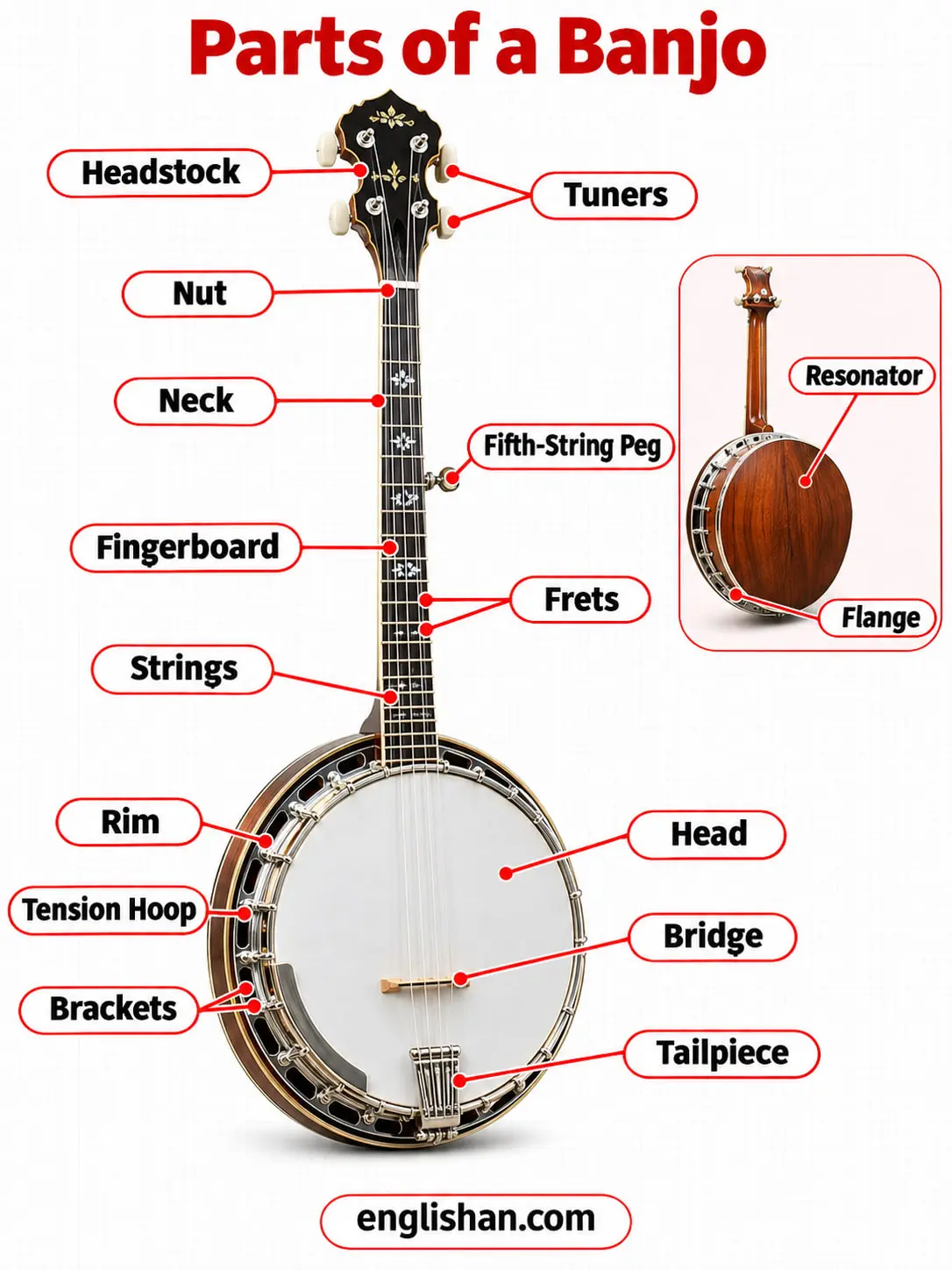
In a labeled diagram of a banjo, the headstock is at the top and the neck extends down to the pot. The pot is a round body with a stretched head on the front. The tailpiece is at the pot end, and the resonator is on the back.
| Part | Where you find it |
|---|---|
| 1. Headstock | Top of the banjo, where the pegs secure the strings |
| 2. Tuners | Four pegs on the headstock that set the pitch of the strings |
| 3. Fifth-string peg | Peg set partway down the neck for the short fifth string |
| 4. Nut | Slotted strip at the base of the headstock |
| 5. Neck | Wooden length that supports the fingerboard and the headstock |
| 6. Truss rod | Rod under the fingerboard that adjusts the curve of the neck |
| 7. Fingerboard | Hardwood top of the neck where the player forms chords |
| 8. Frets | Nickel-silver bars across the fingerboard |
| 9. Strings | Four main strings and a short fifth string |
| 10. Rim | Wooden ring at the center of the pot, also called the shell |
| 11. Tone ring | Metal collar between the rim and the head |
| 12. Head | Membrane stretched across the pot |
| 13. Tension hoop | Metal ring over the outer edge of the head |
| 14. Brackets | Hooks around the pot that secure the tension hoop, also called hooks |
| 15. Bridge | Movable piece on the head that passes the string vibration to it |
| 16. Tailpiece | Piece at the pot end that anchors the strings |
| 17. Coordinator rods | Rods parallel to the strings that join the neck to the pot |
| 18. Resonator | Bowl-shaped plate fitted to the back of the pot |
| 19. Flange | Metal ring that connects the pot to the resonator |
| 20. Resonator screws | Three or four screws that secure the resonator |
How Many Parts a Banjo Has
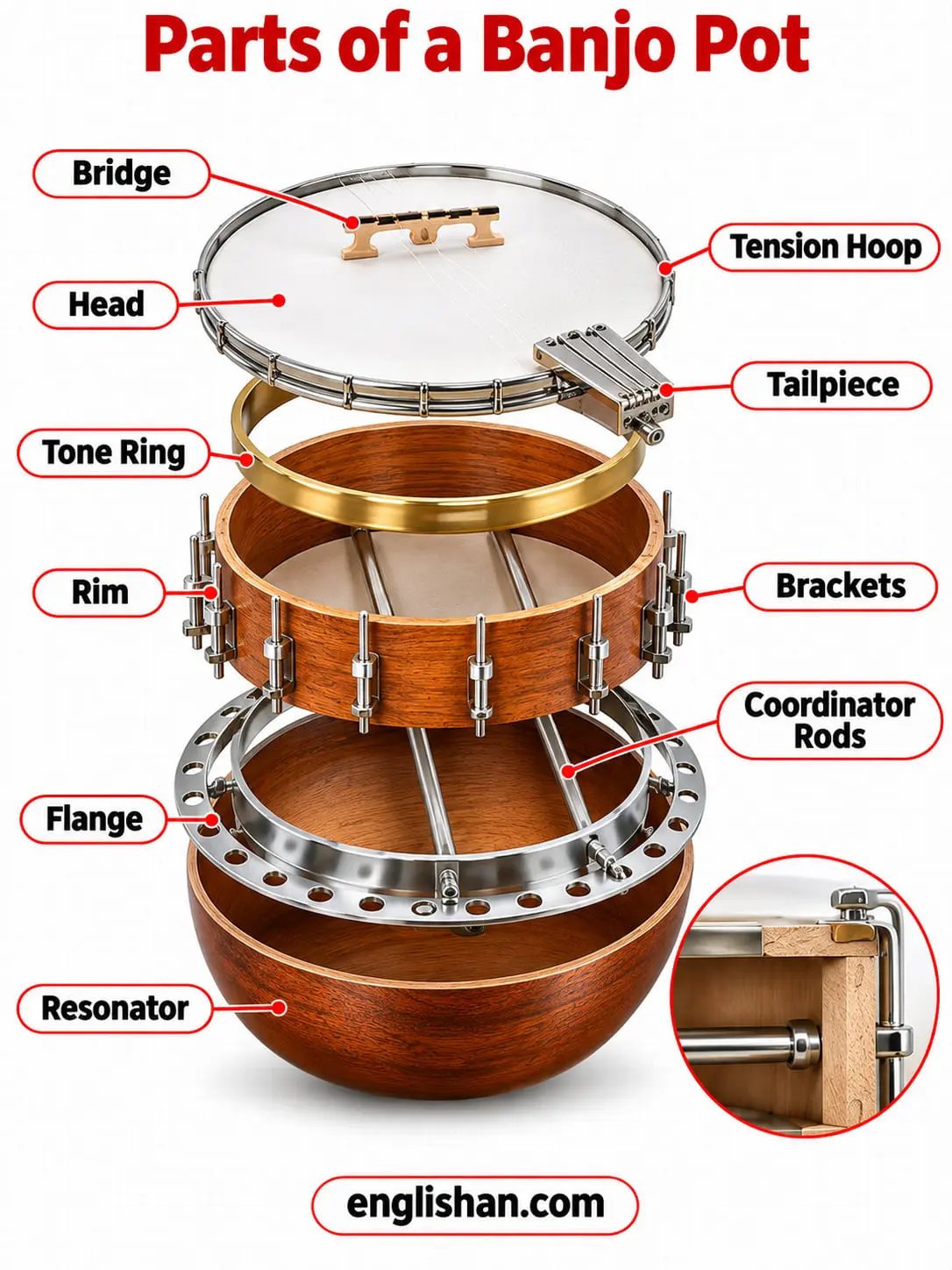
The parts of a banjo have no single fixed number, because reference counts group the instrument differently. A count of 15 names the parts from the headstock to the resonator. The drum set applies the same principle of a head stretched over a shell.
The labeled diagram names 20 parts. An open back banjo omits the resonator, the flange, and the resonator screws.
Parts of a Banjo Neck
The neck is the wooden length that supports the fingerboard and the headstock. A standard five-string banjo has a scale length of 26.25 inches.
Headstock and Tuners
The headstock is the top of the banjo, where the pegs secure the strings to the neck. Four tuners are fitted to it. They are friction pegs or planetary-gear tuners of hard plastic or ebony, with metal on some models.
Nut
The nut is a small strip at the base of the headstock. Its slots keep the strings aligned and separated. It is ebony or hard plastic.
Fingerboard and Frets
The fingerboard is the hardwood top of the neck, where the player forms chords. It is ebony, with silver or steel inlays on some banjos. Frets are nickel-silver bars across the fingerboard that set the pitch. Fretless banjos also exist.
Truss Rod
The truss rod is a rod under the fingerboard. It adjusts the curve of the neck and the height of the strings.
Fifth-String Peg
The fifth string is shorter than the other four, so it has its own peg partway down the neck. On a Seeger neck, that peg is in line with the 8th fret instead of the 5th. Some players shorten the string with a fifth-string capo, a small spike.
Banjo String Parts
The strings are the sounding parts of a banjo. A five-string banjo has four main strings and a short fifth string, called the drone string. Bluegrass tuning is open G: G4, D3, G3, B3, and D4, with the fifth string first.
Steel and bronze-phosphor strings are standard, and the fourth string is wound. Nylon or gut strings give a mellower sound. Early strings were gut or vegetable fiber.
Parts of a Banjo Pot
The pot is the round body of the banjo, a circular rim with a tensioned head. It shapes the sound of the instrument.
Rim
The rim, also called the shell, is the wooden ring at the center of the pot. It is laminated or blocked maple or mahogany. Some older banjos have metal rims.
Tone Ring
The tone ring is a metal collar between the rim and the head. It shapes the tone and projects the sound. Bronze and brass are the metals. Many old-time banjos have none.
Flat-top rings touch the head least, which leaves more of it free to vibrate. Arch-top rings touch the head more and give a flatter tone with greater projection. A scalloped ring is a middle ground.
Parts of a Banjo Head
The head is the membrane that vibrates when the strings are plucked, and it produces most of the tone. Modern heads are Mylar. Early banjos used animal hides such as goat skin.
Clear and Frosted Heads
A clear head sounds bright and snappy. A frosted head sounds more muted and is preferred for bluegrass. Old-time players use natural skin, which is sensitive to humidity, or Fiberskyn, a synthetic alternative.
Tension Hoop
The tension hoop, also called the stretcher band, is a metal ring over the outer edge of the head. It stretches the head evenly as the brackets tighten. It is steel or brass.
Brackets and Hooks
The brackets, also called hooks, secure the tension hoop. A banjo has 20 or more of them. Bracket screws on the underside of the pot tighten the head.
Banjo Bridge and Tailpiece Parts
The bridge and the tailpiece are the parts of a banjo that connect the strings to the pot. The coordinator rods join the pot to the neck.
Bridge
The bridge is a movable piece on the head that transmits string vibration to it. String tension keeps it in place. A bridge measures 5/8 to 3/4 inch.
Tailpiece
The tailpiece anchors the strings at the pot end. Many tailpieces are adjustable, which subtly changes the tone.
Coordinator Rods
The coordinator rods run parallel to the strings and are visible from the back. They keep the neck attached to the pot and adjust the string action. A banjo has one or more, and some open back banjos use a dowel stick instead.
Open Back and Resonator Banjo Parts
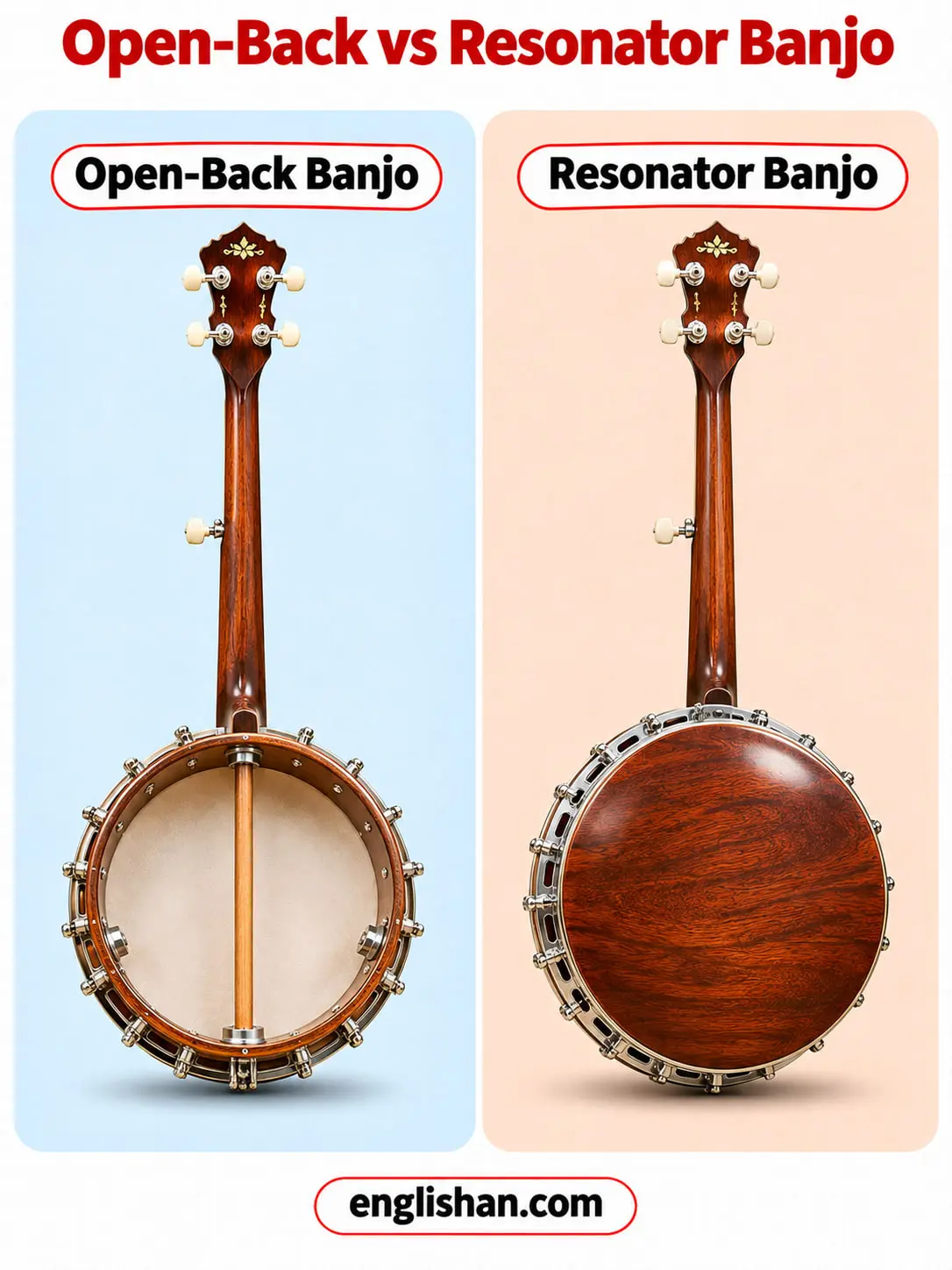
A resonator banjo has a bowl-shaped plate on the back of the pot that projects the sound forward. An open back banjo has none.
Resonator
The resonator is a bowl-shaped piece fitted to the back of the pot. It is mahogany on most banjos. It gives bluegrass banjos their presence and projection.
Flange and Resonator Screws
The flange is a circular metal piece that connects the pot to the resonator. Three or four resonator screws secure the resonator to the pot.
Open Back Banjo
An open back banjo is lighter and has a mellower tone. It is set up with higher string action. It has no resonator and no flange, and old-time banjos are built this way.
Parts of a Banjo by String Count
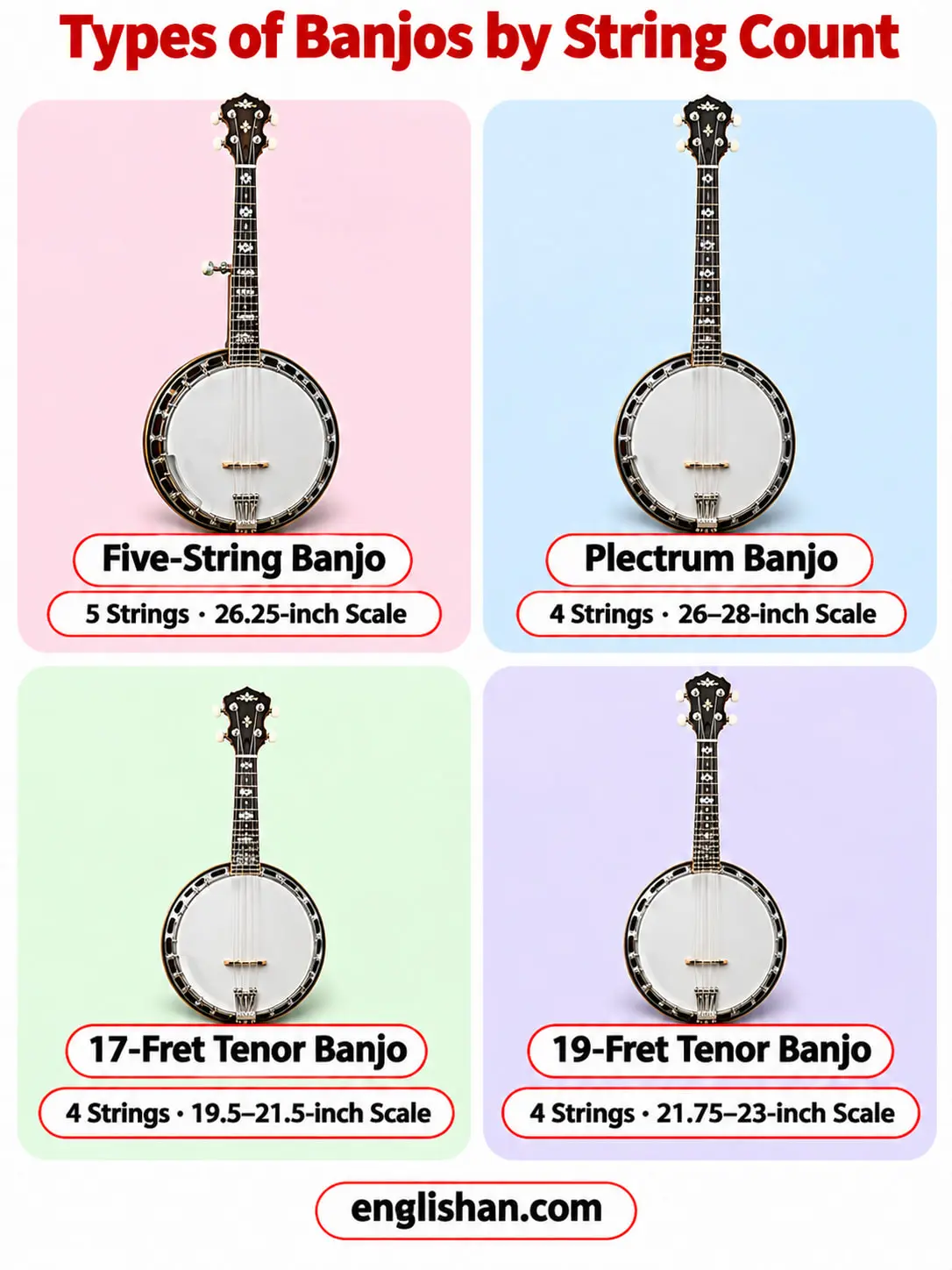
The parts of a banjo are the same on every model, and the neck changes with the string count. The five-string banjo is the standard for bluegrass.
| Banjo | Strings | Scale length | Standard tuning |
|---|---|---|---|
| Five-string | 5 | 26.25 inches | G4 D3 G3 B3 D4 |
| Plectrum | 4 | 26 to 28 inches | C3 G3 B3 D4 |
| Tenor, 17 frets | 4 | 19.5 to 21.5 inches | C3 G3 D4 A4 |
| Tenor, 19 frets | 4 | 21.75 to 23 inches | C3 G3 D4 A4 |
A plectrum banjo has 22 frets, and a tenor banjo has 17 or 19. A tenor banjo is also tuned G2, D3, A3, and E4. A six-string banjo is found in modern bluegrass and guitar-style models and is tuned G4, G2, D3, G3, B3, and D4.
Banjo Parts and Their Materials
The materials of the parts of a banjo split between wood for the neck and the rim and metal for the pot hardware.
Neck: Wood, with an ebony or other hardwood fingerboard and nickel-silver frets.
Nut and tuners: Ebony or hard plastic, with metal on some tuners.
Rim: Maple or mahogany, in laminations or blocks.
Head: Mylar today. Goat or other animal skin in the past.
Tone ring: Bronze or brass.
Tension hoop and brackets: Steel or brass.
Resonator: Mahogany on most banjos.
Strings: Steel or bronze-phosphor, with nylon or gut for a mellower sound.
FAQs
FAQs
The parts of a banjo are the headstock, the neck, the fingerboard, the frets, the strings, and the pot. The pot has the rim, the head, the tone ring, the bridge, and the tailpiece.
The count depends on the level of detail. A reference count of 15 names the parts from the headstock to the resonator, and the labeled diagram names 20.
The nut is a small strip at the base of the headstock. Its slots keep the strings aligned and separated. It is ebony or hard plastic.
A banjo has four main strings and, on a five-string model, a short fifth string. Steel and bronze-phosphor strings are standard, and the bluegrass tuning is open G.
The parts of a banjo head are the membrane, the tension hoop, and the brackets. The membrane is Mylar or skin, the hoop is a steel or brass ring, and the brackets tighten the head with screws.
A banjo is made of a wooden neck, a wooden rim, a metal tone ring, and a Mylar head. The tension hoop and brackets are metal, and the resonator is mahogany on most banjos.
A resonator banjo has the parts of an open back banjo plus the resonator, the flange, and three or four resonator screws. The resonator projects the sound forward.
A banjo makes sound when a plucked string vibrates and the bridge transmits that vibration to the head. The head produces most of the tone. The tone ring shapes it, and the resonator projects it forward.
Related: