

The parts of an angle grinder are the disc, the guard, the spindle, the spindle lock, the flanges, the side handle, the main handle, the switch, the motor, and the power supply. The motor turns the spindle through a geared head at a right angle, and the disc mounted on the spindle grinds or cuts.
An angle grinder runs on a power cord, a battery pack, or compressed air. The air-driven version connects to an air compressor, and the electric versions use a motor like the one in a drill. The workpiece is clamped or held firmly in a bench vice before grinding.
Parts of an Angle Grinder Labeled Diagram
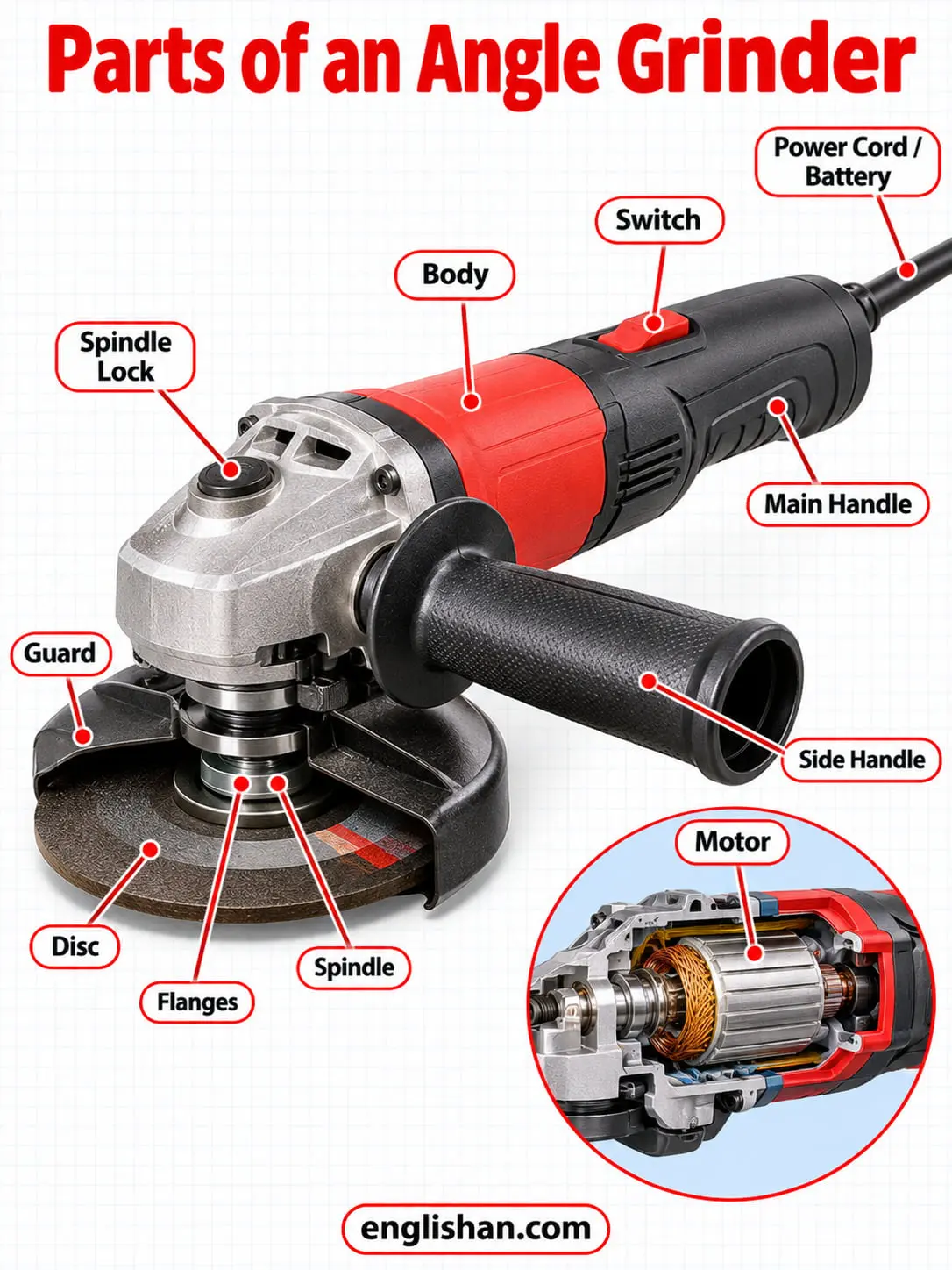
In a labeled diagram of an angle grinder, the disc and the guard are under the head, and the spindle is the shaft that holds the disc. The main handle extends from the head and holds the switch and the lock button. The power cord or battery pack attaches to the end of the main handle.
| Part | Where you find it |
|---|---|
| 1. Disc | Abrasive attachment mounted on the spindle |
| 2. Guard | Semi-circular cover on the underside of the body, facing the operator |
| 3. Spindle | Shaft on the bottom of the head that holds the disc |
| 4. Spindle lock | Button that stops the spindle from turning during disc changes |
| 5. Flanges | Outer and backing washers that clamp the disc, tightened by the flange nut |
| 6. Body | Head of the grinder that houses the motor and the spindle |
| 7. Side handle | Removable grip that screws into the head |
| 8. Main handle | Long rounded grip that holds the switch |
| 9. Switch | Power lever on the main handle |
| 10. Motor | Electric or air drive inside the body |
| 11. Power cord or battery | Supply attached to the end of the main handle |

Angle Grinder Disc Parts
The disc is the abrasive attachment that does the work, and it mounts on the spindle. A center wheel holds the abrasive disc in place on the spindle.
Cut-off discs are thin and cut metal and hard materials, and diamond blades cut stone and concrete. Grinding discs remove heavy stock and smooth welds. Flap discs grind and finish, wire wheels and wire brushes remove rust and paint, and sanding discs finish surfaces with a backing pad behind them. The backing pad is hard plastic, phenolic resin, or medium-hard rubber, depending on the stiffness wanted.
In the United States, angle grinders take 4, 4.5, 5, 6, 7, 9, and 12 inch discs, and the 4.5 inch and 5 inch sizes are the most popular. Outside North America, 115 mm and 125 mm discs are the most common.
Angle Grinder Guard Parts
The guard is a removable, semi-circular cover that fastens to the underside of the body. It faces the operator and covers the operator-side portion of the disc. The guard protects against sparks, debris, and accidental contact.
An angle grinder runs with the guard attached at all times. The operator adjusts the guard so that sparks fly away from the body. A keyless guard system installs, removes, or adjusts the guard without tools.
Parts of an Angle Grinder Spindle and Flanges
The spindle is a protrusion on the bottom of the head that holds the disc. The motor drives it through the geared head, and large bearings counter the side forces the tool generates.
The spindle lock, also called the lock button, stops the spindle from turning for disc changes. The outer flange and the backing flange clamp the disc onto the spindle with the flange nut. A two-pin spanner wrench tightens and loosens the flange nut, and a quick-release disc method removes the need for the wrench on some models.
Parts of an Angle Grinder Handles and Switch
The main handle is the long rounded grip that the dominant hand holds. It houses the power lever, the lock button, and on some models the speed control dial.
The side handle is an optional grip with a textured rubber or plastic surface. It allows two-handed operation. The power lever is a two-stage constant pressure trigger switch, also called a deadman’s switch, which prevents accidental starting when the discs are changed. Anti-vibration handles add a rubber cushioning layer between the handle and the spindle.
Angle Grinder Internal Parts
The internal parts of an angle grinder are the motor, the armature, the ball bearings, the carbon brushes, and the brush holders. The motor powers the tool and drives the disc. Ball bearings support the motor spindle and reduce friction.
Carbon brushes conduct electricity between the stationary parts and the rotating armature. A brush holder keeps each brush against the commutator. Worn brushes lead to poor motor performance or complete failure, and both brushes are replaced together. Pop-off brushes break contact and shut the tool down when replaced.
Parts of a Corded and Cordless Angle Grinder
A corded angle grinder takes current from a power cord attached to the end of the main handle. A cordless angle grinder uses a battery pack in the same position, and the battery pack condition sets the runtime and the performance. Both versions have the same disc, guard, spindle, handles, and motor.
A pneumatic angle grinder runs on compressed air and takes much smaller discs. It avoids the copper motor windings of the electric versions.
Angle Grinder Part Names
Makers, shops, and parts catalogs use more than one name for several parts of an angle grinder. The alternate names come from the maker pages and the encyclopedia entry.
| Part | Also called |
|---|---|
| Spindle lock | Lock button |
| Switch | Power lever, trigger switch, deadman’s switch |
| Guard | Blade guard, adjustable guard |
| Body | Head |
| Motor | Engine |
| Flange nut | Hex hole flange, outer flange nut |
| Wrench | Spanner wrench, angle grinder wrench |
| Side handle | Auxiliary grip |
FAQs
FAQs
The parts of an angle grinder are the disc, the guard, the spindle, the spindle lock, the flanges, the side handle, the main handle, the switch, the motor, and the power cord or battery. The body is the head that houses the motor and the spindle.
The labeled diagram of an angle grinder names eleven parts. Cordless models replace the power cord with a battery pack, and some models add a speed control dial.
The internal parts of an angle grinder are the motor, the armature, the ball bearings, the carbon brushes, and the brush holders. The brushes conduct electricity to the rotating armature, and the bearings support the motor spindle.
The attachments are cut-off discs, grinding discs, flap discs, wire wheels, sanding discs, and diamond blades. All of them mount on the spindle and clamp between the flanges.
The three types are the corded, the cordless, and the pneumatic angle grinder. The corded version takes a power cord, the cordless version takes a battery pack, and the pneumatic version runs on compressed air.
The disc grinds or cuts, and the guard protects the operator from sparks and debris. The spindle lock holds the spindle during disc changes, the side handle steadies the tool, and the switch starts and stops the motor.
Related: