

The parts of a trombone are the mouthpiece, the slide section, and the bell section. The slide is the moving part: extending it lowers the pitch, and contracting it raises the pitch.
A tenor trombone in B♭ has about 9 feet of tubing with the slide retracted, and its slide has seven positions. The F attachment, the bass trombone, and the valve trombone add parts to this layout, and each has its own section here.
Parts of a Trombone Labeled Diagram
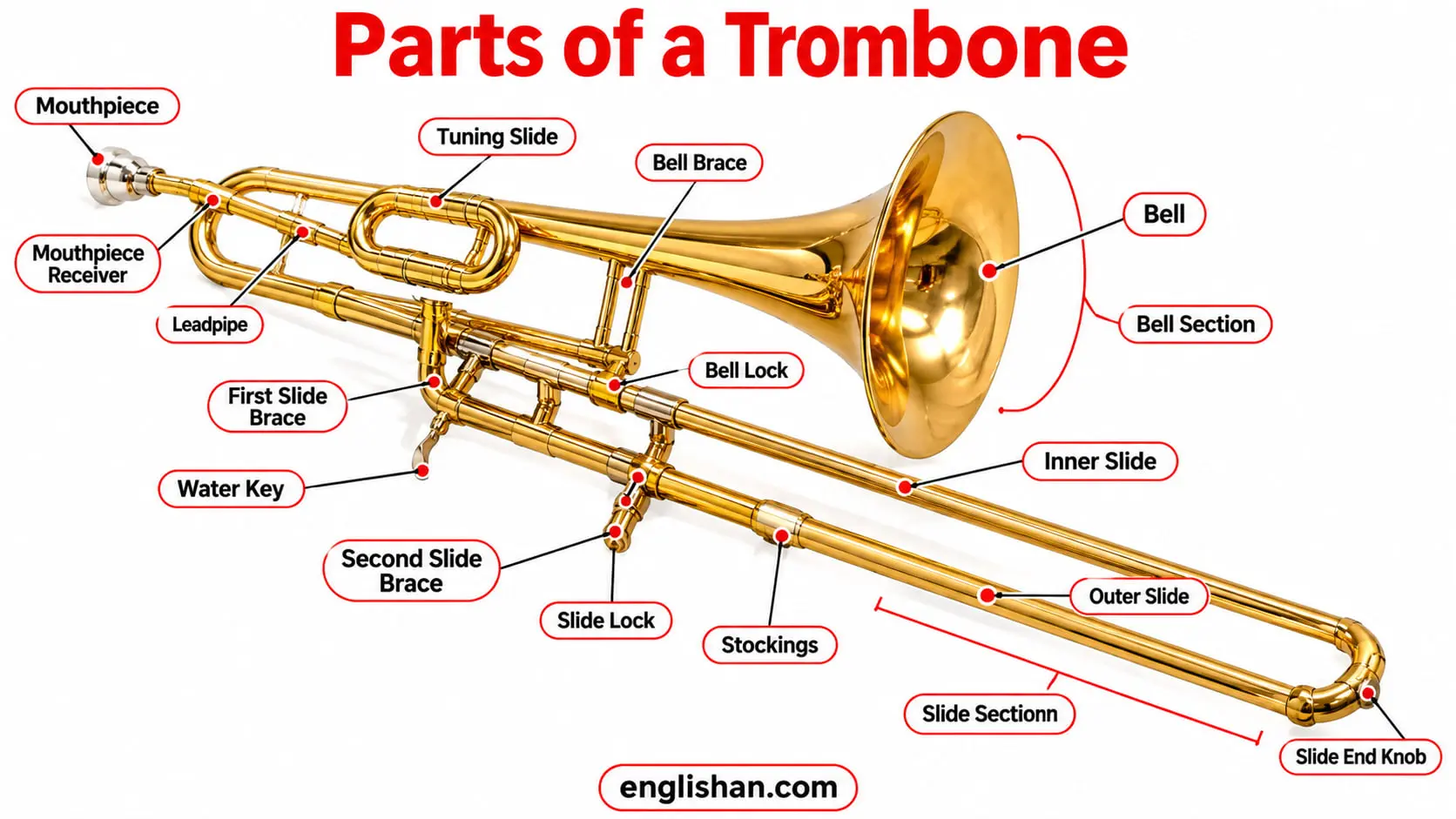
In a labeled diagram of a tenor trombone, the mouthpiece fits into the receiver, and the slide section leads from the receiver to the bell section. The tuning slide is in the U-bend of the bell section. The F attachment, on models that have it, is part of the bell section and is worked by a trigger under the left thumb.
| Part | Where you find it |
|---|---|
| 1. Mouthpiece | Cup-shaped piece that fits into the mouthpiece receiver |
| 2. Mouthpiece receiver | Socket that holds the mouthpiece |
| 3. Leadpipe | Tube that is part of the slide section, with the inner and outer slide tubes |
| 4. Inner slide | Narrow pair of tubes that stays fixed to the instrument |
| 5. Outer slide | Wider pair of tubes that moves over the inner slide |
| 6. Stockings | Slightly enlarged ends of the inner slide tubes |
| 7. Slide lock | Fitting that holds the outer slide against the inner slide |
| 8. Water key | Lever on the crook of the lower outside slide tube |
| 9. Slide braces | First brace held by the left hand, second brace used to move the outer slide |
| 10. Bell lock | Threaded collar that joins the slide to the bell section |
| 11. Tuning slide | Short slide in the U-bend of the bell section |
| 12. Bell brace | Brace that holds the bell section together |
| 13. Bell | Flared end of the bell section |
| 14. F attachment and trigger | Rotary valve in the bell section, worked by the left thumb |
Slide Positions and the Moving Part of a Trombone
The slide is the moving part of a trombone. Straightened, its tubing would measure nearly nine feet, and the slide itself is over two feet long. The player holds the first slide brace with the left hand and moves the outer slide with the right arm on the second brace.
A tenor trombone in B♭ has seven chromatic slide positions. The first position is fully retracted and gives the highest pitch, and the seventh is fully extended and gives the lowest.
| Position | Slide location |
|---|---|
| 1st | Fully retracted |
| 2nd | About 3¼ inches (8 cm) out from the first position |
| 3rd to 6th | Each step lowers the pitch by one semitone, and the gaps widen |
| 7th | Fully extended, about 4¾ inches (12 cm) beyond the sixth |
Each step outward lowers the pitch by one semitone on the same partial. Alternate positions shorten the slide travel on fast passages and legato slurs.
Parts of a Trombone Slide
Among the parts of a trombone, the slide section holds the leadpipe, the inner and outer slide tubes, and the stays that brace them. Soldered stays replaced the loose stays used on the sackbut, the older ancestor of the trombone.
Inner and Outer Slide
The inner slide is a pair of narrow tubes fixed to the instrument. The outer slide is a pair of wider tubes that moves over them and changes the overall tube length. The slide needs frequent lubrication so the outer slide moves without catching.
Stockings
The stockings are the last six inches or so of each inner slide tube. They are a slight ridge where the inner slide meets the outer slide, and the small contact surface reduces friction. Early makers soldered sleeves onto the tube ends to get this effect, and modern inner slides use a slightly larger diameter at the ends instead.
Slide Lock
The slide lock is a two-part fitting: a lug on the outer slide and a threaded piece on the inner slide. It keeps the slides from moving when the instrument is not being played, and it must be locked before the instrument is assembled or put away.
Water Key
The water key, also called the spit valve, is attached to the slide crook on the lower outside slide tube. It releases condensation, which is water from the player’s breath and not saliva. A small felt disc seals the key when it is closed, and the disc wears out and needs replacing. Holding the slide just under horizontal drains the water.
Slide Braces and Bumper
Maker diagrams name a first slide brace, a second slide brace, and a slide end knob with a bumper, also called the stopper. The braces stabilize the slide tubes and give the hands their grips.
Bell Section and Tuning Slide
Of all the parts of a trombone, the bell section is the one that connects to the slide through the neckpipe and a U-bend called the bell bow or back bow. A threaded collar, the bell lock, secures the joint. Before the early 20th century this joint relied on friction alone. Before the bell lock is tightened, the slide is set at a 90-degree angle, or slightly less, in the slide receiver.
Lacquered brass is the standard tubing. Lacquer is a thin protective layer, and unlacquered brass tarnishes easily. Bell materials change tone and projection slightly. Yellow brass (70 percent copper and 30 percent zinc) is the most common. Rose brass is 85 percent copper and 15 percent zinc, red brass is 90 percent copper and 10 percent zinc, and gold brass is the material of many German trombones. Some bells are solid sterling silver, and plastic trombones appeared in the 2010s as cheaper, more durable instruments.
Bell
The bell amplifies and stabilizes the sound. Tenor bells measure 7 to 9 inches (18 to 23 cm) across, and most fall between 7½ and 8½ inches. A bell is made from two brass sheets or from one hammered piece. Most bells have a wire around the rim, and the wire affects tone.
Flare size follows the type of instrument. Alto trombones and small-bore tenors have smaller flares, and large-bore tenors and bass trombones have larger ones.
Tuning Slide
The tuning slide is a short cylindrical slide in the U-bend between the neckpipe and the bell. François Riedlocker, a French maker, designed it in the early 19th century. Pulling it out makes the instrument flatter, and pushing it in makes the instrument sharper.
Bell Brace and Counterweight
The bell braces hold the bell section together. On a straight tenor, the left thumb wraps around the brace closest to the left hand. Maker diagrams also name a counterweight and a counterweight brace on the bell section.
Parts of a Trombone Mouthpiece
The mouthpiece is a detachable, cup-shaped piece with a venturi at the throat. Wikipedia describes it as similar to a baritone horn’s and closely related to the mouthpiece in the parts of a trumpet. Mouthpieces from different makers are interchangeable between trombones of similar size.
The mouthpiece twists gently to the right into the receiver and to the left to come out. A stuck mouthpiece needs a mouthpiece puller, not pliers. Mouthpieces are brass with silver or gold plating, and some are made of other metals, wood, or plastic.
Trombone Mouthpiece Shank
The shank must fit the receiver. Standard tenor receivers take a small-shank mouthpiece, and bass trombone receivers take a large-shank one. Some large-bore tenors accept only large-shank mouthpieces.
Sizing differs by maker, but in most systems a lower number marks a larger mouthpiece. Smaller mouthpieces sound brighter and make higher notes easier.
Mouthpipe
One retailer calls the tube from the mouthpiece receiver to the tuning slide the mouthpipe, or gooseneck. Wikipedia names the first tube of the slide section the leadpipe.
F Attachment and Trigger Parts
On B♭/F models, the F attachment is a rotary valve among the parts of a trombone, worked by the left thumb through a trigger. The trigger connects to the valve by a string or a metal lever. It adds about 3 feet (0.9 m) of tubing and lowers the instrument by a perfect fourth, from B♭ to F.
With the valve engaged, the slide has six usable positions, down to C2. The F attachment avoids long slide positions and reaches extra low notes. An F tuning slide sets the pitch of the added tubing.
Christian Friedrich Sattler developed the F attachment in the late 1830s. The Bb/F layout is called the tenor-bass trombone.
Open Wrap and Closed Wrap
Open-wrap tubing, introduced in the early 1980s, has fewer corners, a more open sound, and less resistance. Closed-wrap tubing is the traditional layout, with more corners and more resistance, and it protects the valve better in marching bands.
The Thayer axial-flow valve and the Hagmann valve are alternatives to the standard rotary valve.
Tenor and Bass Trombone Parts
The parts of a trombone change with the type. The main differences are bore, bell size, valves, and slide length.
| Type | Pitch and parts |
|---|---|
| Soprano | B♭, an octave higher than the tenor; the slide has six positions |
| Alto | E♭, a fourth higher than the tenor; a valve lowers it to B♭ |
| Tenor | B♭; slide bore 0.450 to 0.547 inches (11.4 to 13.9 mm); bell 7 to 9 inches |
| Bass | B♭ with a wider bore, a larger bell, and a larger mouthpiece; two valves in modern models |
| Contrabass | Traditionally B♭♭, an octave lower than the tenor, with a double slide; modern versions are in 12-foot F with two valves |
| Valve trombone | Piston valves in place of a slide; first made in Vienna in the 1820s |
Common tenor slide bores are 0.500, 0.508, 0.525, and 0.547 inches (12.7, 12.9, 13.3, and 13.9 mm). The common bass slide bore is 0.562 inches (14.3 mm). Large-bore trombones sound darker and suit orchestral playing, and small-bore trombones sound brighter and suit jazz and pop.
Bass Trombone Parts
A bass trombone has the same parts as a tenor, scaled up. The bell measures 9½ to 10 inches (24 to 25 cm) across on most models. Modern models have two sets of extra tubing, each with its own valve and trigger, which give the full chromatic range down to B♭1.
Valve Trombone Parts
A valve trombone replaces the slide with double-piston valves, and it was made in alto, tenor, and bass sizes. Some tenor and bass models have a fourth valve that lowers the pitch by a fourth, and that valve adds intonation problems. Sax’s six-piston system matched each valve to a slide position, and all valves raised gave the seventh.
Trombone Part Names
Makers and players use more than one name for several parts of a trombone. The alternate names come from maker diagrams, retailers, and reference entries.
| Part | Also called |
|---|---|
| Water key | Spit valve |
| Bell bow | Back bow |
| Slide | Hand slide |
| Bumper | Stopper |
| F attachment | Valve, plug, trigger |
| Mouthpipe | Gooseneck |
| Bell lock | Lock nut, threaded collar |
| B♭/F tenor | Tenor-bass trombone |
FAQs
The parts of a trombone are the mouthpiece, the receiver, the leadpipe, the inner and outer slide, the stockings, the slide lock, the water key, the tuning slide, the bell brace, and the bell. An F attachment adds a rotary valve and a trigger.
The moving part of a trombone is the slide, and its movable section is the outer slide. Extending the slide lowers the pitch, and contracting it raises the pitch.
No source gives one fixed count. Wikipedia’s anatomy entry describes three assemblies: the mouthpiece, the slide section, and the bell section. A maker diagram names about 15 parts.
A tenor trombone in B♭ has seven chromatic slide positions. The first position is fully retracted, and the seventh is fully extended. With the F valve engaged, the slide has six usable positions.
The U-shaped part of a trombone is the bell bow, also called the back bow. It joins the slide section to the bell, and the tuning slide is in its bend.
An F attachment adds about 3 feet of tubing through a rotary valve and lowers the pitch by a perfect fourth. The left thumb works it with a trigger. It avoids long slide positions and reaches extra low notes.
A bass trombone has a mouthpiece, slide, tuning slide, and bell like a tenor, with a wider bore, a larger bell, and a large-shank mouthpiece. Modern models have two valves, each worked by its own trigger.
Related: