

The parts of a shovel are the blade, the tip, the step, the collar, the shaft, and the grip. The blade cuts and moves loose material, the step gives the foot a surface to press, and the grip is where the hands hold the tool.
A shovel is a hand tool for digging, scooping, and moving soil, gravel, sand, and snow. Parts references name six or seven parts, and the pole is called the handle in some references and the shaft plus the grip in others. A power shovel, a steam shovel, and a spade bit are different tools with their own parts.
Parts of a Shovel Labeled Diagram
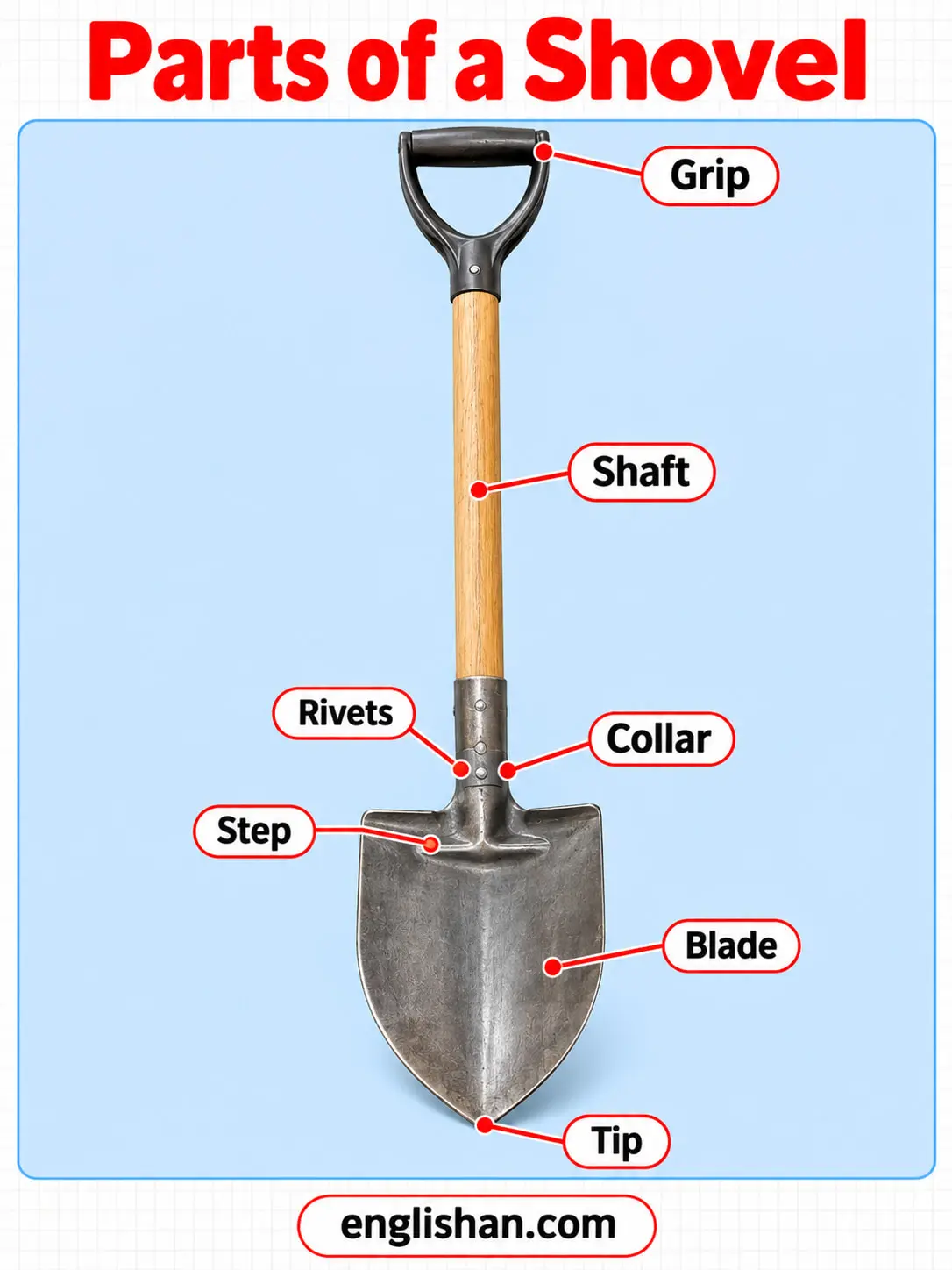
In a labeled diagram of a shovel, the grip is at the top and the tip is at the bottom. The shaft runs between them, and the collar joins the shaft to the blade. The step is a ledge at the top edge of the blade.
| Part | Where you find it |
|---|---|
| 1. Grip | Top of the shaft, where the hands hold the tool |
| 2. Shaft | Long pole between the grip and the collar |
| 3. Collar | Joint between the shaft and the blade, also called the socket |
| 4. Rivets | Fasteners that fix the shaft in the collar |
| 5. Step | Folded or welded ledge at the top edge of the blade |
| 6. Blade | Broad working surface at the lower end |
| 7. Tip | Lowest edge of the blade |
Shovel Blade and Tip
The blade and the tip do the digging. The blade moves the material, and the tip is the edge that enters the ground first.
The blade is sheet steel, forged steel, hard plastic, or aluminum.
Blade
Among the parts of a shovel, the blade is the broad working surface, also called the scoop. Hand shovel blades are sheet steel or hard plastic, and grain shovels use aluminum. Steel blades are pressed from sheet or forged and rolled.
A steel blade has a folded seam or hem at the back that forms the socket and adds rigidity. A round-point garden blade is 8 to 9 inches wide, and a transplanting blade is 5 to 6 inches wide.
Tip
The tip is the lowest edge of the blade and the first part to enter the soil. A round point tapers to a single point for breaking ground, and it slices through roots. A flat or square tip suits cutting sod and edging, and it scoops and moves loose material but digs hard ground less well.
Parts of a Shovel Step and Collar
The step and the collar are the two load-bearing parts of a shovel. The foot drives the blade through the step, and the collar passes that force to the shaft.
The collar is metal, fixed with rivets or screws.
Step
The step is the folded or welded ledge at the top edge of the blade, also called the tread, the kickplate, or the foot peg. The foot presses it to drive the blade into the ground, which moves body weight through the leg and reduces strain on the back and arms. Some steps have ridges for footing.
Collar
The collar connects the blade to the shaft, and it is also called the socket. It is the highest-stress joint on the tool, so its construction sets how long the shovel lasts.
A strap socket, also called an open socket, is flat steel wrapped around the shaft and fixed with rivets. A solid socket is forged as a single seamless sleeve that accepts the shaft from the top, with no rivets. A closed-back socket adds a weld at the back, which keeps water out of the wood end grain.
Rivets or screws hold the shaft in the collar and allow a broken shaft to be replaced, while glue suits light use only. An older joint, the tang and ferrule, has a tapered tang from the blade that enters a drilled handle end, with a ferrule reinforcing it.
Parts of a Shovel Shaft and Grip
The shaft and the grip form the handle. The shaft sets the length, and the grip sets the hold.
The shaft is ash, maple, fiberglass, or steel. The grip is wood, fiberglass, or metal when bare, and silicone or rubber when non-slip.
Shaft
The shaft is the long pole between the grip and the collar, and it transfers force from the hands and the foot to the blade. A standard shaft is 48 inches long. Shafts are made of ash or maple wood, fiberglass, or steel, and fiberglass is a glass-reinforced plastic.
Grip
The grip is the top of the shaft, either a straight continuation of the shaft or a D-shaped loop attached to the shaft end. A straight handle gives the most leverage for moving large volumes of soil.
A T-grip is a cross-piece fitted to the end of the handle, and it aids grip and control on shovels for soil and heavy materials. A D-grip is a closed loop 4 to 5 inches wide that fixes the hand position and gives control in tight spaces. A welded D-grip is stronger than one bolted to the shaft.
Shovel Blade Shapes
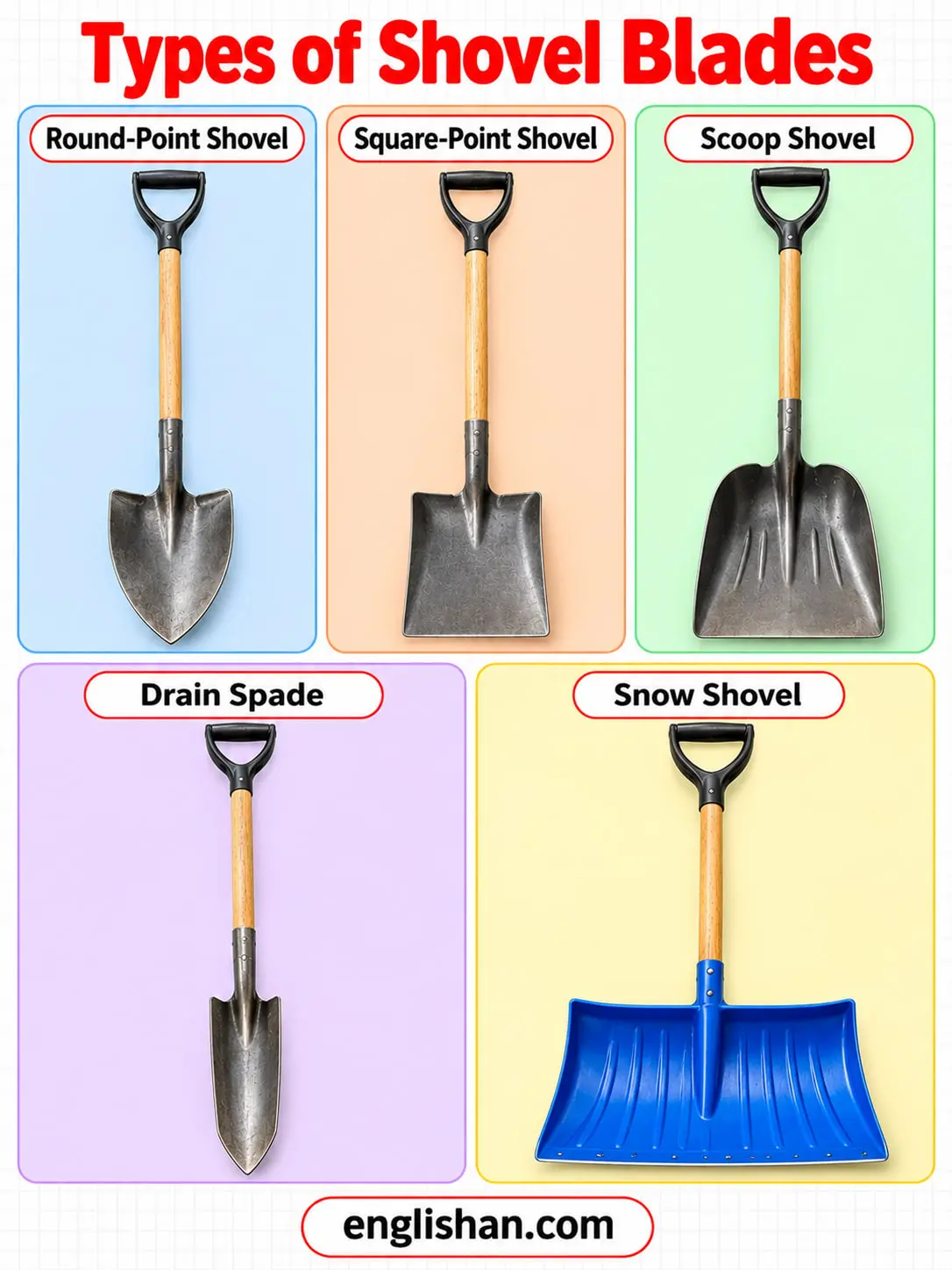
The general categories of shovel are the spade, the square shovel, and the scoop. A square shovel has a square outline rather than the pointed outline of many spades. A scoop has a dished or cupped blade with a fairly square edge, made for scooping up loose material.
Parts of a Snow Shovel and a Spade
Each type reshapes the blade, the handle, or the grip, so the parts of a shovel change with the type.
- ✅ Snow shovel: A very wide, sideless blade that curves upward, on a short handle with a D-shaped grip.
- ✅ Snow sled shovel: A large, deep blade shaped like a hopper, with a wide loop handle. It is also called a snow scoop.
- ✅ Coal shovel: A wide, flat blade with steeply turned sides and a flat face, on a short D-shaped handle.
- ✅ Grain shovel: A large, wide aluminum or plastic blade on a short hardwood handle with a D-shaped grip.
- ✅ Spoon shovel: A long handle with a small, oval, cupped, inclined blade for deep, narrow holes.
- ✅ Drain spade: A long, thin blade with pronounced upturned side flanges, used for trenches.
- ✅ Garden spade: A long handle and a wide blade with treads, which are rests for the feet.
- ✅ Border spade: A smaller garden spade with a proportionately longer handle.
Shovel is the generic term for tools with broad blades that scoop and move loose material, and spades are built for digging. A spade blade is narrower and flatter than the common shovel blade.
Shovel Part Names
Makers and gardeners use more than one name for several parts of a shovel. The alternate names come from parts references and retailer pages.
| Part | Also called |
|---|---|
| Grip | Handle, D-handle, T-piece |
| Shaft | Handle, pole |
| Collar | Socket |
| Step | Tread, kickplate, foot peg |
| Blade | Scoop |
| Tip | Cutting edge |
FAQs
The parts of a shovel are the blade, the tip, the step, the collar, the shaft, and the grip. Rivets fix the shaft in the collar. The collar is also called the socket, and the step is also called the tread.
A shovel has six or seven named parts. The six are the grip, the shaft, the collar, the step, the blade, and the tip. Some references add the handle as a seventh name for the grip or the shaft.
The blade cuts and moves material, and the tip enters the soil first. The step lets the foot drive the blade into the ground, and the collar joins the blade to the shaft. The shaft transfers force, and the grip gives the hands control.
The metal part of a shovel is the blade, and the tip is its lower edge. The collar, also called the socket, is the metal joint that connects the blade to the shaft. Steel blades are pressed from sheet or forged, while snow and grain shovels use plastic or aluminum blades.
The parts of a snow shovel are the blade, the shaft, and the grip. The blade is very wide and sideless and curves upward. The shaft is short, and the grip is D-shaped.
Shovel handles are made of ash or maple wood, fiberglass, or steel. Fiberglass is a glass-reinforced plastic. A non-slip grip adds silicone or rubber.
Yes, a spade is a kind of shovel. Shovel is the generic term for tools that scoop and move loose material, and spades are built for digging. A spade blade is narrower and flatter than the common shovel blade.
The general categories are the spade, the square shovel, and the scoop. The square shovel has a square outline, and the scoop has a dished or cupped blade. Many spades have a pointed or narrow blade for digging.
Related:
