

A harmonium is a wooden box with a keyboard on the front, a hand-pumped bellows at the back, and rows of brass reeds inside. The parts of a harmonium are the keyboard, the stop and drone knobs, the coupler, the bellows, the reeds, and the case that encloses them. The keyboard resembles that of a piano, but the sound comes from air moving across metal reeds, not from struck strings.
The tabla is the drum that accompanies the harmonium in vocal music. The sitar shares the stage with it in instrumental concerts. The hand-pumped Indian harmonium, the form sold as a portable instrument, is the model described here.
Parts of a Harmonium Labeled From Front to Back
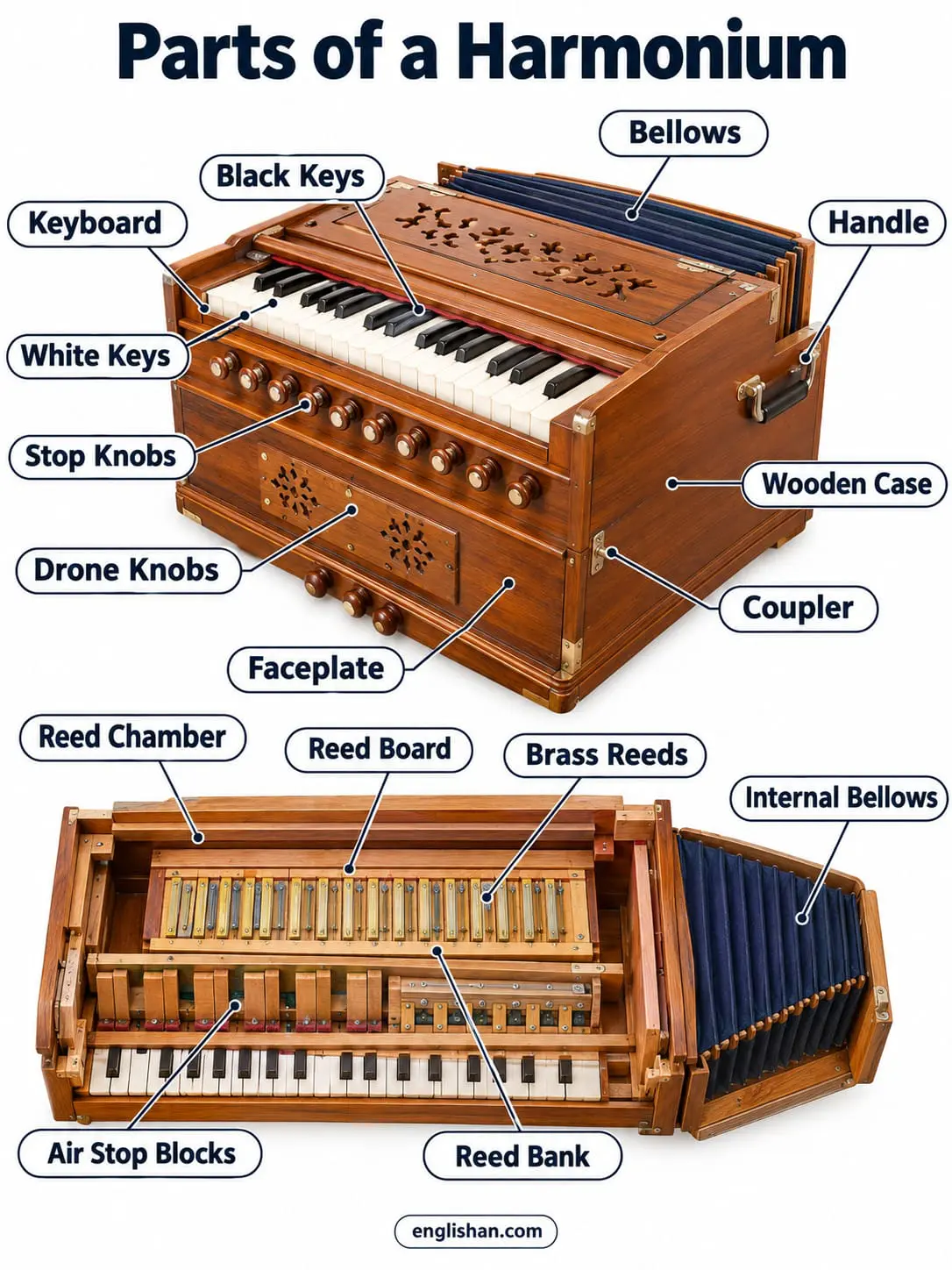
The player faces the keyboard and the row of stop knobs over it. The bellows and the handle are on the back panel, and the reeds are enclosed in the box under the keys.
| Part | Where you find it |
|---|---|
| 1. Keyboard | Row of white and black keys across the front |
| 2. White keys | Long keys for the natural notes |
| 3. Black keys | Short raised keys between the white keys |
| 4. Stop knobs | Knobs on the faceplate over the keys |
| 5. Drone knobs | Knobs that open a continuous note, set in the stop row |
| 6. Coupler | Lever or knob that links each key to its octave partner |
| 7. Scale changer | Sliding mechanism that shifts the pitch of the keyboard |
| 8. Tremolo stop | Special air stop found on some models |
| 9. Faceplate | Wooden panel over the keyboard that bears the knobs |
| 10. Case | Wooden box that encloses the reeds and the keyboard |
| 11. Keyboard base | Wooden bed under the keys |
| 12. Bellows | Folding leather and cloth bag on the back of the case |
| 13. Internal bellows | Air reservoir inside the case, filled by the bellows |
| 14. Handle | Grip on the back that the player pushes and pulls |
| 15. Bellows spring | Metal spring that pushes the bellows open |
| 16. Leather flap valve | One-way flap that closes the bellows against air loss |
| 17. Air regulator | Valve that evens out the air supply |
| 18. Reed chamber | Enclosed space under the keyboard that houses the reed banks |
| 19. Reed board | Board that bears the reed frames |
| 20. Reeds | Brass tongues on brass frames, a pair for each key |
| 21. Reed bank | Full row of reeds across the reed board |
| 22. Air stop block | Small wooden block that opens when its knob is pulled |
Harmonium Keyboard and Stop Parts
Among the parts of a harmonium, the keyboard and the knob row form the front. Each key is labeled with a note name, such as C, D, and E, or with the swars Sa, Re, and Ga.
Keys
The keys are wooden levers in white and black, laid out like a piano keyboard. Pressing a key opens the hole over its reed, and air then flows through. The standard portable harmonium has 39 keys over three and a half octaves.
Stop Knobs
The stop knobs are small round knobs, set in a row on the faceplate. Each knob is joined to an air stop block that opens a bank of reeds when the knob is pulled out. Models have between none and six stops, and most have two to four.
Drone Knobs
The drone knobs are set in the same row as the stops. A drone knob opens reeds that sound one note continuously, such as Sa or Pa, while the player works the keys. A harmonium has between none and five drones.
Coupler
The coupler is a lever or knob that links each key to a key an octave away. One press sounds two reeds at once, which thickens the tone. The coupler calls for firmer pumping.
Scale Changer
The scale changer is a sliding mechanism that shifts the keyboard against the reeds. The player keeps one fingering and changes the pitch of the whole instrument. A harmonium with this part is called a scale changer harmonium, and it suits accompanying singers who change pitch.
Tremolo Stop
The tremolo stop is a special air stop found on some models. It varies the air to the reeds and gives the tone a wavering pulse.
Harmonium Bellows Parts
The bellows is the largest of the moving parts of a harmonium. It is attached to the back of the case and is pumped with the left hand while the right hand plays.
Bellows
The bellows is a folding bag of cloth and leather with wooden frames at the top and bottom. The external bellows fills the internal bellows, which is the reservoir that feeds the reed chamber. Top-fold bellows open at the top, and side-fold bellows open to the side.
Handle
The handle is a wooden or metal grip on the back panel of the case. The player pushes and pulls it with one hand, and the bellows opens and closes with it.
Bellows Spring
The bellows spring is a metal spring fixed inside the folds. It pushes the bellows open after each pump.
Leather Flap Valve
The leather flap valve is a one-way flap of thin leather over an air hole. It opens as the bellows draws air in and shuts as the bellows is pushed, so the air stays in the reservoir.
Air Regulator
The air regulator is a valve that evens out the air supply to the reeds, so the tone stays steady between pumps.
Parts of a Harmonium Reed Chamber
The reed chamber is the enclosed space under the keyboard. It is the least visible of the parts of a harmonium and the one that produces the sound.
Reeds
A reed is a thin brass tongue riveted over a slot in a brass frame. Air drawn across the slot makes the tongue vibrate, and the vibration is the sound. This is why the harmonium is a free-reed instrument.
Reed Board
The reed board is the board that bears the reed frames in rows. Each reed is tuned to a fixed pitch.
Reed Banks
A reed bank is one full row of reeds across the board. A single reed harmonium has one bank, a double reed harmonium has two, and a triple reed harmonium has three. The two rows of a double reed model are tuned an octave apart, so each key opens a pair of reeds.
Air Stop Blocks
An air stop block is a small wooden block under the faceplate. Pulling a stop knob lifts the block and opens the holes to one reed bank.
Harmonium Case Parts
The case is the wooden box that encloses the keyboard and the reed chamber. Its front, back, and sides are the largest surfaces among the parts of a harmonium.
Faceplate
The faceplate is the wooden panel over the keyboard. The stop knobs and the drone knobs are mounted in it, and the air stop blocks are fitted behind it.
Case
The case is the box itself, made of wood and finished with varnish. The bellows is attached to its back, and the keyboard is fitted into its front.
Keyboard Base
The keyboard base is the wooden bed that the keys rest on. It is fitted inside the front of the case, under the faceplate.
Harmonium Types and Their Added Parts
A single reed harmonium has one reed bank and the fewest stops. A double reed harmonium adds a second bank an octave apart, and a triple reed harmonium adds a third. A coupler harmonium adds the octave coupler to the banks, and a scale changer harmonium adds the sliding mechanism. These added parts of a harmonium raise the price and fill out the tone.
Harmonium Parts and Their Materials
The reeds and the reed frames are brass. The case, the faceplate, and the air stop blocks are wood, while the bellows is cloth and leather and the flap valve is thin leather.
Related:
FAQs
FAQs
The parts of a harmonium are the keyboard, the stop knobs, the drone knobs, the coupler, the scale changer, the bellows, the handle, the reeds, and the case. The bellows supplies air, and the reeds produce the sound.
The reeds produce the sound. Each reed is a brass tongue over a slot, and air from the bellows makes it vibrate when a key is pressed.
The stops open and close air to the reed banks. Pulling a stop knob lifts an air stop block and lets the air reach a bank, so the stops set the fullness of the tone. The drone knobs open reeds for a continuous note.
Yes, a harmonium is a wind instrument, specifically a free-reed aerophone. Air from the bellows moves across metal reeds, and the reeds vibrate to make the sound. The keyboard only selects which reeds receive the air.
The coupler links each key to a key an octave away. One press then sounds two reeds, which thickens the tone of the harmonium and calls for firmer pumping.
The scale changer is a sliding mechanism that shifts the pitch of the whole keyboard. A player keeps the same fingering and changes the pitch of the music, which suits accompanying singers with different ranges.
A standard portable harmonium has 39 keys over three and a half octaves. Other models of the harmonium have fewer or more keys.
