

A dholak is a barrel-shaped hand drum about 18 inches long, with a smaller treble head at one end and a larger bass head at the other. The parts of a dholak are the wooden shell, the two heads, the masala paste, the hoops, the rope and rings, and the strap. The tabla is a pair of separate drums, while the dholak is a single shell with a head at each end.
Like the drum set, the dholak is a membranophone, a drum that sounds from a stretched skin. The harmonium and the sitar belong to the same family of South Asian instruments.
Parts of a Dholak Labeled on the Shell and Heads
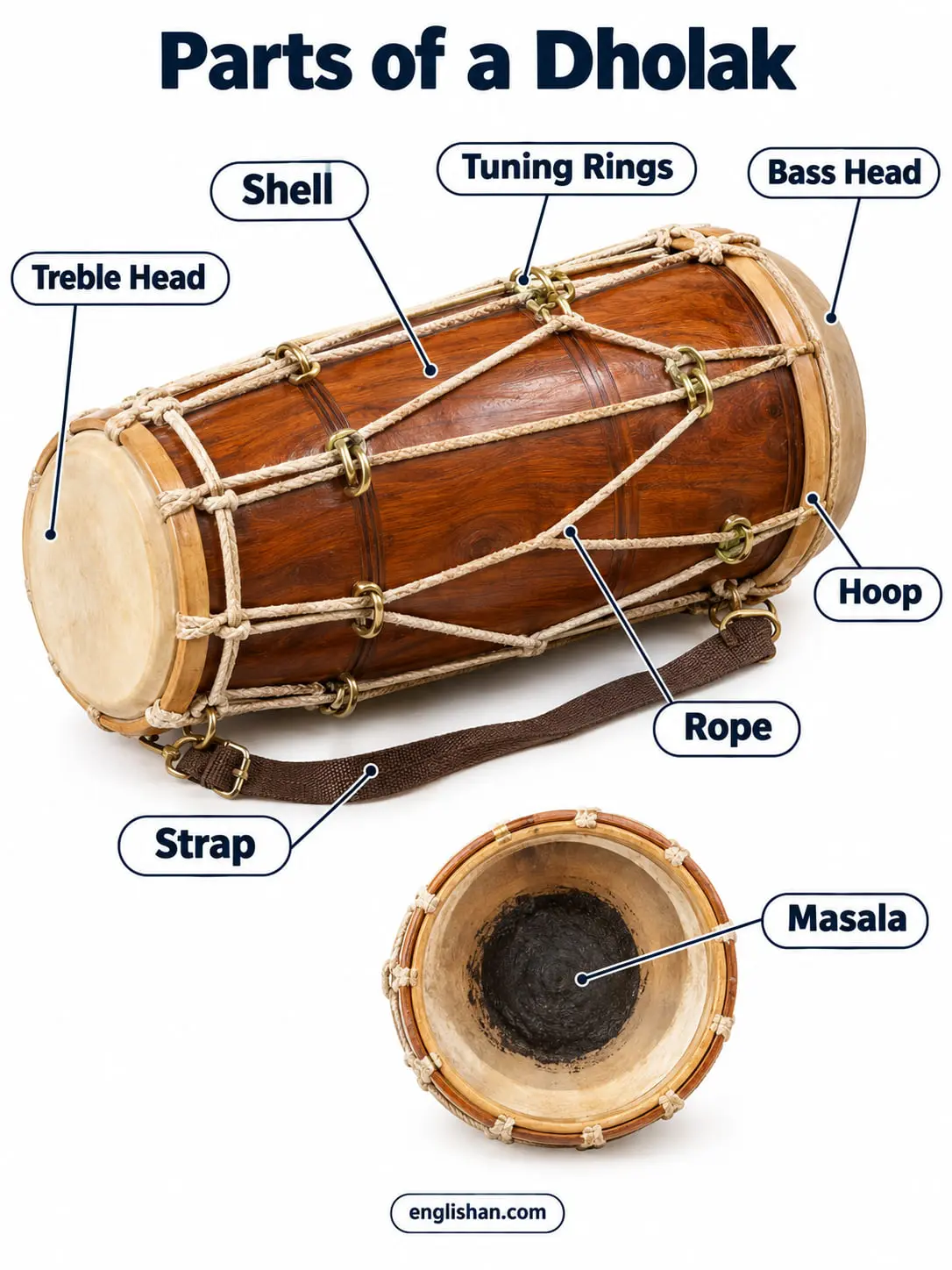
The shell is the long wooden barrel in the center, and each head is stretched over one open end. The rope or the bolts extend along the shell and draw the two hoops toward each other.
| Part | Where you find it |
|---|---|
| 1. Shell | Barrel-shaped wooden body, cut from one piece of sheesham or mango wood |
| 2. Treble head | Smaller goatskin head at one end of the shell |
| 3. Bass head | Larger head at the other end, buffalo or goat skin |
| 4. Masala | Black paste of tar, clay, and sand on the inside of the bass head |
| 5. Hoop | Round wooden or rattan frame around the edge of each head |
| 6. Rope | Cotton or synthetic cord laced between the two hoops |
| 7. Tuning rings | Metal rings that slide along the rope |
| 8. Bolts and nuts | Metal bolts that draw the hoops together on the nut-and-bolt model |
| 9. Tuning key | Small spanner that turns the nuts |
| 10. Strap | Cloth strap slung from the shoulder or the waist |
| 11. Thumb ring | Iron ring worn on the thumb in the Punjabi style |
| 12. Gajra | Pleated edge of the head on the dholki |
| 13. Iron ring | Ring on the treble head of the dholki |
| 14. Bamboo ring | Ring on the bass head of the dholki |
Dholak Shell and Head Parts
The shell and the two heads form the body of the drum. These parts of a dholak set the pitch range, and the heads are the playing surfaces.
Shell
The shell is a hollow wooden barrel, open at both ends, and it measures 8 to 10 inches across the center. It narrows toward the rims to 6 to 8 inches. Sheesham and mango are the common woods, and teak is used on some models.
Treble Head
The treble head is the smaller of the two, 5.5 to 8 inches across. It is made of goat skin and is stretched over the rim of the shell. It is also called the dayan.
Bass Head
The bass head is the larger of the two, 7.5 to 10 inches across. It is made of buffalo skin, and some models use goat skin. It is also called the bayan.
Masala
The masala is a black paste of tar, clay, and sand, applied to the inside of the bass head. It adds weight to the skin and produces the sliding bass tone of the drum. The name syahi refers to the same paste.
Rope Tuning Parts of a Dholak
The rope-tuned dholak is the traditional form, and its hoops, rope, and tuning rings together set the tension of both heads.
Hoops
The hoops are the round frames, wooden or rattan, that grip the edge of each head. The rope is laced between the two hoops.
Rope
The rope is a cotton or synthetic cord laced in a zigzag between the hoops along the length of the shell. It pulls the heads taut and fixes their pitch.
Tuning Rings
The tuning rings are metal rings, steel or brass, threaded on the rope. The player slides them along the rope to tighten it, and the pitch of the treble head rises as the rope tightens.
Nut and Bolt Parts of a Dholak
The nut-and-bolt model replaces the rope with metal hardware and is the modern form.
Bolts and Nuts
The bolts are metal rods with nuts that pass through the hoops. Turning a nut draws a hoop toward the shell and tightens the head. Models with eight bolts are sold.
Tuning Key
The tuning key is a small spanner that fits the nuts. The player uses it to adjust each bolt in turn.
Dholak Strap and Playing Parts
The strap and the thumb ring are the playing parts of a dholak. They are attached to the player’s body, not to the shell.
Strap
The strap is a cloth band slung from the shoulder or the waist. It supports the drum so that both heads are free to be played.
Thumb Ring
The thumb ring is an iron ring worn on the thumb of the playing hand in the Punjabi style.
Dholak Parts and Their Materials
The materials of the parts of a dholak are wood, skin, paste, cord, and metal. The shell is sheesham, mango, or teak, and the heads are goat skin and buffalo skin. The rope is cotton or synthetic, and the rings and bolts are steel or brass.
Dholak Types and Their Added Parts
The dholki is the narrower relative of the dholak. It has an iron ring on the treble head, a bamboo ring on the bass head, and a pleated gajra at the edge. The dhol is a larger drum played with sticks. Both share the core parts of a dholak: the shell, the two heads, and the hoops.
Dholak Parts Names in English and Hindi
Dholak parts names vary by region and by spelling. Each part has a standard English form, and the alternates are the names a student meets in books and lessons.
| Part | English gloss | Alternate names |
|---|---|---|
| Treble head | Small head | Dayan |
| Bass head | Large head | Bayan |
| Masala | Tuning paste | Syahi |
| Shell | Wooden body | Barrel |
| Hoop | Head frame | Frame |
| Tuning key | Spanner | Key |
Related:
FAQs
FAQs
The parts of a dholak are the shell, the treble head, the bass head, the masala, the hoops, the rope, the tuning rings, and the strap. The nut-and-bolt model replaces the rope with bolts, nuts, and a tuning key.
The two heads produce the sound. The player strikes the treble head and the bass head, and the skins vibrate. The shell amplifies the vibration.
The black paste is the masala, also called the syahi. It is made of tar, clay, and sand and is applied inside the bass head to add weight to the skin and shape the bass tone.
A rope-tuned dholak is tuned by sliding the rings along the rope. A nut-and-bolt dholak is tuned by turning the nuts with a tuning key. The masala on the bass head also sets the pitch.
The difference is the build. A dholak is a single barrel with a head at each end, while a tabla is a pair of separate drums, the dayan and the bayan.
The difference is the size and the playing method. A dhol is larger and is played with sticks, while a dholak is played with the hands.
A dholak is made of sheesham or mango wood for the shell, goat skin and buffalo skin for the heads, and cotton or synthetic rope with metal rings. The nut-and-bolt model uses steel or brass hardware.