

ASTM F381-24 names the minimum parts of a trampoline sold for home use: a frame, a bed, a suspension system, frame padding, instructions, and markings. The bed is the jumping mat. The suspension system joins the mat to the frame and consists of steel springs on most models.
Boxed sets add two more parts of a trampoline: an enclosure net and enclosure poles. Retailer manuals name the smaller parts: V-rings, leg braces, pole foam, and a spring tool. The standard keeps one accessory out of the box: the ladder.
Parts of a Trampoline Labeled Diagram
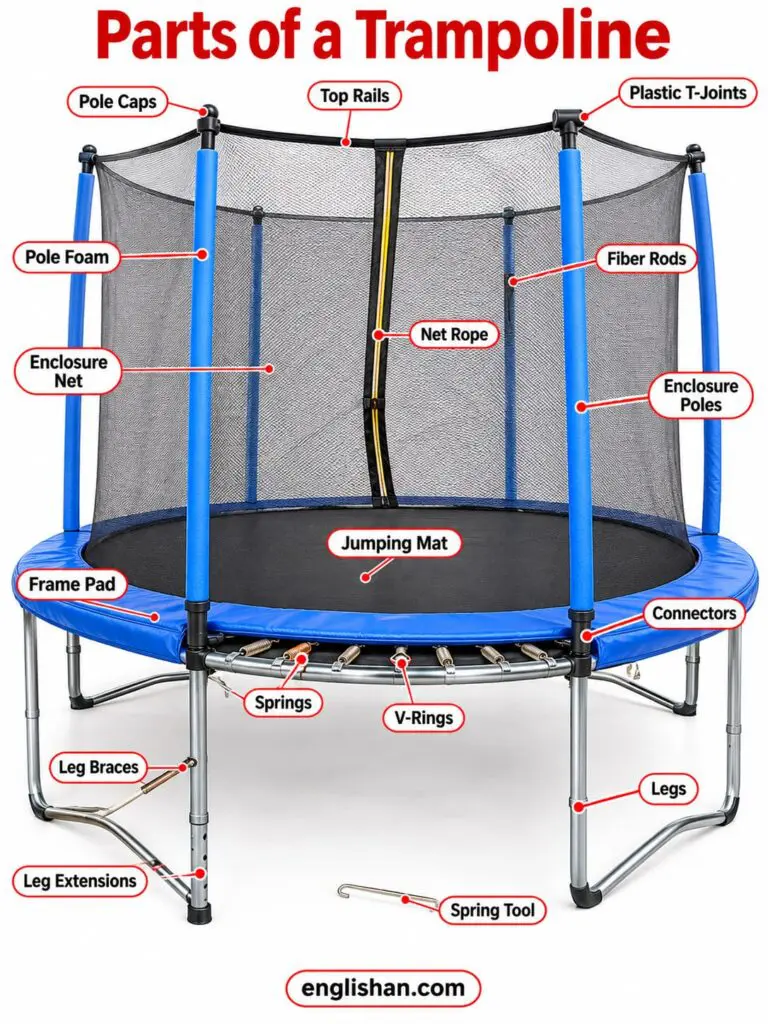
In a top view, a trampoline has the jumping mat at the center, a ring of springs around the mat, and the frame outside the springs. The frame pad covers the springs and the frame. The enclosure poles rise from the frame and support the net.
| Part | Position | Role |
|---|---|---|
| 1. Jumping mat | Center, inside the frame | Surface that the jumper lands on and pushes from |
| 2. V-ring | Along the edge of the mat | Anchor loop for the springs and the net hook |
| 3. Spring | Between the mat edge and the top rail | Steel coil that stretches under load and returns the jumper upward |
| 4. Top rail | Upper tube of the frame, with a hole for each spring | Holds the outer end of every spring |
| 5. Leg | Under the top rail | Keeps the unit stable |
| 6. Leg brace or balance bar | Between neighboring legs | Links the legs into one stable base |
| 7. Frame pad | Over the springs and the top rail | Cushions falls onto the springs and the frame |
| 8. Enclosure pole | Rises from the frame | Supports the net at the height of the enclosure |
| 9. Enclosure net | Hung from the top of the poles | Keeps jumpers from falling off the edge |
Jumping Mat and V-Rings
The mat and its V-rings form the jumping surface and its link to the springs.
Jumping Mat
Jumping mat
The jumping mat is the surface a jumper lands on and pushes from, and it lies inside the ring of springs. Wikipedia states that the fabric is not elastic itself and that the springs create the rebound. Home mats are woven polypropylene or waterproof canvas, and competition mats are woven webbing.
Springfree states that polypropylene resists UV light and water and withstands the stretching of bouncing. Mat life depends on weave density, UV resistance, and added treatment. A gymnastics supplier lists mats from 8 ft to 15 ft, and reinforced stitching marks a well-made mat.
V-ring
V-rings are the loops along the mat edge that the springs attach to. One retailer manual tells the builder to mark the quarter marks on the mat and the top rail and then match the V-rings to the rail holes. A second manual hangs the net hook on a V-ring.
The jumping mat is woven polypropylene for home use and woven webbing for competition, with UV treatment.
Springs and the Suspension System
ASTM F381 uses the term suspension system for the parts that connect the bed to the frame. On a standard trampoline these are coiled steel springs.
Spring
Spring
A spring is a steel coil between the mat edge and the top rail. Each spring hooks to the mat at one end and to a hole in the top rail at the other. Springfree describes the springs as galvanized steel, which gives them elasticity and a zinc coating against rust.
Spring count depends on the trampoline size. Springfree puts a high spring count at 72 to 104, and one retailer manual lists 72, 80, 90, and 100 springs across four set sizes. A competition trampoline has about 110 springs, according to Wikipedia.
Length changes the feel. A trade source reports that longer springs give a softer bounce and shorter springs give a firmer one. Builders attach the springs in an X-shaped order so that the tension stays even across the mat. One manual asks owners to check the springs and the bolts at the start of each season.
Spring tool
A spring tool, also called a spring loading tool, pulls each coil into place during assembly. Both retailer manuals supply one. Both warn about pinched fingers during the spring step.
Springs are galvanized steel with a zinc coating.
Parts of a Trampoline Frame
The frame is the foundation of the trampoline, as Rebound Products describes it. Its top rail forms the circle, rectangle, or octagon that the springs pull against, and the parts of a trampoline frame are the top rails, connectors, legs, leg extensions, and braces. One retailer manual connects six base units with top rails and connectors.
Most frames are galvanized or powder-coated steel with a zinc coating against rust, and some toddler and small models use aluminum. Welded joints hold up better than bolted ones, and steel is more durable than aluminum. Competition frames fold for transport to venues, and home frames are less sturdy.
Top Rails and Connectors
Top rail
The top rail is the upper tube of the frame and holds a hole for each spring. The spring holes face the ground when the rails are joined. One manual lists four to five top tubes with a T-joint and the same number with a socket end, depending on the set size.
Connector
A connector joins two top rails and is secured with an M6 screw in one manual. Two people are needed for this step in that manual.
Legs and Balance Bars
Leg
The legs support the top rail and keep the unit stable. Rebound Products states that a frame has at least four.
Leg extension
A leg extension joins each leg and is fastened with screws. One manual lists 8 to 10 leg extensions per set.
Leg brace or balance bar
Leg braces and balance bars connect neighboring legs. One manual fits the balance bars between two legs and not inside a single leg, and another lists 4 to 5 leg braces per set.
Frame Pad Over the Springs
Frame pad
The frame pad is the foam cover that lies over the springs and the top rail. CPSC instructs owners not to use a trampoline without shock-absorbing pads that completely cover its springs, hooks, and frame. Falls onto the springs and the frame are listed as a cause of injury.
Pads are thick foam covered in PVC or vinyl, and Springfree adds that quality padding is waterproof and UV-treated. Elevate Trampoline Park adds that the pad should cover the full circumference. A strap under the pad is tied to the frame so that the pad stays in place, and one manual asks the builder to check that the pad covers all metal parts.
The frame pad is foam with a PVC or vinyl cover, treated against UV and water.
Parts of a Trampoline Enclosure
An enclosure sets the boundary of the bouncing surface and consists of a net, poles, and the hardware that joins them. ASTM F2225-13 is the standard for consumer trampoline enclosures and covers parts, assembly, use, labeling, and performance. CPSC states that enclosures help prevent injuries from falls off trampolines.
The evidence is not uniform. Wikipedia reports that the American Academy of Pediatrics sees no epidemiological evidence that home retaining nets improve safety. Springfree advises against jumping without a net.
Enclosure Net
Enclosure net
The enclosure net hangs from the top of the poles and closes the sides of the bouncing surface. Nets are woven from UV-resistant polyethylene or polyester. The mesh is fine enough to keep fingers from catching and strong enough to absorb a fall, and Springfree adds that reinforced edges and sturdy poles mark a quality net. One manual asks owners to replace the net and the protective parts every three years.
Net rope
One manual fits net ropes around the springs together with the net.
The enclosure net is polyethylene or polyester with UV treatment.
Poles and Pole Foam
Enclosure pole
In two retailer manuals, each enclosure pole has a lower pole that attaches to the frame and an upper pole that joins it. One manual lists 8 to 10 poles per set. The other manual locks the upper pole into the lower pole until marbles pop out.
Pole foam
Foam tubes slide over the poles. One manual lists 8 to 10 pieces, one for each pole.
Pole cap
One manual lists 16 to 20 pole caps per set, twice the pole count.
Net Support Rods and T-Joints
Fiber rod
Fiber rods form a circle on top of the poles, and the net hangs from this ring. One manual connects 12 rods this way for a set with 12 poles.
Plastic T-joint
A plastic T-joint links neighboring fiber rods into the circle in the same manual.
Springfree Trampoline Parts
Fiberglass composite rod
A springfree trampoline replaces the steel springs with flexible fiberglass composite rods. The maker states that the rods give a softer bounce and free about two feet of jumping room that springs take up. Springfree states that the design removes spring-related pinch injuries and does not need a spring pad.
The other parts of a trampoline stay in place. A springless trampoline still has a frame, a polypropylene mat, and a net. The maker puts its frame through a three-layer rust-proofing process and 3,000 hours of salt spray testing. These figures come from Springfree, and no independent test is cited.
The springless rods are fiberglass composite.
Parts of a Trampoline in a Boxed Set
A boxed set includes more parts than the diagram. One retailer manual gives quantities in four columns without labeling the sizes, so the columns are numbered in the manual’s order, and the parts of a trampoline set vary with each size.
| Part | Set 1 | Set 2 | Set 3 | Set 4 |
|---|---|---|---|---|
| Springs | 72 | 80 | 90 | 100 |
| Top tubes with T-joint | 4 | 5 | 5 | 5 |
| Leg extensions | 8 | 10 | 10 | 10 |
| Enclosure poles | 8 | 10 | 10 | 10 |
| Pole caps | 16 | 20 | 20 | 20 |
| Jumping mat, frame pad, and net | 1 each | 1 each | 1 each | 1 each |
The box also holds a multi-functional tool, and the screws, nuts, washers, and spacers for the frame. The manual lists a user limit of 200 lbs, which applies to that model and not to trampolines in general.
Ladder
A ladder is an accessory, and the standards treat it as a separate product. ASTM F381 states that a trampoline ladder must not be included as a part or in the same packaging. CPSC advises against using any ladder with a trampoline because it gives small children unsupervised access. One retailer manual lists step poles, frame poles, and ladder screws among its parts, and the rails and rungs of a ladder are covered in parts of a ladder.
FAQs
The parts of a trampoline are the jumping mat, springs, frame, frame pad, enclosure net, and enclosure poles. The frame consists of a top rail, legs, and braces, and the mat attaches to the springs through V-rings. ASTM F381 calls the mat the bed and the springs the suspension system.
The part you jump on is called the mat or the bed, and the bounce itself comes from the springs. The mat is a woven fabric that is not elastic itself. The springs store the energy of the landing and return it to the jumper.
The frame is the main part, because it supports the springs, the mat, the pad, and the enclosure poles. A frame has at least four legs and a top rail with a hole for each spring. Most frames are galvanized or powder-coated steel.
The mat is made of woven polypropylene on most home trampolines. Some home mats use waterproof canvas, and competition trampolines use woven webbing. The springs that create the rebound are galvanized steel.
Parts differ by size and model. One manual lists 72, 80, 90, and 100 springs across four set sizes, and the top rail holes must line up with the V-rings on the mat. Check the manual of the existing trampoline before ordering a replacement.
A spring tool is the main tool, and both retailer manuals supply one. One adds a wrench and the other a multi-functional tool. The manuals ask for two adults for the frame and spring steps and for two to three adults for the enclosure, with hands kept away from the springs while they are fitted.
A Springfree trampoline has a frame, a polypropylene mat, a net, and flexible fiberglass composite rods in place of steel springs. The maker states that the rods remove the need for a spring pad. The frame is galvanized or powder-coated steel.
Related:
- Parts of an Umbrella
- Parts of a Kayak
- Parts of a Hockey Stick
- Parts of a Baseball Bat
- Parts of a Golf Club