An umbrella is a folding frame of ribs under a fabric canopy, mounted on a central shaft or pole. The parts of an umbrella are the canopy, the ribs, the stretchers, the runner, the shaft, the handle, and the ferrule, which is the tip at the top of the shaft.
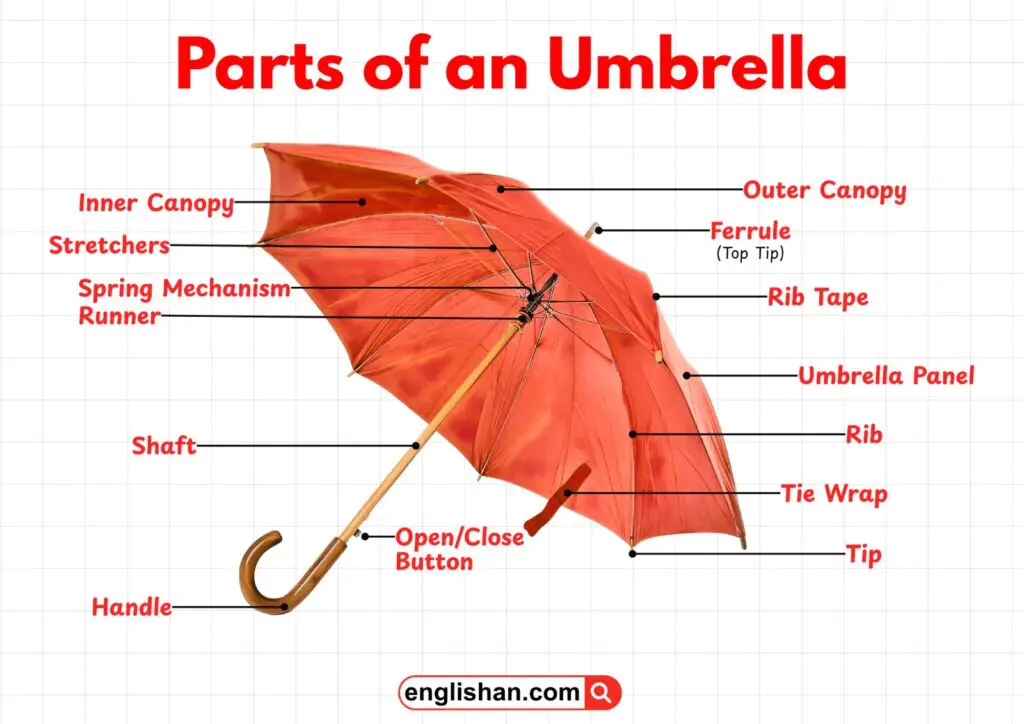
The parts of an umbrella differ between a handheld model, which opens with a sliding runner and spring catches, and a patio model, which opens with a crank and a pole. Both forms share the canopy and rib frame, much like the pole-and-fabric frame of a tent.
Parts of an Umbrella Labeled Diagram
In a labeled diagram of an umbrella, the canopy is the fabric dome at the top and the ribs radiate from the top notch beneath it. The stretchers join each rib to the runner, and the runner slides along the shaft. The handle is at the bottom of the shaft. The 32 numbered parts of an umbrella extend from the canopy of a handheld model to the base of a patio model.
| No. | Part | Location | Function |
|---|---|---|---|
| 1 | Canopy | The fabric dome over the frame | Sheds rain and blocks sun |
| 2 | Canopy panels | The wedge-shaped fabric sections of the dome | Form the curve of the canopy |
| 3 | Seams | The stitched lines between panels, over each rib | Join the panels and seal the stitching |
| 4 | Ribs | Under the canopy, from the top notch to the canopy edge | Support and spread the canopy |
| 5 | Rib tips | At the outer end of each rib | Cap the rib ends and fasten the canopy corners |
| 6 | Stretchers | Between the runner and the middle of each rib | Push the ribs outward as the umbrella opens |
| 7 | Top notch | At the top of the shaft, where the ribs attach | Hinges the rib ends |
| 8 | Open cap | At the center of the canopy, over the top notch | Secures the canopy apex and tensions the fabric |
| 9 | Lower notch | On the shaft, under the runner when the umbrella is closed | Stops the runner at the closed position |
| 10 | Runner | On the shaft under the stretchers | Slides to open and close the frame |
| 11 | Top spring | On the shaft, where the runner stops when open | Catches the runner in the open position |
| 12 | Bottom spring | On the shaft, near the handle | Catches the runner in the closed position |
| 13 | Shaft | The central rod from the handle to the ferrule | Supports the runner and the rib frame |
| 14 | Ferrule | The tip at the top of the shaft | Protects the end of the shaft |
| 15 | Handle | At the bottom of the shaft | Grip for the hand |
| 16 | Tie strap | On the canopy edge | Fastens the folded canopy |
| 17 | Sleeve | Over the closed canopy | Covers the folded umbrella for storage |
| 18 | Hinges and pivot pins | At the rib and stretcher joints | Let the frame fold |
| 19 | Telescopic shaft sections | Inside the shaft of a folding umbrella | Shorten the shaft |
| 20 | Push-button release | In the handle of an automatic umbrella | Frees the runner to open |
Rows 21 to 32 cover the patio umbrella, the outdoor form of the parts of an umbrella, which adds a hub, a crank, a tilt joint, and a weighted base.
| No. | Part | Location | Function |
|---|---|---|---|
| 21 | Finial | On top of the pole, over the canopy | Caps the pole and secures the canopy |
| 22 | Wind vent | In the top of the canopy | Releases wind pressure from under the fabric |
| 23 | Hub | At the top of the pole, where the ribs meet | Fastens the rib heads |
| 24 | Pole | The central post from the base to the finial | Supports the canopy and the lift hardware |
| 25 | Crank | On the lower pole | Raises and lowers the canopy |
| 26 | Tilt joint | On the pole under the canopy | Angles the canopy toward the sun |
| 27 | Rope and pulley | At the top of the pole on hand-lift models | Raises the canopy without a crank |
| 28 | Base tube | The center opening of the base | Receives the pole |
| 29 | Lock collar | Where the pole meets the base tube | Joins the pole to the base |
| 30 | Adapter ring | Inside the base tube | Fits the base to a thinner pole |
| 31 | Base | On the ground, around the pole | Weights the umbrella and braces the pole |
| 32 | Offset arm | On cantilever models, from the side pole to the canopy | Extends the canopy over the seating |
Canopy Panels and Seams
The canopy is the part of an umbrella that meets the rain and the sun, so water and light pass to the frame only through its fabric, its panels, and its seams. Fabric comes first, then the panels, then the seams.
Canopy
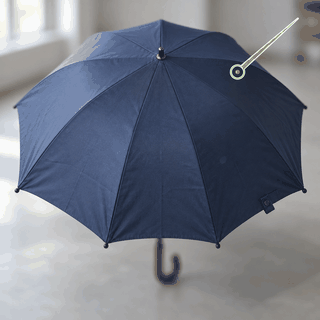
The canopy is the fabric cover that forms the dome of the umbrella, much as the canopy of a parachute forms its dome. Rain umbrellas use polyester, nylon, or pongee, a lightweight plain-weave fabric, with a water-repellent coating. Sun umbrellas add an ultraviolet coating, and patio umbrellas use acrylic or polyester woven to resist fading. Windproof handheld models add a second canopy layer over the first, with a gap between the layers.
Canopy Panels
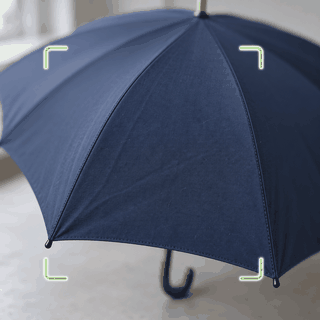
Canopy panels are the wedge-shaped fabric sections that are sewn together to form the dome. A canopy has one panel between each pair of ribs, and eight panels is a common count on a handheld umbrella. Designs and logos are printed across the panels before the sections are sewn.
Seams
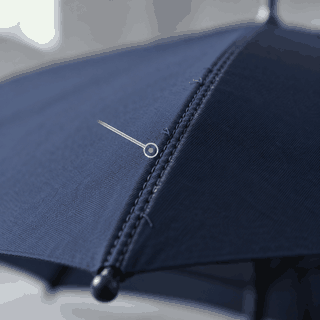
Seams are the stitched lines that join one panel to the next, and each seam lies over a rib. Waterproof seam tape is a thin film pressed over the stitching on the inside of the canopy, and it seals the needle holes that would otherwise leak. Patio canopies have sewn pockets at the seams that secure the rib ends.
Ribs Stretchers and Rib Tips
The ribs, the stretchers, and the rib tips are the largest parts of an umbrella frame. The ribs extend from the center, the stretchers open them, and the tips cap their ends.
Ribs
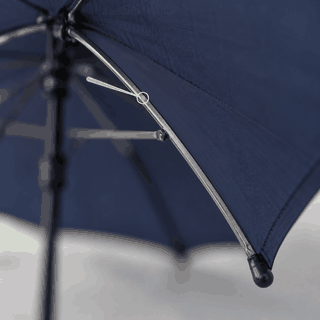
The ribs are the curved arms of the frame, and each one extends from the top notch to the edge of the canopy. Common rib counts are 6, 8, 10, 12, and 16, and eight is standard on a handheld canopy. Steel ribs are strong, fiberglass ribs flex in wind without bending permanently, and carbon fiber ribs are lighter still. Aluminum ribs are lighter than steel and more flexible than plastic, which is why they are standard on patio umbrellas.
Rib Tips
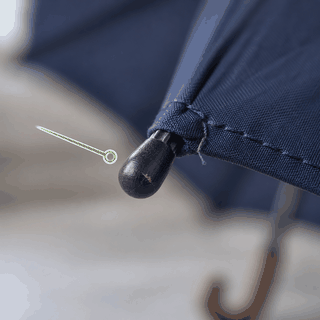
Rib tips are small caps at the outer end of each rib, also called end caps or safety tips. They are made of plastic or metal and are rounded so that they do not tear the fabric or scratch a hand. The canopy corner is stitched or tied to each tip, which fastens the edge of the fabric at the end of the rib.
Stretchers
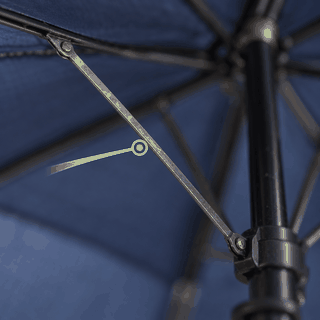
Stretchers are thin metal arms that join the runner to the middle of each rib. Each stretcher pivots at both ends, and an umbrella has one stretcher for every rib. When the runner slides up the shaft, the stretchers push the ribs outward and the canopy opens. When the runner slides down, they pull the ribs inward. Patio catalogs call the stretchers struts.
Runner Springs and Notches
The runner, the springs, and the notches are mounted on the shaft and regulate how the frame opens and locks. The runner slides, the springs catch it at each end of its travel, and the lower notch stops it.
Runner
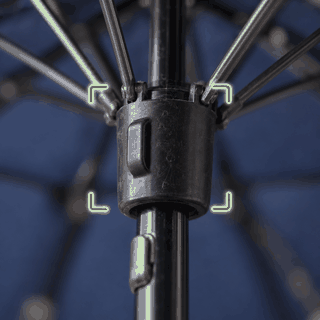
The runner is a sliding sleeve on the shaft, made of plastic or metal. The stretchers attach to it at their lower ends, and it lifts them along the shaft as the umbrella opens. A raised tab on the runner engages the spring catches.
Top Notch
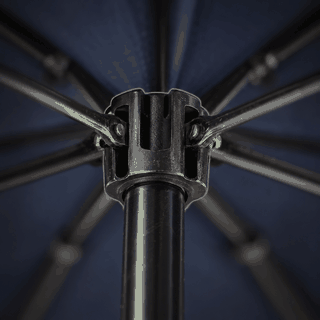
The top notch is a fixed fitting at the top of the shaft, directly under the canopy apex. It is slotted, and the ribs attach to it with small hinge pins, so that each rib pivots there. The top notch, also called the crown, is the highest point of the frame and is fixed in place when the umbrella opens.
Lower Notch
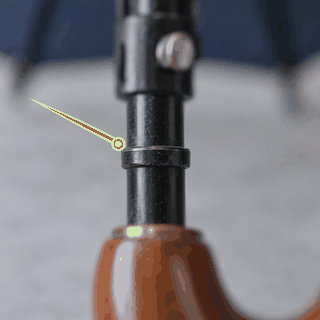
The lower notch, also called the stopper, is a ridge or a fitting on the shaft near the handle. It limits the travel of the runner at the closed end, so the folded frame is compact when the umbrella is carried.
Open Cap
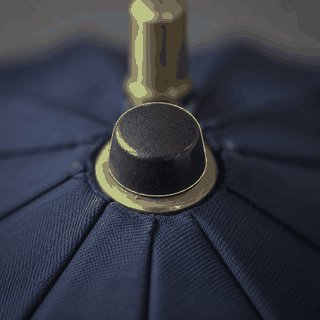
The open cap is a small fitting at the center of the canopy over the top notch. It secures the apex of the fabric to the shaft and tensions the canopy. A metal washer or fastener under it reinforces the hole at the center of the fabric.
Top Spring and Bottom Spring
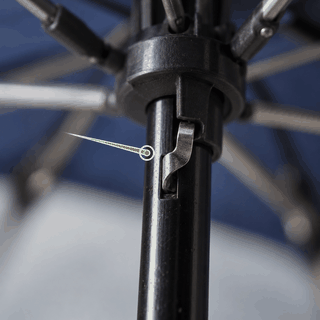
The top spring and the bottom spring are spring-steel catches set into slots on the shaft. The top spring catches the runner when the umbrella is fully open, and the bottom spring catches it when the umbrella is closed. Pressing the catch releases the runner and frees the frame to fold. The top spring is also called the open lock.
Shaft Handle and Ferrule
Among the parts of an umbrella, the shaft is the main structural rod. The handle is the grip at its bottom end, and the ferrule is the tip at its top end.
Shaft
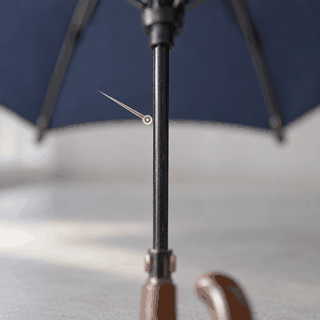
The shaft is the central rod of the umbrella, made of steel, aluminum, fiberglass, or wood. The runner slides on it, the springs are set into it, and the top notch is fixed to its top. The length of shaft between the runner and the top notch is called the tube, and the segment over the open cap is called the end.
Handle
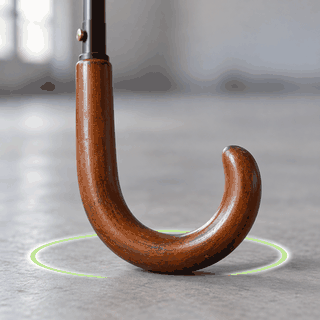
The handle is the grip at the bottom of the shaft. A hook handle, also called a crook or J handle, curves back on itself so that the umbrella hangs from a wrist or an arm. A straight handle ends in a flat or rounded grip, and it is standard on golf, compact, and automatic umbrellas. Handles are made of wood, plastic, or metal, and many are wrapped in rubber or foam for grip.
Ferrule
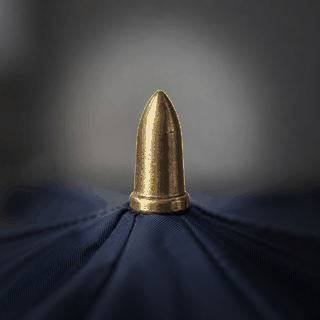
The ferrule is the tip at the top of the shaft, over the open cap. It is a small cap of metal or plastic, pointed or rounded, that seals the crown and protects the end of the shaft. On a decorative umbrella the ferrule is shaped in brass or wood, and on a modern umbrella it is plain.
Parts of a Folding Umbrella
A folding umbrella has the same frame as a stick umbrella, shortened by a telescopic shaft. The shaft is built from two, three, or five nested sections, called telescopic tubes, and low-friction plastic bushings let them slide. A center spring on the shaft extends the sections as the umbrella opens.
Each rib and stretcher also hinges at a joint, fastened by a rivet or a pivot pin, so that the frame folds into a compact bundle. Folding changes only a few parts of an umbrella: the shaft, the ribs, and the stretchers. The canopy, the runner, and the springs match the stick form.
A golf umbrella is a large stick umbrella with a canopy that spans about 60 to 68 inches, fiberglass ribs, and a vented double canopy for wind. The handle is a straight, rubber-wrapped grip, similar to the grip of a golf club.
Parts of an Automatic Umbrella
The push button, the compression spring, and the push rod are the parts of an umbrella found only on automatic models. The push button is set into the handle. The button retracts the catch tab, which frees the runner, and a compression spring inside the shaft raises the runner on a push rod. The stretchers push the ribs outward, and the canopy opens in one motion.
The runner is pushed down by hand to close the umbrella, until the bottom spring catches it. Retraction springs pull the ribs inward as the canopy folds. Some models also close on a second button press, and others lock the shaft with a one-way ratchet so it does not spring back.
Tie Strap Sleeve and Handle Strap
The tie strap, the sleeve, and the handle strap are the fabric parts of an umbrella that fasten, cover, and hang a closed umbrella. None of them changes how the frame opens.
Tie Strap
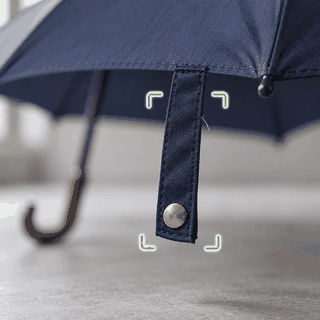
The tie strap is a short fabric band on the canopy edge, closed with a snap or a hook-and-loop fastener. It wraps around the folded canopy and stops it from loosening when the umbrella is carried. Printed straps bear a logo on some models.
Sleeve
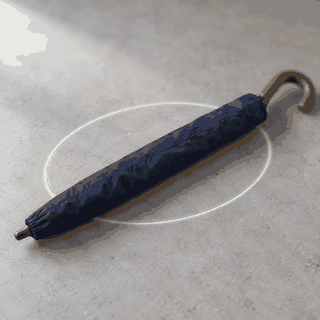
The sleeve is a fabric or leather cover that slides over the closed canopy. It protects the folded fabric and the rib tips in a bag or a car.
Handle Strap and Handle Ring
The handle strap is a wrist loop of webbing or leather attached to the end of the handle. A handle ring is a small metal or thick plastic loop on a straight handle, used for hanging the umbrella on a hook or a belt.
Parts of a Patio Umbrella
A patio umbrella is a large outdoor umbrella that shades a table, a pool deck, or a seating space. Beyond the parts of an umbrella that every model shares, a patio umbrella mirrors the handheld frame, scaled up, with a central pole instead of a shaft and a base in place of a handle. Market umbrellas span 6 to 11 feet across and open with a crank or a rope and pulley.
Finial
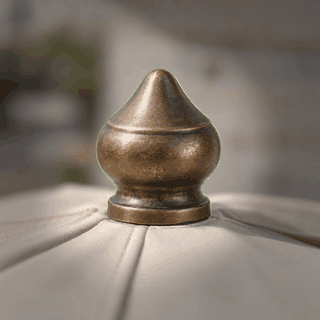
The finial is the cap at the very top of the pole, over the canopy. It is made of wood, metal, or plastic, and it fastens the canopy and the vent to the pole. On some models the finial unscrews, and it shields the hub from rain and debris.
Wind Vent
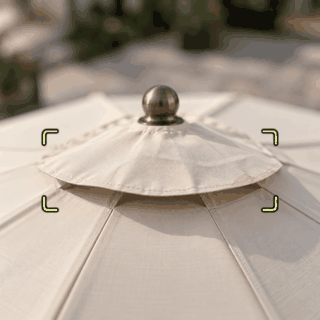
The wind vent is a slit or a raised flap in the top of the canopy. Wind passes through it instead of lifting the whole canopy, which steadies the umbrella in a breeze. A double-layer vent is common on larger canopies.
Hub
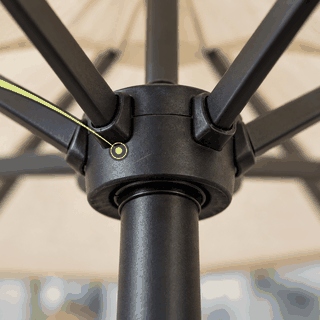
The hub is the fitting at the top of the pole where all the ribs meet. A second sliding piece, the hub runner, slides up and down the pole and lifts the struts that open the ribs. It is the patio counterpart of the runner on a handheld umbrella.
Pole
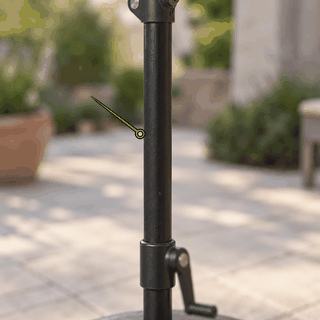
The pole is the central post that supports the canopy at its top and joins the base at its bottom. Poles are made of aluminum, steel, fiberglass, or wood. The hub runner slides on the upper pole, and the crank mounts on the lower pole. Some catalogs call the lower end of the pole the ferrule, because it is the length of pole that inserts into the base.
A beach umbrella follows the same layout, but a pointed pole replaces the base and is driven into the sand. A pool umbrella uses a standard base or fits through the umbrella hole of a patio table.
Crank Tilt Lock Collar and Base
The crank, the tilt joint, the lock collar, and the base are the parts of an umbrella with no counterpart on a handheld model. They bear the load, raise the canopy, and set its angle.
Crank
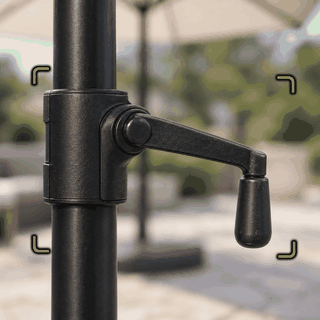
The crank is a rotating arm on the lower pole, with a folding handle in most models. Turning it winds a lift cord around a gear inside the pole housing, and the cord pulls the hub runner up the pole to open the canopy. A crank lift suits large, heavy canopies.
Rope and Pulley
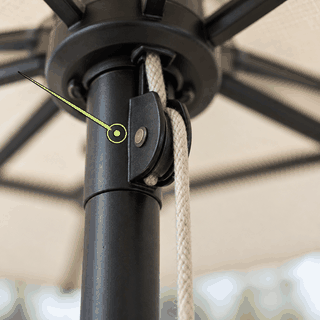
A rope and pulley replaces the crank on smaller umbrellas. A rope passes over a pulley at the top of the pole and is cleated at the lower pole after lifting. The runner rises as the rope is pulled, and the cleat locks the canopy open. A push-lift umbrella has neither, and the canopy is raised by hand and locked with a pin.
Tilt Joint
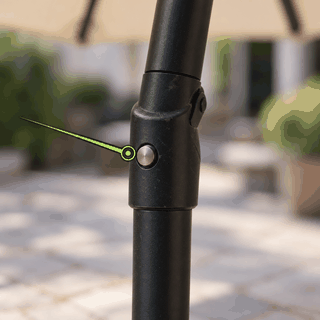
The tilt joint is a hinge on the pole under the canopy, worked by a push button or a collar. Once the umbrella is open, the tilt joint angles the canopy toward the sun. A tilt joint does not change the height of the canopy.
Base Tube, Lock Collar, and Adapter Ring
The base tube is the center opening of the base, and the pole slides into it. The lock collar is a metal or plastic ring with a tightening knob or a push pin. The ring fixes the pole in the base so that the umbrella does not rotate or lift out, much like the leg lock of a tripod. An adapter ring is an insert that fits a base tube to a thinner pole.
Base
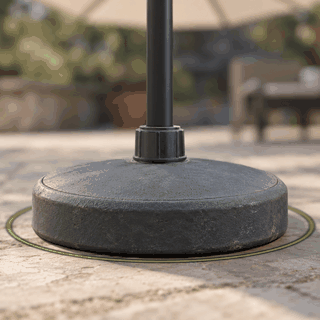
The base is the weighted foundation that braces the umbrella on the ground. A base is made of concrete, cast iron, steel, or resin that fills with sand, gravel, or water. Cast iron and steel bases need no fill. A freestanding base surrounds the pole at ground level, and some have wheels. A table umbrella passes through the table hole and seats in a small base underneath. The required weight depends on the diameter of the canopy.
Parts of a Cantilever Umbrella
A cantilever umbrella, also called an offset umbrella, relocates the pole to the side so that the canopy extends over the seating without a center post. Its canopy spans 9 to 13 feet across. The cantilever form changes the support, not the other parts of an umbrella: the canopy, ribs, runner, and finial match the patio frame, mounted on an arm.
Offset Arm
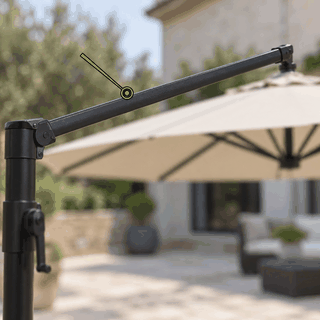
The offset arm is the only one of the parts of an umbrella found on cantilever models alone. It is the horizontal or angled tube that extends from the top of the side pole to the center of the canopy. It is made of aluminum or steel and supports the canopy frame at its far end.
Cross Base
The cross base is a four-legged base that lies flat on the ground beside the seating. Weight plates or fill containers are placed on the legs, and the side pole is mounted at the center of the cross. Cantilever bases are heavier than market bases because the canopy extends sideways from the pole.
Rotation Handle
Many cantilever models rotate the canopy through a full circle, using a handle or a foot pedal on the lower pole. The crank and the tilt joint are the same as on a market umbrella.
Other Names for Parts of an Umbrella
The parts of an umbrella have several names, depending on the maker, the region, and the type. A rib is called an arm in everyday use, and a shaft is called a stick. The canopy is the cover, and in the UK an umbrella is also called a brolly and a patio umbrella is called a parasol.
| Everyday name | Standard name | Location |
|---|---|---|
| Arms | Ribs | Under the canopy, from the top notch outward |
| Cover or fabric | Canopy | The outer dome |
| Stick or pole | Shaft | The central rod of a handheld umbrella |
| Grip | Handle | At the bottom of the shaft |
| Tip or point | Ferrule | At the top of the shaft |
| Top cap | Open cap or finial | At the center of the canopy |
| Crown | Top notch | At the top of the shaft, under the canopy |
| Slider | Runner | On the shaft under the stretchers |
| Struts | Stretchers | Between the runner and the ribs |
| Metal frame | Ribs and stretchers | Inside the canopy |
| End caps | Rib tips | At the outer end of each rib |
| Release button | Push button | In the handle of an automatic umbrella |
FAQs
Q1. What are the parts of an umbrella called?
The parts of an umbrella are the canopy, the ribs, the stretchers, the runner, the top notch, the shaft, the handle, and the ferrule. Springs on the shaft catch the runner when the umbrella is open or closed. A patio umbrella adds a pole, a crank, a tilt joint, and a base.
Q2. What are the metal parts of an umbrella called?
The metal parts of an umbrella are the ribs, the stretchers, the shaft, the runner, the top notch, and the ferrule. Together they form the frame that opens and closes the canopy. The ribs and stretchers are the most visible metal parts of an umbrella when the canopy is open.
Q3. What is the top part of an umbrella called?
The top part of an umbrella is the canopy, and the very top point is the ferrule. The open cap secures the center of the fabric under the ferrule. On a patio umbrella, the top fitting is called the finial.
Q4. What is the inside of an umbrella called?
The inside of an umbrella is the frame, which contains most of the parts of an umbrella. It consists of the ribs, the stretchers, the runner, the top notch, and the springs on the shaft. The frame is visible under the canopy when the umbrella is open.
Q5. What are the arms of an umbrella called?
The arms of an umbrella are called ribs. Each rib extends from the top notch to the edge of the canopy and supports the fabric. The shorter arms that join the ribs to the runner are called stretchers.
Q6. What are the parts of a patio umbrella?
The parts of a patio umbrella are the canopy, the ribs, the finial, the wind vent, the hub, the pole, the crank, the tilt joint, the lock collar, and the base. Rope-and-pulley models replace the crank with a rope. A cantilever model adds an offset arm and a cross base.
Q7. What are the parts of an outdoor umbrella called?
An outdoor umbrella shares the parts of an umbrella frame and adds a pole, a crank, a tilt joint, and a base. A market umbrella has a center pole, and a cantilever umbrella hangs from a side pole and an offset arm. A beach umbrella replaces the base with a pointed pole for the sand.
Q8. What are the parts of an umbrella and their functions?
Each of the parts of an umbrella has one function. The canopy sheds rain and sun, and the ribs support and spread it. The stretchers push the ribs outward when the runner slides up the shaft, and the springs catch the runner. The handle is the grip, and the ferrule protects the tip of the shaft.
Q9. What are the different parts of an umbrella?
The different parts of an umbrella are in three places: the canopy and ribs at the top, the runner and springs on the shaft, and the handle at the bottom. A folding umbrella adds a telescopic shaft with a center spring. A patio umbrella adds a crank, a tilt joint, and a base.
Q10. What do you call the parts of an umbrella in the UK?
The parts of an umbrella have the same names in the UK, where the whole umbrella is also called a brolly. A patio umbrella is called a parasol, and a cantilever umbrella is called a cantilever parasol or a side-pole parasol.
Q11. What is an umbrella made of?
An umbrella is made of a fabric canopy, a metal or fiberglass frame, and a shaft of steel, aluminum, fiberglass, or wood. The canopy is polyester, nylon, or pongee on a handheld umbrella, and acrylic or polyester on a patio umbrella. The handle is wood, plastic, or metal.
Q12. What is the runner on an umbrella?
The runner is one of the parts of an umbrella on the shaft: a sliding sleeve that opens and closes the frame. The stretchers attach to it, and it lifts them along the shaft to spread the ribs. The springs on the shaft catch the runner at the open and closed positions.
You May Also Like
- Parts of a Tent
- Parts of a Parachute
- Parts of a Tripod
- Parts of a Hot Air Balloon
- Parts of a Golf Club