

The parts of an excavator fall into three assemblies: the arm that digs, the house that rotates, and the undercarriage that travels. United Rentals and Wikipedia divide the machine the same way.
Sources disagree on the count. Al Marwan names 16 parts, HR Parts labels 20 on its diagram, and BigRentz numbers 22. Each part here is defined by the job it does and the assembly it is part of.
Parts of an Excavator Labeled Diagram
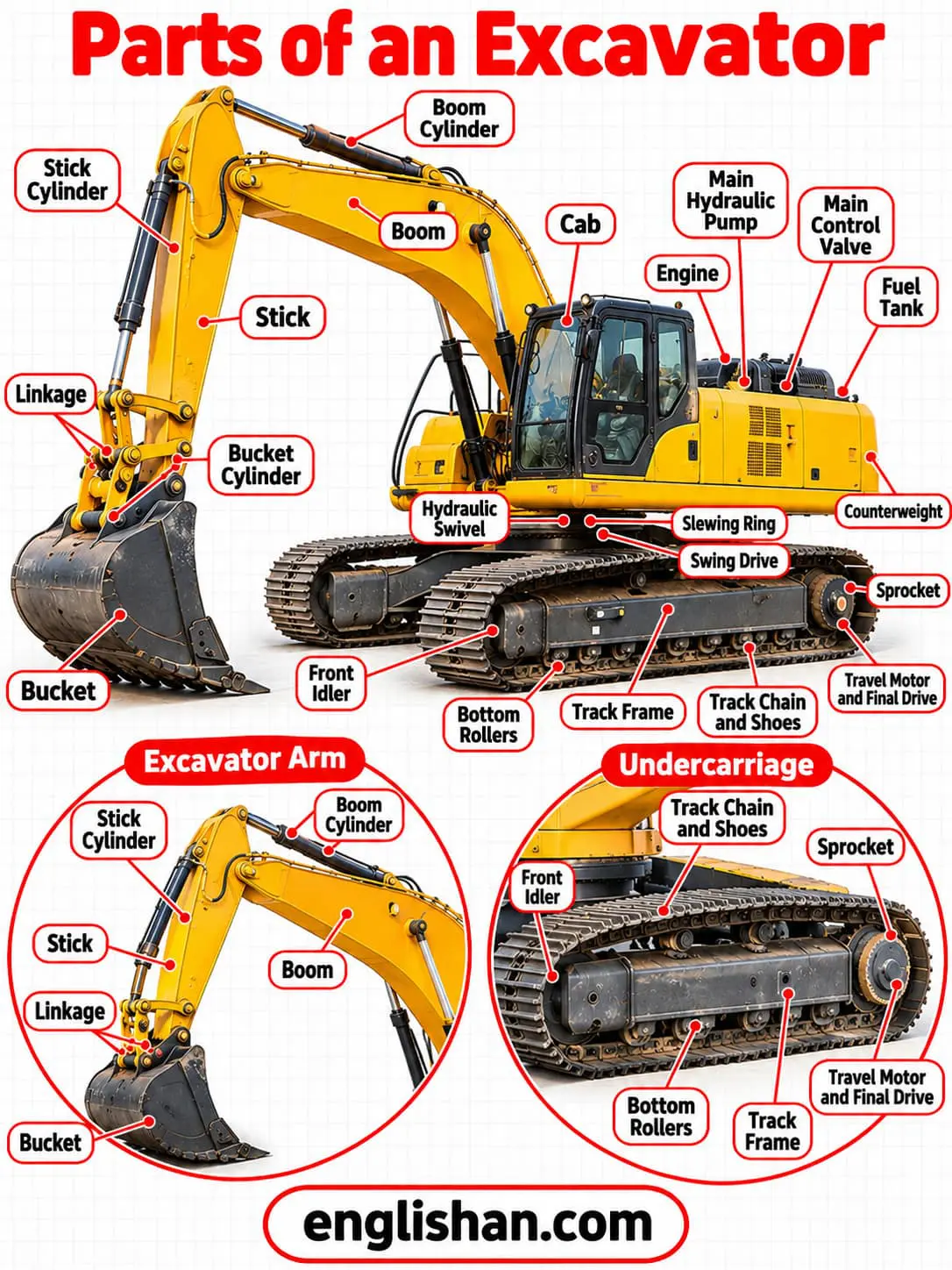
Each numbered row names a part, the assembly it is part of, and the job it does. The numbers run from the bucket tip back to the tracks.
| No. | Part | Assembly | Job |
|---|---|---|---|
| 1 | Bucket | Arm | Digs, scoops, and dumps material at the end of the stick |
| 2 | Bucket cylinder | Arm | Scoops when it extends and dumps when it retracts |
| 3 | Linkage | Arm | Heavy-duty bars and pins that join the bucket to the stick |
| 4 | Stick (arm or dipper) | Arm | Pulls the bucket toward the machine for digging |
| 5 | Stick cylinder | Arm | Pivots the stick and bucket toward or away from the house |
| 6 | Boom | Arm | Front member attached to the house that raises and lowers the arm |
| 7 | Boom cylinder | Arm | Lifts and lowers the boom |
| 8 | Cab | House | Operator station with the controls and rollover protection |
| 9 | Engine | House | Diesel engine that drives the pumps |
| 10 | Main hydraulic pump | House | Converts engine power into hydraulic power |
| 11 | Main control valve | House | Sets the pressure and direction of hydraulic oil |
| 12 | Fuel and hydraulic oil tanks | House | Store the diesel and the hydraulic oil |
| 13 | Counterweight | House | Balances the machine during digging |
| 14 | Swing drive | House | Swing motor and gearbox that turn the house |
| 15 | Slewing ring | Joint | Large bearing that joins the house to the undercarriage |
| 16 | Hydraulic swivel | Joint | Passes oil between the house and the undercarriage |
| 17 | Track frame | Undercarriage | Structure the tracks attach to |
| 18 | Track chain and shoes | Undercarriage | Linked chain and the plates that grip the ground |
| 19 | Sprocket | Undercarriage | Toothed wheel that drives the track |
| 20 | Front idler | Undercarriage | Large wheel that keeps the track in line |
| 21 | Bottom rollers | Undercarriage | Short rollers that bear the weight and keep the track in line |
| 22 | Travel motor and final drive | Undercarriage | Power each track and multiply torque |
Excavator Boom Stick and Bucket Joints
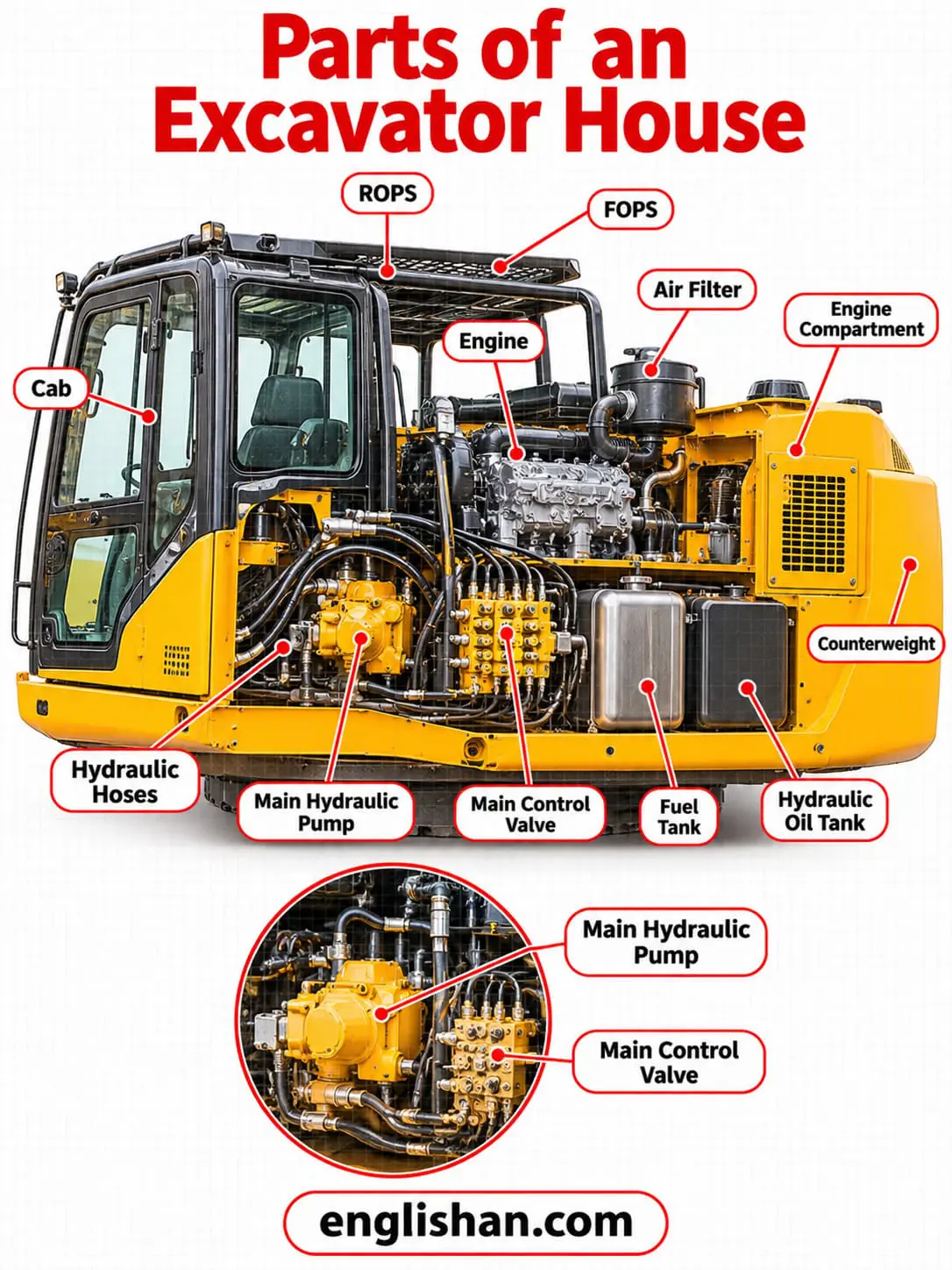
The boom attaches to the house, and Wikipedia counts three joints between the house, the boom, the stick, and the bucket. The house is the rotating platform that contains the operator cab, the counterweight, the engine, and the fuel and hydraulic oil tanks.
The house attaches to the undercarriage through a center pin. A hydraulic swivel at that pin lets the house slew through 360 degrees. The undercarriage consists of the tracks or wheels, the track frame, and the final drives with their hydraulic motors.
Excavator Arm
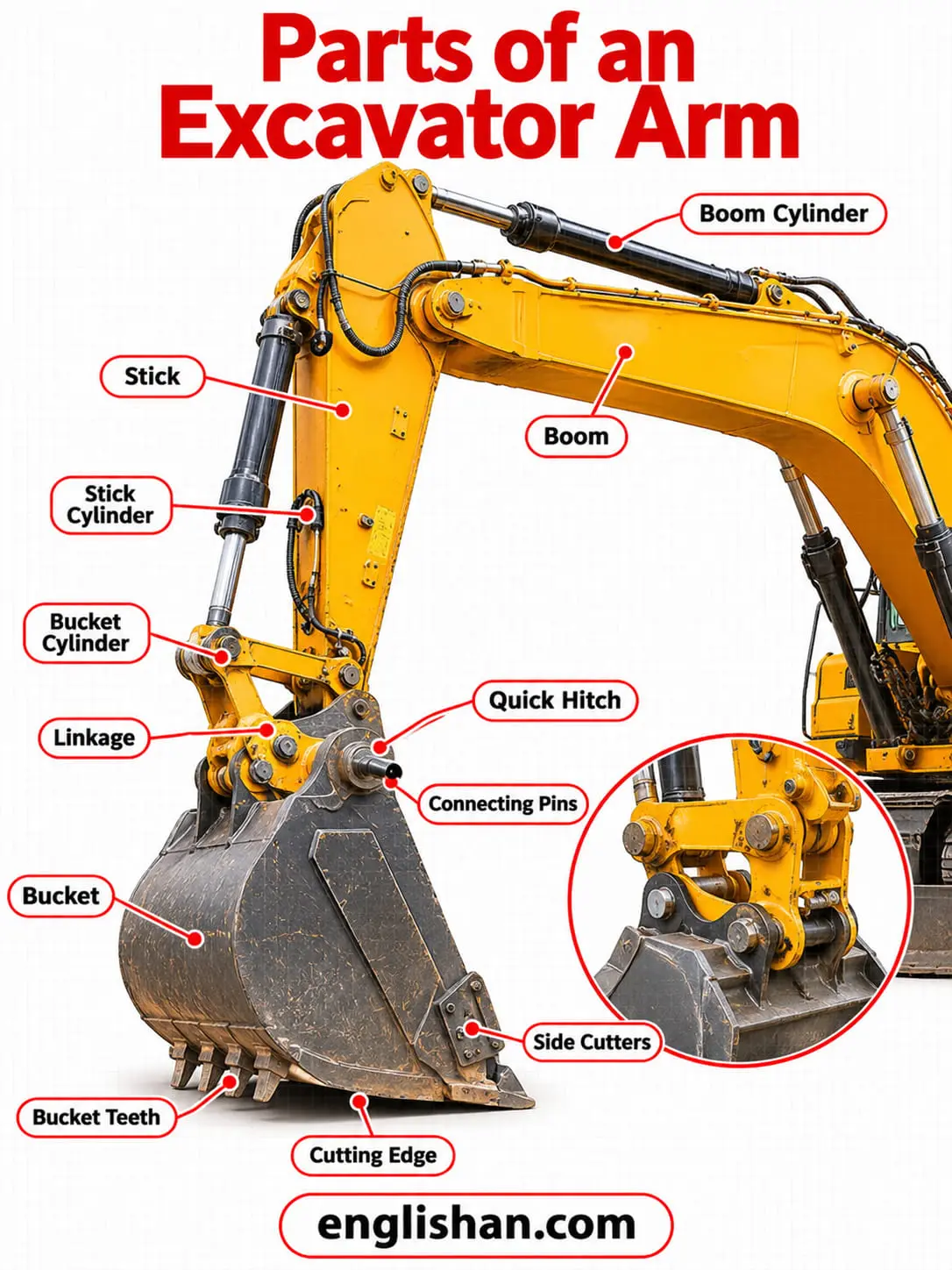
HR Parts states that the length of the boom and the stick sets the reach and the digging depth of the machine. Seven parts of an excavator make up the arm: the boom, the stick, the bucket, their three cylinders, and the linkage.
Boom
The boom is the front member attached to the house, and it provides the up and down movement of the arm. Wikipedia counts three joints between the house, the boom, the stick, and the bucket.
Boom cylinder
United Rentals specifies one or two hydraulic cylinders for the boom. They are pinned to the house and to the boom, and they lift and lower it.
Stick
The stick, also called the arm or the dipper, is mounted between the boom and the attachment. It pulls the bucket toward the machine for scooping and digging. HR Parts explains the length trade: a longer stick adds reach and a shorter stick adds digging power.
Stick cylinder
The stick cylinder is fitted between the boom and the stick. It pivots the attachment toward or away from the machine.
Bucket
The bucket is the primary earthmoving part at the end of the stick, according to Al Marwan.
Bucket cylinder
The bucket cylinder connects the stick to the bucket. Extending it scoops and retracting it dumps, as HR Parts states.
Linkage
HR Parts describes the linkage as heavy-duty metal bars that join attachments to the stick through pins. Al Marwan names the pins and bushings at the boom and stick joint and at the stick and bucket joint, and notes that regular greasing keeps them quiet.
Excavator Boom and Stick
Wikipedia names four boom configurations: mono, knuckle, hinged, and variable-angle, which is triple-articulated. Hinged booms are fitted mainly to compact machines. United Rentals adds that a knuckle boom moves left and right as well as up and down.
Compact machines add a boom swing, also called an offset. Wikipedia describes the workgroup pivoting left or right so the bucket digs around obstacles or along foundations and walls. Sticks also come in telescopic form, and Wikipedia gives the length choice as a trade between reach and breakout power.
Bucket Parts and Attachments
Wikipedia separates two bucket styles. Mud buckets suit soft material and cleanup, while general-purpose buckets are stronger and have teeth for hard ground.
Teeth
Teeth are wear parts on the digging edge of the bucket, and FridayParts lists them for routine replacement.
Cutting edges
FridayParts classes cutting edges as wear parts that are replaced as part of the bucket parts.
Side cutters, adapters, and wear plates
FridayParts names side cutters and adapters among the replaceable bucket parts and lists wear plates as wear parts. The source gives no further definition for these three.
Pins and bushings
FridayParts names pins and bushings as the attachment hardware of bucket systems.
Quick hitch
A quick hitch at the end of the stick swaps the bucket for another tool. United Rentals describes manual and automatic quick hitches and tells operators to check the engagement after every attachment change. Wikipedia notes that many excavators use quick couplers.
Attachments
Attachments run on their own hydraulic circuit. United Rentals names buckets, augers, grabs, and hammers, and BigRentz adds bucket rotators, brush cutters, stump cutters, boom extensions, breakers, tree shears, pipelayers, and grading buckets. Wikipedia reports tiltrotators with a tilt of 45 degrees to either side.
Parts of an Excavator Cab
Four parts of an excavator cab need their own definition: the cab itself, the two protective structures, and the controls.
Cab
HR Parts calls the cab the operator’s central control station, with controls for movement and attachments. The cab is part of the house, so it turns with the arm.
ROPS
ROPS is the rollover protective structure. United Rentals states that it is required where rollover risk exists.
FOPS
FOPS is the falling object protective structure. United Rentals describes it as a cage or grille that keeps rocks, tools, and debris out of the cab.
Controls
Controls are pedals, handles, and joysticks. Wikipedia names two control layouts: SAE, which is common in the United States, and ISO, which is common elsewhere.
Parts of an Excavator Hydraulic System
Wikipedia states that hydraulic cylinders and motors do all the work on a modern excavator. Power flows from the engine to the pumps, through the main control valve, and out to the cylinders and motors.
Engine
United Rentals describes a diesel engine that powers the machine and the hydraulic system, which powers the boom, the stick, and the swing (slew) motor. Al Marwan places the engine in a compartment with the fuel tank, the hydraulic oil tank, and the main control valve.
Main hydraulic pump
The pump converts mechanical energy from the engine into hydraulic energy for the cylinders and motors, as HR Parts states. Wikipedia describes three pumps: two variable-displacement piston pumps and one gear pump.
Main control valve
The valve controls the pressure and the direction of the hydraulic oil that directs each movement. BigRentz adds that it connects the engine to the hydraulics.
Fuel and hydraulic oil tanks
Wikipedia places both tanks in the house. The fuel tank stores the fuel for the engine, and the hydraulic oil tank stores the oil for the hydraulic circuit.
Cylinders and motors
The boom, stick, and bucket cylinders move the arm. The swing motor turns the house, and the travel motors drive the tracks.
Wikipedia gives the high-pressure circuit as 5000 psi (345 bar). The pilot circuit runs at 700 psi (48 bar) and reduces the effort the operator applies at the controls.
Counterweight and Tail Swing
Counterweight
The counterweight is a heavy block at the rear of the house. It balances the machine while the arm digs and prevents tipping. Al Marwan gives two machines: the Caterpillar 395 weighs 94 tons with a 15.5-ton counterweight, and the Komatsu PC400 weighs 43.3 tons with a 9.2-ton counterweight. The counterweight is 16.5 percent of the machine weight on the first and 21.2 percent on the second.
Tail swing describes how far that block extends when the house turns. A conventional tail swing counterweight extends beyond the tracks. A zero tail swing house stays within the track width, which suits work beside a wall. Wikipedia credits Yanmar with the first zero tail swing excavator in 1993, and it states that every excavator before the 1990s had a long conventional counterweight.
Excavator Slewing Ring and Swing Drive
Three parts at the center of the machine make the house turn: the slewing ring, the swing drive, and the hydraulic swivel.
Slewing Ring
HR Parts defines the slewing ring as a horizontal bearing with an attached gear that connects the upper house to the undercarriage. Al Marwan lists the swing drive and slewing ring among the lower structure parts that need regular greasing.
Swing Drive
The swing drive is mounted to the house. Conequip describes a swing motor and a planetary swing gearbox, with a pinion shaft that engages the slewing gear. The gearbox turns fast motor rotation into high torque, and the pinion drives the house through 360 degrees around its center axis.
Hydraulic Swivel
The hydraulic swivel is at the center of the machine, where the upper and lower sections meet. HR Parts describes a center shaft with channels, an outer housing, seals at the ends of each fluid cavity, and bearings between the rotating parts. It passes oil to the undercarriage while the house turns, and without it the hoses would twist and tear. Worn internal seals cause internal leaks.
Parts of an Excavator Undercarriage
United Rentals describes the undercarriage as the assembly that houses the tracks, the track frame, the final drive, and the rollers. Each undercarriage part is defined here, from the frame to the final drive.
Track frame
The track frame is the structure that the tracks attach to, according to BigRentz.
Track chain and shoes
The track chain is a flexible linked chain that allows efficient movement. The track shoes are the individual track sections that grip the ground and pull the machine, and grousers on their outer edges add grip. HR Parts describes whole track groups as metal, rubber, or a hybrid of both. Wikipedia adds that compact machines use rubber or steel tracks and that some micro models have hydraulically expanding tracks.
Track pads
Track pads reduce noise, vibration, and damage, and they improve traction. Al Marwan names tracks and track pads as the most commonly replaced parts, because they touch the ground constantly.
Track bolts
BigRentz states that track bolts join the track shoes into a complete track.
Sprocket
The sprocket is a cogwheel whose teeth engage the segments of the track, and it drives the machine forward or backward.
Front idler
The front idler is a large wheel at the front of the track group. It guides the track and, with the track springs, sets the tension.
Track springs
Track springs are large springs that absorb impacts and keep the track tensioned. HR Parts pairs them with a grease cylinder.
Bottom rollers
Bottom rollers are short rolling cylinders under the undercarriage that bear the weight of the machine and keep the track in line. Al Marwan places the rollers between the sprocket and the idler.
Top rollers
BigRentz describes rollers as metal wheels that align the chains and counts a bottom set and a top set.
Rock guards
Rock guards protect the machine from debris and stray objects.
Backfill blade
Some mini excavators and medium machines of 11 to 18 tonnes have a backfill blade, according to Wikipedia. The blade grades, levels, backfills, and stabilizes the machine while it digs.
Travel motor and final drive
The travel motor is located at the back of the tracks and is paired with a final drive gearbox. The final drive transfers power to the tracks, reducing speed and increasing torque. United Rentals states that final drives power each track individually, which gives fine control and turning.
Crawler and Wheeled Excavator Parts
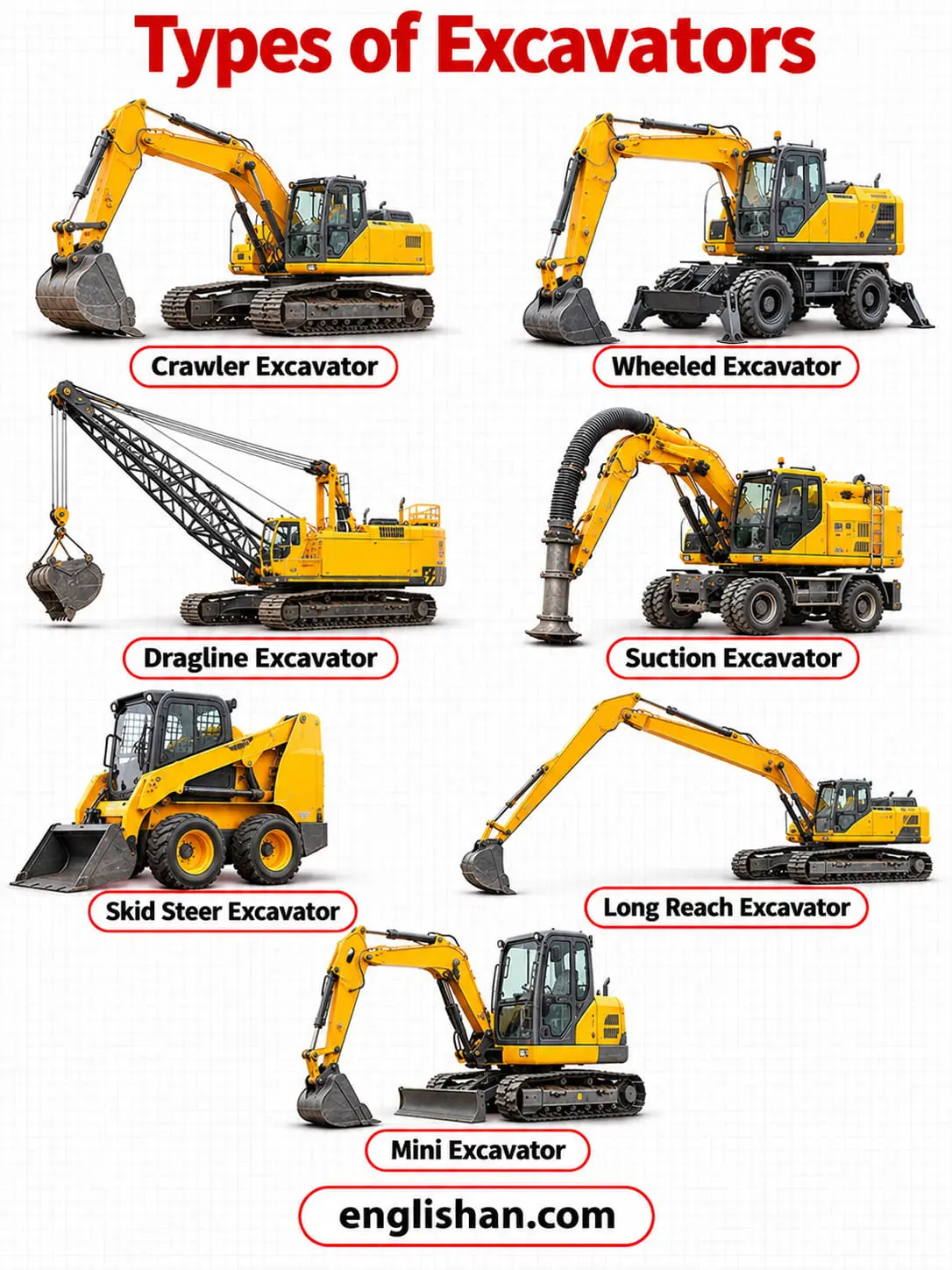
BigRentz counts seven types of excavator, and each differs from the standard layout in one named part.
| Type | What changes in the parts |
|---|---|
| Crawler | Runs on two endless tracks |
| Wheeled | Wheels replace the tracks, and outriggers add stability |
| Dragline | A hoist rope raises and lowers the bucket, and a dragline pulls it toward the cab |
| Suction | A wheeled vehicle with a suction pipe and a water jet that loosens the soil |
| Skid steer | The boom and bucket face away from the driver, so attachments reach over the cab |
| Long reach | Longer arm and boom members, with 40 to 100 feet of extendable arm |
| Mini | A smaller and lighter machine with reduced or zero tail swing |
FAQs
The parts are the bucket, stick, boom, cab, engine, counterweight, slewing ring, and the undercarriage with its tracks, rollers, idler, and sprocket. Hydraulic cylinders, pumps, and a main control valve move the arm. These parts form three assemblies: the arm, the house, and the undercarriage.
The main parts are the arm, the house, and the undercarriage. The arm is the boom, stick, and bucket. The house is the rotating platform with the cab, engine, and counterweight. The undercarriage is the tracks or wheels, the track frame, and the final drives.
The parts of an excavator arm are the boom, the stick, the bucket, and three hydraulic cylinders. The stick is also called the arm or the dipper. A linkage of bars and pins joins the bucket to the stick.
The boom is the front member attached to the house. It raises and lowers the whole arm and is moved by one or two hydraulic cylinders. The stick attaches to the end of the boom, and the bucket attaches to the end of the stick.
The parts are the bucket body, teeth, adapters, cutting edges, side cutters, wear plates, pins, and bushings, according to FridayParts. Teeth and cutting edges are fitted to the digging edge and are replaced as they wear. The bucket cylinder and the linkage connect the bucket to the stick.
The hydraulic parts are the main hydraulic pumps, the main control valve, the hydraulic oil tank, the boom, stick, and bucket cylinders, the swing motor, the travel motors, and the hydraulic swivel. The pumps and the valve are in the house, and the swivel passes oil to the undercarriage.
The undercarriage consists of the track frame, track chain, track shoes and pads, sprocket, front idler, bottom and top rollers, track springs, rock guards, the travel motors, and the final drives. The sprocket drives the track and the idler guides it.
The inside parts are in the house: the diesel engine, the hydraulic pumps, the main control valve, and the fuel and hydraulic oil tanks. The swing drive is mounted to the house, and the slewing ring and hydraulic swivel are at the joint with the undercarriage.
Sources count 16, 20, and 22 parts. Al Marwan names 16, HR Parts labels 20 on its diagram, and BigRentz numbers 22, which it calls the most common count.
Related:
