

A valve is a metal body with a pipe connection at each end and a handle on top. Inside the body, a disc, ball, or gate closes the opening.
The parts of a valve divide into the operator you turn, the body and bonnet that hold the pressure, and the trim that seals.
Valve Parts and Their Names
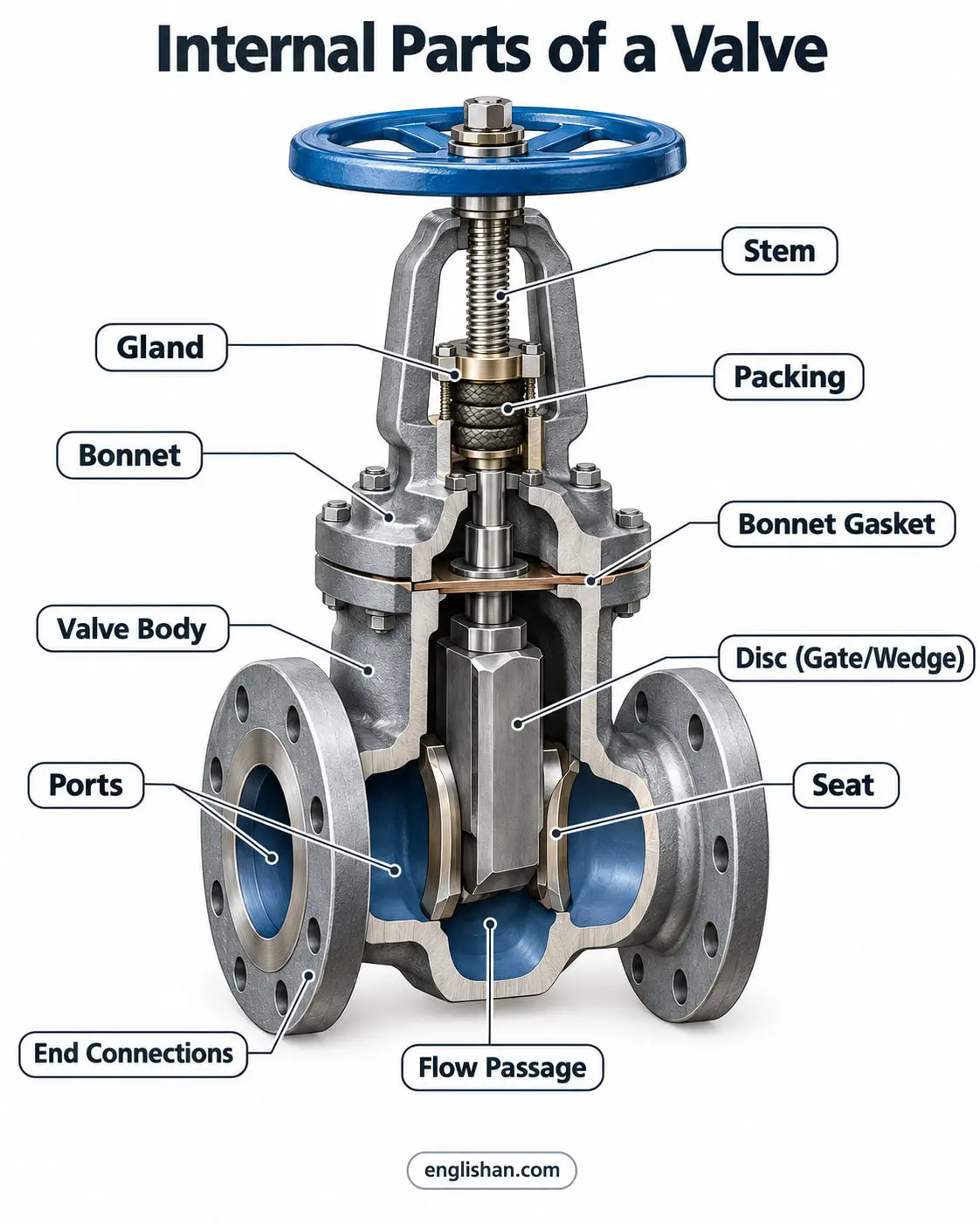
A rising-stem gate valve shows each group in one casting. A round handwheel turns a threaded stem, and the stem lifts a flat wedge out of the opening. A yoke braces the stem over the bonnet, and packing seals it where it leaves the body. These are the parts of a valve in its standard gate pattern.
| Part | Where you find it |
|---|---|
| 1. Handwheel | Round wheel on top of the stem |
| 2. Lever handle | Flat steel arm on a quarter-turn stem |
| 3. Stem | Threaded rod between the handle and the disc |
| 4. Yoke | Cast frame over the bonnet |
| 5. Actuator | Motor or air cylinder bolted to the bonnet |
| 6. Gland | Metal collar around the stem at the top of the bonnet |
| 7. Packing | Braided rings under the gland |
| 8. Bonnet | Cover bolted or threaded to the top of the body |
| 9. Bonnet gasket | Ring between the bonnet and the body |
| 10. Valve body | Main casting with a connection at each end |
| 11. End connections | Threaded, flanged, or soldered ends of the body |
| 12. Ports | Inlet and outlet openings through the body |
| 13. Disc | Wedge, plug, ball, or plate that closes the port |
| 14. Seat | Ring at the edge of the port |
Main Parts of a Valve
The main parts of a valve stack from the top down. A handwheel or lever is fixed to the stem, and the stem passes through packing in the bonnet. The bonnet closes the top of the body, a cast shell from 1/2 to 48 inches across that joins the pipe.
Inside the body, a disc, ball, or gate faces a seat ring. That pair decides whether the valve seals or leaks. Small home valves are brass or bronze throughout. Larger line valves are cast iron or steel, with a flanged body bolted between pipe ends.
Valve Operator Parts
The operator covers the parts of a valve you grip or bolt on from outside the body. It runs from the handle down to the stem.
Handwheel
The handwheel is a round wheel of cast iron, ductile iron, or aluminum, fixed to the top of the stem. It measures 2 to 24 inches across, and spokes join its rim to a center hub, and an arrow marks the closing direction. Clockwise rotation closes a standard right-hand valve.
Lever Handle
Quarter-turn valves, such as ball and butterfly valves, use a flat steel lever with a vinyl grip. The lever measures 4 to 12 inches. It lies along the pipe when the valve is open and across the pipe when closed. A stop plate limits the swing to 90 degrees.
Valve Stem
The valve stem is a steel or stainless steel rod, 1/4 to 2 inches across, that joins the handle to the closing part. On a rising-stem valve its upper half is threaded and runs through a stem nut in the yoke. The polished lower half passes through the packing. The yoke is the cast frame that supports the threaded half over the bonnet.
Valve Actuator
A valve actuator is an electric motor, air cylinder, or hydraulic cylinder bolted to the bonnet or yoke. It turns or lifts the stem in place of a hand. Electric models run on 24 or 120 volts, and pneumatic models run on 60 to 100 psi of air.
Valve Body and Bonnet Parts
These parts of a valve enclose the line pressure and join the pipe. The body forms the lower shell, and the bonnet closes the top.
Valve Body
The valve body is a cast or forged shell of brass, bronze, cast iron, carbon steel, stainless steel, or PVC. It has an inlet port, an outlet port, and a chamber between them. Pressure class ratings run from 125 to 600 psi. An arrow cast into the wall shows the flow direction on globe and check valves.
Bonnet and Gasket
A bonnet is the cover that closes the opening in the top of the body. It is screwed on, bolted on, or held by a union nut, and a hole through its center passes the stem. A bolted bonnet is clamped by four to eight studs and nuts. A flat gasket of graphite or PTFE, about 1/8 inch thick, seals the joint. A wet line around the flange marks a leak there.
Packing and Gland
Packing is a stack of braided graphite or PTFE rings in a stuffing box around the stem. A gland, a metal collar with two bolts or a threaded nut, presses them down. Tightening the gland nut stops a drip at the stem. Among the parts of a valve, this seal needs adjusting more than any other.
End Connections
The end connections are the machined ends where the valve meets the pipe. Threaded NPT ends, sweat ends for copper, and compression ends fit home plumbing. Flanged ends with bolt holes join pipes of 2 inches or larger.
Valve Trim Parts
Trim covers the stem, disc, and seat, the surfaces that touch the fluid. Among the parts of a valve, the disc and seat decide whether it leaks.
Valve Disc
The valve disc is the part that closes the port, and its shape sets the valve type. A gate valve has a flat wedge, a globe valve a round plug, and a butterfly valve a round plate. A ball valve has a drilled ball, and a check valve has a hinged flapper. Discs are brass, stainless steel, or coated cast iron.
Valve Seat
A valve seat is a ring at the edge of the port that the disc presses against. It is metal on high-temperature valves and PTFE, nylon, or EPDM rubber on water valves. Seat rings are pressed or threaded into the body. A worn seat is the main cause of a valve that leaks while closed.
Valve Types and Their Parts
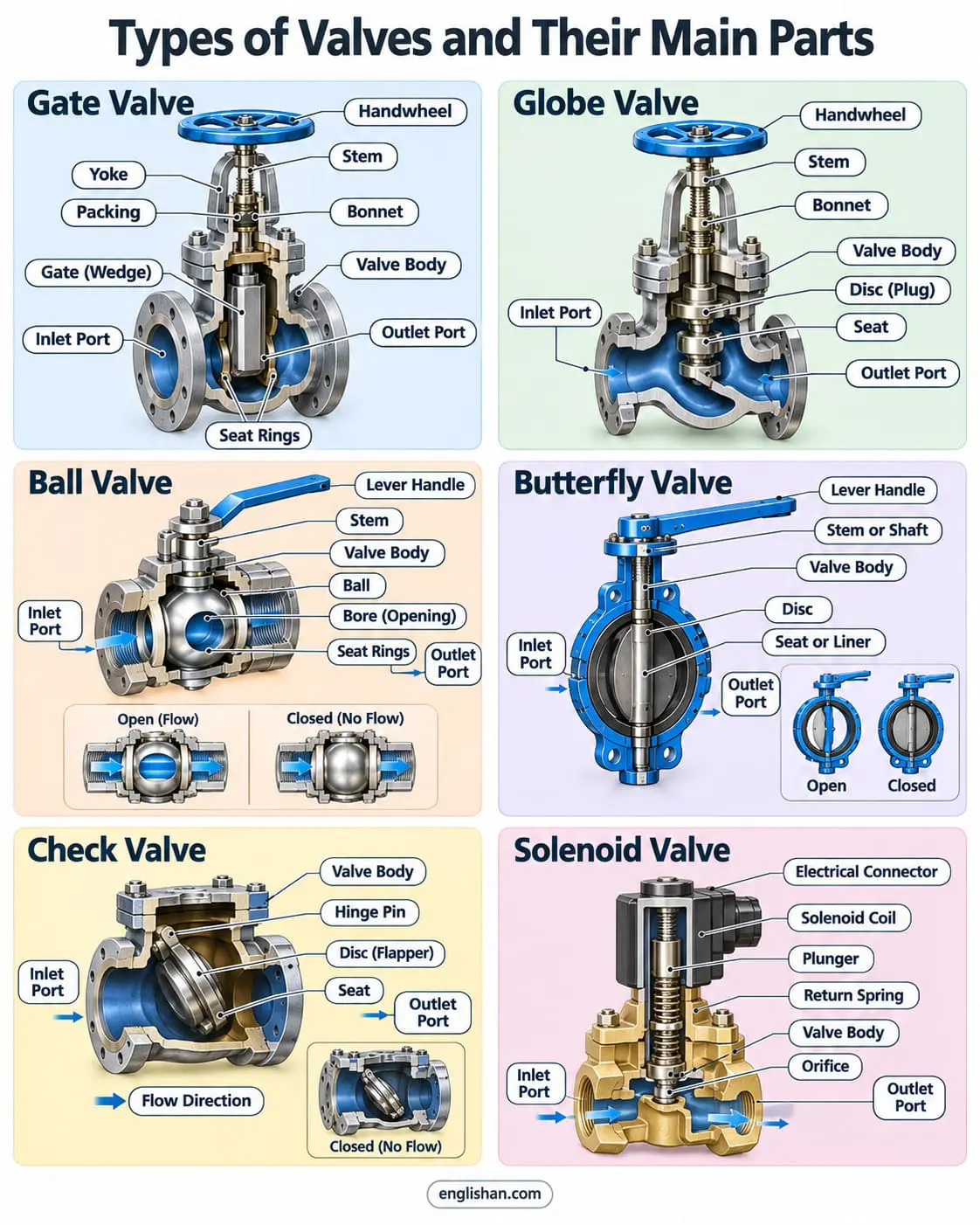
The parts of a valve change with its type, since the disc and the operator differ. Home plumbing, such as the shutoff on a water heater, is fitted mostly with ball and gate valves.
Gate Valve
A gate valve has a handwheel on a stem that lifts a flat wedge straight out of the flow. Two seat rings face the wedge inside the body, which leaves the opening full bore. A non-rising model keeps the stem inside the bonnet. Gate valves from 1/2 to 48 inches are fitted on main water lines.
Globe Valve
A globe valve has an S-shaped body, and its stem lowers a round disc straight down onto a seat ring. The handwheel throttles flow in fine steps, and a Y-pattern body angles the stem at 45 degrees to cut resistance. An arrow on the body marks the inlet.
Ball Valve
A ball valve has a lever on a stem that turns a steel ball with a hole drilled through it. Two PTFE seats press against the ball, and a quarter turn lines the hole with the pipe. Sizes run from 1/4 to 12 inches, and it is the standard shutoff valve in a house.
Butterfly Valve
A butterfly valve has a short ring body with a round disc turned on a stem across the pipe. A rubber liner forms the seat, and a lever or gear operator turns the disc 90 degrees. Wafer and lug bodies fit between pipe flanges, in sizes from 2 to 24 inches.
Check Valve
A check valve has no stem and no handle. A hinged flapper or spring-loaded disc rests on a seat inside the body. Flow pushes the flapper open, and reverse flow presses it shut. A swing check adds a hinge pin, and a lift check has a guided piston.
Solenoid Valve
A solenoid valve has a brass or plastic body topped by a copper coil. A steel plunger slides inside the coil, with a return spring under it. A 24-volt or 120-volt current lifts the plunger, which opens the orifice. Sprinkler systems and washing machines are fitted with them.
Related:
FAQs
The parts of a valve are the handwheel or lever, stem, bonnet, packing, body, end connections, disc, and seat. Larger valves add a yoke and an actuator. The body and bonnet enclose the pressure, and the disc and seat close the flow.
A gate valve has a handwheel, a stem, a yoke, a bonnet, packing, a wedge gate, two seat rings, and a body. The stem lifts the wedge out of the flow to open the valve.
A ball valve has a body, a drilled ball, two PTFE seats, a stem, and a lever. A quarter turn of the lever lines the hole in the ball with the pipe.
A sprinkler valve has a plastic body, a solenoid, a diaphragm, a spring, a bonnet, a flow control stem, and a bleed screw. The solenoid lifts a plunger on 24 volts, and water pressure then lifts the diaphragm.
A shower valve has a brass body, a cartridge, a handle, a trim plate, and inlet stops. A tub-shower valve adds a diverter stem that switches the water between spout and head. The shower page names each fitting.
The disc closes a valve and the seat seals it, so these two parts decide whether it leaks. In a ball valve the closing part is the ball, and in a gate valve it is the wedge. The stem moves it against the seat, and the packing seals the stem.
A valve stem has a threaded portion, a polished portion that passes through the packing, and a square end that joins the handle. A rising stem lifts out of the bonnet as the valve opens.