A shower is a spray head on a wall pipe, an enclosure of walls and a door or curtain, and a floor that drains.
The parts of a shower fall into four groups. You touch the fixtures, stand inside the enclosure and on the base, and the valve is behind the wall. A glass door adds a fifth set of parts.
Labeled Shower Parts on a Tub-Shower Diagram
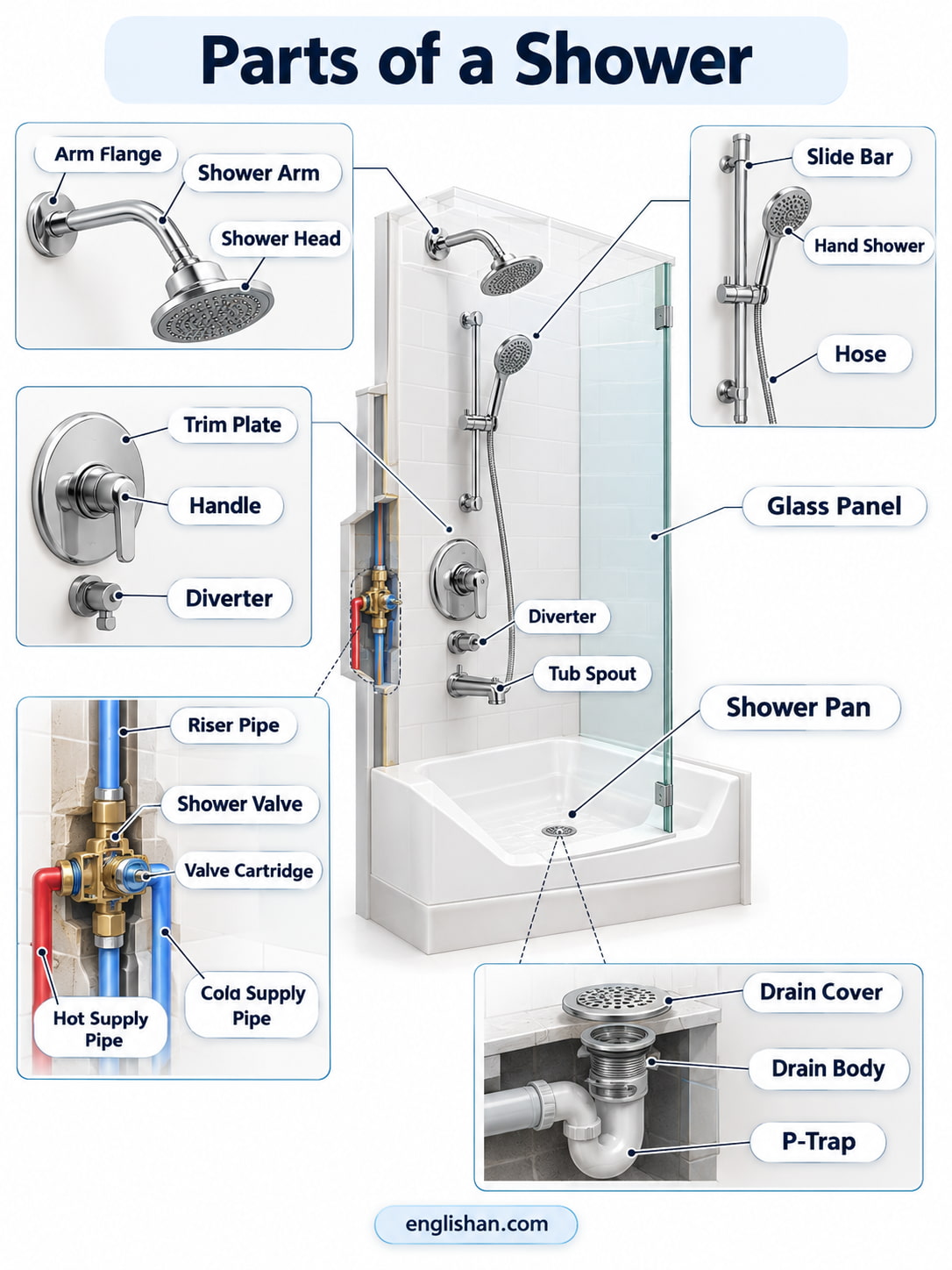
A chrome shower head on a curved arm is fixed high on the back wall. A round flange covers the joint where the arm meets the tile. A single handle and a trim plate are at chest height, and a tub spout is under them. A curtain rod spans the opening, and the floor ends at a drain. These are the parts of a shower in a standard bathroom.
| Part | Where you find it |
|---|---|
| 1. Shower head | Spray fixture at the end of the arm |
| 2. Shower arm | Curved pipe projecting from the back wall |
| 3. Arm flange | Round cover plate where the arm meets the wall |
| 4. Handle | Lever or knob at chest height |
| 5. Trim plate | Round or square plate behind the handle |
| 6. Tub spout | Curved spout low on the wall over the tub |
| 7. Diverter | Lift knob on the spout or a handle on the wall |
| 8. Hand shower | Spray wand on a hose |
| 9. Hose | Flexible tube from the wall to the hand shower |
| 10. Slide bar | Vertical rail fixed to the wall |
| 11. Wall surround | Tile or panels lining the walls |
| 12. Recessed shelf | Cutout between two wall studs |
| 13. Bench | Built-in seat in a corner |
| 14. Grab bar | Steel bar fixed to the wall studs |
| 15. Curtain rod | Bar across the top of the opening |
| 16. Shower curtain | Fabric or vinyl sheet on rings |
| 17. Glass panel | Tempered glass filling the opening |
| 18. Door frame | Metal header and jambs around the glass |
| 19. Door hinges | Along the wall edge of a swinging door |
| 20. Door rollers | Wheels on the top edge of a sliding door |
| 21. Track and bottom fin | Rail over the opening and a small fin on the curb |
| 22. Door handle and towel bar | Bar bolted through the glass |
| 23. Door sweep and seal | Vinyl strips on the lower and closing edges |
| 24. Shower pan | Molded basin forming the floor |
| 25. Curb | Raised lip around the door opening |
| 26. Drain cover | Slotted plate at the low point of the floor |
| 27. Drain body | Threaded fitting under the pan floor |
| 28. P-trap | Curved pipe under the floor |
| 29. Shower valve | Brass body inside the wall behind the handle |
| 30. Cartridge | Cylinder inserted in the valve body |
| 31. Supply pipes | Hot and cold pipes running through the wall |
| 32. Shutoff stops | Slotted valves on the valve body or the pipes |
| 33. Body sprays | Small jets on the side wall of a walk-in shower |
| 34. Steam generator | Boiler unit near a steam shower |
Main Parts of a Shower
Seven main parts of a shower spray the water, mix it, and drain it away.
- Shower head: The round nozzle disc, 3 to 8 inches across, that sprays the water.
- Shower arm: The curved pipe that joins the head to the wall.
- Handle: The lever or knob that sets flow and temperature.
- Valve: The brass body in the wall that mixes hot and cold water.
- Enclosure: The walls and the door or curtain around the spray.
- Pan: The molded floor basin that slopes toward the drain.
- Drain: The floor outlet, 2 inches wide, that sends the water to the sewer.
Shower Head and Control Parts
The fixtures you touch are the most visible parts of a shower, and ten of them cover the head, the handle, and the tub.
Shower Head
Set high on the back wall, the shower head is a round disc of chrome-plated plastic or metal, 3 to 8 inches across. Rows of small nozzles cover its face. It screws onto the arm, and US law caps its flow at 2.5 gallons per minute. Its parts are the faceplate, the nozzles, a swivel ball joint, and a mesh screen. A rain shower head is a wider disc, 8 to 12 inches across, on a ceiling arm.
Shower Arm
The shower arm is a curved pipe of chrome-plated brass, 6 to 8 inches long, projecting from the wall. Its wall end is threaded into a fitting inside the wall. Its outer end takes the shower head.
Arm Flange
A round cover plate, about 3 inches wide, covers the hole where the arm leaves the wall. It is also called an escutcheon. The finish matches the arm, in chrome, brushed nickel, or matte black.
Handle
Among the parts of a shower, the handle is the one you use most. It is a lever, a knob, or a cross handle, 36 to 48 inches from the floor. Turning it sets the flow and the temperature. The handle parts are the lever or knob, a set screw, a cap, and an adapter that fits the stem. A two-handle or three-handle shower has one handle for each supply.
Trim Plate
Trim is the name for the visible parts of a valve: the handle, the plate, and the stem sleeve. The trim plate is a round or square disc, 4 to 7 inches wide, behind the handle. Screws or a snap ring fix it to the wall.
Tub Spout
On a tub-shower combination, the tub spout, also called a spigot, is a curved chrome or brushed metal spout, 6 to 8 inches long. It is low on the wall over the tub. It threads or slides onto a copper pipe.
Diverter
The diverter is a lift knob on top of the tub spout, a small handle on the wall, or a pull-up stem. It closes the spout and sends the water up to the shower head. A spout diverter has a pull-up stem, a gate, and a rubber gasket. Three-handle showers use a separate diverter valve between two handles.
Hand Shower
The hand shower is a spray wand with a slim handle, 8 to 10 inches long, on a hose. Its spray head is 2 to 4 inches wide. A holder, a bracket with a ball joint, mounts it on the wall or the slide bar. It borrows the idea of the pull-out sprayer in a kitchen sink.
Hose
The hose is a flexible tube of stainless steel or PVC, 59 to 72 inches long, with a brass nut at each end. A 1/2-inch threaded connector joins it to an elbow on the wall. A rubber washer seals each end.
Slide Bar
The slide bar is a vertical rail of chrome-plated metal, 24 to 36 inches long, fixed to the wall by two brackets. A slider moves up and down the rail. It clamps the hand shower at the chosen height.
Shower Enclosure Parts
An enclosure keeps the spray inside. Six parts of a shower form it: the walls, the built-in fittings, and the curtain.
Wall Surround
Among the parts of a shower, the wall surround is the largest. It lines the enclosure with ceramic tile or with panels of acrylic, fiberglass, or stone composite. Tile joints are 1/8 inch wide and filled with grout. Panels come in one to three pieces. A water-resistant board is behind both.
Recessed Shelf
A recessed shelf is a cutout built between two wall studs, 12 by 24 inches and 3.5 inches deep. It is lined with tile or a one-piece insert. Its floor slopes slightly outward. A hanging shower caddy is the removable version: a metal frame, two or three baskets, and hooks that clip over the arm.
Bench
The bench is a built-in seat, 17 to 19 inches high and 12 to 18 inches deep, in a corner of a walk-in shower. It is tiled or molded in solid surface. Its top slopes slightly toward the drain. A freestanding shower chair has a seat, a backrest, and four adjustable legs with rubber feet.
Grab Bar
A grab bar is a stainless steel bar, 18 to 36 inches long and 1.25 to 1.5 inches thick. It is fixed to the wall studs at 33 to 36 inches high. Its grip is smooth or knurled. Two flanges cover its screws.
Curtain Rod
The curtain rod is a chrome or stainless steel tube, 1 inch across and 60 inches long. Spring tension holds it between the side walls. Some rods bolt to the wall with flanges. A curved rod adds elbow room.
Shower Curtain
The shower curtain is a sheet of vinyl, polyester, or nylon, 72 by 72 inches. It hangs from 12 metal or plastic rings through reinforced eyelets. A weighted hem hangs straight. A vinyl liner hangs inside it.
Shower Door Parts
A glass door replaces the curtain on most stalls and walk-in showers. Among the parts of a shower door, seven are visible, and the set changes with a swinging, sliding, or pivoting door.
Glass Panel
The glass panel is a sheet of tempered glass that fills the opening. It is 1/4 to 1/2 inch thick and 24 to 36 inches wide. A frameless panel has polished edges and no metal border. A framed panel is set in an aluminum channel.
Door Frame
The door frame is a set of aluminum or stainless steel extrusions around the glass. It has a header across the top and side jambs down each side. A swinging door has a hinge jamb, a strike jamb, and a wall jamb.
Hinges
Two or three hinges of stainless steel or brass are clamped to the glass edge and screwed to the wall or the jamb. A pivot hinge is a single pin at the top and the bottom of the door. It swings the door in and out.
Rollers
A sliding door hangs from two wheels on its top edge. Each roller is a nylon or stainless steel wheel, about 1 inch across, in a small bracket bolted to the glass. Bypass doors have four in all.
Track and Bottom Fin
The track is a metal rail, 48 to 60 inches long, over the opening, and the rollers ride in it. The bottom fin is a small plastic or metal blade on the curb. It slides in a slot at the foot of the door.
Handle and Towel Bar
A handle or a pull bar, 8 to 24 inches long, is bolted through the glass. On a sliding door, a towel bar serves as the pull. Its finish matches the arm and the flange.
Sweep and Seal
The door sweep is a transparent vinyl or rubber strip on the lower edge of the door, with a small drip rail. It blocks water at the floor. A magnetic seal strip runs along the closing edge.
Shower Base and Drain Parts
Five of the parts of a shower are under your feet. They form the floor, the lip, and the drain line.
Shower Pan
The shower pan is a shallow basin, 32 by 32 to 60 by 32 inches, of acrylic, fiberglass, or cast iron. Among the parts of a shower, it forms the floor. A tiled shower uses a mortar bed with a waterproof liner in its place. The floor slopes 1/4 inch per foot toward the drain.
Curb
The curb is a raised lip, 2 to 6 inches high, around the door opening. It is molded into the pan or built of tile over a block of concrete or foam. Barrier-free showers have none.
Drain Cover
The drain cover is a round or square plate of stainless steel, brass, or plastic, about 4 inches wide. It is at the low point of the floor, with slots or holes for the water. A linear drain uses a long slot along one wall in its place.
Drain Body
Under the cover, the drain body is a threaded fitting of PVC or brass, 2 inches wide, bolted through the pan floor. A clamping ring and a rubber gasket seal it. It ends in a short tailpiece. A three-part drain is a cover, a clamping ring, and a body.
P-Trap
The P-trap is a U-shaped pipe of PVC or ABS, 2 inches wide, under the drain. It holds a plug of water that blocks sewer gas. A waste outlet pipe joins it to the main drain.
Shower Valve and Pipe Parts Behind the Wall
Four parts of a shower are hidden in the wall, behind the trim plate. They mix the water and bring it in. With the drain body and the trap under the floor, they are the plumbing parts of a shower.
Shower Valve
The shower valve is a brass body, 3 to 4 inches long, fixed to a wood block between the studs. Two 1/2-inch pipes join it, one hot and one cold. A pressure-balancing valve regulates the temperature when another fixture runs. A thermostatic valve holds the set temperature and adds a separate volume control.
Valve Cartridge
Among the parts of a shower behind the wall, the cartridge is the one that mixes the water. It is a brass or plastic cylinder, about 2 inches long, inserted into the valve body from the front. The handle stem fits into it. Ceramic disks or a plastic spool inside it blend the hot and cold supplies.
Supply Pipes
The supply pipes of a shower are 1/2-inch copper, PEX, or CPVC. They run through the wall from the water heater. PEX is red for hot and blue for cold. A riser pipe rises to the shower arm, 72 to 80 inches from the floor.
Shutoff Stops
Shutoff stops are slotted screw valves built into the valve body on many models. Removing the trim plate reaches them. Each stops one supply, so a repair needs no shutdown of the house.
Shower Types and Their Parts
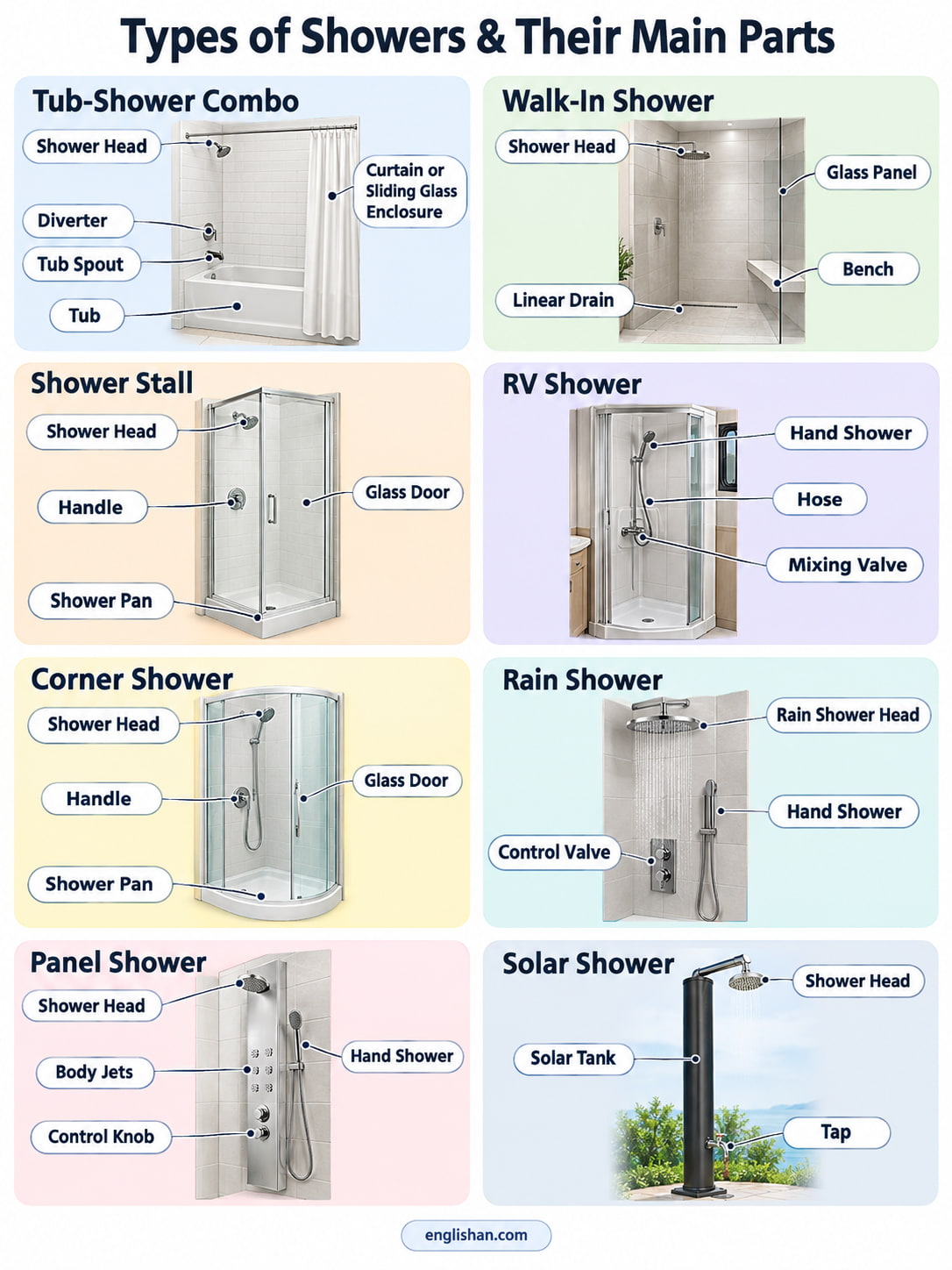
The parts of a shower change with the type, and eight types cover US homes, shops, job sites, and campers. Each adds or drops some of the parts named earlier.
Tub-Shower Combo
A tub-shower combination is a bathtub with a shower head over it. It adds a tub spout, a diverter, an overflow plate, and a tub drain with a stopper. It has no pan or curb. A curtain rod or a sliding door closes the front.
Walk-In Shower
A walk-in shower has a glass panel and no curb, with a floor that slopes to a linear drain. Body sprays, small jets on the side wall, and a bench are added to many. It is part of the layout of a bathroom.
Shower Stall
A shower stall is a self-contained enclosure with a pan, three walls, and a door, 32 by 32 to 60 by 36 inches. Outside the US, it is called a shower cubicle. It has a curb, a valve behind the wall, and one head.
RV Shower
Among the parts of a shower in a camper, the stall is the smallest. An RV shower is a compact stall of molded fiberglass, about 24 by 36 inches, built into a camper. It has a small faucet with a mixing valve and a hose and head on a hook. The pan has a 1-1/2 inch drain, and the door slides or hinges.
Steam Shower
A steam shower is a sealed stall with a ceiling and a tight door. A steam generator, a boiler unit of 3 to 15 kilowatts, is installed in a nearby closet. It feeds a small steam head low on the wall. A control panel sets the temperature and the time. A sloped ceiling sheds the condensation.
Outdoor Shower
An outdoor shower has a shower head and an arm on a pole or a wall and a mixing valve or a hose connection. Its floor is gravel or wood slats. It has no pan and no trap.
Emergency Shower
An emergency shower is a safety fixture in a lab or plant. It has a 10-inch shower head, a pull rod, and a 1-1/4 inch supply pipe. A stay-open ball valve and a wall bracket or floor stand complete it. An eyewash unit adds two small spray heads on a bowl, with a push paddle. It flows at 20 gallons per minute.
Electric Shower
An electric shower is a wall-mounted unit with a built-in heater that warms the cold supply at the fixture, 7 to 10.5 kilowatts. It has a plastic casing, temperature and power dials, a shower head, a hose, and a riser rail. It is common in the UK.
FAQs
Q1. What are the parts of a shower called?
The parts of a shower are called the shower head, arm, flange, handle, trim plate, valve, cartridge, pan, and drain. The head, arm, and handle are the fixtures you touch. The valve and cartridge are behind the wall. The pan and drain form the base.
Q2. What are the parts of a shower head?
A shower head has a faceplate with small nozzles, a body, a swivel ball joint, a mesh filter screen, and a threaded connector. A rain shower head adds a wide disc. A handheld head adds a handle and a hose.
Q3. What are the parts of a shower faucet called?
A shower faucet has a handle, a trim plate, a stem, a cartridge, and a valve body. A tub-shower combination adds a tub spout and a diverter. In the UK, the same fixture is a shower tap. The handle and trim plate show on the wall, and the rest is inside it.
Q4. What are the parts of a shower valve?
A shower valve has a brass valve body, a cartridge, a stem, a handle, a trim plate, and two or more stops. Hot and cold pipes join the body. A pressure-balancing or thermostatic cartridge sets the temperature.
Q5. What are the parts of a shower drain?
A shower drain has a cover, a drain body, a clamping ring, a rubber gasket, a tailpiece, and a P-trap. The cover and the body are at the floor. The trap and the waste pipe are under it.
Q6. What are the parts of a walk-in shower?
A walk-in shower has a glass panel, a sloped floor, and a linear or center drain. It also has a shower head and arm, a valve, and a wall surround. Many add a bench, a recessed shelf, a grab bar, and body sprays. It has no curb.
Q7. What are the parts of a shower door?
A shower door has a glass panel, hinges or rollers, a handle, a door sweep, and a magnetic seal strip. A framed door adds a header, side jambs, a track, and a bottom fin. A frameless door has only the glass and the hardware.
You May Also Like