

A water heater is an upright steel cylinder, 48 to 60 inches tall, with pipes on top and a heat source at the base. In South Asia, the same appliance is called a geyser.
The parts of a water heater fall on three levels: the top of the tank, the middle, and the base.
Parts of a Water Heater Labeled by Level
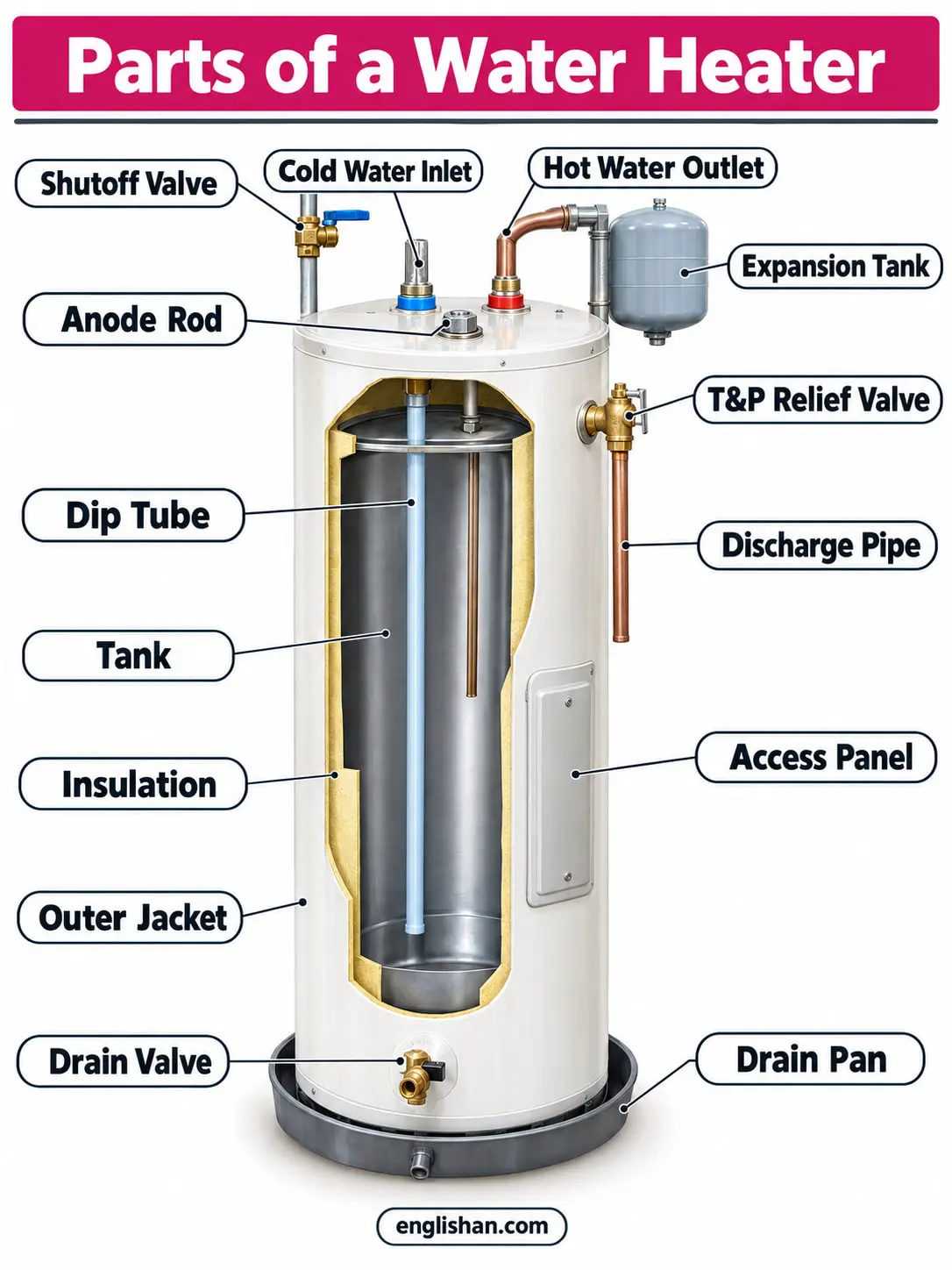
A tank-type water heater is a tall white cylinder with a flat top. Two pipe fittings, a brass relief valve, and a round anode rod head are on the top. A discharge pipe runs down the side of the tank. A square access panel covers the controls of an electric model at mid-height. A gas model has a control valve and a burner door near the floor. A drain valve is fixed at the bottom. These are the parts of a water heater, numbered from the top of the tank to the base.
| Part | Where you find it |
|---|---|
| 1. Cold water inlet | Blue-marked pipe fitting on top of the tank |
| 2. Shutoff valve | Handled valve on the cold water pipe |
| 3. Hot water outlet | Red-marked pipe fitting on top of the tank |
| 4. Dip tube | Plastic pipe inside the tank, joined to the cold inlet |
| 5. Anode rod | Hex head on top of the tank, rod inside |
| 6. T&P relief valve | Brass valve with a lever on the top or upper side |
| 7. Discharge pipe | Pipe running down the side from the relief valve |
| 8. Expansion tank | Small steel tank fixed on the cold water pipe |
| 9. Flue pipe | Metal duct rising from the top of a gas unit |
| 10. Draft hood | Metal cap where the flue meets the vent pipe |
| 11. Blower | Round fan housing on top of a power vent unit |
| 12. Tank | Welded steel cylinder inside the jacket |
| 13. Insulation | Foam layer between the tank and the jacket |
| 14. Outer jacket | Painted steel shell around the tank |
| 15. Access panel | Square metal plate on the side of an electric tank |
| 16. Thermostat | Gray control behind each panel on an electric tank |
| 17. Upper heating element | Bent metal loop near the top of an electric tank |
| 18. Reset button | Red button on the upper thermostat |
| 19. Gas control valve | Gray housing on the lower front of a gas tank |
| 20. Burner | Round steel tray under the tank of a gas unit |
| 21. Pilot assembly | Thin tube and nozzle beside the burner |
| 22. Thermocouple | Thin copper lead with its tip in the pilot flame |
| 23. Lower heating element | Bent metal loop near the base of an electric tank |
| 24. Drain valve | Spigot on the lower side of the tank |
| 25. Drain pan | Shallow tray under the whole unit |
| 26. Flow sensor | Small housing on the inlet of a tankless unit |
| 27. Heat exchanger | Metal coil inside a tankless unit |
| 28. Control panel | Buttons and display on the front of a tankless unit |
| 29. Compressor unit | Round housing on top of a heat pump water heater |
| 30. Solar collector | Flat glass-topped panel on the roof |
Main Parts of a Water Heater
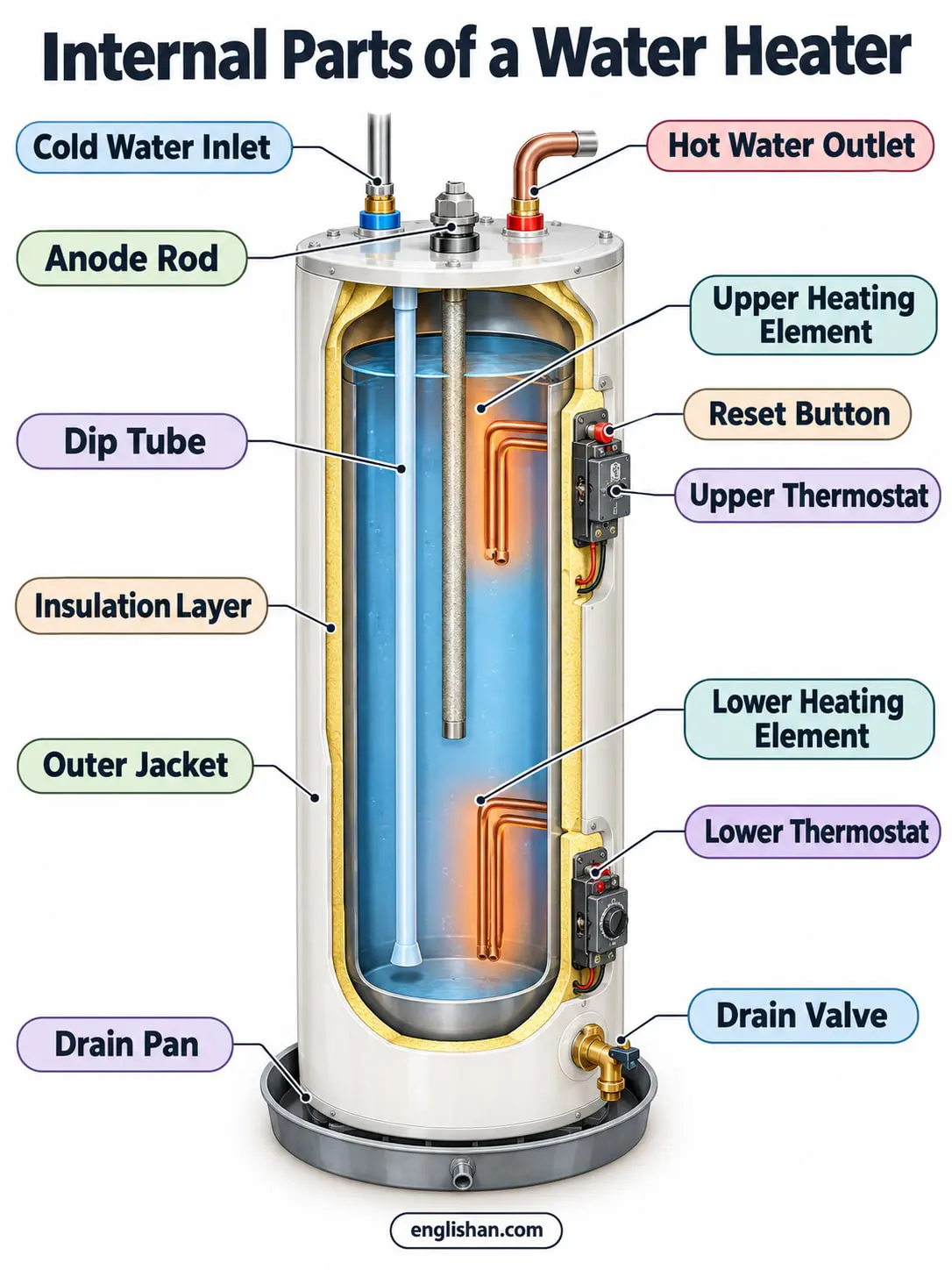
Seven of the parts of a water heater store, heat, and protect the water. The others connect the pipes or vent the exhaust.
- Tank: The steel cylinder that stores 30 to 80 gallons of water.
- Heat source: The gas burner or the electric heating coils that heat the water.
- Thermostat: The control that sets the water temperature, with 120°F as the standard setting.
- Dip tube: The plastic pipe that delivers cold water to the bottom of the tank.
- Anode rod: The metal rod that corrodes in place of the tank wall.
- T&P relief valve: The brass valve that opens at 150 psi or 210°F.
- Drain valve: The spigot at the base that empties the tank.
Salvageable parts of an old water heater are the brass drain valve, the copper fittings, and the steel tank as scrap metal.
Water Heater Top Parts
Ten of the parts of a water heater are at the top of the tank. They join the pipes, release pressure, and vent a gas burner. Water leaking from the top of a water heater comes from a loose fitting, the relief valve, or the anode rod port.
Cold Water Inlet
The cold water inlet is a 3/4-inch threaded fitting on top of the tank, marked with a blue ring or a blue cap. Copper, brass, or PEX pipe attaches to it. A dip tube is joined to its underside inside the tank.
Shutoff Valve
The shutoff valve is a brass ball valve or gate valve with a red or gray handle. It is fixed on the cold water pipe next to the tank. A ball valve closes with a quarter turn. A gate valve takes several turns.
Hot Water Outlet
The hot water outlet is a 3/4-inch threaded fitting on top of the tank, marked with a red ring or a red cap. Its pipe leads to every tap and shower in the house, including the kitchen sink. Flexible braided steel hoses, 18 inches long, or copper pipe attach to it.
Dip Tube
The dip tube is a plastic pipe, 40 to 55 inches long, fitted inside the tank from the cold water inlet. It is 3/4 inch wide. Its open end stops a few inches short of the tank floor. It is white or blue.
Anode Rod
The anode rod is a steel wire coated in magnesium or aluminum, about 44 inches long. It is screwed into a port on top of the tank. Its hex head, 1-1/16 inches across, shows on the top of the tank. The rod corrodes first, which protects the steel wall from rust. A powered anode rod uses a small electric current in place of a metal coating.
T&P Relief Valve
The temperature and pressure relief valve is a brass valve, 3/4 inch wide, with a lever handle and a short probe. It is fixed in a port on the top or the upper side of the tank. It opens at 150 psi or 210°F and vents into the discharge pipe. Among the parts of a water heater, it is the safety device.
Discharge Pipe
The discharge pipe is a 3/4-inch pipe of copper, CPVC, or PEX that screws into the outlet of the T&P valve. It runs straight down the side of the tank. Its open end stops 2 to 6 inches from the floor or a drain, with no valve or cap.
Expansion Tank
The expansion tank is a blue or gray steel tank of 2 to 4 gallons, fixed on the cold water pipe over the heater. A rubber diaphragm divides it into a water side and an air side. Its air valve looks like the valve on a tire. It is a separate add-on, not a built-in part, and it is charged to the home’s water pressure, 40 to 60 psi.
Flue Pipe
The flue pipe is a metal duct, 3 or 4 inches wide, on top of a gas water heater. It rises to the roof. It is galvanized steel or double-wall stainless steel. A twisted metal strip called a baffle is fitted inside the tank flue. A roof jack and a vent cap finish the run. The flue gets hot enough to burn skin. Electric heaters have no flue.
Draft Hood
The draft hood is a cup-shaped metal fitting on top of a gas water heater, where the tank flue meets the vent pipe. A gap around its base draws in room air. Power vent models replace it with a blower, a round black fan housing about 6 inches wide that pushes exhaust through a PVC pipe.
Water Heater Tank Parts
Seven of the parts of a water heater are at the middle level: the tank body and, on an electric model, the controls.
Tank
The tank is a welded steel cylinder, 48 to 60 inches tall and 20 to 24 inches across. A glass coating lines the inside wall. The standard home size is 40 or 50 gallons. Every storage water heater has one, and a tankless unit has none. It is the largest of the parts of a water heater, and it weighs 100 to 150 pounds empty.
Insulation
The insulation is a layer of polyurethane foam or fiberglass, 1 to 2 inches thick, between the tank and the outer jacket. It is pale yellow or white. Wet insulation means the tank has a leak. Its R-value, a rating of resistance to heat loss, is printed on the data label.
Outer Jacket
The outer jacket is a painted steel shell, white or beige, that covers the insulation. The jacket stays warm to the touch. A data label on its side lists the model, capacity, and wattage or BTU rating. A drain pipe and a wiring box are fixed to it on the outside.
Access Panel
The access panel is a square metal plate, about 4 by 8 inches, fastened with two screws to the side of an electric tank. A foam pad and a plastic cover are behind it. Many electric tanks have two panels, one near the top and one near the bottom.
Thermostat
The thermostat is a gray or white control, about 3 inches tall, screwed against the tank wall behind the upper access panel. A dial on its face is turned with a screwdriver, and 120°F is the standard setting. A second thermostat is fixed near the lower element.
Upper Heating Element
The upper heating element is a bent metal loop, about 1 foot long, screwed into the tank wall near the top. It is rated at 4,500 watts on a 240-volt circuit. It works like the coil in an electric kettle, only much larger.
Reset Button
The reset button is a small red button, about half an inch wide, on the upper thermostat. It trips when the water passes 170°F. Pressing it restores power to the heating loops.
Water Heater Base Parts
Seven of the parts of a water heater are at the base. They heat the water, drain the tank, and catch leaks. Gas units add the burner assembly, and electric units add the lower element.
Gas Control Valve
The gas control valve is a gray or black housing, about 4 inches wide, fixed on the lower front of a gas tank. A temperature dial and a pilot knob are on its face. A gas line and a thermostat probe attach to it.
Burner
The burner is a round or flat steel tray, 6 to 9 inches across, under the tank in a sealed chamber. A ring of small ports gives off the flame. It is rated at 30,000 to 40,000 BTU on a 40 or 50 gallon tank. A metal door at the base covers it, and some doors have a small viewing window.
Pilot Assembly
The pilot assembly is a thin metal tube with a small nozzle, fixed beside the burner. It gives a steady flame about 1 inch tall, lit with a push-button igniter. Newer models replace the standing flame with an electronic igniter.
Thermocouple
The thermocouple is a thin copper lead, 18 to 30 inches long, with its tip in the pilot flame. Its other end screws into the gas control valve. It shuts off the gas when the flame goes out.
Lower Heating Element
The lower heating element matches the upper one: a bent metal loop of 4,500 watts, screwed into the tank wall near the base. It runs longer than the upper element and does most of the heating. The lower thermostat is fixed beside it, behind the lower access panel.
Drain Valve
The drain valve is a brass or plastic spigot, 3/4 inch wide, fixed on the lower side of the tank. It has a garden hose thread. A plastic handle or a slotted stem opens it. It empties the tank for flushing or repair.
Drain Pan
The drain pan is a shallow tray of aluminum or plastic, 2 inches deep, under the whole unit. It is a few inches wider than the tank. A 3/4-inch drain pipe is fitted in its side. It catches water from leaks.
Water Heater Types and Their Parts
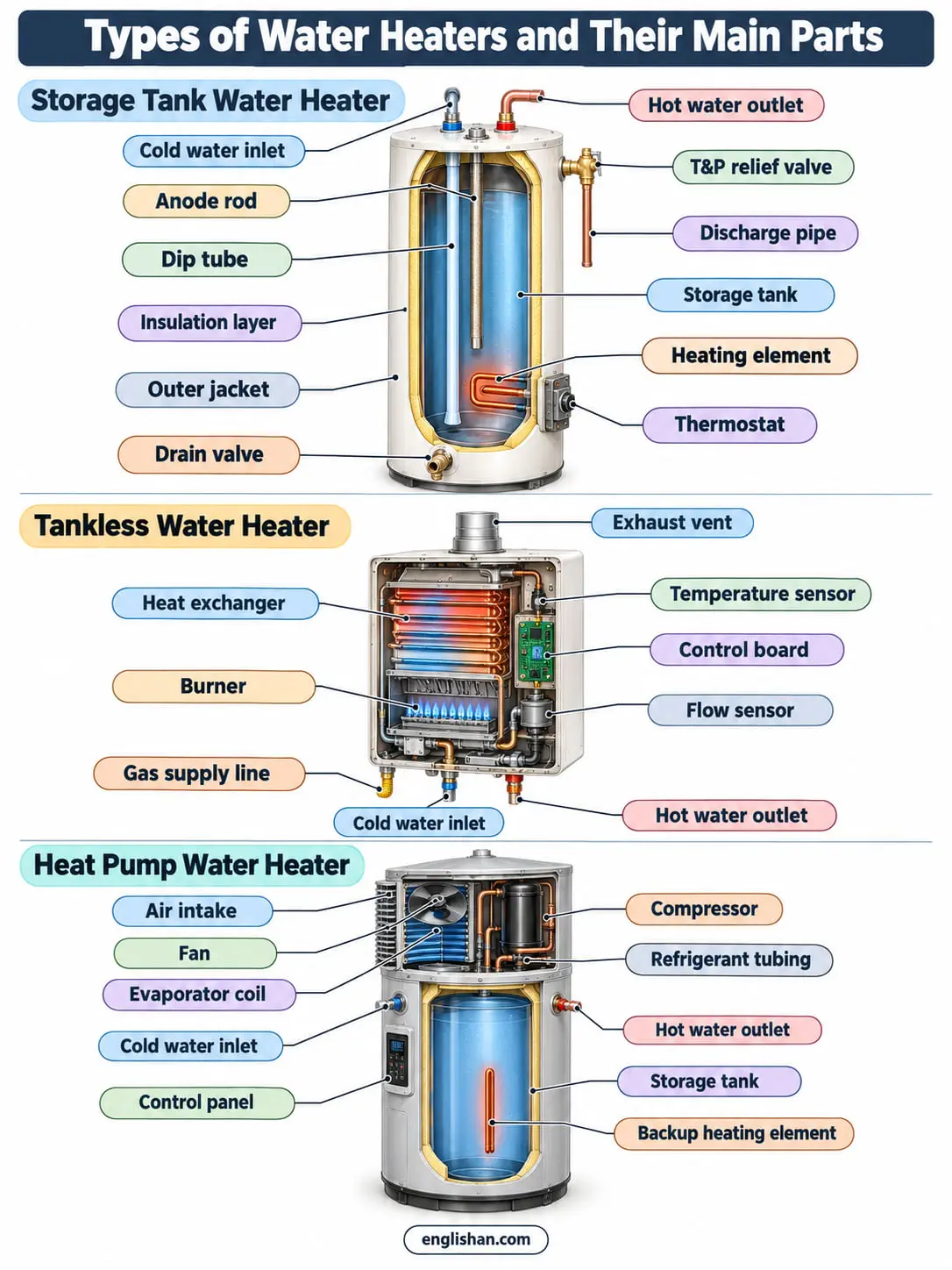
The parts of a water heater change with the type. Five types are common in US homes.
Electric Tank Water Heater
The electric tank water heater is a smooth-sided cylinder with no burner and no flue. Two heating loops, two thermostats, and two access panels are on its side. A wiring box on top takes a 240-volt cable from a 30-amp breaker. Behind the panels, the thermostats and the heating loops get hot.
Gas Tank Water Heater
The gas tank water heater runs on natural gas or propane. It adds a gas control valve, a burner, and a pilot assembly at the base. A thermocouple, a flue pipe, and a draft hood complete the gas parts. A gas line with its own shutoff valve feeds the control valve. The electrical parts of a gas water heater are the igniter and, on power vent models, the blower. Power vent models add a blower.
Tankless Water Heater
The tankless water heater is a wall-mounted box, about 27 inches tall, 14 wide, and 10 deep, with no storage tank. It is also sold as an instant or on-demand unit. A flow sensor on the inlet detects running water. A heat exchanger of copper or stainless steel coil heats it. A control panel on the front sets the temperature. Gas models rate 140,000 to 199,000 BTU, and electric models rate 18 to 36 kilowatts.
Heat Pump Water Heater
The heat pump water heater is a 50 to 80 gallon tank, about 6 feet tall, with a compressor unit on top. The unit has a fan, an evaporator coil, and an air filter. It draws heat from room air, much like an air conditioner run in reverse. It uses a 240-volt circuit.
Solar Water Heater
The solar water heater is a roof collector panel joined to a storage tank of 80 to 120 gallons. The collector is a flat glass-topped box, about 4 by 8 feet, with copper tubes inside. Insulated pipes join it to the tank, and many tanks add a backup electric element.
FAQs
Q1. What are the parts of a water heater?
The parts of a water heater are the tank, dip tube, anode rod, T&P relief valve, thermostat, heat source, and drain valve. A hot water heater has the same parts under another name. The pipe fittings are on top, and the heat source and drain valve are at the base.
Q2. What are the main parts of a water heater?
The main parts of a water heater are the tank, heat source, thermostat, dip tube, anode rod, T&P relief valve, and drain valve. The tank stores the water, and the heat source warms it. The valve and the rod protect the tank.
Q3. What are the internal parts of a water heater?
The internal parts of a water heater are the dip tube, the anode rod, the glass lining, the heating loops, and the flue baffle. They are inside the tank or behind the panels. Only the pipe fittings, valves, and jacket are visible from the outside.
Q4. Is a water heater part of the HVAC system?
No, a water heater belongs to the plumbing system, not the HVAC system. Its pipes connect to the home’s water supply, and it does not heat or cool room air. The top of the tank has the pipe fittings, the relief valve, and the anode rod head.
Q5. What are the parts of a gas water heater?
A gas water heater has a tank, a gas control valve, a burner, a pilot assembly, a thermocouple, and a flue pipe. It also has a dip tube, an anode rod, and a drain valve. Power vent models add a blower.
Q6. What are the parts of an electric water heater?
An electric hot water heater has a tank, an upper and a lower heating element, two thermostats, and two access panels. It also has a reset button, a wiring box, a dip tube, an anode rod, and a drain valve. It has no burner and no flue.
Q7. What are the parts of a tankless water heater?
A tankless water heater has a flow sensor, a heat exchanger, a control panel, and a gas burner or electric heating coils. It has a cold inlet, a hot outlet, and a gas line or a wiring box. It has no storage tank, no dip tube, and no anode rod.
You May Also Like
- Parts of a Kettle
- Parts of a Kitchen
- Parts of a Refrigerator
- Parts of an Air Conditioner
- Parts of an Espresso Machine
