An espresso machine is a countertop appliance with a water reservoir at the back and a group head on the front. Its steam wand is on the side. The parts of an espresso machine work around four stations: fill, brew, steam, and cup.
A portafilter is the handled metal holder for the coffee, and the group head is the fitting it locks into.
Parts of an Espresso Machine Labeled by Station
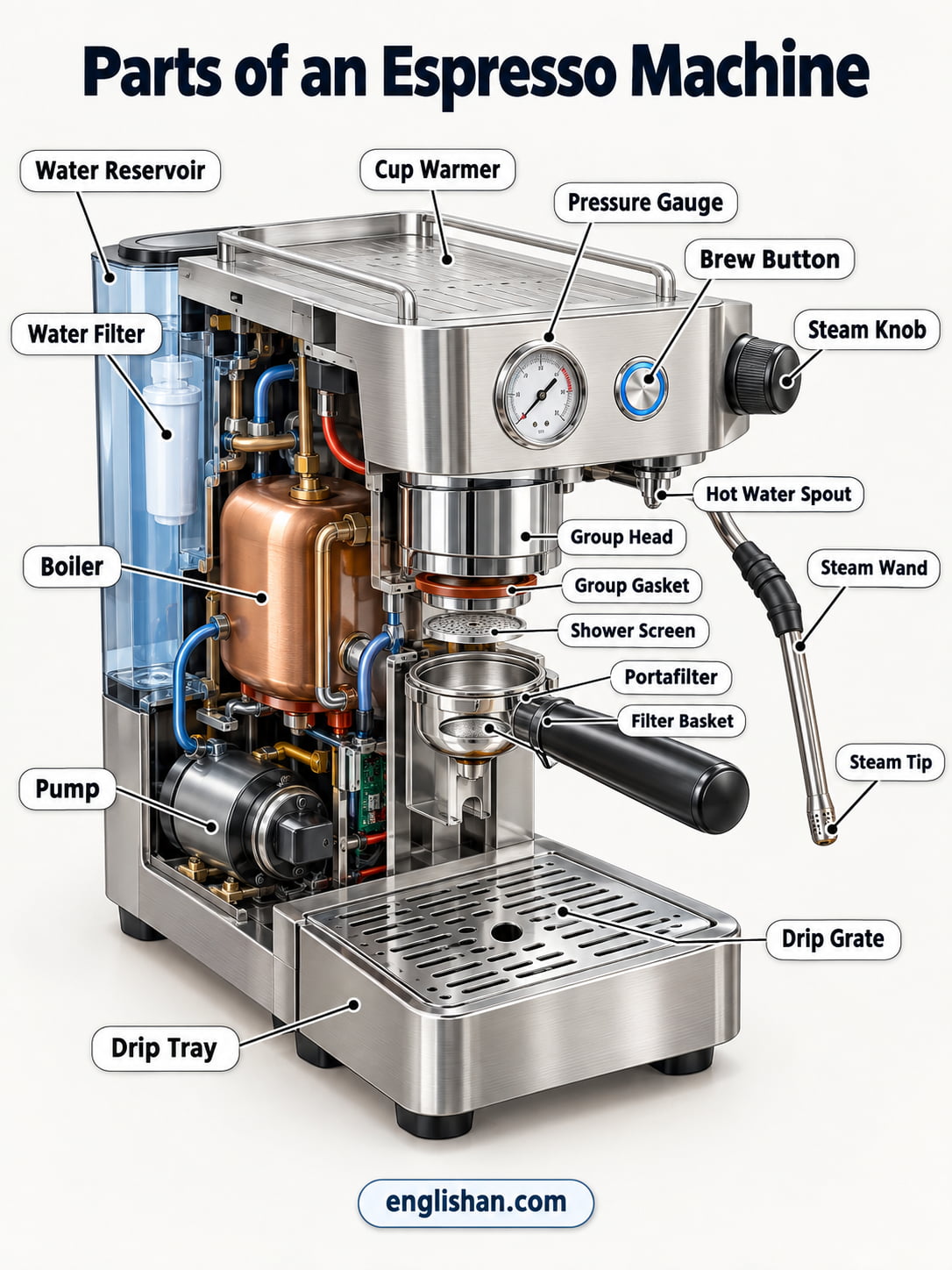
The front of an espresso machine is a chrome group head with a handled portafilter locked into its underside. A pressure gauge and a row of buttons are set over it. The steam wand extends from one side, with a hot water spout next to it. A drip tray with a grate is under the group head, and a warming plate covers the top. The reservoir is fixed at the back, and a pump and boiler are inside the case. These are the parts of an espresso machine, numbered from the reservoir to the cup.
| Part | Where you find it |
|---|---|
| 1. Water reservoir | Removable tank at the back or side |
| 2. Water filter | Small cartridge fitted in the reservoir |
| 3. Pump | Cylindrical motor inside the case |
| 4. Boiler | Brass or steel tank near the base of the group head |
| 5. Group head | Chrome fitting on the front of the machine |
| 6. Group gasket | Rubber ring inside the group head |
| 7. Shower screen | Perforated steel disc under the group head |
| 8. Portafilter | Handled metal holder locked under the group head |
| 9. Filter basket | Perforated steel cup inside the portafilter |
| 10. Portafilter spouts | Twin metal lips under the portafilter |
| 11. Pressure gauge | Round dial on the front panel |
| 12. Brew button | Push button or rocker on the front panel |
| 13. Power switch | Lit rocker on the front or side |
| 14. Indicator lights | Small lamps beside the buttons |
| 15. Steam wand | Steel tube on the side of the machine |
| 16. Steam tip | Perforated cap at the end of the wand |
| 17. Steam knob | Dial at the side, next to the wand |
| 18. Hot water spout | Short tube near the steam wand |
| 19. Drip tray | Shallow tray under the group head |
| 20. Drip grate | Perforated plate over the tray |
| 21. Cup warmer | Flat plate with rails on top of the machine |
| 22. Bean hopper | Funnel on top of a super-automatic |
| 23. Built-in grinder | Burr set under the hopper |
| 24. Lever arm | Long handle on a manual lever machine |
Main Parts of an Espresso Machine
Seven of the different parts of an espresso machine make the shot. The others control it, steam the milk, or catch the drips.
- Water reservoir: The tank that stores 40 to 80 ounces of water.
- Pump: The motor that pushes water to the boiler and through the coffee.
- Boiler: The brass or steel tank, or the metal block, that heats the water.
- Group head: The fitting that spreads hot water over the coffee.
- Portafilter: The handled holder for the coffee basket.
- Steam wand: The tube that froths milk.
- Drip tray: The tray that catches spills.
Espresso Machine Fill Station Parts
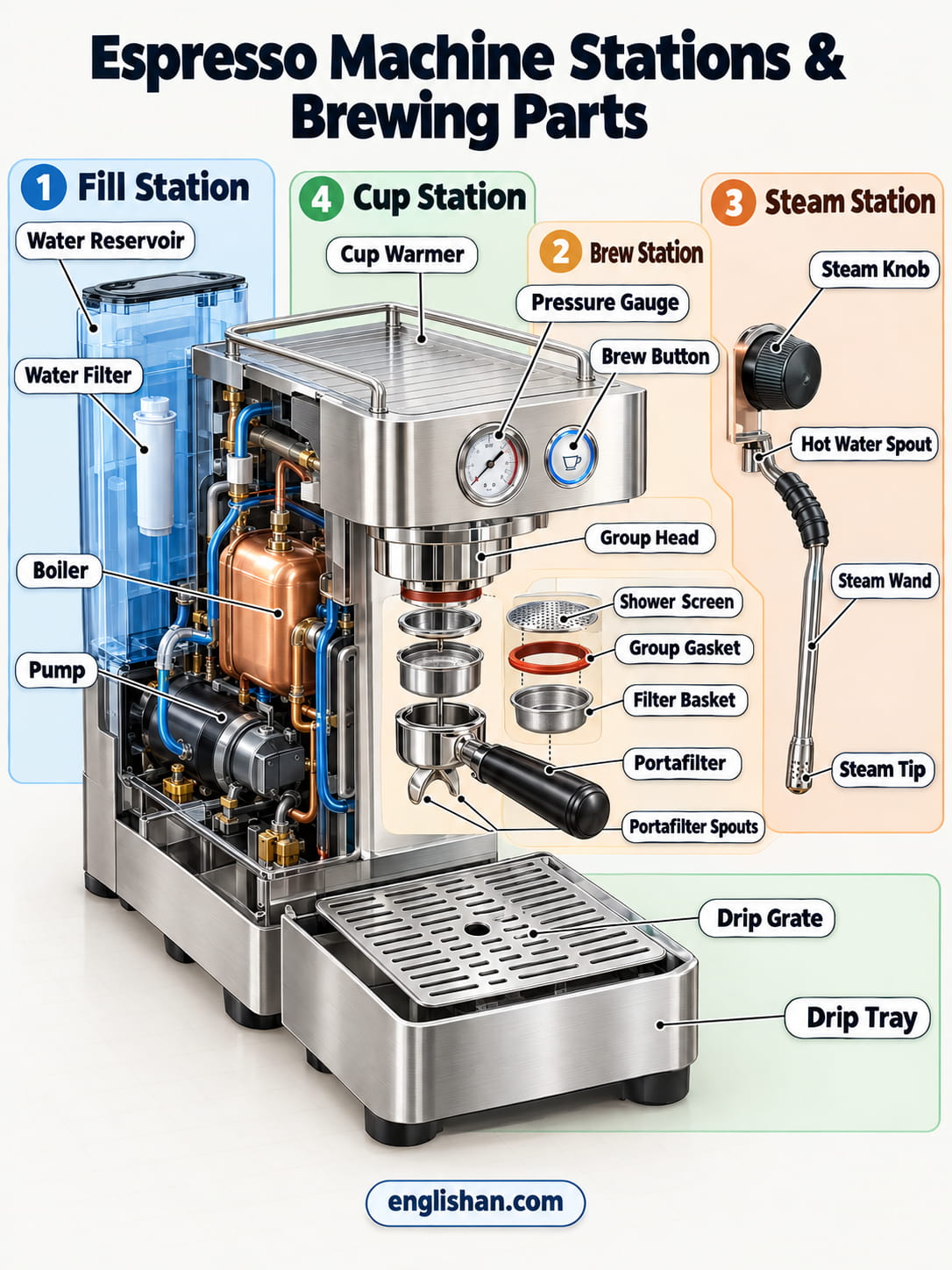
Four of the parts of an espresso machine store, filter, move, and heat the water. Three are hidden inside the case, and only the reservoir is in view.
Water Reservoir
The water reservoir is a transparent plastic tank, 40 to 80 ounces (1.2 to 2.4 liters), fixed at the back or side. A hinged lid and a grab handle are molded into it. Level marks are printed on its wall. It lifts out for refilling.
Water Filter
The water filter is a small plastic cartridge, about 2 inches wide, fitted in the bottom of the reservoir. It is filled with resin beads. It softens the water and lowers mineral buildup.
Pump
The pump is a cylindrical metal motor, about 3 inches long, mounted inside the case. A vibratory pump is the standard on home machines, and it is rated at 15 bar (217 psi). Brew pressure is set lower, near 9 bar (130 psi).
Boiler
The boiler is a brass or stainless steel tank of 10 to 60 ounces, fixed near the base of the group head. It heats the water to about 200°F. Entry-level machines use a thermoblock in place of a tank. It is a solid metal block with a channel in it, much like the heating plate in a kettle.
Espresso Machine Brew Station Parts
Ten of the parts of an espresso machine make up the brew station. It is the front of the machine, where the group head meets the portafilter.
Group Head
The group head is a chrome-plated brass fitting on the front of the machine, about 2.3 inches (58 mm) wide. A pair of metal slots inside it takes the portafilter lugs. Hot water flows out through a screen on its underside.
Group Gasket
The group gasket is a black or white rubber ring, about 8 mm thick, in the underside of the group head. The portafilter presses against it and seals. It stiffens and cracks with age.
Shower Screen
The shower screen is a perforated stainless steel disc, about 2 inches across, screwed to the underside of the group head. Dozens of small holes spread the water over the coffee. It is silver, with a bolt in the center.
Portafilter
The portafilter is a chrome-plated metal cup on a handle, 2.3 inches (58 mm) across. The handle is 5 to 6 inches long, with a wooden or black plastic grip. Two lugs on the rim lock it into the group head with a quarter turn. Among the parts of an espresso machine, it is the one you handle most.
Filter Basket
The filter basket is a stainless steel cup with a perforated floor, fitted inside the portafilter. A single basket takes 7 to 10 grams of ground coffee, and a double takes 14 to 20 grams. Its holes are about 0.3 mm wide.
Portafilter Spouts
The portafilter spouts are two chrome lips under the basket, one on each side, that direct the espresso into two cups. A single-spout version has one lip. A bottomless portafilter has none, and it shows the shot as it runs.
Pressure Gauge
The pressure gauge is a round dial about 2 inches across, set in the front panel. Its scale runs from 0 to 16 bar (0 to 230 psi), and a green band marks 8 to 10 bar. Entry-level machines have none.
Brew Button
The brew button is a push button or rocker on the front panel, marked with one-cup and two-cup icons. It starts and stops the pump. Some machines add a program button for shot volume.
Power Switch
The power switch is a lit rocker or toggle on the front or side of the machine. It has On and Off positions. A small light glows behind it.
Indicator Lights
The indicator lights are small LED lamps beside the buttons, marked Ready, Steam, and Water. Some show a Descale warning. Each is a dot or a symbol under a translucent cover.
Espresso Machine Steam Station Parts
Four of the parts of an espresso machine make the steam and hot water. They are on the side of the machine.
Steam Wand
The steam wand is a stainless steel tube, 6 to 8 inches long, on a ball joint at the side of the machine. A rubber or plastic sleeve covers the end where the hand grips it. It swings in a wide arc.
Steam Tip
The steam tip is a brass or steel cap, about half an inch long, screwed onto the end of the wand. It has one to four small holes. Milk is heated by the steam that leaves them.
Steam Knob
The steam knob is a round dial with a rubber grip, on the side of the machine near the wand. Turning it opens the steam flow. Some models replace it with a lever or a push button.
Hot Water Spout
The hot water spout is a short stainless steel tube on the side, close to the steam wand. It pours hot water for tea or an Americano. A dial or a button beside it starts the flow.
Espresso Machine Cup Station Parts
Three of the parts of an espresso machine are at the cup station. They catch the drips and keep the cups warm.
Drip Tray
The drip tray is a shallow tray of stainless steel or plastic, 8 to 12 inches wide, under the group head. It slides out at the front. A red or yellow float pops up when the tray is full.
Drip Grate
The drip grate is a perforated plate of stainless steel or chrome-plated metal that covers the drip tray. It supports the cups during the shot. The slots let spills fall through into the tray.
Cup Warmer
The cup warmer is a flat stainless steel plate with a raised rail, on top of the machine. Heat from the boiler warms it. It fits four to six cups, and it turns a kitchen counter into a small coffee bar.
Espresso Machine Types and Their Parts
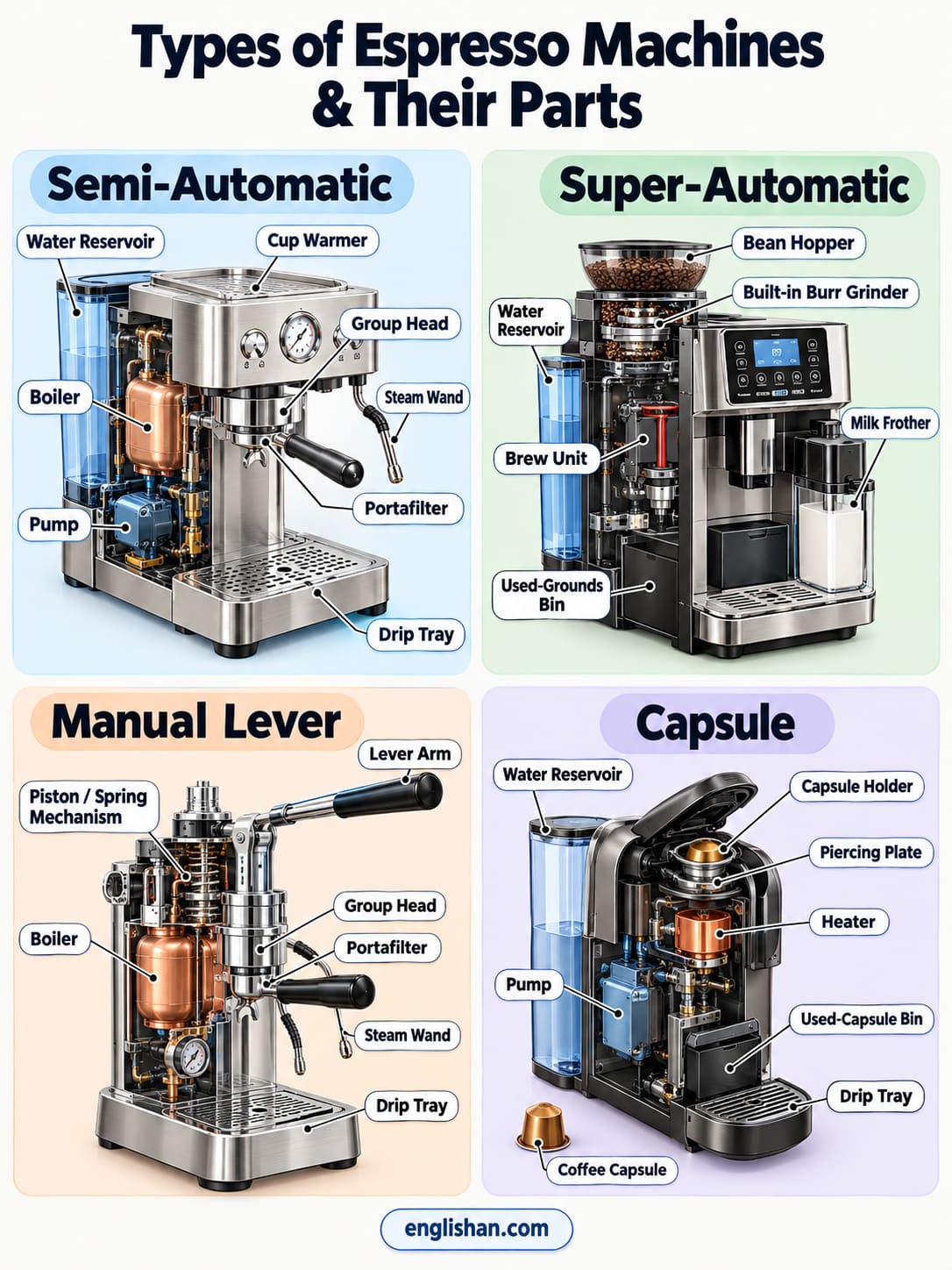
The parts of an espresso machine change with the type. Four types cover home and café machines.
Semi-Automatic Espresso Machine
The semi-automatic espresso machine is the most common home type. It has all four stations: a portafilter, group head, pump, boiler, steam wand, and drip tray. You grind, tamp, lock in the portafilter, and start the shot. It is rated at 1,000 to 1,600 watts on a 120-volt outlet.
Super-Automatic Espresso Machine
The super-automatic espresso machine grinds, tamps, and brews at one touch. It has a bean hopper on top, a built-in burr grinder, and a removable brew unit. A touchscreen or dial, a milk frother, and a used-grounds bin are on the front. It has no portafilter.
Manual Lever Espresso Machine
The manual lever espresso machine has a long lever arm on the front or the side. Pulling the arm pushes the water through the coffee with a spring or a piston. It has a group head, a portafilter, and a boiler, and many models have no pump.
Capsule Espresso Machine
The capsule espresso machine is a compact box with a capsule holder on top or in front. A piercing plate opens the capsule, and a bin collects used capsules. It has a reservoir, a pump, and a small heater. It has no portafilter.
FAQs
Q1. What are the parts of an espresso machine called?
The parts of an espresso machine are called the water reservoir, pump, boiler, group head, portafilter, basket, steam wand, drip tray, and gauge. The reservoir, pump, and boiler are the fill station. The group head, portafilter, and basket are the brew station.
Q2. What are the main parts of an espresso machine?
The main parts of an espresso machine are the reservoir, pump, boiler, group head, portafilter, steam wand, and drip tray. The pump and boiler make hot pressurized water. The group head and portafilter turn it into espresso.
Q3. What are the parts of an espresso machine and their functions?
The reservoir stores the water, and the pump pushes it through the boiler. The boiler heats it, and the group head spreads it over the coffee. The steam wand froths milk, and the drip tray catches the spills. Each part of an espresso machine does one job at its station.
Q4. What is the handle part of an espresso machine called?
The handle part of an espresso machine is the portafilter. It is a metal cup on a handle that locks into the group head. The filter basket inside it takes the ground coffee.
Q5. What are the parts of a coffee machine?
A coffee machine has a water reservoir, a heater, a filter holder, a carafe or cup rest, and a drip tray. The parts of an espresso coffee machine add a pump, a group head, a portafilter, and a steam wand.
Q6. Do espresso machines come with a portafilter?
Yes, most semi-automatic espresso machines come with a portafilter and one or two baskets. Super-automatic and capsule machines have none. Many packages add a tamper and a milk pitcher.
Q7. What are the internal parts of an espresso machine?
The internal parts of an espresso machine are the pump, boiler or thermoblock, heating element, solenoid valve, hoses, and a control board. They are behind the case. Only the reservoir, group head, and steam wand are visible from the outside.
You May Also Like
- Parts of a Grinder
- Parts of a Kettle
- Parts of a Kitchen
- Parts of a Microwave Oven
- Parts of a Toaster