

An electric kettle is a jug of plastic, glass, or steel that lifts off a round power base. The parts of a kettle fall on either side of one ring of contacts under the jug. The lid, spout, body, and heating element go with the jug.
A stovetop kettle has no ring, and its handle, lid, and whistle attach to the pot itself.
Kettle Parts Labeled and Numbered
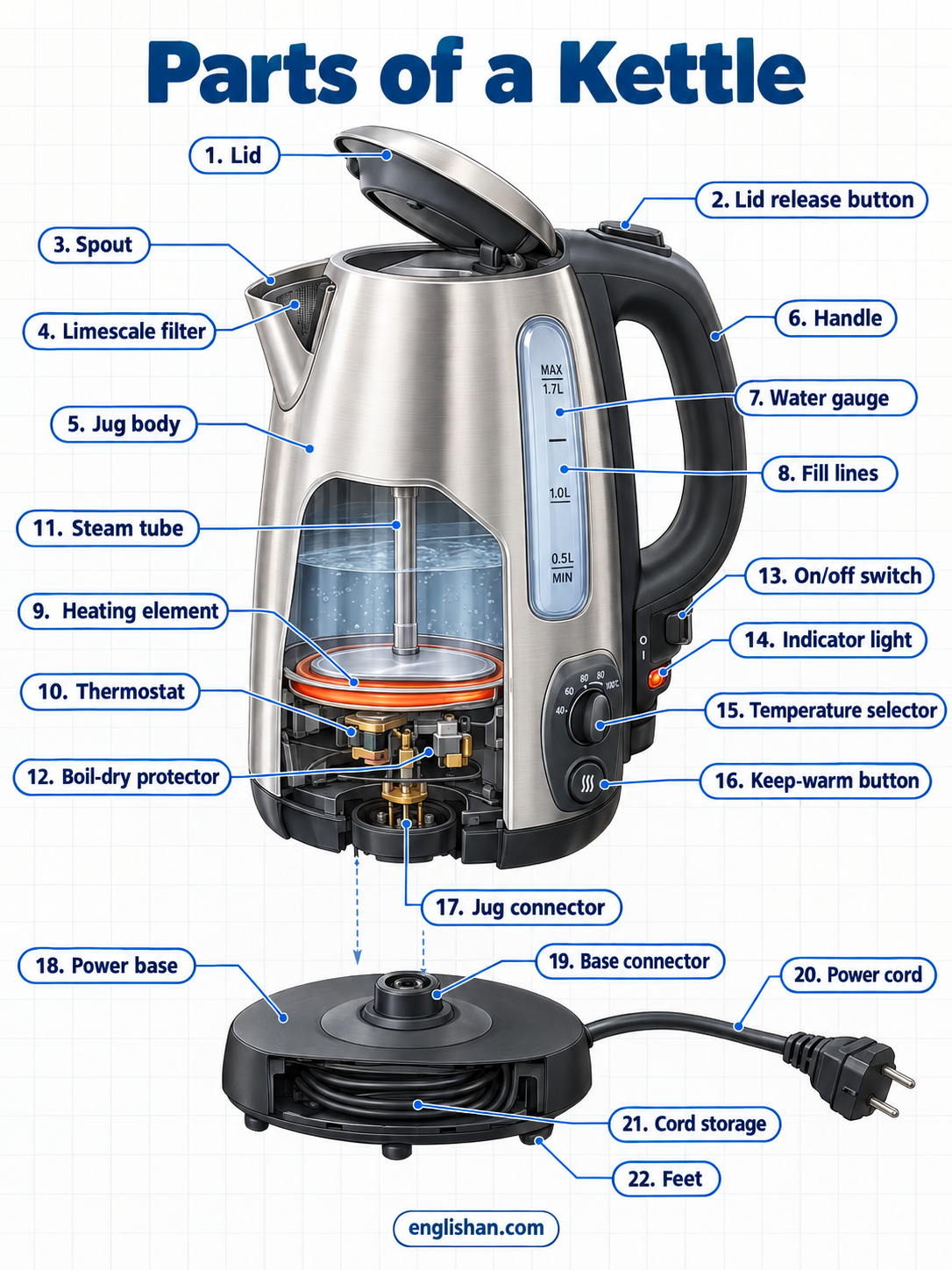
On top of the jug are a hinged lid and a spout with a mesh filter set into its throat. A handle is molded to the back, with a switch under the thumb rest, and a water gauge is cut into the wall. Inside the floor is a flat heating element, the metal plate that heats the water, and a small thermostat is fixed under it. A round connector on the underside of the jug meets the power base, which has a cord and rubber feet. These are the major parts of a kettle on the counter, plus the ones hidden under the floor plate.
| Part | Where you find it |
|---|---|
| 1. Lid | Hinged cap over the top opening |
| 2. Lid release button | Push button on top of the handle |
| 3. Spout | Pouring lip at the front of the jug |
| 4. Limescale filter | Mesh screen inside the spout |
| 5. Jug body | Wide vessel of steel, glass, or plastic |
| 6. Handle | Molded loop on the back of the jug |
| 7. Water gauge | Transparent window in the jug wall |
| 8. Fill lines | Molded marks beside the gauge |
| 9. Heating element | Flat steel plate across the jug floor |
| 10. Thermostat | Bimetal disc under the element plate |
| 11. Steam tube | Narrow channel from the lid to the thermostat |
| 12. Boil-dry protector | Thermal switch beside the thermostat |
| 13. On/off switch | Rocker or lever at the top or side of the handle |
| 14. Indicator light | Small lamp next to the switch |
| 15. Temperature selector | Dial or buttons on the base or handle |
| 16. Keep-warm button | Small button on the base or handle |
| 17. Jug connector | Round contact plate under the jug |
| 18. Power base | Round plastic disc under the jug |
| 19. Base connector | Raised collar with a center pin in the base |
| 20. Power cord | Cable leaving the back of the base |
| 21. Cord storage | Wrap channel in the underside of the base |
| 22. Feet | Rubber pads under the base |
Kettle Lid and Spout Parts
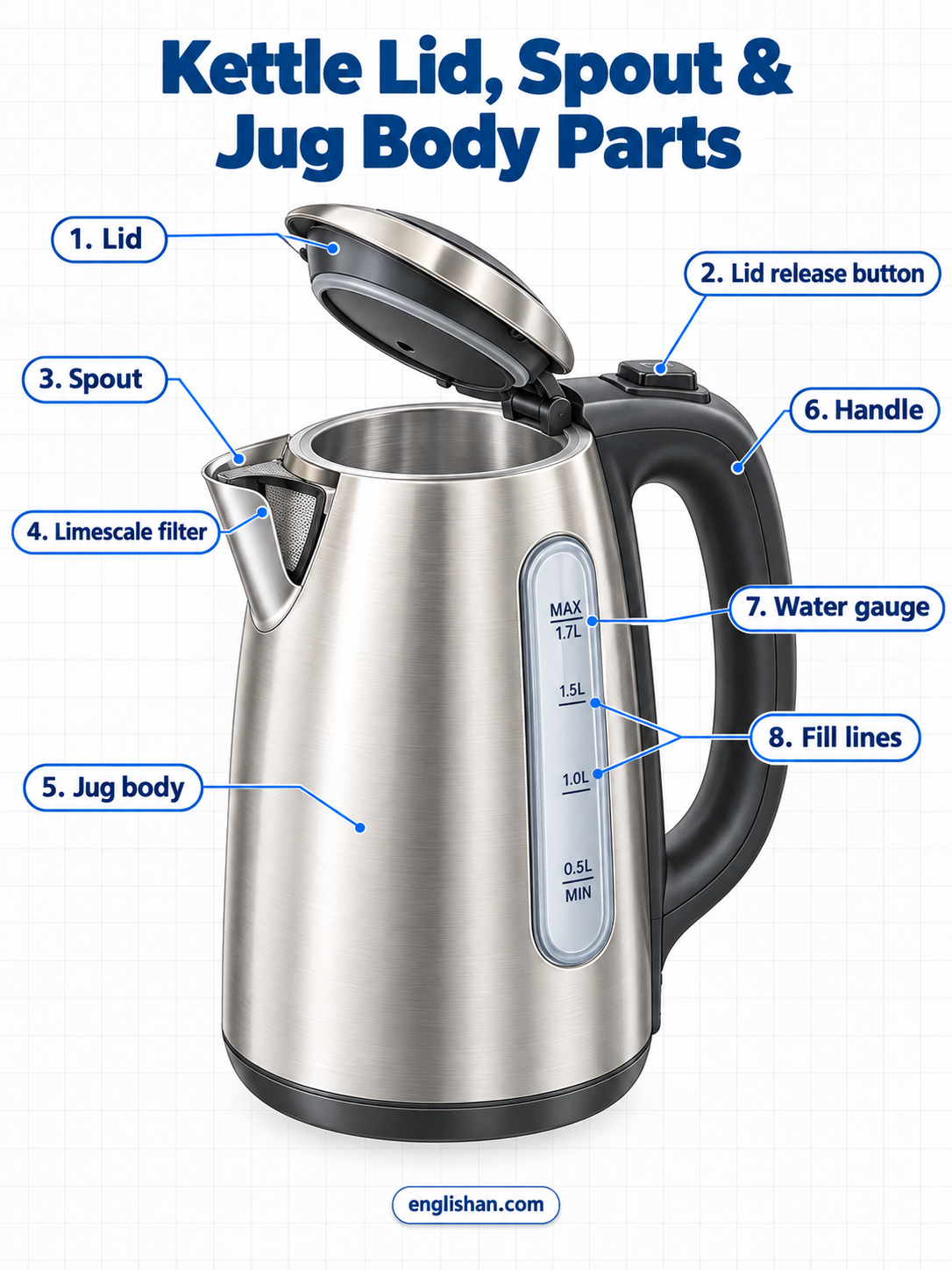
Four of the parts of a kettle make up the top of the jug. They are the lid, the release button, the spout, and the limescale filter.
Lid
The lid is a round cap of plastic or stainless steel with a silicone rim and a hinge at the back. It closes the wide opening at the top of the jug. A tiny steam vent is cut near the hinge, and glass models pair the steel lid with a plastic knob.
Lid Release Button
A push button on top of the handle springs the lid open when pressed. It is molded plastic, marked with a small arrow. Budget models drop the button and use a tab on the lid’s front edge that you lift by hand.
Spout
The spout is the pouring lip molded into the front of the jug body. It is a short curved channel with a narrow tip on standard kettles and a long thin neck on gooseneck models. Its wall is made of the same material as the jug.
Limescale Filter
A curved mesh screen of stainless steel or nylon lines the inside opening of the spout. Limescale is the white mineral crust that forms when hard water boils, and the screen blocks loose flakes from the pour. Snap-in filters lift out for rinsing, while fixed ones are riveted to the spout.
Kettle Jug Body Parts
Four of the parts of a kettle form the walls of the jug: the body, the handle, the water gauge, and the fill lines. Most household jugs have a 1.7-liter capacity, about 57 ounces, which fills five mugs.
Jug Body
The jug body is a wide vessel of stainless steel, borosilicate glass, or hard plastic. Steel jugs have a brushed or polished finish, and glass jugs show the water and add a blue light ring at the base. Double-wall steel models add an air gap between two skins, so the outer wall stays cool to the touch.
Handle
The handle is a molded plastic loop on the back of the jug, with a thumb rest on top. Two or three screws or heat-resistant rivets fasten it to the body. Its grip is textured, and on many models a hollow channel runs through its length.
Water Gauge
The water gauge is a vertical window of transparent plastic set into the jug wall, placed beside the handle. Cup and liter numbers are printed or molded along its edge. On glass jugs the marks are printed straight onto the wall.
Fill Lines
Two molded lines mark the safe range of water in the jug. The MIN line is near the bottom and covers the element plate, and the MAX line is near the top of the wall. Filling past MAX pushes boiling water up the spout.
Kettle Heating Element and Safety Parts
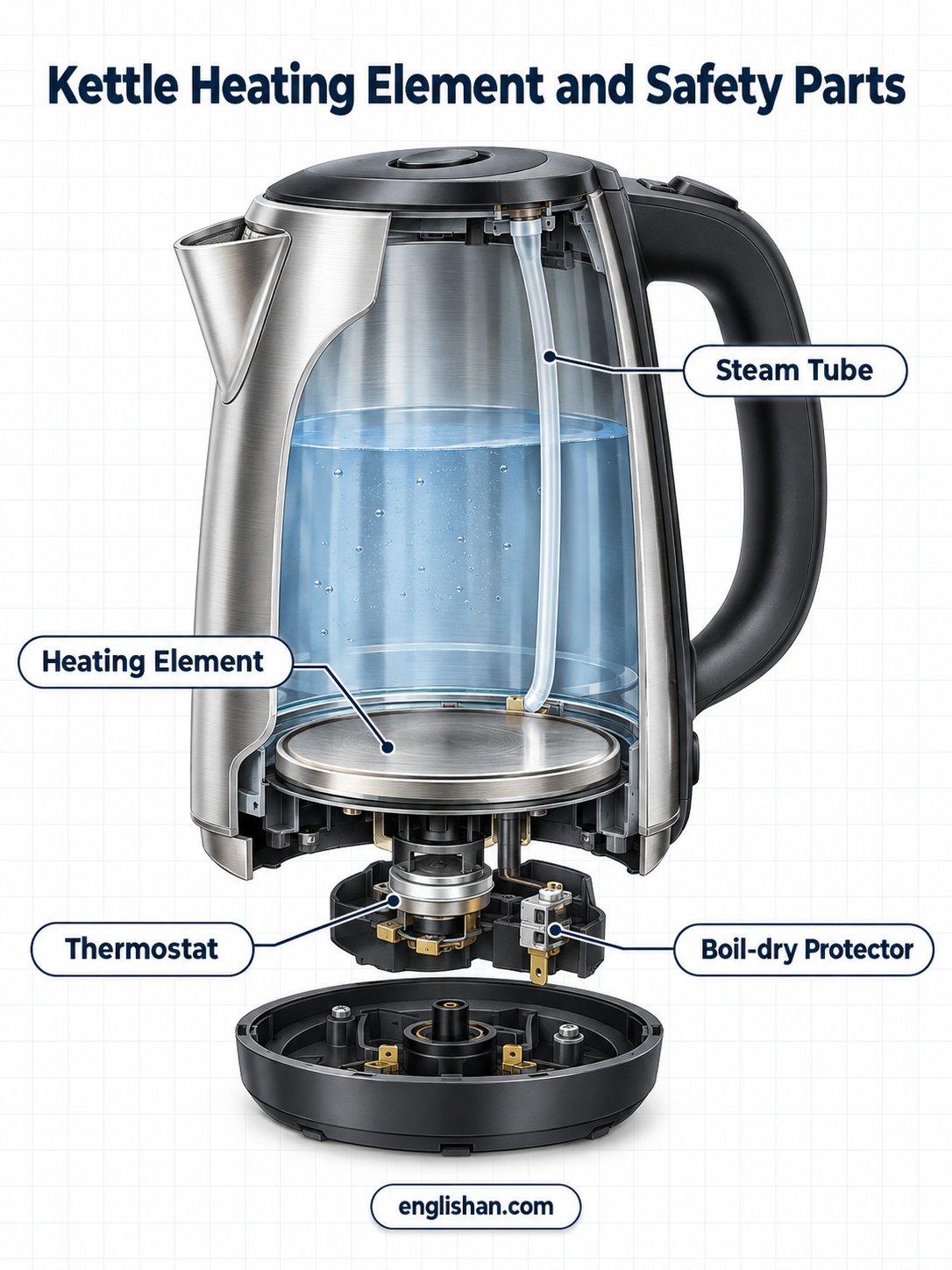
Four of the parts of a kettle are fixed in the jug floor and the handle. None is removable, and each is sealed from the water.
Heating Element
The heating element is a length of nickel-chromium resistance wire, and it gives the kettle its heat. Most current models hide the wire under a flat stainless steel plate welded across the jug floor. This concealed element is a smooth disc rated at up to 1,500 watts on a 120-volt US outlet. Older kettles used an exposed coil that lay in the water.
Thermostat
The thermostat is a bimetal disc, a round strip of two metals bonded together that bends at a set temperature. It is mounted on the underside of the element plate, a small dished disc about the size of a quarter. A stem links it to the on/off switch, and it releases the switch near 212°F at sea level.
Steam Tube
A slim pipe of plastic or steel, the steam tube, starts under the lid near the handle and ends at the thermostat. In hollow-handle kettles the pipe runs inside the handle. A small vent hole near the hinge marks its upper end.
Boil-Dry Protector
The boil-dry protector is a second thermal switch, or a one-shot thermal fuse, wired to the element plate. It is a small metal disc with two leads, fixed beside the thermostat. Resettable versions have a tiny pin on the underside of the jug that you press to restore power.
Kettle Switch and Control Parts
The switch and controls are the last of the parts of a kettle that belong to the jug or its handle. Premium models move the temperature controls to the base.
On/Off Switch
The on/off switch is a rocker or a lever, molded in plastic, at the top or side of the handle. It clicks down when pressed and springs back up when the water reaches a boil. A small rod inside the handle links it to the thermostat.
Indicator Light
The indicator light is a small neon lamp or LED next to the on/off switch. Its window is a translucent dot or ring of plastic. Glass kettles add a wider band of light around the base of the jug.
Temperature Selector
Variable-temperature kettles add a dial or a row of buttons marked with temperatures from 140°F to 212°F. A small circuit board is fixed behind the panel. Presets are labeled with the drink names, such as green tea, oolong, and coffee.
Keep-Warm Button
The keep-warm button is a small button beside the selector, or on the handle of simpler models. A light comes on when it is pressed. The mode maintains the water near the set temperature for 30 to 60 minutes.
Kettle Power Base Parts
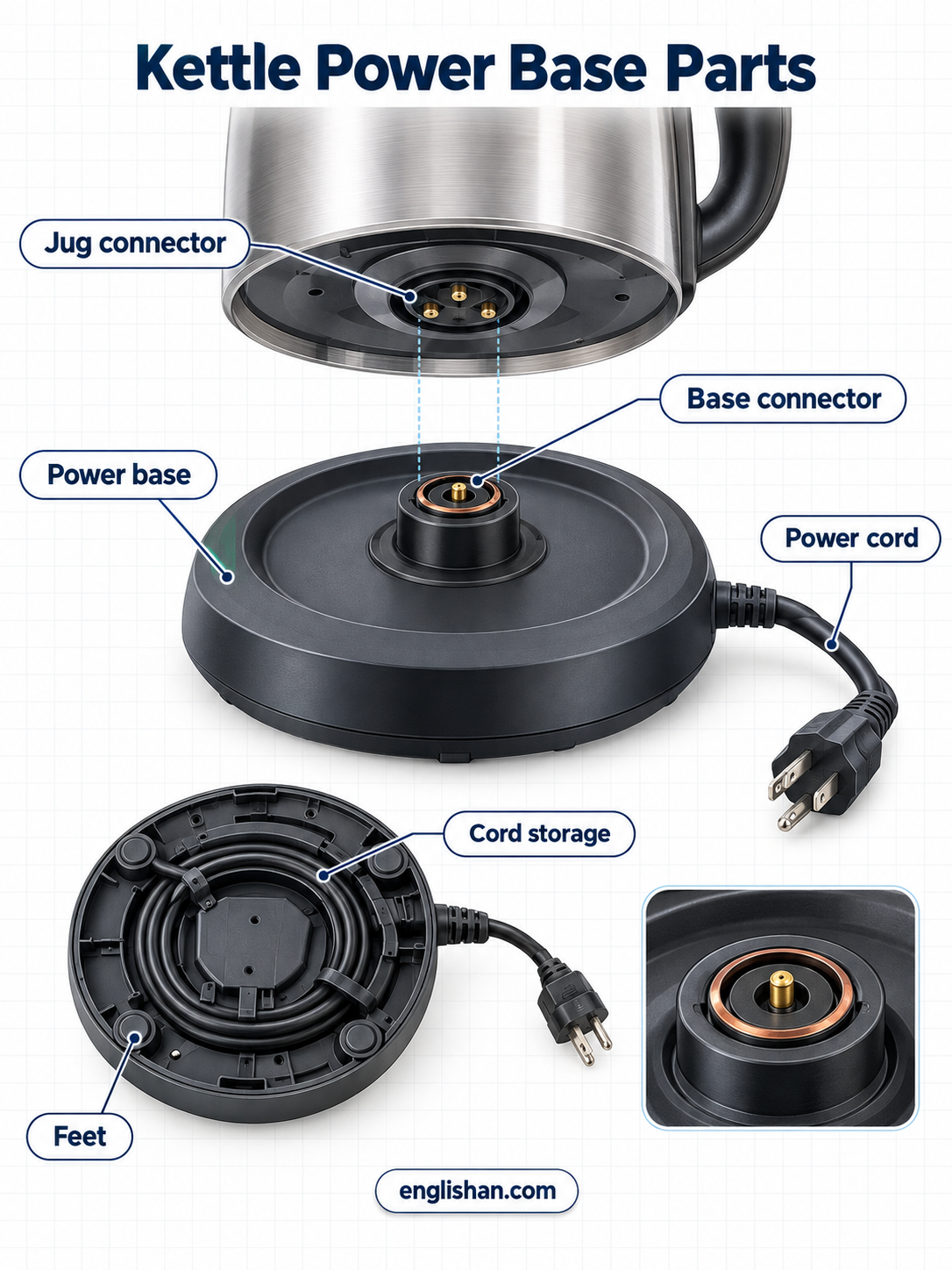
The power base and its connectors are the parts of a kettle that never touch water. Six pieces make up this half, and all of them are fixed in one round housing.
Jug Connector
The jug connector is a round contact plate molded into the bottom of the jug. Three metal contacts are pressed into it, and a plastic locating ring surrounds them. Its contacts meet the base connector when the jug is set down in any direction.
Power Base
The power base is the bottom part of a kettle. It is a round plastic disc, 5 to 6 inches across, with a shallow recess in the top for the jug. It is made of molded plastic, and the underside is screwed shut. Steel base plates are fitted in some models to add weight.
Base Connector
The base connector is a raised plastic collar in the center of the base. It has a spring-loaded center pin and an outer ring of copper contacts. It meets the jug connector directly. The ring shape lets the jug seat at any angle.
Power Cord
The power cord leaves the back of the base and measures two to three feet on most US models. It ends in a two-prong or three-prong plug for a 120-volt outlet. A rubber strain relief guards the point where it enters the housing.
Cord Storage
A shallow channel or spool in the underside of the base takes up the extra cord. Its walls are molded plastic, and a gap at the edge lets the cord exit at the back. A neat wrap keeps the base flat on the counter.
Feet
Three or four rubber pads are fitted to the underside of the base. They lift the disc slightly off the counter and prevent slipping. Some models add a silicone ring around the recess to stop the jug from sliding.
Stovetop Tea Kettle Parts
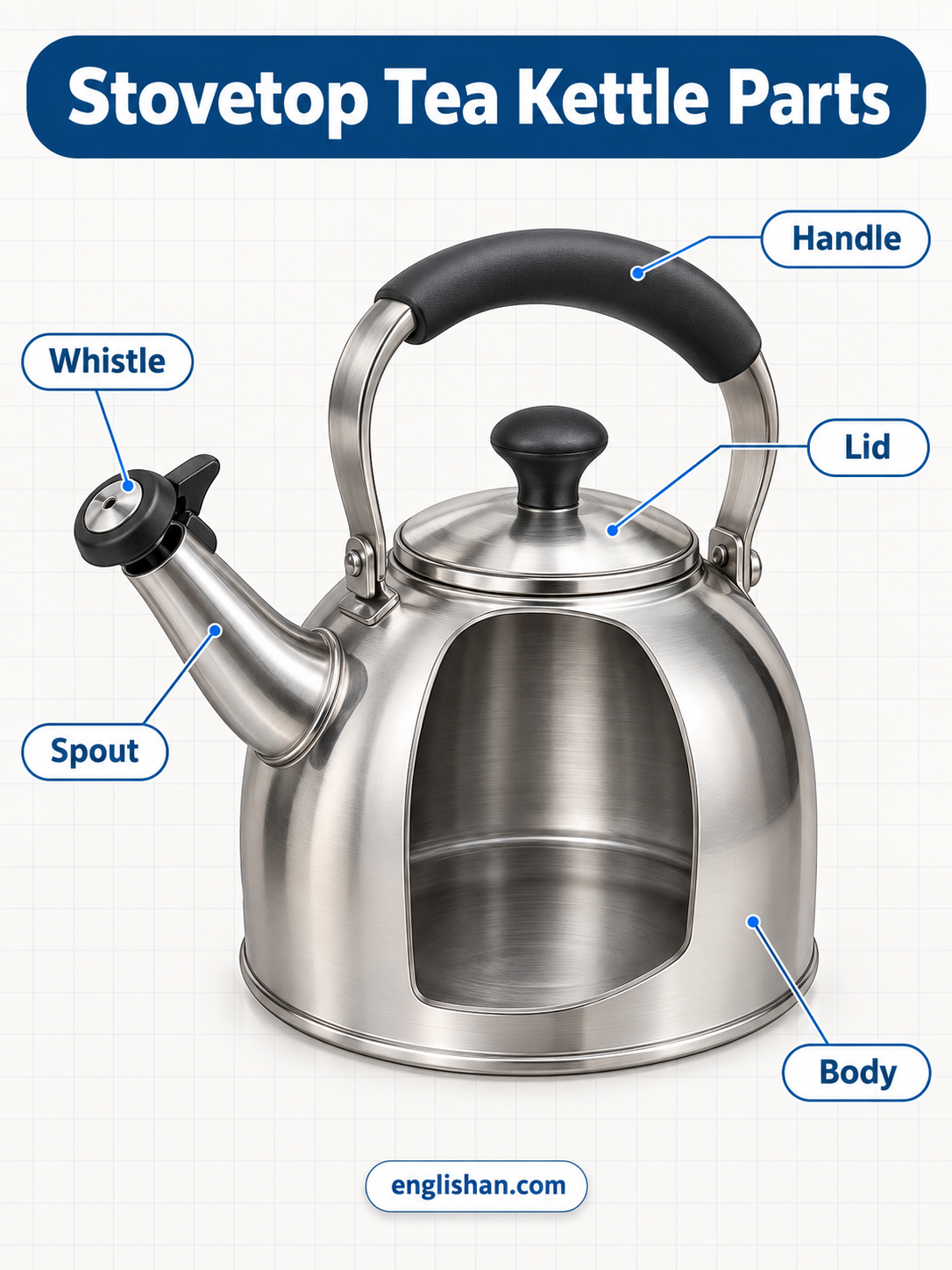
The parts of a kettle change on a stovetop model, since it has no cord, no power base, and no heating element. Five main parts make up the pot.
- Body: A pot of stainless steel, enameled steel, or copper with a wide, flat bottom that matches a burner.
- Spout: A curved tube welded to the front of the body, fitted with a hinged cover or a whistle cap.
- Whistle: A small cap with a narrow slot at the tip of the spout, which sounds when steam escapes through it.
- Handle: A fixed or folding arch of steel or wire, wrapped in a phenolic or silicone grip.
- Lid: A domed cover with a knob, seated in the top opening of the body.
Kettle Parts FAQs
Q1. What are the parts of a kettle called?
The different parts of a kettle are the lid, spout, filter, jug body, handle, water gauge, heating element, thermostat, switch, and power base. An electric model adds a jug connector and a cord. A stovetop model swaps those for a flat base and a whistle.
Q2. What are the inner parts of a kettle?
The inner parts of a kettle, also called its internal or inside parts, are the heating element, thermostat, steam tube, and boil-dry protector. All four are fixed in the jug floor and handle. The limescale filter and the fill lines are the two inner parts you see from outside.
Q3. What are the parts of an electric kettle and their functions?
The heating element warms the water, and the thermostat cuts power at a boil. The steam tube leads steam to the thermostat, and the boil-dry protector shuts the kettle off when the jug is empty. The lid and spout close and pour the water, and the base and cord deliver power.
Q4. What are the parts of a tea kettle called?
A tea kettle has a body, spout, whistle cap, handle, and lid. The flat base fits over a gas or electric burner. Some models add a spout cover with a lever that flips up for pouring.
Q5. What are the parts of a kettle heater?
The kettle heater is the heating element, the plate across the jug floor with resistance wire fixed under it. A thermostat and a boil-dry protector are wired beside it. The jug connector under them links the plate to the power base.
Q6. What are the parts of a kettle diagram?
A kettle diagram labels the lid, spout, filter, handle, water gauge, switch, jug body, heating element, thermostat, contact ring, base, cord, and feet. The jug side has the first ten of those, and the base side has the rest. Variable-temperature kettles add a dial and a keep-warm button.
Q7. What is the anatomy of a kettle?
The anatomy of a kettle is two units joined by a ring of contacts: the jug and the power base. The jug has the lid, spout, body, handle, and heating element. The base is the bottom part of a kettle and has the connector, cord, and feet.
You May Also Like