

The parts of a bulldozer follow the layout of a crawler tractor with a metal blade at the front. The blade is mounted at the front and the ripper at the rear, with a track assembly on each side. The cab, the engine compartment, and the final drives complete the machine.
Wikipedia traces the word bulldozer to the blade attachment alone. It now applies to any crawler tractor with a front-mounted blade. A front-end loader with a bucket is a different machine, so the parts described are the blade, the push frame, the ripper, the undercarriage, the powertrain, and the cab of the crawler type.
Parts of a Bulldozer Labeled Diagram
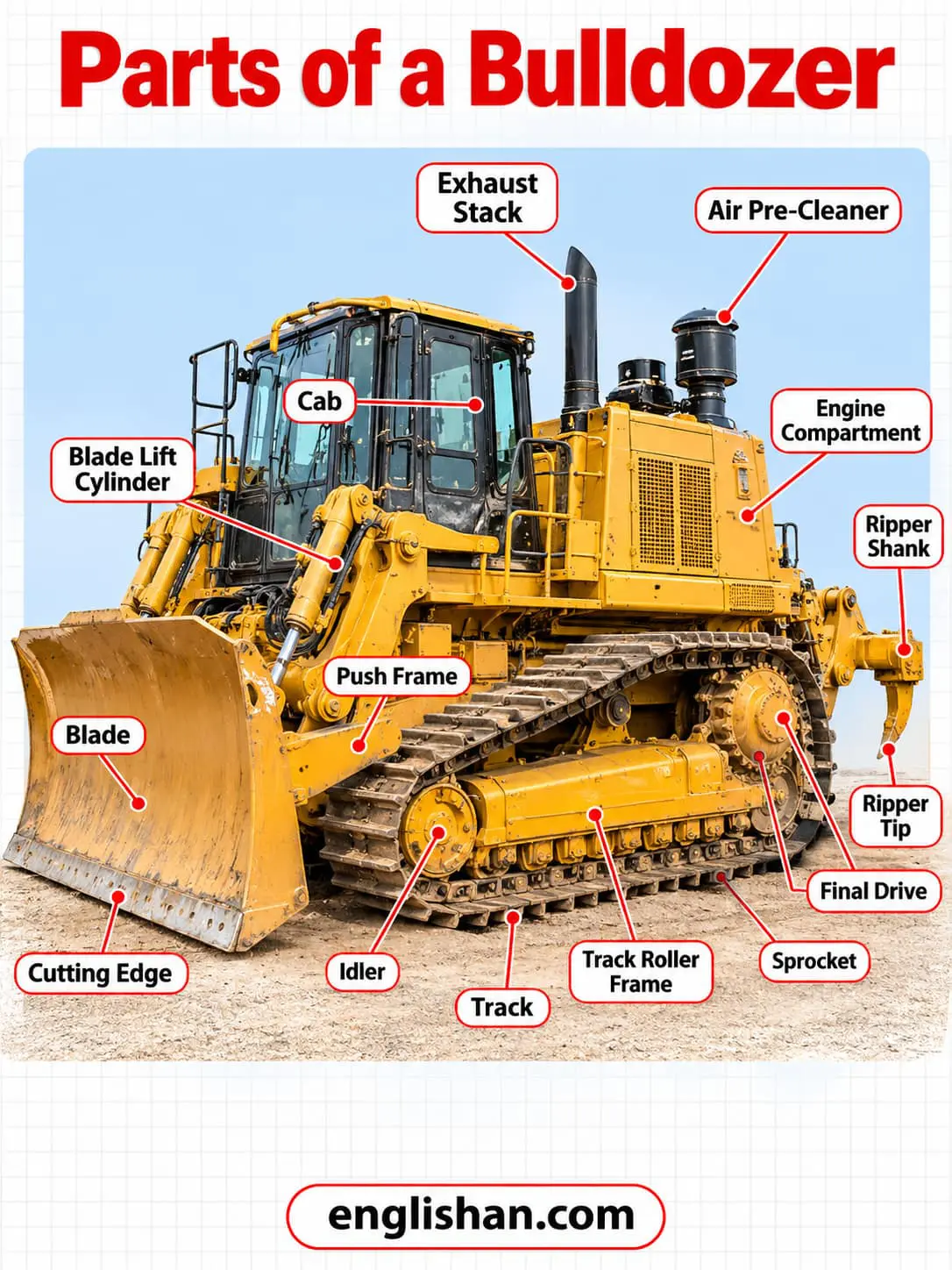
In a labeled diagram of a bulldozer, the blade is the front-most part and the ripper is the rear-most part, with the tracks running along both sides. The numbers start at the blade, move through the undercarriage and the cab, and end at the ripper.
- Blade: a heavy metal plate at the front of the machine that pushes and levels soil, sand, and rubble.
- Cutting edge: the edge of the blade that meets the ground, labeled as a separate part in the Visual Dictionary.
- Blade lift cylinder: the hydraulic cylinder that raises and lowers the blade.
- Push frame: the frame that moves the blade, according to Heavy Equipment College.
- Track: a loop of metal links on each side of the machine, fitted with trackshoes.
- Track roller frame: the frame on each side that the push frame pivots on through a trunnion.
- Idler: the wheel at the end of the track that keeps the track on its path and sets its tightness.
- Sprocket: the large cogwheel whose teeth engage the track’s pins and bushings and turn the track.
- Final drive: the gear unit that transfers power from the drive motor to the tracks.
- Cab: the operator’s enclosure, which shields the operator from debris and sound.
- Engine compartment: the compartment for the diesel engine, labeled with the air pre-cleaner filter and the exhaust stack.
- Ripper shank: the long claw-like tooth mounted at the rear that loosens hard ground.
- Ripper tip: the replaceable tungsten steel alloy tip on the end of the shank, also called a boot.
- Ripper cylinder: the hydraulic cylinder that raises and lowers the ripper.
Not every bulldozer has a ripper. Plant and Equipment describes it as an addition to the base machine rather than a standard part.
Bulldozer Blade and Cutting Edge
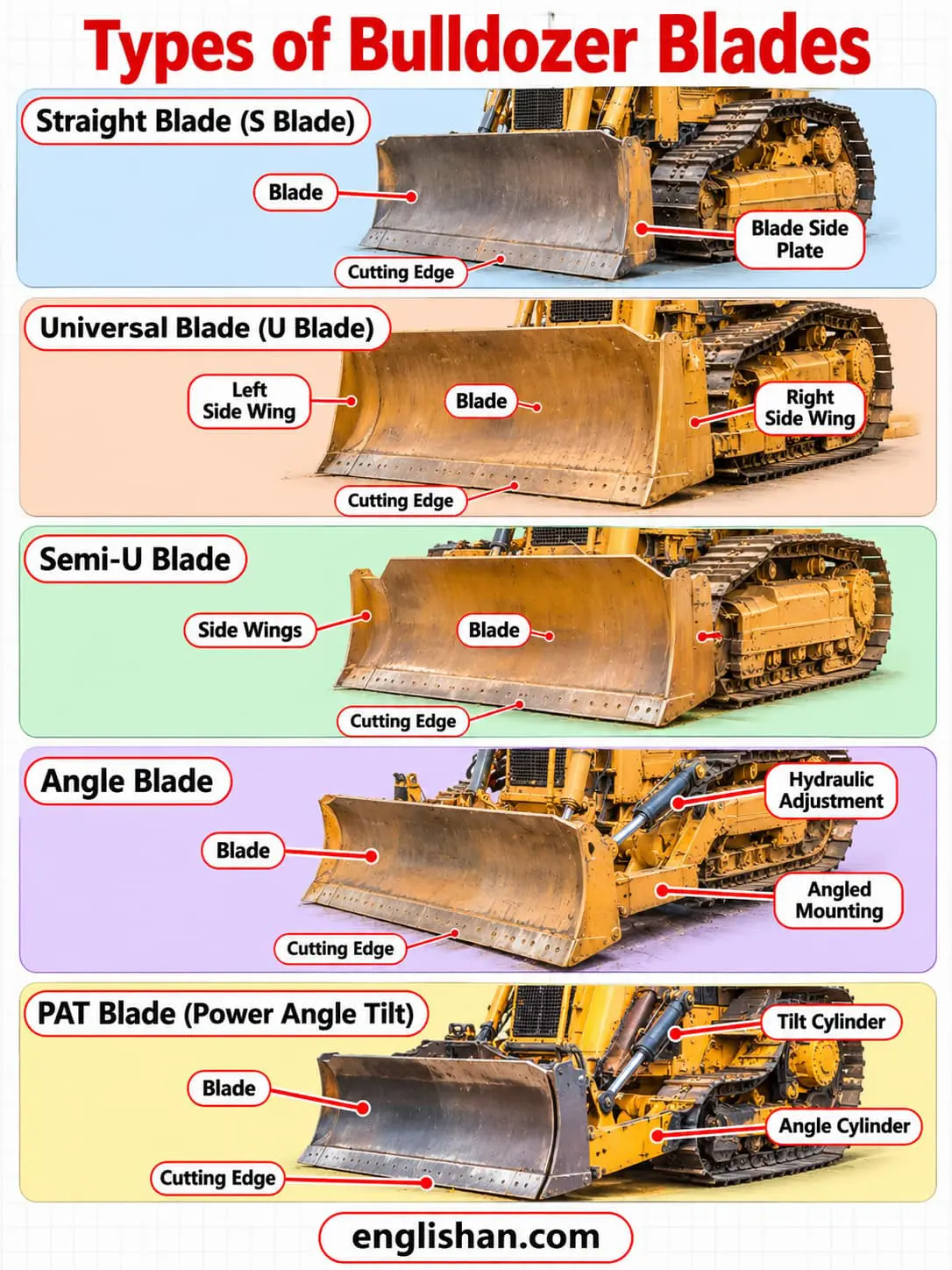
Among the parts of a bulldozer, the blade has the most variety, and its shape sets what it moves best. The cutting edge is a separate labeled part of the blade.
Blade
The blade is a heavy metal plate mounted at the front of the machine. Plant and Equipment states that it lifts material on hydraulic arms, and Wikipedia defines a bulldozer as a motorized unit fitted with a blade designed for pushing. A bull blade has a reinforced center section for pushing.
Cutting edge
The cutting edge is the edge of the blade that meets the ground. The Visual Dictionary labels it as a separate part of the blade.
Wikipedia names three blade shapes by curvature and side wings, and Mico Equipment adds two hydraulically adjusted shapes.
| Blade | Shape | Job |
|---|---|---|
| Straight (S blade) | Short, with no lateral curve or side wings | Fine grading and leveling |
| Universal (U blade) | Tall and very curved, with large side wings | Moving large volumes of loose soil, sand, and gravel |
| Semi-U (S-U or combination) | Shorter, with less curvature and smaller side wings | Pushing large rocks, as at a quarry |
| Angle | Set at an angle to the frame and adjusted left to right by hydraulics | Ditching, backfilling, sloping, and snow removal |
| PAT | Combines angle and tilt movement | Fine grading and slope shaping |
Push Frame and Lift Cylinders
Of the parts of a bulldozer, the push frame joins the blade to the rest of the machine. A patent for a bulldozer C-frame (US 4,167,979) shows the same assembly in detail, and the pivots and cylinders described here come from it. Two side arms form the C-frame, and the middle of the frame pivots on the lower rear of the blade.
Push Frame and Trunnions
Push frame
The push frame is the part that moves the blade, as Heavy Equipment College describes it. In the patent, the equivalent C-frame consists of two side arms, and the rear ends of the arms connect through trunnion sockets to a trunnion.
Track roller frame
The track roller frame is the part that holds the trunnion in the patent, and the Visual Dictionary labels it as a separate part. The pivot at the rear lets the front of the push frame, and the blade with it, move up and down.
Lift and Tilt Cylinders
Blade lift cylinder
The lift cylinder raises and lowers the front of the C-frame and the blade, according to the patent. Early bulldozers raised and lowered the blade with a cable winch and brake, and later machines used hydraulic cylinders or electric motors. Wikipedia states that hydraulic cylinders added down force, more precise blade control, and automated controls.
Thrust members and tilt struts
Thrust members attach to the lower rear corners of the blade, and a tilt strut on each member connects to the upper rear corners. The thrust members set the blade angle, and the tilt struts set the tilt. Wikipedia adds that some blades tilt to one side with additional hydraulic cylinders.
Parts of a Bulldozer Ripper
The ripper is one of the parts of a bulldozer mounted at the rear, and it breaks up hard ground behind the machine. The Visual Dictionary labels five ripper items: the ripper, the shank, the tip, the shank protector, and the cylinder.
Ripper
The ripper is the rear attachment that holds the shanks. Dozr states that its shanks penetrate tough, icy, or compacted ground, and Plant and Equipment describes it as an addition to the base machine.
Ripper shank
The shank is a long claw-like tooth, mounted singly or in multiples, that loosens hard and impacted materials. A single shank is preferred for heavy ripping.
Ripper tip
Each shank ends in a replaceable tungsten steel alloy tip called a boot. The Visual Dictionary labels it as the ripper tip tooth. A stumpbuster is a variant of the ripper with a single horizontal spike that splits tree stumps.
Shank protector
The Visual Dictionary labels the shank protector as a separate part of the ripper.
Ripper cylinder
Hydraulic cylinders raise and lower the ripper, according to Wikipedia, and the Visual Dictionary labels the ripper cylinder as its own part.
Parts of a Bulldozer Undercarriage
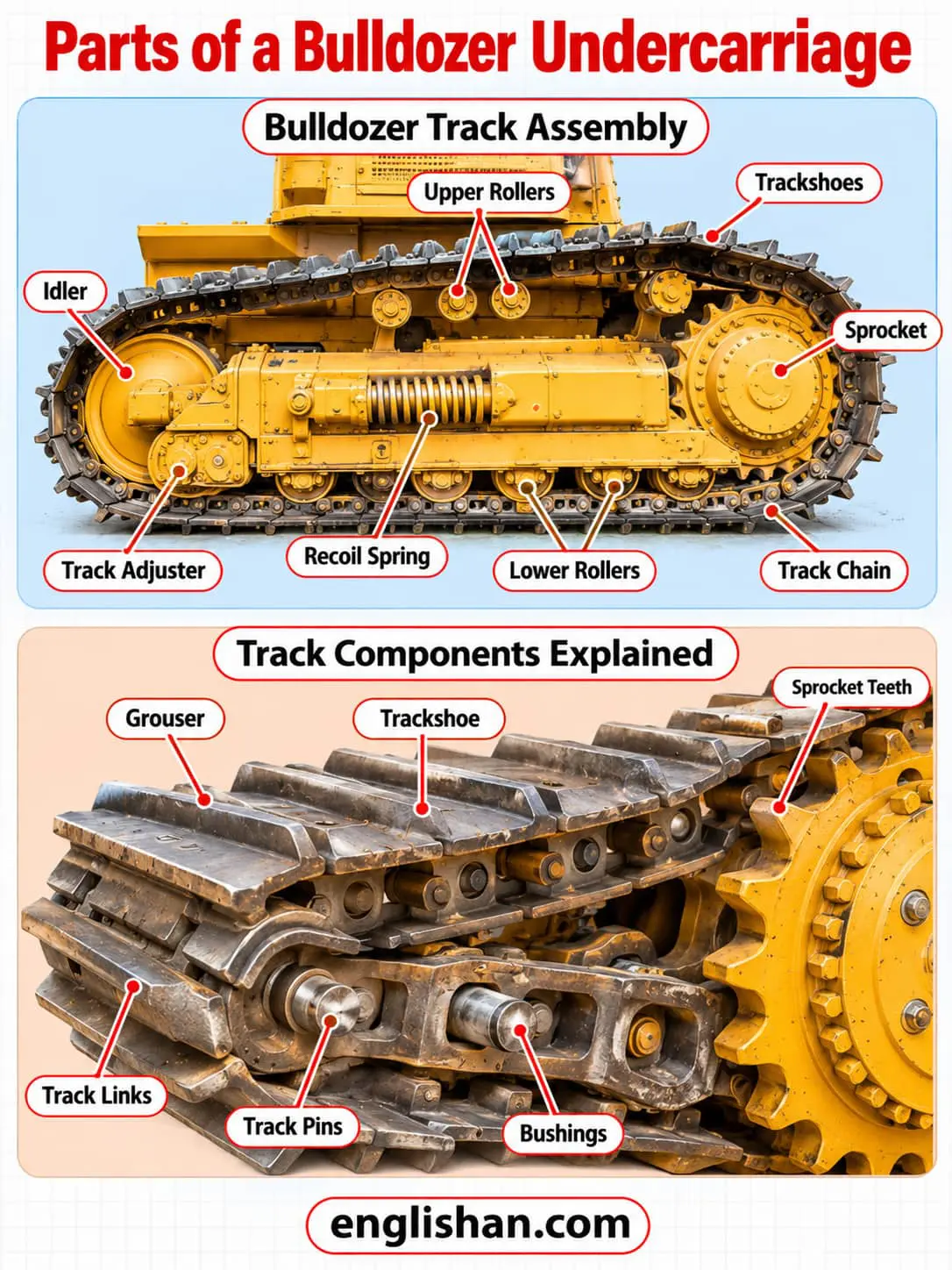
The parts of a bulldozer under the machine form the undercarriage, the track system. Wide tracks spread the weight of a bulldozer over more ground, which reduces ground pressure and limits soil compaction. Extra-wide tracks are called swamp tracks or low ground pressure (LGP) tracks.
Track Chain and Trackshoes
Track
The track is a loop of heavy metal links on each side of the machine. Plant and Equipment notes that the wide tracks give strong traction on rough ground, and Dozr describes the tracks as steel.
Track chain
The track chain is a closed loop of modular links joined by hinges. Wikipedia states that the links are made of manganese alloy steel in some designs, for strength, hardness, and abrasion resistance.
Pins and bushings
Pins and bushings connect the track links, according to HR Parts. The sprocket teeth engage them, and both parts have a finite life.
Trackshoes
Trackshoes are plates bolted to the chain on construction machines. Grousers on the shoes add traction in mud or snow.
Sprocket and Final Drive
Sprocket
The sprocket is a large cogwheel whose teeth engage the pins and bushings of the track and turn it. It has a finite life, according to HR Parts.
Final drive
The final drive transfers power from the drive motor to the tracks, and it turns the sprocket. Planetary gears inside it convert high-speed input into low-speed, high-torque output.
Idler Recoil Spring and Track Adjuster
Idler
The idler is a non-powered wheel at the opposite end of the track from the sprocket. Its main job is to tension the track, and vertical guide horns on the links engage grooves between the wheels.
Recoil spring
The recoil spring connects to the idler through a yoke. It protects the track from impact.
Track adjuster
The track adjuster works with the recoil spring to hold and adjust track tension.
Upper and Lower Rollers
Upper rollers
Upper rollers, also called carriers, keep the top run of the track from sagging.
Lower rollers
Lower rollers bear the weight of the machine and maintain ground clearance.
Steel Tracks and Rubber Tracks
Wikipedia compares the two track materials on hardness, noise, and ground damage.
| Feature | Steel track | Rubber track |
|---|---|---|
| Wear and repair | Hard-wearing and damage-resistant | Cannot be disassembled for repair and is discarded whole if damaged |
| Weight | Heavier | Lighter, with less power lost to friction |
| Noise | Louder | Quieter |
| Ground | Sharp edges damage turf, gravel roads, and farm fields | Does not damage paved roads |
| Use | Preferred for heavy construction and military vehicles | Smoother, quieter travel on paved surfaces |
Engine Compartment and Powertrain
The engine compartment, the engine, and the powertrain are the parts of a bulldozer that power the tracks.
Engine compartment
The Visual Dictionary labels the diesel engine compartment as one part of the crawler tractor diagram.
Engine
The engine is a diesel unit. Plant and Equipment explains that diesel torque handles rough terrain, and Dozr states that the engine converts fuel into the energy that drives the machine.
Powertrain
The powertrain transmits engine power to the tracks, according to Dozr. Its last stage is the final drive described under the undercarriage.
Air pre-cleaner filter and exhaust stack
The Visual Dictionary labels the air pre-cleaner filter and the exhaust pipe stack as two separate parts.
Parts of a Bulldozer Cab and Controls
The cab is where the operator works, and it holds the controls for the tracks, the blade, and the ripper.
Cab
The cab keeps the operator safe from debris and sound, according to Heavy Equipment College. Mico Equipment adds rollover protection, visibility features, and climate control. Early bulldozers had no cab, and the driver sat in the open.
ROPS
OSHA standard 1926.1001 sets minimum performance criteria for rollover protective structures (ROPS) on crawler tractors and crawler-type loaders, and on rubber-tired dozers. Armor was added to some machines to protect the driver from firearms and debris.
Operator controls
Levers, pedals, and joysticks let the operator steer the machine and move the blade and the ripper. Plant and Equipment states that the controls operate the left and right tracks. Remote-controlled bulldozers operate “from up to 1,000 feet away,” according to Wikipedia.
Parts of a Bulldozer Hydraulic and Cooling Systems
Hydraulic system
The hydraulic system is one of the parts of a bulldozer that powers the movement of the blade and the ripper and controls the force applied to the ground. Hydraulic cylinders do the lifting, tilting, and angling described under the push frame and the ripper.
Cooling system
The cooling system holds the temperature of the engine and the hydraulic fluid in range. Dozr lists radiators, fans, and coolant tanks as its parts, and they remove excess heat from both circuits.
Electrical and Fuel Systems
Electrical system
The electrical system includes the lighting and the battery. The lights give the operator visibility, and the battery supplies starting power.
Fuel system
The fuel system supplies the diesel engine with fuel. Dozr groups the electrical and fuel systems together as the systems that keep the bulldozer running.
Crawler and Wheeled Bulldozer Parts
Most bulldozers are crawlers, but Wikipedia also describes the wheeled bulldozer. Rubber-tired bulldozers came into use in the 1940s, and R. G. LeTourneau and Caterpillar built large ones.
| Feature | Crawler bulldozer | Wheeled bulldozer |
|---|---|---|
| Ground contact | Continuous tracks | Four large rubber-tired wheels |
| Drive | Sprockets turn the tracks | All-wheel drive |
| Steering | Controls drive the left and right tracks | Hydraulically operated articulated steering |
| Blade mount | Front of the machine on the push frame | Forward of the articulation joint |
Dozr gives bulldozer weights from about 18,000 pounds to 250,000 pounds.
Bulldozer Part Names
Sources name several parts differently, and the same part has more than one term.
| Part | Other names |
|---|---|
| Bulldozer | Dozer, crawler, track-type tractor, crawler tractor |
| Push frame | C-frame (patent wording) |
| Ripper tip | Boot (Wikipedia), tip tooth (Visual Dictionary) |
| Upper rollers | Carriers |
| Idler | Track idler, idler wheel |
| Engine compartment | Diesel motor compartment (Visual Dictionary) |
| Trackshoes | Track shoes, with grousers for traction |
FAQs
The parts of a bulldozer are the blade, the push frame, the lift cylinders, the track with its rollers, idler, and sprocket, the final drive, the cab, the engine compartment, and the ripper. The Visual Dictionary labels 19 items on one crawler tractor diagram. The numbered diagram near the top has 14 of them.
The main parts of a bulldozer are the blade, the undercarriage with its tracks, the engine and powertrain, and the cab. Dozr adds the ripper, the hydraulic system, and the cooling, electrical, and fuel systems to that group.
The front of a bulldozer is called the blade. It is a heavy metal plate mounted at the front, and a push frame with lift cylinders moves it. The cutting edge is the labeled edge of that blade.
The tracks on a bulldozer are called the track chain, and the plates bolted to the chain are called trackshoes. Grousers on the shoes add traction in mud or snow. Pins and bushings join the links.
Yes, wheeled bulldozers exist. Wikipedia describes an all-wheel-drive wheeled bulldozer with four large rubber tires and hydraulically operated articulated steering. Rubber-tired bulldozers came into use in the 1940s.
No, a bulldozer has a blade instead of a bucket. Wikipedia defines the word bulldozer as a motorized unit fitted with a blade designed for pushing, and it notes that the word is misused for front-end loaders.
The name began with the blade. Wikipedia reports that the attachment was first called a bull grader blade around 1929, that bulldozer blade became common in the mid-1930s, and that by the 1940s bulldozer meant the whole machine.
Dozr describes bulldozer tracks as steel. Plant and Equipment describes the blade as a heavy metal plate, and Wikipedia describes the ripper tip as a replaceable tungsten steel alloy boot. Wikipedia also notes that track links are made of manganese alloy steel in some designs.
Related:
