

The parts of a hockey stick are the shaft, the blade, and the grip. The heel, the toe, the curve, and the lie are set on the blade. Ice and field sticks share a shaft-and-blade layout but name the playing end differently.
An ice hockey stick runs from the butt end to the toe of the blade. Field, goalie, and floor hockey sticks change the blade, the shaft, or both. The baseball bat and the golf club are two other striking tools.
Parts of a Hockey Stick Labeled Diagram
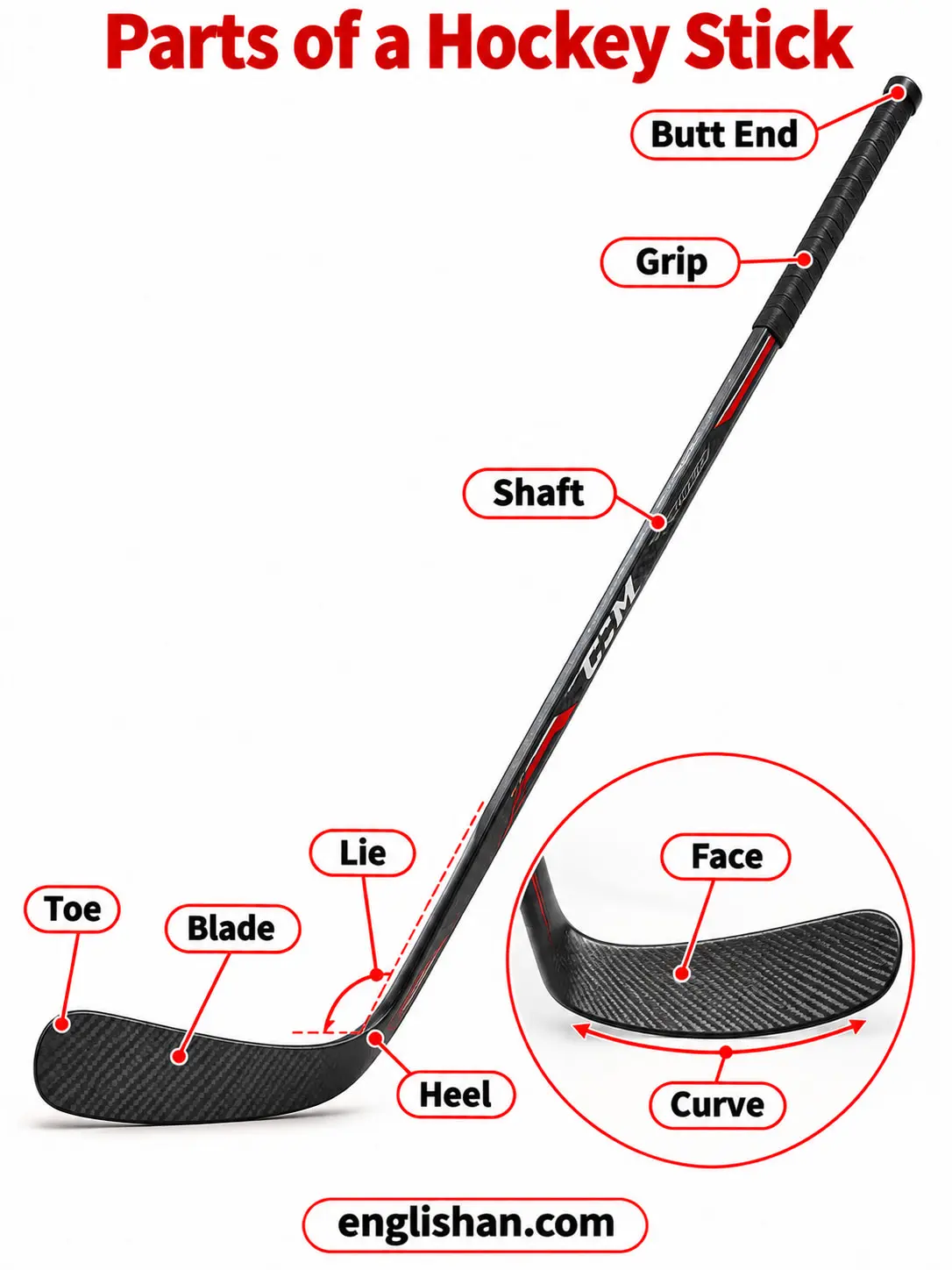
In a labeled diagram of an ice hockey stick, the butt end is at the top, and the shaft extends down to the heel. The blade ends at the toe, and the curve and the lie are measured on the blade.
To draw and label the parts of a hockey stick by hand, draw the shaft first. Mark the butt end and the grip at the top. Then draw the blade at the bottom and mark the heel, the toe, and the face.
| Part | Where you find it |
|---|---|
| 1. Butt end | Top end of the shaft |
| 2. Grip | Textured or taped upper shaft where the hands close |
| 3. Shaft | Long, slender body between the grip and the blade |
| 4. Heel | Base of the blade, where it meets the shaft |
| 5. Blade | Flat, wide lower part that contacts the puck |
| 6. Toe | Front end of the blade |
| 7. Face | Playing side of the blade |
| 8. Curve | Bend of the blade from heel to toe |
| 9. Lie | Angle between the shaft and the blade |
How Many Parts a Hockey Stick Has
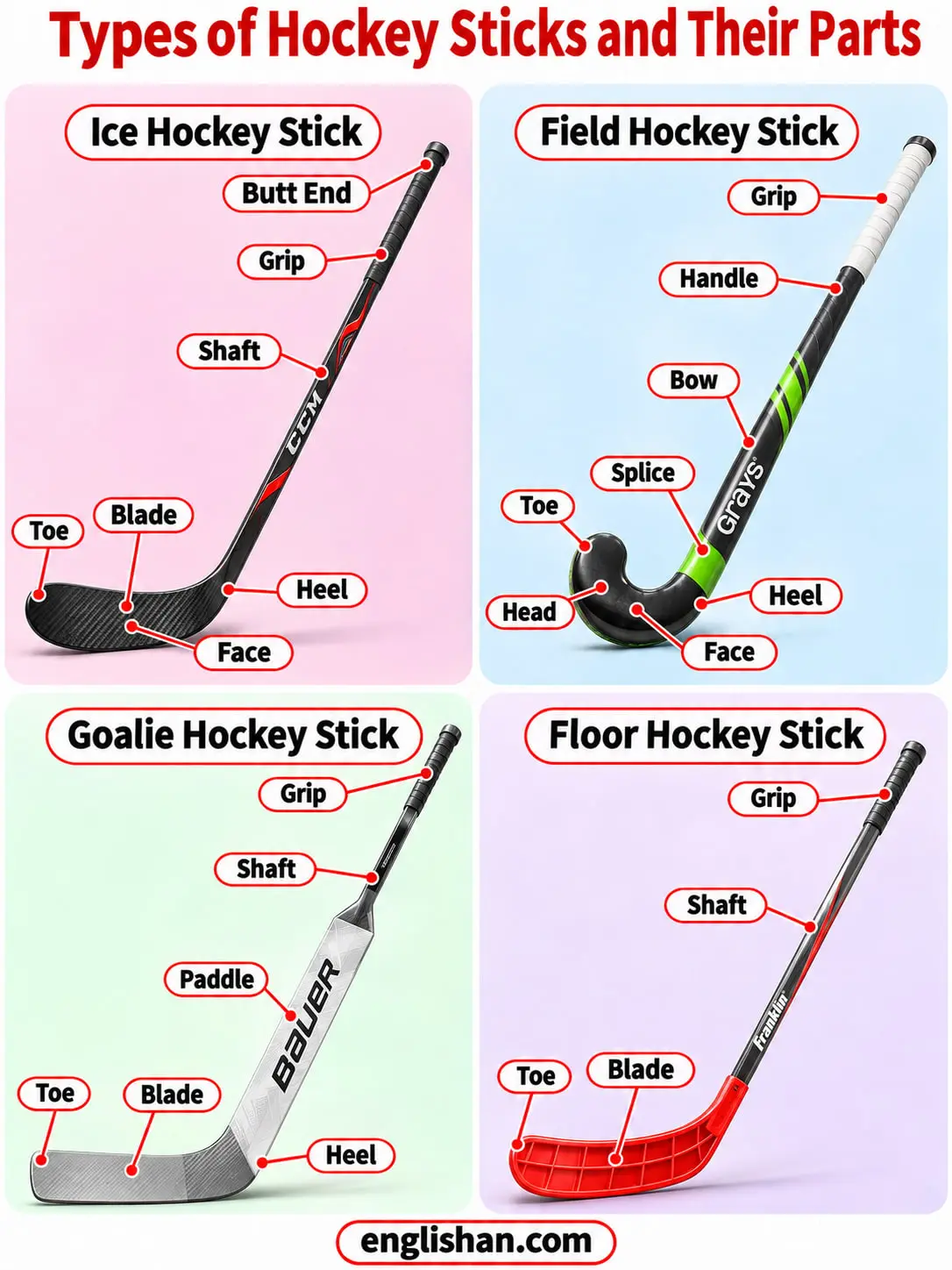
The count depends on how the stick is grouped. A two-part count names the shaft and the blade, which join at the heel. A three-part count adds the grip, the textured upper shaft. The tennis racket is another sports tool with a handle and a striking head, though its head is strung in place of a flat blade.
Counts of four or five add the heel, the toe, and the curve, which are the three features of the blade. Every count describes the same stick. A field hockey stick has its own three groups: the head, the splice, and the handle.
Hockey Stick Shaft Parts
Among the parts of a hockey stick, the shaft is the long, slender body. It is rigid with a slight give. Wood was the traditional shaft material, and aluminum and carbon fiber composite replaced it.
Butt End and Grip
The butt end is the top end of the shaft, and the upper hand closes over it. The grip is the textured upper shaft. Players wrap tape on the grip to set the hold they want. Traditional shafts have four sides, and some current shafts have six asymmetrical sides.
Shaft Flex
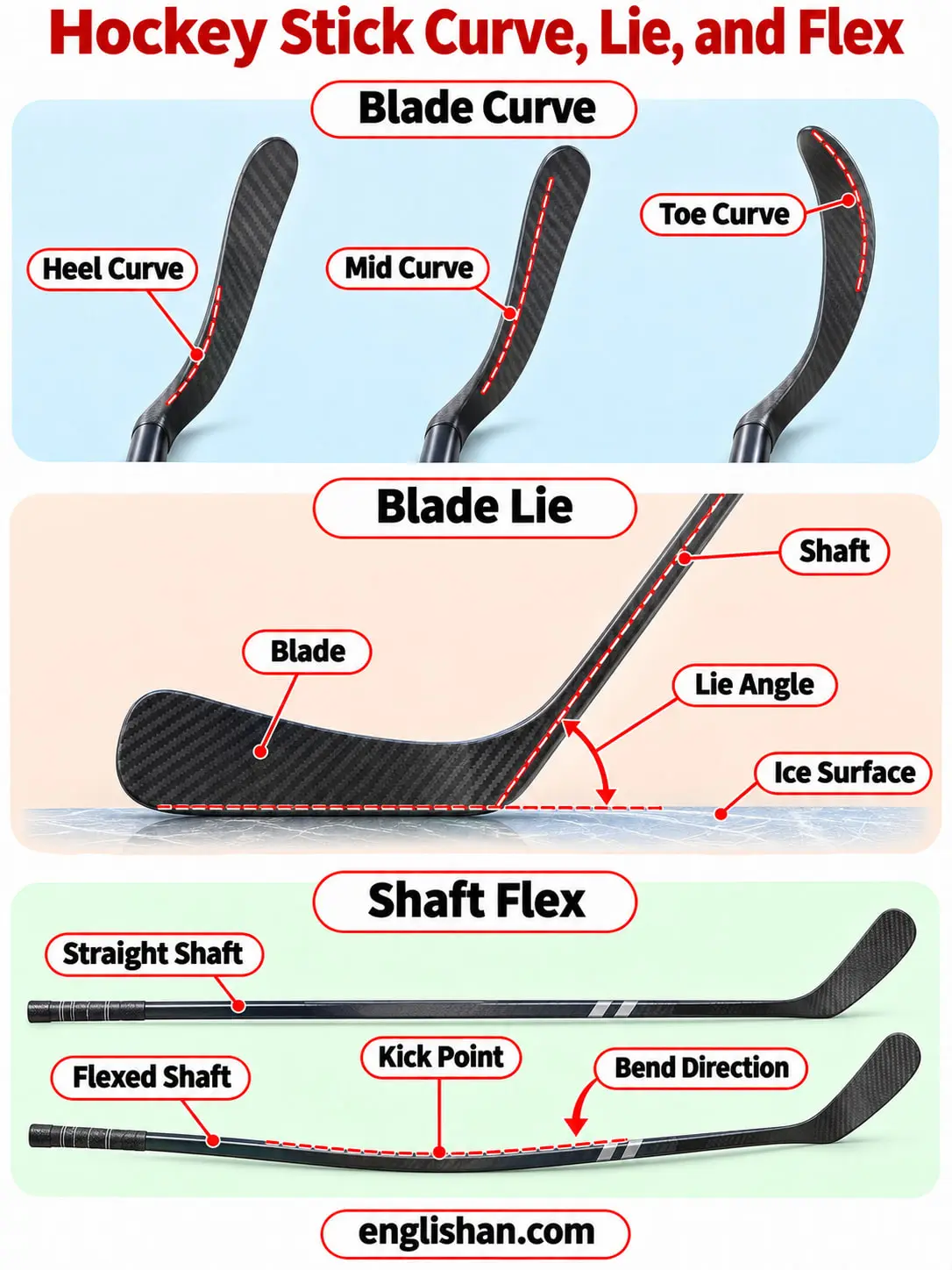
Flex is the force in pounds needed to bend the shaft one inch. Ratings span 40 to 160, and a lower number is softer. A starting point is half the player’s body weight in pounds. Cutting the shaft shorter raises the flex rating.
Kick Point
The kick point is the spot where the shaft bends most under load. A low kick point bends near the blade, and a mid kick point bends near the center. A hybrid kick point blends the two.
Parts of a Hockey Stick Blade
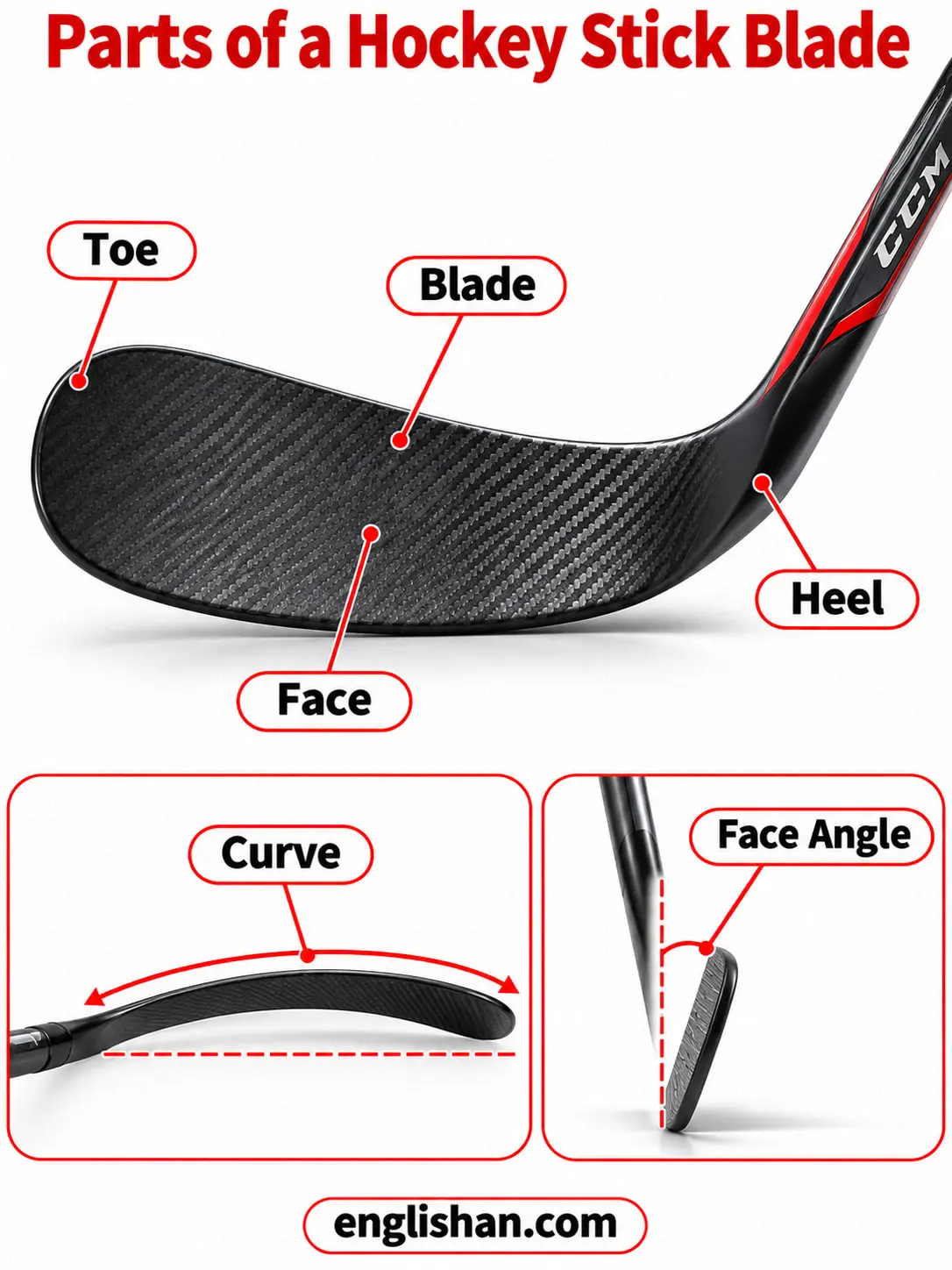
The blade is the flat, wide lower part of the stick. Among the parts of a hockey stick, it is the only one that touches the puck. It measures 25 to 40 centimeters, and the NHL maximum is 12.5 inches from heel to end.
The blade has three features: the heel, the toe, and the curve. On a wood stick the blade has a tongue that fits into a groove in the shaft. A joint block reinforces that joint.
Heel and Toe
The heel is the base of the blade, where it meets the shaft. The toe is the front end of the blade, and its shape is round or square. A square toe pulls a puck off the boards and helps with toe drags. A round toe makes it easier to flip the puck.
Blade Curve
The curve is the bend of the blade from heel to toe. Most curves measure 3/8 to 3/4 inch, and a moderate curve is close to 1/2 inch. The NHL limit is 3/4 inch, set in the 2007 rules.
A toe curve puts the bend near the toe, and forwards use it to lift the puck and shoot wrist shots. A mid curve puts the bend in the center and suits stickhandling, passing, and backhand shots. A heel curve puts the bend near the heel, and defensemen use it for slap shots.
Makers give each curve a code such as P92 or P28. The direction of the curve follows the side of the body where the player holds the stick.
Blade Face
The face is the playing side of the blade, and the face angle is the tilt of that side against the ice. A closed face keeps shots low and powerful. A slightly open face adds lift and keeps the power. An open face gets the puck airborne quickly in tight spaces.
Blade Lie
The lie is the angle between the shaft and the blade. A lie of 5 equals 135 degrees, and each step up lowers the angle by 2 degrees. Printed lies span 4 to 8, and senior sticks are near 5 or 6. The right lie keeps the bottom of the blade flat on the ice in the player’s normal stance.
Parts of a Field Hockey Stick
The parts of a field hockey stick are the head, toe, heel, splice, handle, grip, face, back, and bow. They differ from the other parts of a hockey stick in name more than in layout. The head is the curved, hook-shaped striking end that replaces the blade of the ice stick.
Head: The head is the curved striking end of the stick.
Toe: The toe is the upturned end of the head.
Heel: The heel is the bend where the head joins the shaft.
Splice: The splice is the thickest middle portion between the handle and the head.
Handle: The handle is the long, straight portion over the head, rounded at the back and flat on the face side.
Grip: The grip is non-slip tape wrapped on the upper handle.
Face: The face is the flat playing side of the stick.
Back: The back is the rounded reverse side of the handle.
Bow: The bow is the face-side curve of the handle, with a maximum depth of 25 millimeters.
Field Hockey Stick Shapes
A short head is about 110 to 115 millimeters long, and a midi head is about 113 millimeters. A hook head is about 124 millimeters, and a J-shaped head curves like the letter. A set-back head moves the bend away from the toe.
Field Hockey Stick Size and Weight
A typical adult stick is 89 to 95 centimeters long, and the maximum length is 105 centimeters. The weight limit is 737 grams. A legal stick passes through a ring 51 millimeters wide.
Goalie Stick Parts
The parts of a goalie stick are the blade, the shaft, and the paddle, a change from the other parts of a hockey stick. The blade is larger than a skater’s blade and is curved to help play the puck. The paddle is the widened, flat lower portion of the shaft.
A goalie stick is shorter than a skater stick, and its lie spans 11 to 15. The shaft is slightly curved to help pick the stick up off the ice after a drop.
Parts of a Floor Hockey Stick
The parts of a hockey stick for floor play are the shaft and the playing end. The playing end changes with the game.
Shaft: The shaft is rectangular or round, like a broomstick.
Blade: The blade angles sharply from the shaft and lies flat on the floor in puck games.
Hook: The hook ends the stick in ball games.
Drag-tip: The drag-tip is a plain end on straight sticks used in some codes.
Hockey Stick Parts and Their Materials
The materials of the parts of a hockey stick differ between the shaft and the blade, and between ice and field sticks.
Wood: Wood is laminated plywood coated in plastic or fiberglass, low in cost but prone to warping.
Fiberglass: Fiberglass was the first composite, and it is now combined with wood, carbon fiber, or Kevlar.
Carbon fiber composite: Carbon fiber is the most common NHL material, light and predictable but more prone to breaking.
Aluminum: Aluminum is durable and consistent but less elastic, and it pairs with a replaceable blade of wood or composite.
Field hockey wood: Early field sticks were hickory, ash, or mulberry, and metal handles are banned.
A one-piece composite stick forms the shaft and the blade as a single unit, and it is the most common design.
FAQs
FAQs
The three parts of a hockey stick are the shaft, the blade, and the grip. The shaft is the long body, the blade is the flat playing end, and the grip is the textured upper shaft.
The lie is the angle between the shaft and the blade. A lie of 5 equals 135 degrees, and each step up lowers the angle by 2 degrees.
The bottom part is the blade on an ice hockey stick and the head on a field hockey stick. The flat playing side of the blade is the face.
The top part of an ice hockey stick is the butt end, with the grip just under it. On a field hockey stick the top part is the handle, wrapped in grip tape.
The parts of a field hockey stick are the head, toe, heel, splice, handle, and grip. The flat face of the head is the playing side used to dribble and hit, and the back is rounded.
No, the flat face is the playing side of a field hockey stick, and the rounded back is not used to play the ball. Current rules also allow the edges of the stick to strike the ball.
Related: