

The parts of a skateboard are a maple deck with grip tape on top, two trucks, and four wheels. Eight bearings and the hardware that joins them complete the board. Each truck is built from a baseplate, a kingpin, a hanger, an axle, and two bushings.
A street skateboard runs from the grip tape on the deck to the wheels underneath. Longboards and electric skateboards change the deck, the trucks, or the drive. The scooty is a different machine with its own parts.
Parts of a Skateboard Labeled Diagram
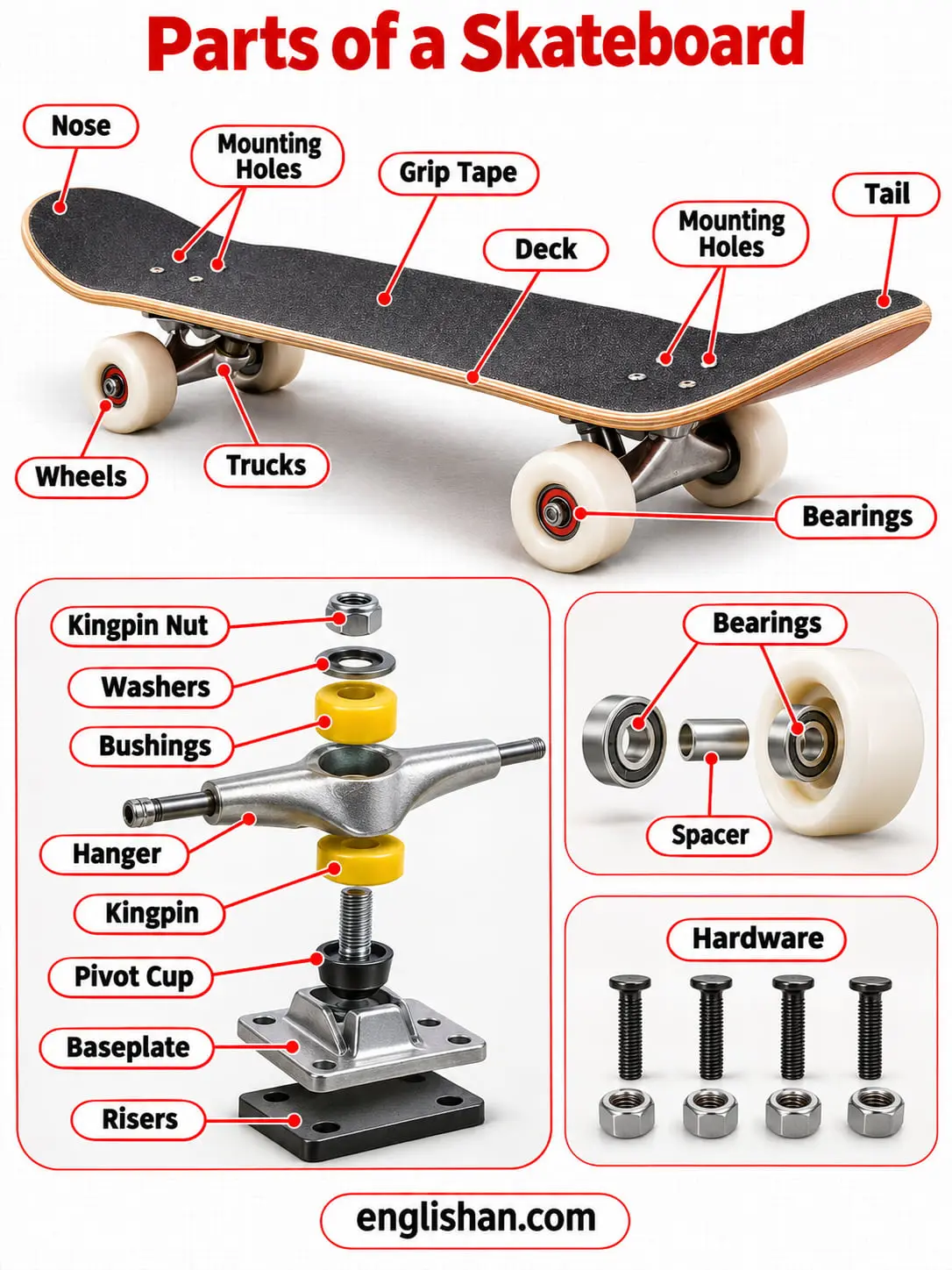
In a labeled diagram of a skateboard, the grip tape is the top surface and the deck is the board beneath it. The trucks are bolted to the underside of the deck. A wheel is fitted on each end of both axles. The bicycle also turns on axles, and its wheel parts are listed on a separate page.
| Part | Where you find it |
|---|---|
| 1. Grip tape | Sandpaper-like sheet on the top surface of the deck |
| 2. Deck | Laminated maple board that forms the platform |
| 3. Nose | Front end of the deck, curved upward |
| 4. Tail | Rear end of the deck, curved upward |
| 5. Mounting holes | Eight holes through the deck, four near each end |
| 6. Hardware | Eight bolts and eight nuts that fasten the trucks to the deck |
| 7. Risers | Plastic pads between the deck and the baseplate |
| 8. Baseplate | Flat metal plate that mounts to the underside of the deck |
| 9. Kingpin | Large threaded bolt that projects from the baseplate |
| 10. Kingpin nut | Nut on the kingpin that adjusts the tightness of the truck |
| 11. Pivot cup | Plastic cup in the baseplate where the hanger pivots |
| 12. Bushings | Two urethane cushions on the kingpin of each truck |
| 13. Hanger | T-shaped metal piece that pivots in the baseplate |
| 14. Axle | Steel rod through the hanger that the wheels turn on |
| 15. Axle nuts | Nuts that secure the wheels on the axle ends |
| 16. Wheels | Four urethane wheels, one on each end of the axles |
| 17. Bearings | Eight steel bearings, two pressed into each wheel |
How Many Parts a Skateboard Has
The parts of a skateboard have no single count, because sources group them differently. Three groups are the most common: the deck, the trucks, and the wheels. Retailers add the grip tape, the bearings, and the hardware, which makes six groups. The car wheel also turns on an axle, and its parts are listed on a separate page.
A complete board needs one deck, two trucks, four wheels, eight bearings, and eight bolts. Every part of a skateboard belongs to one of those groups.
Skateboard Deck Parts
Among the parts of a skateboard, the deck is the wooden platform where the rider places both feet. The trucks mount to its underside, and the grip tape covers its top. A popsicle deck is 7.5 to 9 inches wide.
Nose and Tail
The nose is the front kicktail, and the tail is the rear kicktail. Both ends curve upward. The nose is slightly broader than the tail, and that difference tells the two apart. An old-school board has a single kicktail.
Mounting Holes and Wheelbase
The mounting holes are the eight holes drilled through the deck, four near each kicktail. The wheelbase is the distance between the two inner sets of holes. Wheel bite occurs when a wheel contacts the deck in a hard turn and stops the board abruptly. Risers prevent it.
Plies and Concave
A ply is one layer of wood in the deck, and the laminates are the glues that bond the plies. A deck has seven to nine plies of hard maple veneer. The concave is the dished shape pressed across the deck. It gives the feet control during tricks.
Deck Rails
Deck rails are thin plastic strips screwed to the underside of the deck along its edges. They reduce friction during slides and protect the graphic.
Grip Tape
The grip tape is a self-adhesive sheet with a sandpaper-like surface. It covers the top of the deck and gives the feet traction.
Parts of a Skateboard Truck
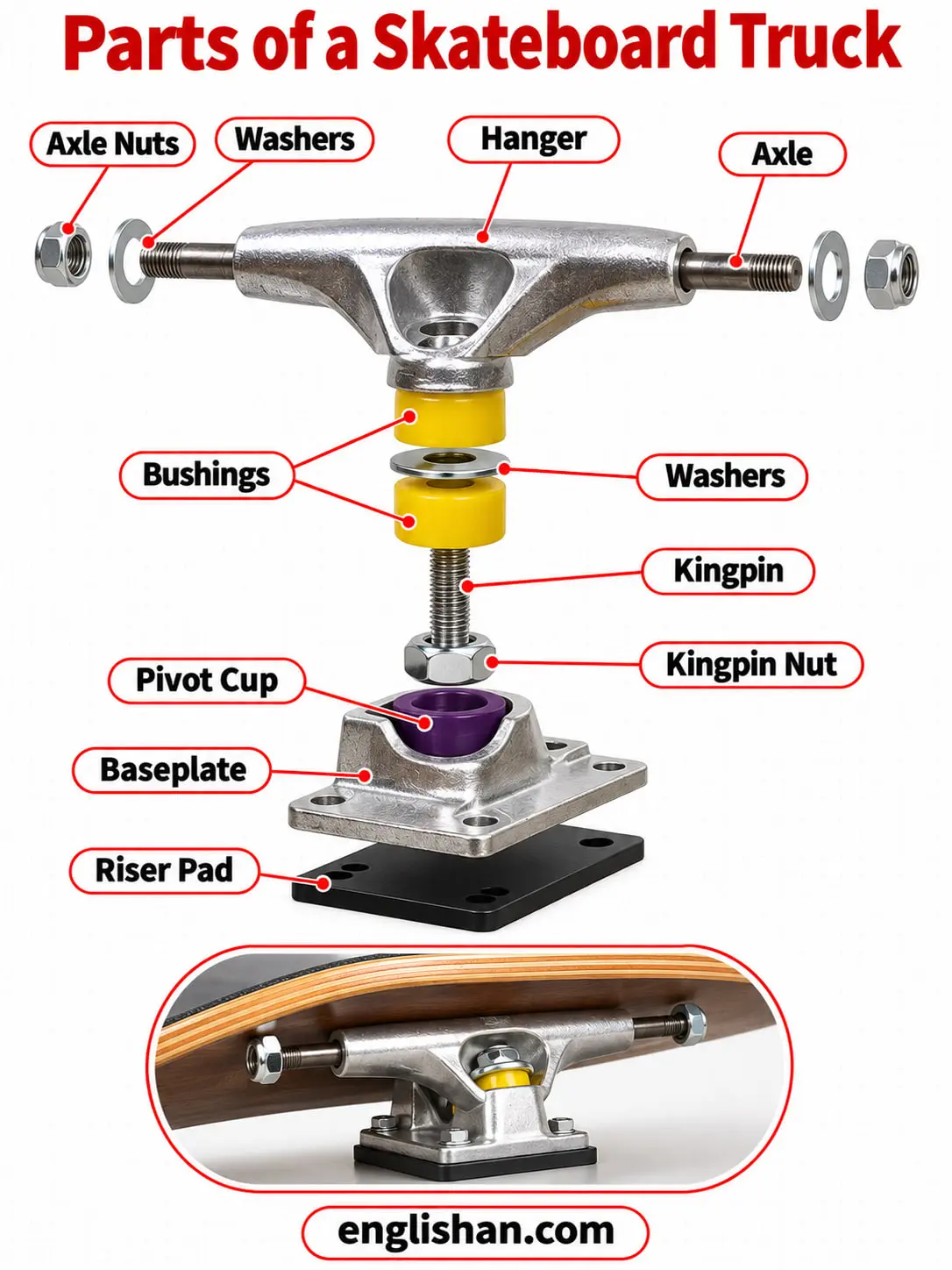
A truck is the metal assembly that joins the deck to the wheels, and it is the heaviest metal part. A board has a front truck and a rear truck. Each truck pivots on the kingpin, and that pivot lets the board turn.
Baseplate
The baseplate is the flat metal plate that mounts to the deck through four or six holes. It contains the kingpin and the pivot cup.
Kingpin and Kingpin Nut
The kingpin is a large threaded bolt that projects from the baseplate. The hanger and the bushings are threaded onto it. The kingpin nut adjusts the tightness of the bushings and the hanger.
Hanger and Pivot Cup
The hanger is the T-shaped metal piece that houses the axle. Its pivot end seats in the pivot cup, the plastic cup in the baseplate. This joint lets the hanger turn.
Axle and Axle Nuts
The axle is the metal rod that passes through the hanger and extends on both sides. An axle nut on each end secures the wheel. A board uses four axle nuts.
Bushings and Washers
The bushings are urethane cushions on the kingpin, one on each side of the hanger. They control how readily the truck turns. The washers are small metal discs between the axle nut and the wheel bearing, and they let the wheel spin freely.
Wedges
A wedge is an angled pad between the baseplate and the deck. It changes the turning behavior of the truck.
Parts of a Skateboard Wheel
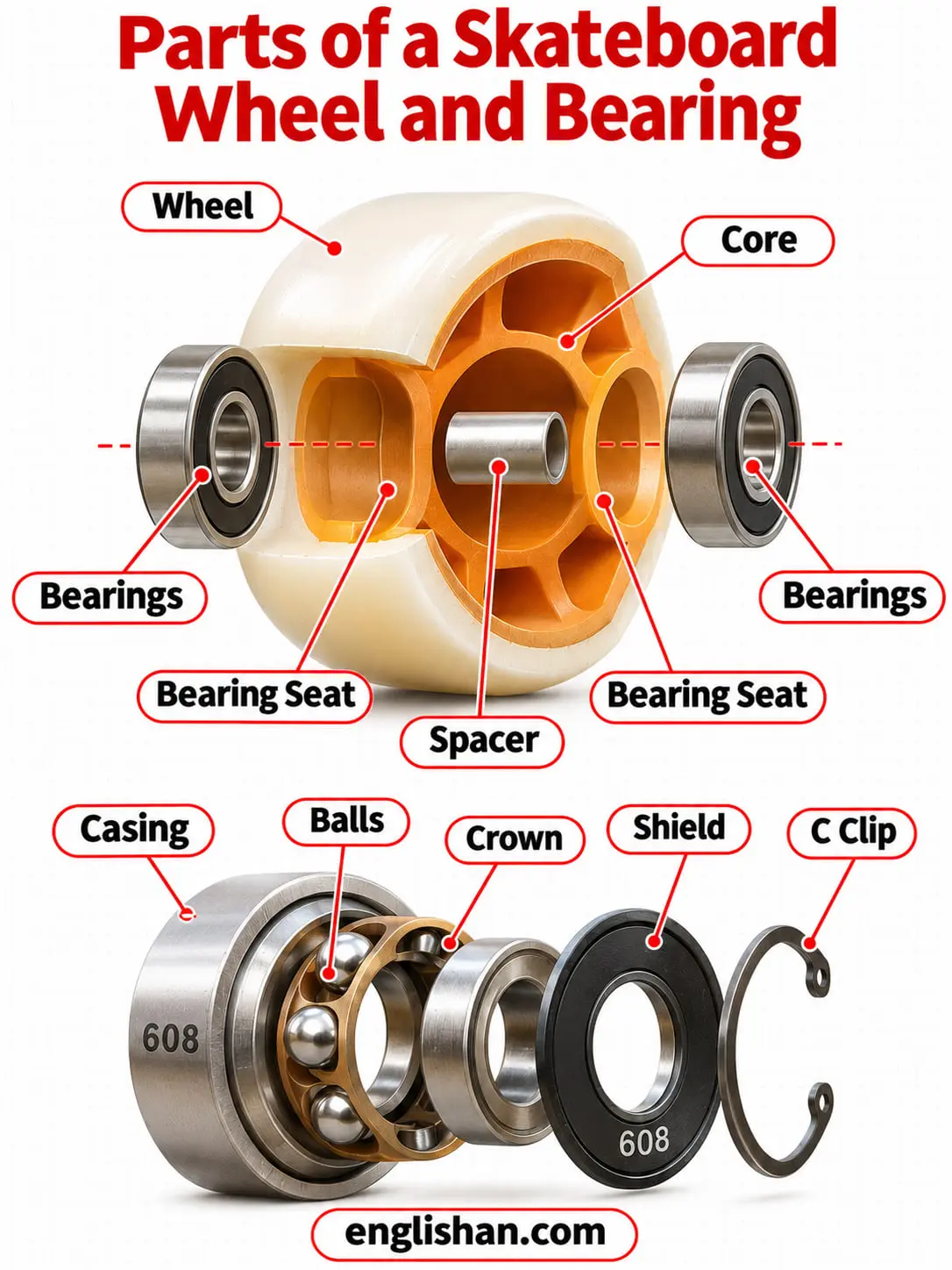
Among the parts of a skateboard, the wheel is a cast urethane wheel with a core at its center. The core contains the bearing seat, which keeps the two bearings centered and in place.
Wheel Diameter
Diameter is measured in millimeters. Small, hard wheels of 52 to 58 mm suit tricks. Large, soft wheels of 67 to 80 mm suit speed and distance.
Durometer
The durometer is the hardness rating of the urethane. Ratings run from 78A for soft wheels to 100A or higher for hard wheels.
Skateboard Bearing Parts
Among the parts of a skateboard, the bearing is the unit that lets a wheel roll on its axle. A complete board has eight bearings, with two in each wheel.
Casing: The casing is the metal body that houses the other bearing parts.
Balls: The balls are held in a crown inside the casing. Most bearings have seven balls, and some have six or eight.
Crown: The crown is the retainer that separates the balls. It is made of Delrin in many bearings.
Shield: The shield is the side cover that keeps dirt out and the balls in. A thin wire C clip secures it.
Spacer: The spacer is a small tube between the two bearings in a wheel. It keeps them aligned.
Lubricant: The lubricant is the oil that reduces friction inside the bearing.
The standard size is 608, with a 22 mm outer diameter and a 7 mm width. The ABEC rating runs from 1 to 9, and a higher number means tighter manufacturing tolerances.
Skateboard Hardware and Riser Parts
The hardware is the set of eight bolts and eight nuts. It fastens the two trucks to the deck and completes the parts of a skateboard. Risers are plastic or rubber pads between the baseplate and the deck. They absorb shock and add clearance for larger wheels.
Parts of a Longboard Skateboard
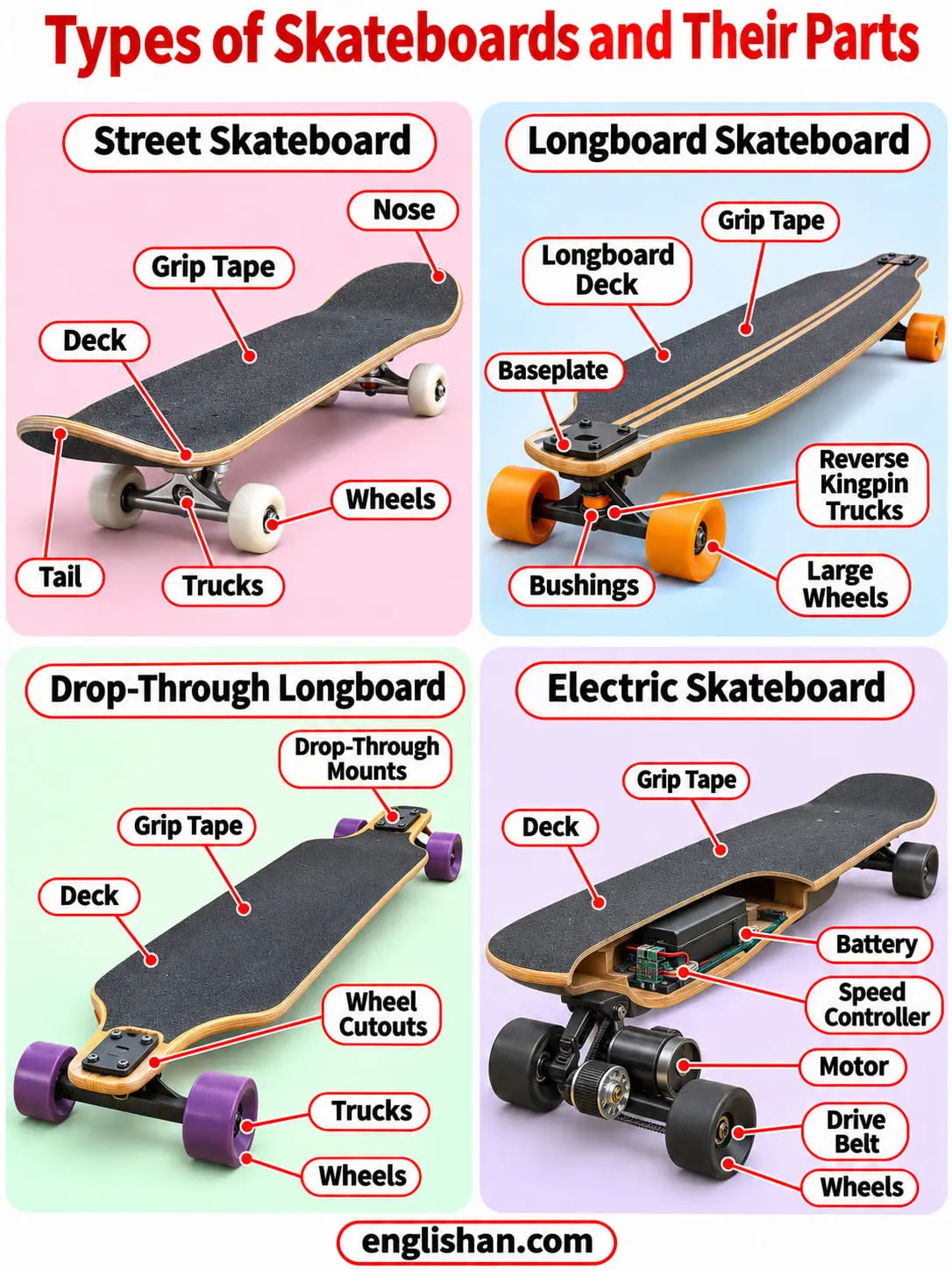
The parts of a longboard skateboard match those of a street board, on a longer and wider deck. A longboard measures 33 to 59 inches long and 9 to 10 inches wide.
Longboard Deck
The deck is plywood of 2 to 11 layers, each about 2 mm thick. Fiberglass, aluminum, and carbon fiber are alternative materials. The mount type changes the shape of the deck.
Top mount: The deck is mounted on top of the trucks, as on a street board. It gives the best grip and the easiest turning.
Drop-through: Cutouts let the baseplates pass through the deck. This lowers the center of gravity of the board.
Drop deck: The foot platform is lower than the truck height, which adds stability.
Longboard Trucks
A reverse kingpin truck has the kingpin on the outer side of the axle. A conventional truck has a vertical kingpin on the inner side. A baseplate angle of 44 degrees turns less and is more stable than an angle of 50 degrees.
Longboard Wheels
Longboard wheels are 65 to 107 mm in diameter and 60 to 70 mm wide in the most common sizes. A rider chooses harder wheels of 95A to 101A for sliding.
Parts of an Electric Skateboard
The parts of an electric skateboard add a motor, a battery, a speed controller, and a remote to the deck, trucks, and wheels.
Motor
A hub motor is inside the wheel. A belt-drive motor connects to the wheel through pulleys and a belt, and a gear-drive motor connects through toothed gears. Dual motors are the most popular setup.
Battery and Speed Controller
The battery stores the energy for the motors, and mini boards use a detachable pack. The electronic speed controller varies the motor speed for acceleration and braking.
Remote Controller
The remote is a wireless, hand-held throttle that sets the speed.
Skateboard Parts and Their Materials
The materials of the parts of a skateboard are maple, urethane, steel, and aluminum alloy.
Maple: The deck is hard maple veneer, glued in plies under pressure.
Urethane: The wheels and the bushings are urethane.
Metal: The hanger, the baseplate, and the axle are metal, and bearings are steel. Ceramic bearings use silicon nitride.
Abrasive sheet: The grip tape is a sandpaper-like sheet with an adhesive backing.
FAQs
The parts of a skateboard are the deck, the grip tape, the trucks, the wheels, the bearings, and the hardware. The trucks contain a baseplate, a kingpin, a hanger, an axle, and bushings.
The metal parts of a skateboard are the trucks. Each truck contains a baseplate, a kingpin, a hanger, and an axle.
The front part of a skateboard is called the nose. It is the upward curve at one end of the deck, and it is slightly broader than the tail.
The tail is the rear kicktail of the deck, the upward curve at the end opposite the nose. It is slightly smaller than the nose.
The deck is the wooden board that forms the platform of the skateboard. It is made of seven to nine plies of hard maple, and the grip tape covers its top surface.
A skateboard needs a deck, two trucks, four wheels, eight bearings, and the hardware that fastens the trucks to the deck. The grip tape is added to the deck for traction.
Related:
- Parts of a Shoe
- Parts of a Hockey Stick
- Parts of a Tennis Racket
- Parts of a Baseball Bat
- Parts of a Golf Club
