

A gearbox is a set of gears on shafts, supported by bearings and enclosed in a housing, and it changes the speed and torque that an engine or motor delivers. The parts of a gearbox are easiest to follow along the path of power. The input shaft takes it from the clutch, the countershaft transfers it, and the output shaft delivers it. The synchronizers, shift forks, housing, bearings, and oil support that path.
The labels here follow the manual car gearbox. Automatic and industrial gearboxes use the same shafts, gears, bearings, and housing, and each gets its own parts further down the page. Airsoft gun gearboxes and transmission towers share the word but not the parts, so they are left out.
Parts of a Gearbox Labeled Diagram
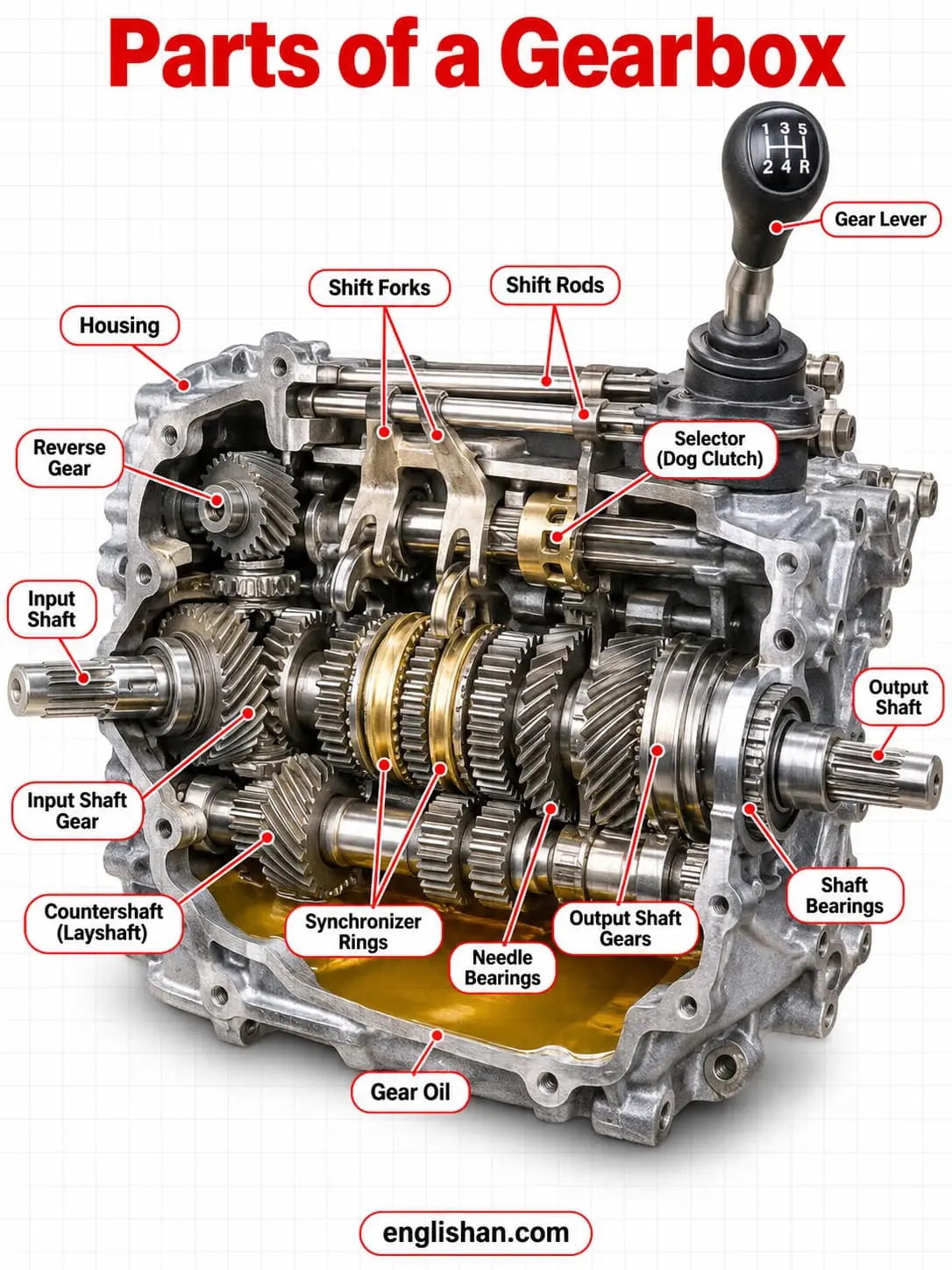
A manual car gearbox has fifteen parts, numbered here from the input shaft to the lubricant. The clutch connects the engine to the input shaft and is counted as a separate unit.
| No. | Part | Where it is fitted | What it does |
|---|---|---|---|
| 1 | Input shaft | Front of the gearbox, fed by the clutch | Spins at engine speed when the clutch is engaged and drives the countershaft |
| 2 | Input shaft gear | On the input shaft | Stays in constant mesh with a countershaft gear |
| 3 | Countershaft (layshaft) | Alongside the output shaft | Holds fixed gears that mesh with the output shaft gears |
| 4 | Output shaft | In line with the input shaft | Turns at road speed and drives the propshaft |
| 5 | Output shaft gears | On the output shaft | Spin freely on needle bearings until a selector locks one |
| 6 | Needle bearings | Between each output shaft gear and the shaft | Let each gear turn independently of the shaft |
| 7 | Synchronizer rings | Beside each gear | Match the speed of the selector and the gear before they engage |
| 8 | Selector (dog clutch) | On the splines of the output shaft | Slides along the shaft and locks a chosen gear to it |
| 9 | Shift forks | In a groove around each selector | Push or pull the selector along the shaft |
| 10 | Shift rods | Through the case | Move the forks when the driver moves the lever |
| 11 | Gear lever | At the shifter | Moves the shift rods |
| 12 | Reverse gear | Beside the other output shaft gears | Reverses rotation and is not in constant mesh |
| 13 | Shaft bearings | Along the shafts | Support the shafts and absorb axial loads |
| 14 | Housing | Around all the other parts | Encloses the gear train and holds the oil |
| 15 | Gear oil | Inside the housing | Lubricates the gears and bearings |
Gearbox Parts in Power Transfer Order
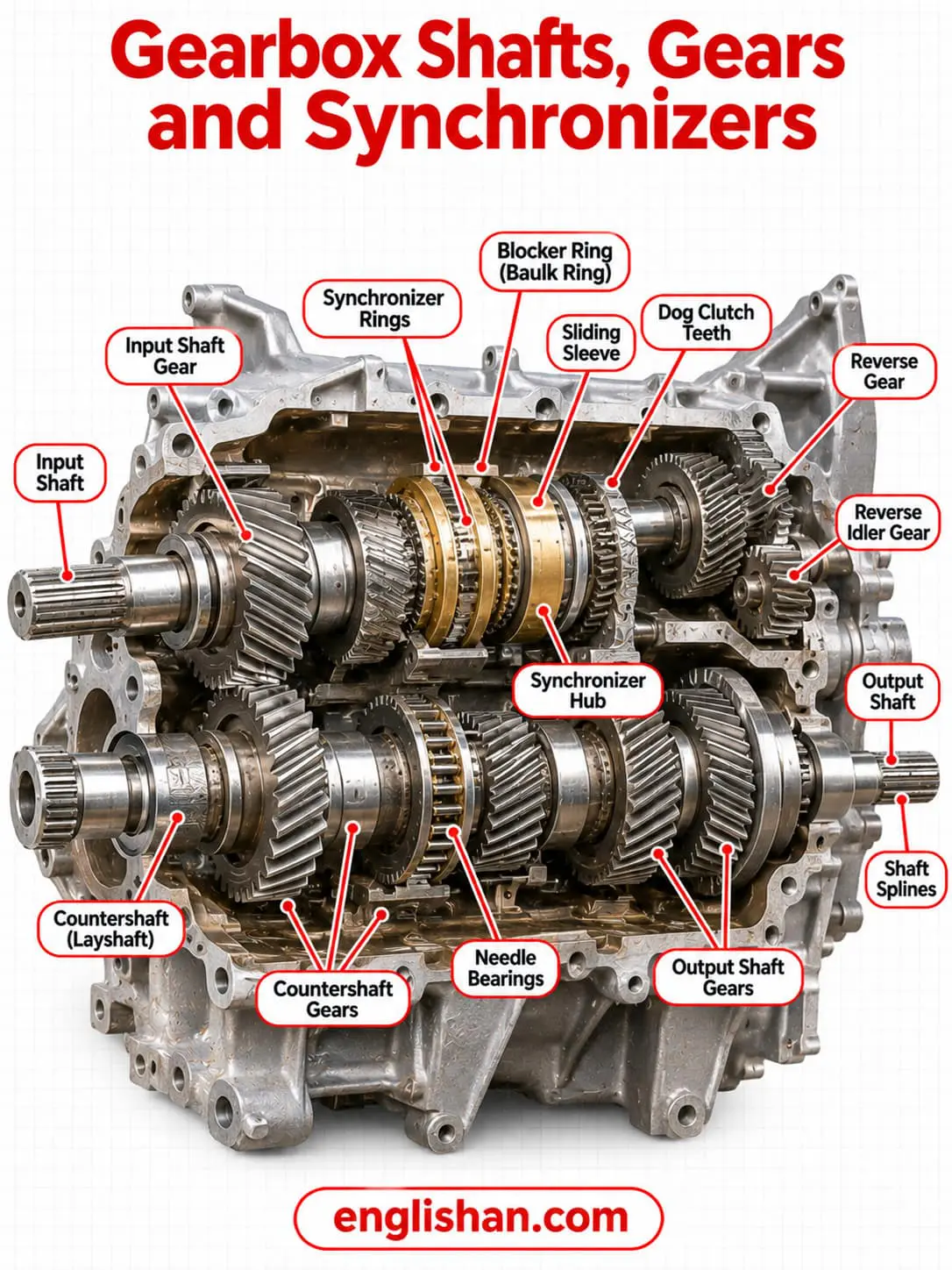
Engine power passes through the gearbox in a fixed order, and each part has one step in that order.
- The clutch connects the engine to the input shaft. With the clutch engaged, the input shaft spins at engine speed.
- The input shaft gear meshes with a gear on the countershaft, which turns in the opposite direction.
- Fixed gears on the countershaft mesh with the output shaft gears, and every one of those gears turns on the output shaft without driving it.
- The shift fork slides a selector along the output shaft, and the selector locks the chosen gear to the shaft.
- The output shaft turns at road speed and drives the propshaft, which leads to the differential, the axles, and the wheels.
BMWBlog describes one more route: in some gearboxes the input shaft couples directly to the output shaft, which gives a 1:1 ratio. Reverse is the one gear set outside the constant mesh, and it is not synchronized, so the car should be stopped before reverse is engaged.
Shafts in a Manual Gearbox
Three of the parts of a gearbox are shafts, and sources name them differently, so the labels shift between manuals.
| Shaft | Other names | Source |
|---|---|---|
| Input shaft | Primary shaft | VAZ-2104 service description |
| Countershaft | Layshaft, intermediate shaft | BMWBlog, Wikipedia, VAZ-2104 |
| Output shaft | Secondary shaft | VAZ-2104 service description |
| Main shaft | Input and output shafts taken together | Wikipedia |
Input shaft
The input shaft is connected to the engine through the clutch and spins at engine speed when the clutch is engaged. Wuling describes it as the part that receives the output moment from the clutch unit. In the VAZ-2104 gearbox it has splines for the clutch disc and turns on two ball bearings.
Countershaft
The countershaft, also called the layshaft, holds fixed gears that mesh with the output shaft gears. Wikipedia adds that its gears stay permanently meshed with the input shaft gears. In the VAZ-2104 gearbox it is the intermediate shaft, a block of four gears turning on front and rear bearings, with the fifth gear and reverse gear block mounted on its rear end.
Output shaft
The output shaft is concentric with the input shaft, and the two are coupled but spin independently. It turns at road speed and drives the propshaft. In the VAZ-2104 gearbox it is the secondary shaft, which turns on three bearings and connects at its rear splined end to the cardan shaft flange.
Main shaft
Wikipedia uses the term for the input and output shafts together, and some gearboxes treat the pair as one assembly. Wuling lists the main shaft as its own part that holds gears, bearings, and synchromesh parts and has channels for oil.
Shafts are steel.
Gearbox Gears
Gears are the parts of a gearbox that set the ratio, because size and tooth count change speed and torque. Wikipedia names the layout constant mesh, because the teeth stay in contact and the selector chooses the ratio.
Input shaft gear
The input shaft gear stays in constant mesh with a countershaft gear. The VAZ-2104 description calls it a constant-mesh helical gear on the primary shaft, next to the 4th gear synchronizer ring.
Output shaft gears
The output shaft gears mesh with the countershaft gears and spin freely on needle bearings. BMWBlog describes them as helical cut, which is quieter in operation. Wikipedia says they rotate independently until a selector locks one to the shaft.
Reverse gear
Reverse is the one gear set outside constant mesh and it is not synchronized, so the car should be stopped before reverse is engaged. BMWBlog describes it as straight cut in many gearboxes. In the VAZ-2104 gearbox, a reverse idler gear is mounted on an axle secured to the rear wall and moves axially to engage reverse.
Wikipedia notes that straight-cut spur gears are noisy and are used in heavy machinery, motorcycles, racing cars, and sequential transmissions. It lists five or six forward ratios and one reverse for contemporary manual car transmissions. A truck transmission has between eight and twenty-five gears, and Wikipedia shows a 16-speed tractor transmission with eight reverse gears.
Gears are cast iron or steel.
Synchronizers and Dog Clutches
The synchronizer parts of a gearbox match speeds before the teeth engage. Wikipedia defines synchromesh as rings that match the speed of the input shaft and the chosen gear, so double clutching is not needed.
| Design | How the ratio is selected | Source |
|---|---|---|
| Constant mesh | Gear teeth stay in contact, and dog clutches select the ratio | Wikipedia |
| Synchromesh | Synchronizer rings match the speeds of the shaft and the chosen gear, so double clutching is not needed | Wikipedia |
Selector (dog clutch)
The selector is a sliding collar that fits around the output shaft. Its teeth engage the splines of the output shaft and lock a chosen gear to it, and a shift fork moves it. BMWBlog splits the selector into blocker rings, a synchronizer hub, a shift sleeve, and smaller parts.
Synchronizer rings
Wikipedia describes cone-shaped brass synchronizer rings attached to each gear, where friction reduces the speed difference between the input shaft and the chosen gear. BMWBlog calls them baulk rings and describes friction cones that brake the quicker of the selector or the gear.
Blocker ring
The blocker ring, also called a baulk ring, stops the collar from engaging until the speeds match. It then twists slightly so the notches line up and the dog clutch engages.
Synchronizer hub
The synchronizer hub is part of the selector. In the VAZ-2104 gearbox the hubs are fixed on the secondary shaft: the 1st-2nd and 3rd-4th hubs ride in grooves, and the 5th gear hub is on a splined portion of the shaft.
Synchronizer rings are brass.
Parts of a Gearbox Shift Linkage
The shift linkage links the driver to the other parts of a gearbox. The driver moves the gear lever, the lever moves the shift rods, and the rods move the shift forks. Each fork rides in a groove around a selector.
Gear lever
The gear lever, or gearshift, moves the shift rods, and moving it out of neutral engages a rod. In the VAZ-2104 gearbox its lower end is in a rod groove, its spherical end is held in a ball joint housing secured to the rear cover, and elastic damper bushings absorb vibration.
Shift rods
Shift rods run through the case to the shifter and move the forks. Wikipedia also mentions linkages and cables as the route from the lever. The VAZ-2104 gearbox has three shift rods.
Shift forks
Shift forks ride in a groove around the selector and push or pull it along the output shaft. Wikipedia says they are linked to the gear lever, and the VAZ-2104 description has them move the synchronizer clutches through the annular grooves.
Ball locks
In the VAZ-2104 gearbox, spring-loaded ball locks hold the shift rods in neutral or engaged positions. They are fitted in bushings in the housing and closed by a common cover.
Interlock crackers
Interlock crackers prevent two gears from engaging at once. In the VAZ-2104 gearbox they are located in the rods and the rear wall.
Parts of a Gearbox Housing
Housing
The housing is the outer shell of the parts of a gearbox. Wikipedia calls it the transmission casing and says it must withstand torsional forces. Gear Solutions adds that it contains the lubricating oil or grease, and GlobalSpec says it also keeps unwanted particles out of the gear assembly. The VAZ-2104 housing is cast aluminum alloy, with a filler hole in the left wall and a vent opening in the front wall.
The housing is cast iron, steel, or aluminum. In one car gearbox, the housing and rear cover are cast aluminum alloy and the front and bottom covers are steel.
Covers and Gaskets
Front cover
The front cover is steel and is pressed into the clutch housing. It holds the primary shaft seal and has a drain opening that releases oil if the seal fails.
Rear cover
The rear cover is cast aluminum alloy, mounted on six studs. It houses the rear bearing of the secondary shaft and the speedometer drive, and it supports the gear lever.
Bottom cover
The bottom cover is stamped steel and closes the base of the housing with ten studs and nuts.
Gaskets
Gaskets seal the joints between the housing, the rear cover, and the clutch housing.
Fill and Drain Plugs
Filler plug
The filler plug is a tapered-thread plug in the left wall of the housing.
Drain plug
The drain plug is a tapered-thread plug in the bottom cover. It holds a permanent magnet that collects metal particles from the oil.
Breather
Breather
The breather vents the gearbox to the atmosphere. In the VAZ-2104 description it is mounted on the clutch housing.
Bearings and Seals
Needle bearings
Each output shaft gear turns on needle bearings, which let it spin independently of the shaft.
Shaft bearings
Shaft bearings support the shafts and, with the case, absorb the axial loads that helical gears produce. Bearings are the parts of a gearbox that allow the shafts and gears to rotate, and Gear Solutions states that their primary function is to reduce friction and wear between moving parts. In the VAZ-2104 gearbox the secondary shaft has a front roller bearing in the primary shaft bore, an intermediate ball bearing in the rear housing wall, and a rear roller bearing in the rear cover.
Seals
Seals are the parts of a gearbox that keep oil inside the housing. The VAZ-2104 gearbox has a primary shaft seal in the front cover and an oil seal at the rear bearing of the secondary shaft. Chery names worn seals as the main cause of transmission fluid leaks, and fluid dripping under the vehicle means a leak at the seals or the gaskets.
Gearbox Oil and Lubrication
Gear oil
The moving parts of a gearbox run in oil. Wikipedia states that manual transmissions use gear oil, and in some vehicles engine oil, and that gear oil contains sulfur-bearing anti-wear compounds. Gear Solutions calls proper lubrication essential for long-term operation, because it reduces friction, dissipates heat, and limits wear. GlobalSpec warns that exceeding the maximum input speed causes oil churning, which harms the gear reducer.
Parts of an Automatic Gearbox
An automatic gearbox replaces the clutch and the sliding selectors with fluid and clutch packs. Wikipedia lists these main parts.
Torque converter
The torque converter couples and decouples the engine, in place of the friction clutch used in manual transmissions.
Planetary gearset
Planetary gearsets form the gear-ratio core in place of the lined-up gears of a manual. Chery splits the planetary gear set into a sun gear, planet gears, and a ring gear, and the sun gear passes rotation to the planetary gears.
Clutches, friction bands, and brake packs
These lock particular gears to set the active ratio. Friction bands are used mainly for manually selected ranges such as low and reverse.
Sprag clutches
Sprag clutches pass torque in one direction and handle routine shifts.
Hydraulic control and valve body
The valve body directs hydraulic pressure to the correct bands and clutches, using spring-loaded valves, check balls, and servo pistons.
Pump
A gear pump between the torque converter and the planetary gearset pressurizes the fluid, and it runs only when the engine is running. Wuling describes the oil pump as the part that moves lubricating oil from the transmission case into the system.
Automatic transmission fluid
The fluid actuates the clutches and bands. It also lubricates the unit and prevents corrosion.
Oil filter
Wuling states that the oil filter cleans the transmission oil to reduce wear caused by friction between parts.
Piston ring
Wuling describes the piston ring as a ring-shaped seal that prevents oil leaks and holds the input shaft in place.
Parts of an Industrial Gearbox
The parts of a gearbox in industry fall into the same four groups as in a car: gears, shafts, bearings, and a housing. GlobalSpec describes gears on shafts, supported by rolling element bearings inside a housing.
Housing
The housing is cast iron, steel, or aluminum, either cast or machined. It contains the lubricant and keeps contaminants out.
Gears
Gears are cast iron or steel. They transmit power and change speed and torque by size and tooth count, and the type of gear sets the type of gearbox.
Shafts
Shafts are steel, with solid, hollow, or integral coupling connections. Gear Solutions notes that a shaft needs enough size to maintain the rigidity of the gear mesh.
Bearings
Bearings are ball, roller, or both. Acorn names deep groove ball, cylindrical roller, and tapered roller bearings, and states that industrial gear bearings need high efficiency and minimum maintenance.
GlobalSpec writes ratios as X:1 and notes that the ratio is fixed once the gearbox is built. A 5:1 ratio turns a 1,750 rpm motor input into a 350 rpm output.
Gearbox Spur Helical and Planetary Gears
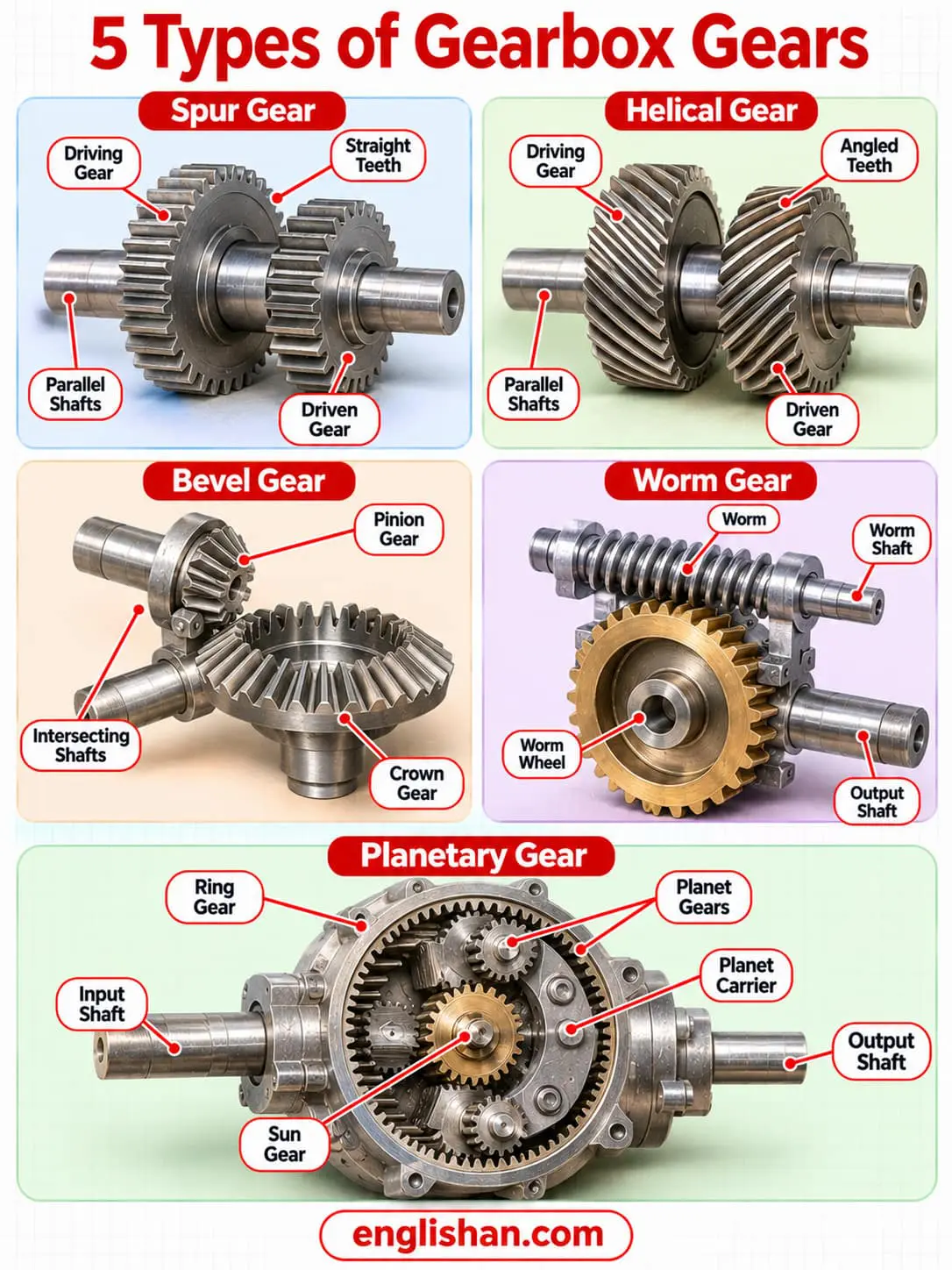
Gear Solutions and GlobalSpec both name five types by the gears inside.
| Type | Gears | Where it fits |
|---|---|---|
| Spur | Straight teeth on parallel shafts | Low cost, high ratios in a compact form, but noisier and more prone to wear |
| Helical | Angled teeth on parallel shafts | Efficient and quiet, in turbines, compressors, and blowers |
| Bevel | Shafts that meet at an angle | Changes the direction of power at right angles in conveyor systems |
| Worm | Spiral thread meeting a wheel | Compact with high torque, and self-locking, so it cannot be back driven |
| Planetary | Small gears around or inside a large gear | Precise and power dense, in robotics, servo motors, and machine tools |
Gear Solutions limits worm gearboxes to about 1,800 rpm and helical spur gearboxes to 8,000 rpm. Wikipedia places planetary gears in the first stage of wind turbine gearboxes.
FAQs
The parts of a gearbox are the input shaft, countershaft, output shaft, gears, synchronizers, shift forks and rods, bearings, seals, housing, and oil. A manual car gearbox adds a gear lever. An automatic adds a torque converter, planetary gearsets, and a valve body.
The main parts of a gearbox are the gears, the shafts, the bearings, and the housing. Gear Solutions and GlobalSpec both describe a gearbox as gears on shafts, supported by bearings inside a housing. Lubricating oil or grease reduces friction and wear between them.
A manual gearbox has an input shaft, a countershaft, an output shaft, gears, synchronizer rings, a selector, shift forks, shift rods, a gear lever, bearings, a housing, and gear oil. The clutch is a separate unit that connects the engine to the input shaft. The numbered diagram at the top of the page labels each part.
The inside of a manual gearbox shows gears of different sizes on an output shaft and a matching set of fixed gears on a countershaft. Selectors with shift forks are fitted between the output shaft gears. Wikipedia notes that the output shaft gears rotate independently until a selector locks one to the shaft.
In everyday car use, yes. Wikipedia says a transmission is also called a gearbox, and Chery describes the gearbox as a transmission part that transmits engine power to the wheels. The racing nickname dog box refers to a non-synchronized manual gearbox with constant-mesh gears.
No, the gearbox is a separate unit that receives engine power through the clutch or the torque converter. Chery places the clutch housing between the clutch and the gearbox. Power then flows from the main shaft to the differential and the wheels.
An automatic gearbox has a torque converter, planetary gearsets, clutches, friction bands, brake packs, sprag clutches, a hydraulic control and valve body, a gear pump, and automatic transmission fluid. Chery adds a sun gear, planet gears, and a ring gear within the planetary gear set.
An industrial gearbox has a housing, gears, shafts, and bearings. GlobalSpec lists the housing as cast iron, steel, or aluminum, the gears as cast iron or steel, and the shafts as steel. The gear type sets the gearbox type: spur, helical, bevel, worm, or planetary.
The gearbox is located between the clutch or torque converter and the propshaft. The clutch feeds the input shaft, and the output shaft drives the propshaft, the differential, the axles, and the wheels. Chery advises checking the undercarriage for fluid seepage from the gearbox seals.
Related:
- Parts of a Bicycle
- Parts of a Train
- Parts of a Drill
- Parts of a Washing Machine
- Parts of a Sewing Machine
