

The parts of a router are the motor, the spindle, the collet, the bit, the base, the depth adjustment, the handles, and the switch. The motor spins the bit, the collet secures it, and the base rests on the workpiece while the bit cuts.
The router described is the handheld woodworking router. The Wi-Fi router, the CNC router, and the router table are separate machines with their own parts. A router bit has its own anatomy, covered with the collet.
Four sources name the parts in different numbers. A visual dictionary labels nine, a school lab safety sheet names nine, a Bosch manual numbers twenty-eight features, and a woodworking retailer lists six parts. Every part named here comes from at least one of them.
Parts of a Router Labeled Diagram
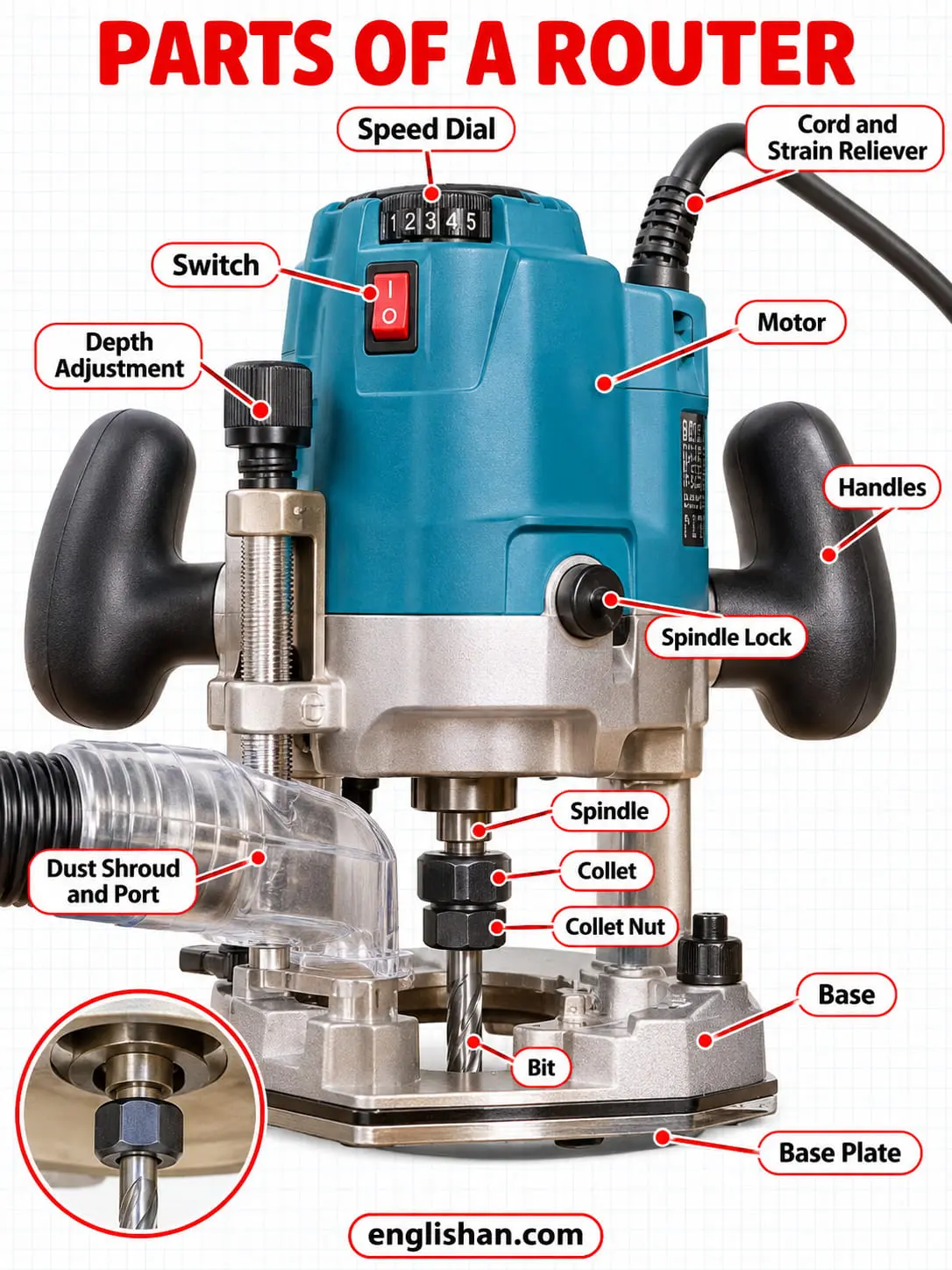
A router has a motor in a base, a collet that grips the bit, and handles for the hands. The numbered rows run from the motor down to the base and out to the controls.
| Part | Function |
|---|---|
| 1. Motor | A universal motor facing downward, held in a base with handles |
| 2. Spindle | The shaft at the end of the motor, where the bit attaches |
| 3. Collet | A ring that tightens or loosens the tool holder around the bit |
| 4. Collet nut | The nut that tightens the bit in place |
| 5. Bit | The sharp cutter attached to the end of the spindle |
| 6. Base | The support plate that rests on the workpiece |
| 7. Base plate | A replaceable plate on the underside that accepts guide bushings |
| 8. Depth adjustment | The control that sets how deep the bit cuts |
| 9. Handles | A D-handle or two knobs, used to hold and guide the tool |
| 10. Switch | Turns the router on and off |
| 11. Speed dial | Sets the bit speed on a variable-speed router, separate from the on and off switch |
| 12. Cord and strain reliever | A protective sleeve around the cable at the point where it enters the router |
| 13. Dust shroud and port | A shroud with a port for a vacuum hose |
| 14. Spindle lock | An optional lock that holds the spindle so one wrench changes the bit |
The count of parts depends on the source. The Bosch manual reaches twenty-eight because it numbers screws, bolts, and accessories, and the sections that follow keep to the groups that every source shares.
Router Motor and Spindle
The motor, the spindle, and the speed dial form the drive of the router. The Bosch manual labels the motor assembly the drive unit.
Motor
The motor is the first of the parts of a router in the diagram. It is a universal motor mounted facing downward inside the base, and it is held in the base with the handles.
Spindle
The spindle is the shaft at the end of the motor. The bit attaches to the end of the spindle, and the collet and collet nut secure it there.
Carbon brush bracket
The Bosch manual numbers a carbon brush bracket beside the drive unit.
Router motors are rated in horsepower, and the rating separates the three size classes.
| Size class | Horsepower | Weight and bit limit |
|---|---|---|
| Full-size | 3 or 3-1/4 hp | Up to 15 pounds |
| Mid-size | 1-1/2 to 2-1/4 hp | Several pounds lighter than full-size |
| Compact | About 1-1/4 peak hp | Takes bits with a 1/4 inch shank only |
Speed dial
The speed dial sets the bit speed on a variable-speed router, and it is separate from the on and off switch. Speeds run from 8,000 to 30,000 rpm. Almost every new router has variable speed, and a large-diameter bit requires a lower setting. A soft start ramps the power up gradually to prevent a sudden jerk, and electronic feedback circuitry holds the bit speed steady under load.
Parts of a Router Collet and Bit Shank
Three of the parts of a router work together to hold the bit: the collet, the collet nut, and the spindle lock.
Collet
The collet is a ring that tightens or loosens the tool holder around the bit. Most routers take 1/4 inch and 1/2 inch collets, and many mid-size and larger routers include both. Compact routers take 1/4 inch shanks only.
Collet nut
The collet nut tightens the bit in place. Check that the nut is tight before the router starts. Insert the shank at least 1/2 inch into the collet before tightening the nut, and loosen the nut to free the bit.
Spindle lock
The spindle lock is an optional part that holds the spindle during a bit change. A router with a spindle lock needs one wrench, and a router without one needs two wrenches to loosen or tighten the nut.
Collet sizes differ by region.
| Region | Removable collet sizes |
|---|---|
| United States | 1/2 inch and 1/4 inch |
| Great Britain | 1/2 inch, 8 mm, and 1/4 inch |
| Europe | Metric sizes |
Parts of a Router Bit
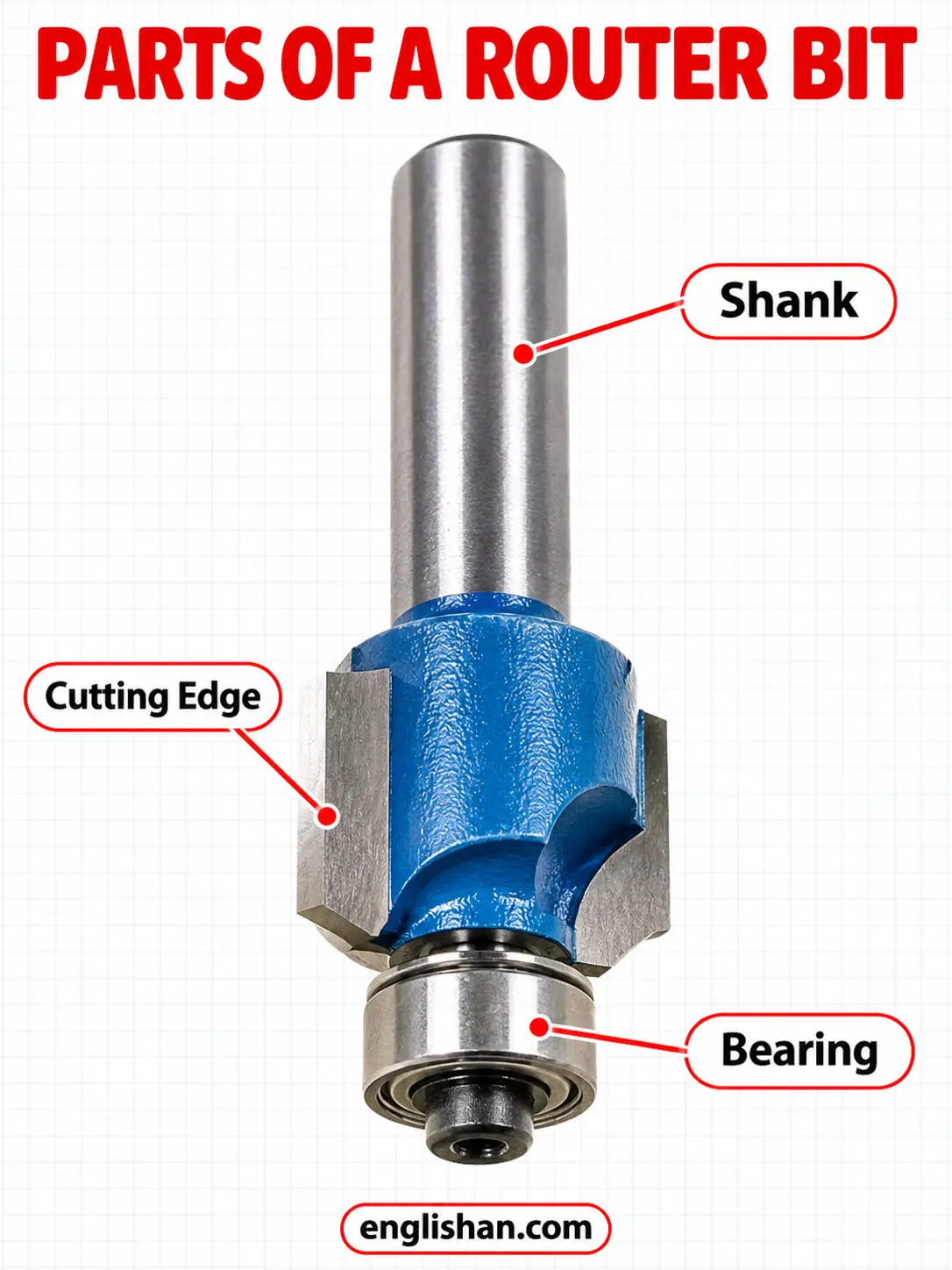
The bit is the sharp cutter attached to the end of the spindle. A router bit has three parts: the shank, the cutting edge, and the bearing.
Bit
The bit does the cutting. The lab safety sheet requires that it is not touching the stock when the router starts. It fits into the collet through its shank, and its cutting edge shapes the wood.
Shank
The shank is the part that fits into the collet. Inspect it before use, since damage on a shank means a damaged collet. Shank sizes run from thickest to thinnest as 1/2 inch, 12 mm, 10 mm, 3/8 inch, 8 mm, 1/4 inch, and 6 mm. A 1/2 inch shank is stronger and stiffer than a 1/4 inch shank.
Cutting edge
The cutting edge shapes the wood. Most production bits have carbide cutting edges.
Bearing
The bearing is optional, and when present it is located at the tip or along the side and follows the edge of the workpiece. Edge-forming bits have pilot bearings. A flush-trim bit has a pilot bearing with the same diameter as the cutter, and a pattern bit has the bearing at the top of the cutter. A bit without a bearing needs a template guide or an edge guide for a controlled cut. Keep pilot bearings free of glue, pitch, and sawdust, because adhesive seizes a bearing and loosens its screw.
Fixed Base and Plunge Base Parts
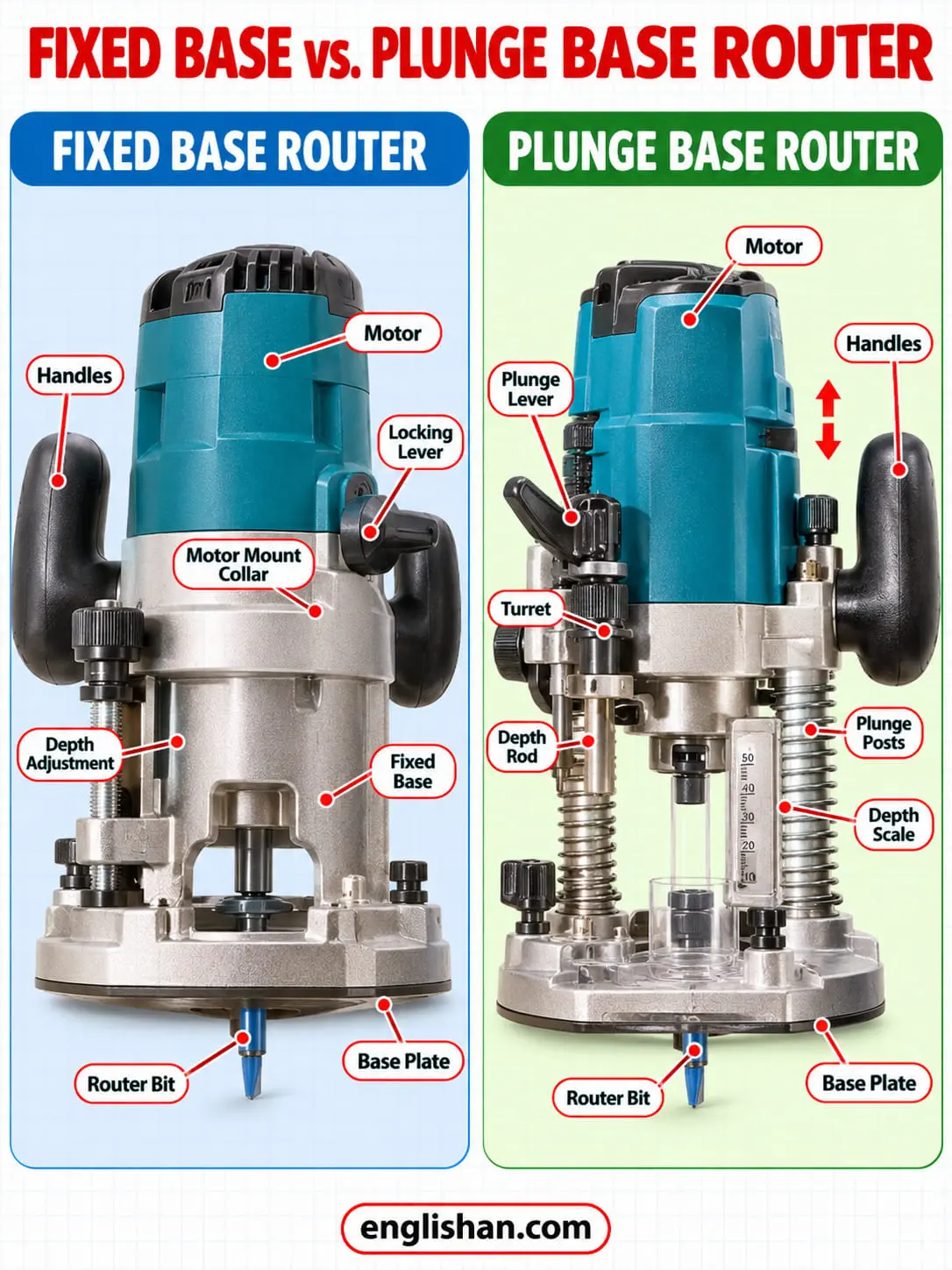
The parts of a router base depend on the design, fixed or plunge. A trim router and a combination router are named as further types, and the two bases are covered in full here.
| Feature | Fixed base | Plunge base |
|---|---|---|
| Motor mount | A large collar secures the motor | The motor clamps into a top housing that rides on two spring-loaded metal posts |
| Height setting | The motor slides in the collar and locks with a lever or cam | A stepped, swiveling turret and an adjustable rod set the depth |
| When depth is set | Before the router is switched on | The bit lowers into the work after the motor starts |
| Handles | Two handles or a single D-handle | One or two handles |
Fixed-base collar
A large collar secures the motor on a fixed base. The motor slides in the collar and locks with a lever or cam.
Plunge posts
Two spring-loaded metal posts support the top housing of a plunge base, and the motor clamps into that housing. The posts lift the motor when the pressure is released.
Plunge lever
The plunge lever locks the motor at any height.
Turret
The turret is a stepped, swiveling part with preset depth stops. Each click of the turret changes the depth by about 1/8 inch.
Depth rod
The depth rod is the adjustable rod that meets the turret. Lowering or raising the rod sets any depth between the preset stops.
Parts of a Router Depth Adjustment
Four parts of a router set the depth on a plunge base: the depth adjustment, the depth scale, the turret, and the depth rod.
Depth adjustment
The depth adjustment controls how far the bit extends beneath the base. A lab safety sheet calls it the micrometer depth adjustment and states that turning it sets the depth of cut. On a fixed base the bit height changes with the height of the motor mount, and the design varies by manufacturer. To set the depth, unclamp the motor and slide it, and some models add a fine-tuning ring or knob.
Depth scale
The Bosch manual numbers a scale for setting the routing depth. On a plunge base the depth reads from a scale behind the rod.
The zero point comes first on a plunge base.
- Unplug the router.
- Lower the bit until it just touches the material. This is the zero point.
- Rotate the turret to its highest stop and lower the depth rod until it touches the turret.
- For a depth of 1/8, 1/4, or 1/2 inch, rotate the turret to the matching stop.
- For any other depth, raise the depth rod by the amount wanted, using a gauge block or a piece of wood of the right thickness.
- Raise the bit before cutting, and test the setting on scrap wood.
A single pass never cuts deeper than the diameter of the bit. A deep cut takes several passes at increasing depths, which reduces tearout, burning, and bit breakage.
Base Plate and Guide Bushings
The base and the base plate are the parts of a router in contact with the workpiece.
Base
The base is the support plate that rests on the workpiece. The Bosch manual numbers a routing base as a separate part from the base plate.
Base plate
The base plate is the replaceable plate on the underside of the base, and it attaches with screws. It accepts guide bushings. The cutout in the base plate is sized for bushings 1-3/16 inches in diameter, which is the industry norm.
Guide bushings
Guide bushings fit the cutout in the base plate. They range from 5/16 inch outside diameter up to 1 inch or more.
Edge guide
An edge guide cuts rabbets, dados, circles, and ellipses. The Bosch manual lists a guide bushing, a parallel guide, and a guide roller as accessories.
Parts of a Router for Dust Collection
The cut produces chips and dust. The dust shroud and the chip deflector are the parts of a router built for dust collection.
Dust shroud and port
The dust-collection shroud has a port for a vacuum hose. The Bosch manual numbers a dust extraction adapter as a standard part. A second adapter and an extraction hose are listed as accessories.
Chip deflector
The Bosch manual numbers a chip deflector as a standard part.
A dust mask is part of the safety kit that the lab sheet requires, along with safety glasses.
Router Handles and Switch
Two of the parts of a router control the motor, the switch and the speed dial, and the handles hold the tool.
Handles
The handles are the parts of a router that the hands hold. They are the guide handle in the visual dictionary and the D-handle and guide knob in the lab sheet. The Bosch manual describes its handle with an insulated gripping surface. Fixed bases come with two handles or a single D-handle, and plunge bases come with one or two. Wikipedia names D-handled and double-knob handled routers as styles. Hold the router firmly with both hands during a cut.
Switch
The trigger switch in the lab sheet, called the on and off switch in the Bosch manual, starts the motor. Make sure the switch is off before plugging the router in.
Cord and strain reliever
The cord sleeve in the visual dictionary is a protective casing around the cable, and the lab sheet calls it the cord strain reliever. It must not be frayed, cut, or pulled loose. Keep the cord away from the stock so the bit cannot cut it.
Locking handle and motor disconnect
The lab sheet lists both as labeled parts and states no function for either.
Trim and Compact Router Parts
A trim router, also called a laminate trimmer, is a smaller, lighter router that holds smaller bits. A compact router takes only 1/4 inch shank bits and has a motor of about 1-1/4 peak hp, which is under the 1-1/2 to 2-1/4 hp of a mid-size router.
Cordless compact routers come in 12-volt and 18-volt lines. The parts of a router are the same as on a corded model, with a battery in place of the cord and strain reliever.
Router Part Names
Sources name the parts of a router in different words. The columns set three of them side by side.
| Part group | Visual dictionary | Lab safety sheet | Bosch manual |
|---|---|---|---|
| Depth control | Depth adjustment | Micrometer depth adjustment | Scale for setting routing depth |
| Bit holder | Tool holder and collet | Collet chuck | Tool holder, collet, and cap nut with collet |
| Support | Base | Base | Routing base and base plate |
| Handle | Guide handle | D-handle, guide knob, and locking handle | Handle with insulated gripping surface |
| Switch | Switch | Trigger switch | On and off switch |
| Cord | Cord sleeve | Cord strain reliever | Not listed |
| Motor | Motor | Motor disconnect | Drive unit |
| Top | Head | Not listed | Not listed |
The Bosch manual also names the open-ended spanners of 10 mm and 17 mm that change the bit, a knurled screw and wing bolts for the routing base, and the nut for the routing guide.
FAQs
The parts of a router are the motor, spindle, collet, collet nut, bit, base, base plate, depth adjustment, handles, switch, and cord. Many routers add a speed dial, a dust port, and a spindle lock. The motor spins the bit, and the base rests on the workpiece.
The main parts are a universal motor facing downward, a base with handles, a bit attached to the spindle, a collet with its nut, and a base plate that accepts guide bushings. The depth adjustment and the switch complete the working set.
A router has a universal motor with a spindle inside the housing. The Bosch manual labels the motor assembly the drive unit and numbers a carbon brush bracket beside it. The collet and the bit attach to the end of the spindle.
A router bit has a shank, a cutting edge, and an optional bearing. The shank fits into the collet and the cutting edge shapes the wood. The bearing is located at the tip or along the side and follows the edge of the workpiece.
A plunge router has a motor that clamps into a top housing riding on two spring-loaded posts. The plunge lever locks the motor at any height. A stepped turret and a depth rod set the depth of cut.
The collet and the collet nut hold the bit. Tightening the nut closes the collet around the shank. A spindle lock holds the spindle during the change, so one wrench is enough.
The depth adjustment sets the depth of cut. On a plunge router the turret stops and the depth rod set it, and each turret click changes the depth by about 1/8 inch. On a fixed base the depth comes from sliding and locking the motor.
The difference is when the depth is set. On a fixed base the depth is set before the router is switched on, and the motor locks in a collar. On a plunge router the bit lowers into the work after the motor starts, on two spring-loaded posts.
Related:
- Parts of a Drill
- Parts of a Circular Saw
- Parts of a Table Saw
- Parts of a Drill Bit
- Parts of an Angle Grinder
