

A farm tractor converts engine power into pull at its large rear wheels. It delivers that power to implements through the hitch and the power take-off shaft. The parts of a tractor are named from the engine at the front to the hitch at the rear.
Between the two are the cab, the transmission, and the hydraulic system. Each part has a fixed position along the length of the tractor.
Parts of a Tractor Labeled in Side View
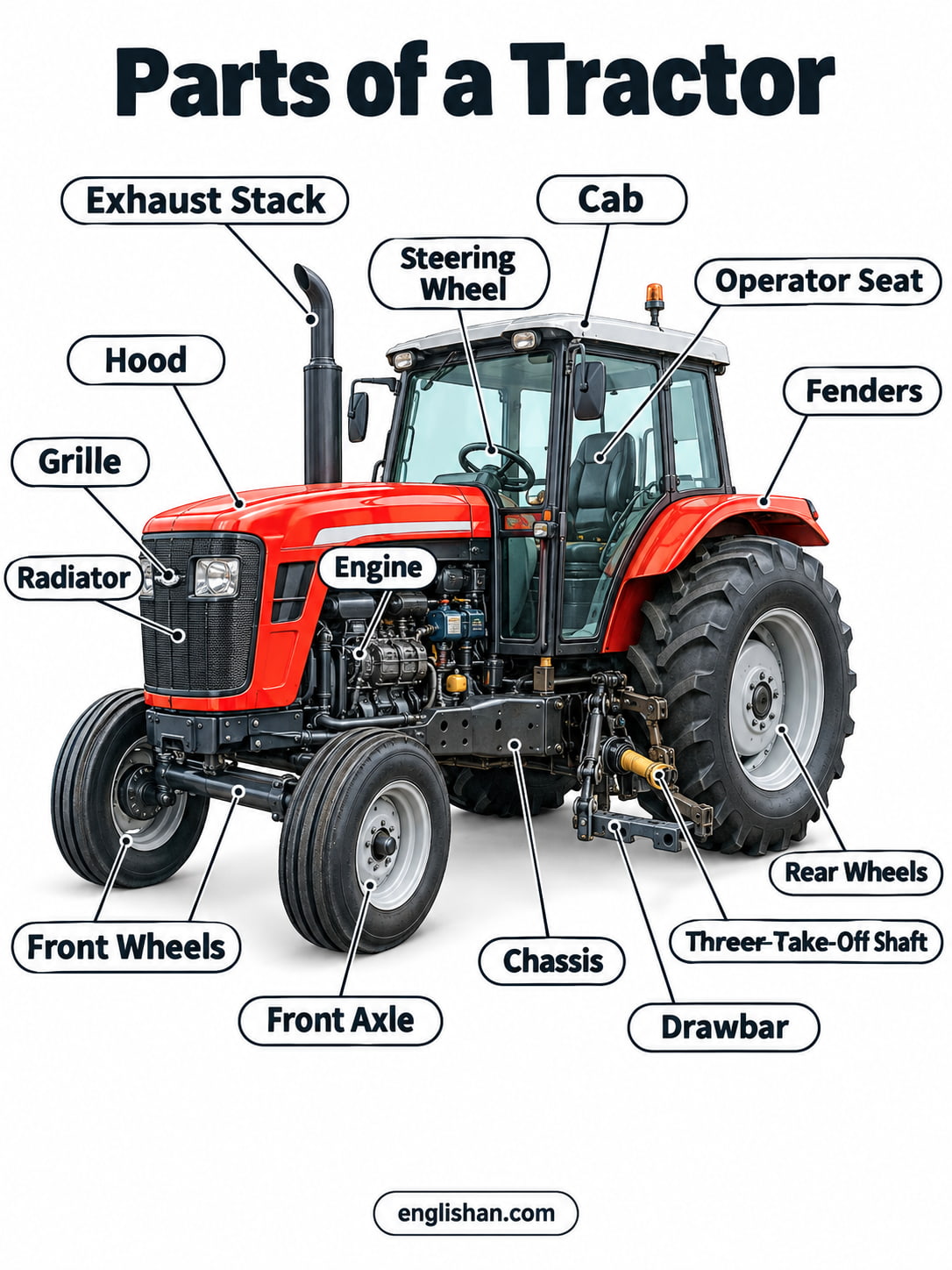
In side view, the hood and grille close the front of the tractor, and the cab is mounted over the rear axle. Small front wheels follow the front axle, and large rear wheels drive the machine forward. The power take-off shaft, the drawbar, and the lift arms of the hitch are bolted to the rear housing. These are the parts of a tractor as farmers and mechanics name them.
| Part | Where you find it |
|---|---|
| 1. Engine | Diesel unit under the hood |
| 2. Radiator | Coolant core behind the grille |
| 3. Cooling fan | Blade wheel between the radiator and the engine |
| 4. Water pump | Pump that circulates coolant |
| 5. Air cleaner | Filter housing beside the hood |
| 6. Exhaust stack | Upright pipe with a muffler at the hood side |
| 7. Fuel tank | Steel tank under or behind the hood |
| 8. Fuel pump and injectors | Pump that feeds the injectors that spray fuel |
| 9. Fuel filter | Canister on the fuel line at the engine |
| 10. Battery | Box with the 12-volt cells near the front |
| 11. Alternator | Belt-driven generator on the engine |
| 12. Starter motor | Electric motor bolted to the flywheel housing |
| 13. Fuses and relays | Switches and cutouts that protect circuits |
| 14. Wiring harness | Bundle of wires linking the electrical parts |
| 15. Hood | Sheet-metal cover over the engine |
| 16. Grille | Perforated panel at the front of the hood |
| 17. Headlights | Lamps in the grille or on the hood |
| 18. Front weights | Cast iron blocks on the front bumper |
| 19. Front axle | Steel beam holding the front wheels |
| 20. Tie rod | Steering bar joining the two front wheels |
| 21. Front wheels | Small steering wheels at the nose |
| 22. Cab | Enclosed operator compartment over the rear axle |
| 23. Roll-over protective structure | Steel frame around the operator seat |
| 24. Steering wheel | Round wheel on the dash column |
| 25. Power steering | Hydraulic assist that turns the front wheels |
| 26. Instrument panel | Gauge cluster behind the steering wheel |
| 27. Warning lights | Lamps that flag low oil, heat, or charge faults |
| 28. Operator seat | Suspended seat in the cab |
| 29. Clutch pedal | Left foot pedal on the cab floor |
| 30. Brake pedals | Pair of right foot pedals on the cab floor |
| 31. Gear lever | Floor-mounted lever beside the seat |
| 32. Clutch | Plate set that links the engine to the transmission |
| 33. Hand throttle | Lever on the dash that sets engine speed |
| 34. Transmission | Gearbox housing behind the engine |
| 35. Final drive | Reduction gears between the differential and the wheels |
| 36. Differential | Gear set inside the rear axle housing |
| 37. Differential lock | Pedal-operated lock joining both rear wheels |
| 38. Rear axle | Steel shaft housing holding the rear wheels |
| 39. Rear wheels | Large lugged wheels at the back |
| 40. Brakes | Disc or drum brakes at the rear wheels |
| 41. Tracks | Rubber or steel belts used in place of wheels |
| 42. Fenders | Curved shields over the rear wheels |
| 43. Hydraulic pump | Gear pump driven from the transmission |
| 44. Hydraulic reservoir | Tank that stores hydraulic fluid |
| 45. Hydraulic filter | Element that removes dirt from the fluid |
| 46. Control valves | Valves that direct fluid to the hitch or loader |
| 47. Hydraulic cylinders | Cylinders that lift the arms and the loader |
| 48. Remote couplers | Quick-connect sockets at the rear |
| 49. Power take-off shaft | Splined shaft at the rear of the housing |
| 50. PTO lever | Control that starts and stops the PTO |
| 51. Mid-mount PTO | Underbelly shaft for a belly mower |
| 52. Lift arms | Two arms that raise the lower links |
| 53. Lower links | Pair of bottom arms of the three-point hitch |
| 54. Top link | Single upper arm of the three-point hitch |
| 55. Stabilizer bars | Adjustable bars that limit sideways swing |
| 56. Drawbar | Flat steel bar under the power take-off shaft |
| 57. Front loader | Hydraulic arms and bucket at the front |
| 58. Chassis | Frame that bears the engine, transmission, and axles |
| 59. Suspension | Axle or cab springs that reduce vibration |
Tractor Engine and Front Parts
The front of the tractor holds the engine and the parts of a tractor that cool, feed, and start it. Everything ahead of the cab belongs to this group.
Engine
The engine is a diesel unit mounted at the front, and it supplies all the power of the tractor. Modern farm tractor engines range from 18 to 575 horsepower, and compact utility tractors run 20 to 50 horsepower. The engine page names its internal parts.
Fuel Types
Diesel is the most common fuel for a tractor. Older and compact tractors burn gasoline, and some burn LPG or kerosene. Electric and hybrid tractors replace the engine with a motor and a battery pack.
Fuel Pump and Injectors
The fuel pump moves fuel from the tank through the filter to the injectors. The injectors spray the fuel into the cylinders as a fine mist.
Water Pump and Lubrication System
The water pump circulates coolant between the engine and the radiator. The lubrication system is the oil pump and the oil passages that cut friction and wear inside the engine.
Radiator and Cooling Fan
Among the parts of a tractor, the radiator is the finned coolant core mounted in front of the engine, behind the grille. A belt-driven cooling fan pulls air through its fins, and rubber hoses join it to the engine block. A coolant overflow bottle is fixed to the side of the radiator.
Air Cleaner and Exhaust Stack
The air cleaner is a cylindrical housing with a paper filter, and it cleans the air before it reaches the engine. Many tractors add a precleaner, a spinning cup on top that throws out heavy dust. The exhaust stack is an upright pipe with a muffler, and it vents the engine gases over the hood.
Fuel Tank and Fuel Filter
The fuel tank is a steel tank mounted under or behind the hood, with a filler cap on top. The fuel filter is a canister on the fuel line that traps dirt. A water separator, a glass bowl at its base, collects water drained from the diesel.
Battery and Starting Parts
The battery is a 12-volt unit in a box near the front, and it feeds the electrical system. These starting parts of a tractor work as a set. The alternator is a belt-driven generator on the engine that recharges the battery. The starter motor is an electric motor that spins the flywheel to start the engine.
Fuses and Wiring Harness
Fuses and relays protect the circuits from overload. The wiring harness is the bundle of wires that links the battery, the lights, the instrument panel, and the starter.
Hood and Grille
The hood is a sheet-metal cover that encloses the engine, hinged at the rear or lifted off in one piece. The grille is a perforated panel at its front that admits air to the radiator.
Headlights and Work Lights
Headlights are lamps fitted in the grille or on the hood sides. Work lights are extra lamps on the cab roof and the fenders, aimed at the field and at the implement.
Front Weights
Front weights are cast iron blocks bolted to a bracket on the front bumper. They balance the weight of a heavy implement hung on the rear hitch and keep the front wheels on the ground.
Front Axle and Tie Rod
The front axle is a steel beam that pivots at its center, so both front wheels follow uneven ground. A tie rod joins the steering arms of the two wheels, so they turn together. On four-wheel-drive models, the front axle is geared to the engine and turns the wheels.
Front Wheels
The front wheels are narrower and smaller than the rear wheels. Each one is a steel rim bolted to a hub, fitted with a ribbed tire that steers the tractor.
Tractor Cab and Control Parts
The cab and the controls are the parts of a tractor that the operator uses, and they are mounted over the rear axle.
Cab
The cab is an enclosed compartment of steel posts, glass, and a roof panel, fitted on almost all modern tractors. It holds the seat, the steering wheel, and the controls. Many cabs are fitted with an air conditioning unit and a sealed filter for dust.
Roll-Over Protective Structure
The roll-over protective structure, or ROPS, is a steel frame bolted around the operator seat. It prevents the cab or seat from crushing the operator if the tractor tips over. Sweden required it in 1959, and the United States followed in 1986.
Steering Wheel
The steering wheel is a round wheel on a column in front of the seat. It turns the front wheels through a hydraulic steering cylinder.
Instrument Panel
The instrument panel is the gauge cluster behind the steering wheel. It holds a tachometer for engine speed, a coolant temperature gauge, a fuel gauge, and an hour meter that records engine running time.
Operator Seat
The operator seat is a padded seat on a spring or air suspension that absorbs shock from the ground. A lever beside it adjusts the seat to the operator’s weight.
Power Steering and Autosteer
Power steering is a hydraulic assist that turns the front wheels with little effort. Older and low-cost tractors have manual steering, while GPS autosteer holds the tractor on its path and prevents overlap between passes.
Warning Lights and Control Unit
Warning lights flag low oil pressure, high coolant heat, and charging faults. An electronic control unit is a computer that manages the engine and the transmission.
Pedals and Levers
The clutch pedal is the left foot pedal, and it disconnects the engine from the transmission. The two brake pedals are on the right, one for each rear wheel, and a latch locks them together for road travel. A gear lever selects the gear, and a hand throttle lever sets engine speed. A separate lever raises and lowers the hitch.
Tractor Drive Parts
The drive turns engine power into forward motion on every tractor, and the parts of a tractor in this group join the engine to the ground.
Transmission
The transmission is a gearbox housing bolted behind the engine. Older farm tractors have three to six gear ratios, split into two or three ranges. Final-drive speeds reach about 25 miles per hour.
Transmission Types
A manual gear transmission uses a clutch and a shift lever to select speed and torque. A power shift transmission changes gears without stopping the tractor. A power shuttle switches between forward and reverse without fully using the clutch. A hydrostatic transmission, or HST, sets speed by fluid pressure with no gear changes. A continuously variable transmission, or CVT, gives infinite speed control within its range.
Clutch
The clutch is a set of plates that links the engine to the transmission and breaks that link when the pedal is pressed. Friction clutches use a single plate or multiple plates. Cone clutches, dog clutches, and fluid couplings serve special drives.
Differential
The differential is a gear set inside the rear axle housing that lets one rear wheel turn faster than the other in a turn. A differential lock pedal locks the two wheels together when one slips.
Differential Lock
The differential lock locks the two rear wheels together, so both turn at the same speed. It stops the slipping wheel from spinning in mud.
Final Drive
The final drive is a set of reduction gears between the differential and the drive wheels. It multiplies torque and traction, and some use spur gears and a bull gear.
Rear Axle and Rear Wheels
The rear axle is a steel shaft housing that holds both rear wheels. Each rear wheel is a steel rim with a large lugged tire. Cast iron wheel weights are bolted to the rim for extra traction.
Brakes
The brakes are disc or drum brakes at the rear wheels, worked by the left and right pedals. Separate left and right brakes help the tractor turn sharply in the field.
Tires and Tracks
Radial tires give better traction and longer life than bias-ply tires. Tracks are rubber or steel belts used in place of wheels, and they spread the weight on wet or soft soil.
Fenders
Among the parts of a tractor, the fenders are curved steel shields over the rear wheels. They stop mud and stones thrown up by the lugs from hitting the cab and the operator.
Tractor Chassis and Suspension Parts
The chassis and suspension form the frame of the machine. These parts of a tractor join the engine, the transmission, and the axles.
Chassis
The chassis is the structural frame of the tractor, and it bears the engine, the transmission, and the axles. A full-frame chassis is rigid and suits heavy-duty tractors. Compact tractors are semi-frame or frameless, and the engine and the transmission housings act as the structure.
Suspension
Front axle suspension and cab suspension reduce vibration and operator fatigue. They are sprung mounts between the axle or the cab and the chassis.
Tractor Hydraulic and Hitch Parts
The rear of the tractor holds the parts of a tractor that power implements. These are the power take-off shaft, the hydraulic system, the hitch, and the drawbar.
Power Take-Off Shaft
The power take-off shaft, or PTO, is a splined steel shaft at the rear of the tractor. It spins an implement directly from the engine. The rear PTO turns at 540 revolutions per minute in North America, and some tractors have a dual 540 and 1000 rpm shaft. A removable shield covers the shaft when it is not in use.
PTO Types
A transmission PTO stops when the clutch is pressed. A live PTO runs independently of the transmission. An independent PTO has its own switch or lever, and a mid-mount PTO is an underbelly shaft for a belly mower. A PTO lever starts and stops the power.
Hydraulic Pump
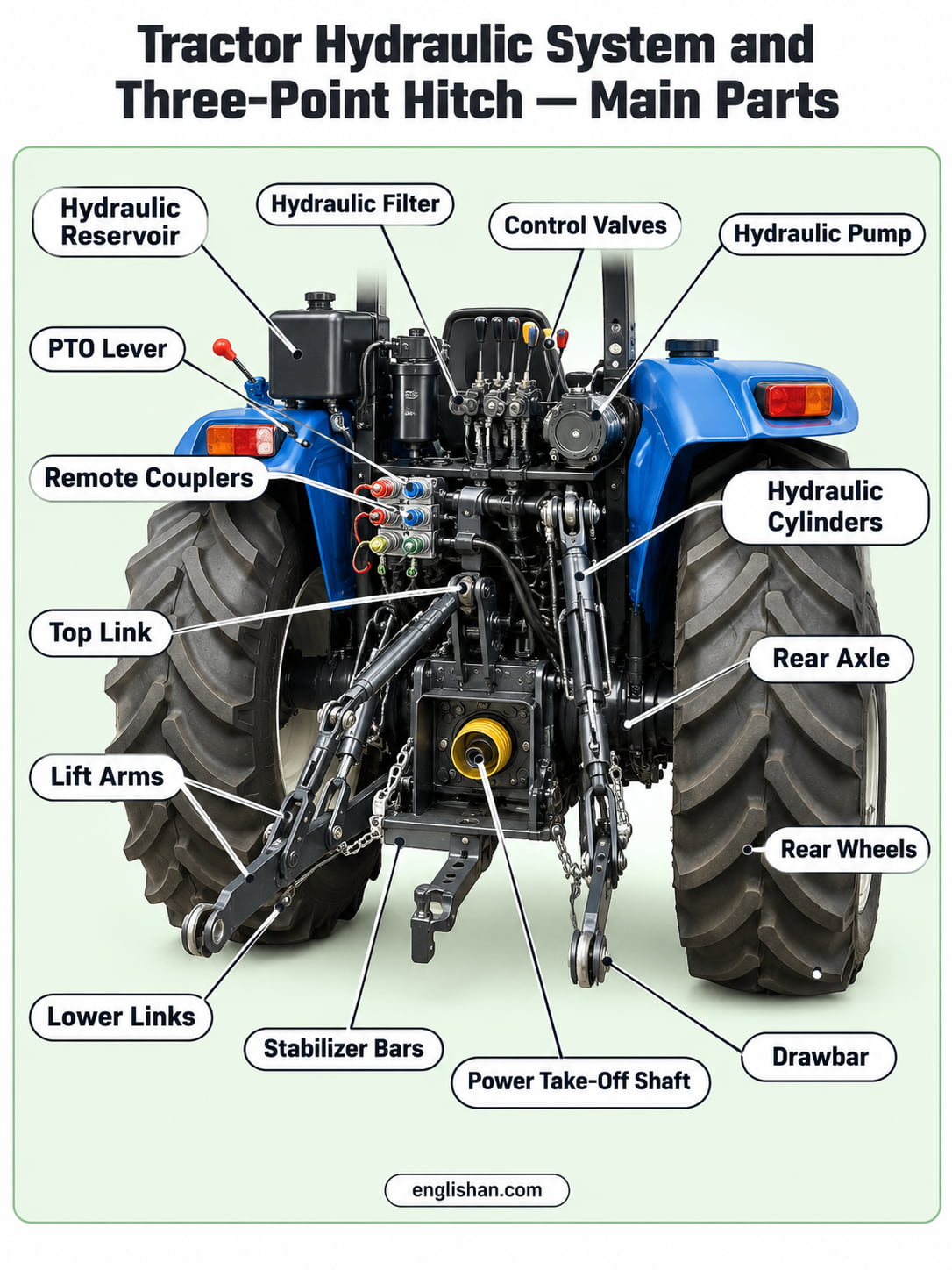
The hydraulic system starts at the pump, a gear pump driven from the transmission. It draws fluid from a reservoir through a filter. Hoses then take the fluid to the lift arms and to any cylinder on an implement. It is the part of a tractor that lifts the hitch and powers every cylinder.
Hydraulic Reservoir and Filter
The reservoir stores the hydraulic fluid, and the filter removes dirt from it before it returns to the pump.
Control Valves
Control valves direct the fluid to the hitch, the steering, or the loader. A lever in the cab moves each valve.
Hydraulic Cylinders
Hydraulic cylinders turn fluid pressure into a straight push or pull. They lift the loader arms and the hitch lift arms. Among the parts of a tractor, the cylinders do the lifting work.
Remote Couplers
Remote couplers are quick-connect sockets at the rear that join the hoses of an attachment to the hydraulic system. A remote lever in the cab opens each pair of couplers.
Lift Arms
The lift arms are two short arms on each side of the rear housing, driven by a hydraulic cylinder. A lift rod joins each arm to a lower link, so raising the arms raises the implement.
Lower Links
The lower links are the pair of bottom arms of the three-point hitch. Ball ends at their tips accept the pins of the implement, and the hydraulic lift arms raise and lower them.
Top Link
The top link is the single upper arm of the three-point hitch. A screw adjuster changes its length, and a longer or shorter top link sets the tilt of the implement.
Stabilizer Bars
Stabilizer bars, or check chains, are adjustable bars fixed to the lower links. They limit the sideways swing of the implement as the tractor turns.
Hitch Categories
Among the parts of a tractor, the three-point hitch is the set of three arms at the rear that mounts an implement. Hitch categories match the size of the tractor. Category 1 fits tractors of 20 to 45 horsepower, category 2 fits 40 to 100 horsepower, and category 3 fits 80 to 225 horsepower. Larger categories use thicker pins on the arms.
Drawbar
The drawbar is a flat steel bar bolted under the power take-off shaft. It has a hole at the end for a hitch pin, and it tows a wagon or a trailer. A drawbar is the part where tractor pull is measured.
Tractor Attachment Parts
An attachment adds its own parts to the tractor, and the front loader is the most common of the optional parts of a tractor.
Front Loader
A front loader is two hydraulic arms mounted on either side of the engine compartment, with a tilting implement at the ends. The implement is a bucket, a pallet fork, or a bale spear. Two cylinders on each side lift the arms, and a third pair tilts the bucket. The bucket is the same working part as on an excavator.
Implements
Implements are the working tools that attach to the hitch or the drawbar. Plows and harrows prepare soil, and mowers, balers, and augers are driven by the PTO.
Lawn and Garden Tractors
A lawn tractor has the same layout at a smaller size, with a mid-mounted mower deck in place of a hitch. Its wheels fix to the hub with a single bolt or clip. Garden tractors use lugged wheels of 12 inches or more. The lawn mower page names the deck and the blades.
FAQs
The parts of a tractor are the engine, radiator, hood, grille, front axle, cab, steering wheel, and seat. The transmission, differential, rear axle, rear wheels, hydraulic system, power take-off shaft, three-point hitch, and drawbar complete the machine. A front loader is an optional attachment that bolts to the front frame and the axle.
The main parts of a tractor are the engine, the transmission, the rear axle and wheels, the cab, and the hitch. The engine supplies the power, and the transmission and axle deliver it to the wheels. The hitch and the power take-off shaft deliver it to implements.
A three-point hitch has two lower links, a top link, lift arms, lift rods, stabilizer bars, and pins. The hydraulic system raises the lower links, and the top link adjusts the tilt of the implement.
The PTO is a rotating shaft at the rear of the tractor. It transfers engine power to an implement such as a mower or baler, and it turns at 540 revolutions per minute in North America.
The hydraulic parts of a tractor are the pump, the fluid reservoir, the filter, and the control valves. The hoses, the remote couplers, and the lift arms complete the circuit. The pump supplies pressure, and the valves direct fluid to the hitch or to a loader cylinder.
A tractor engine is a diesel with a block, a cylinder head, pistons, and fuel injectors. Larger models add a turbocharger, and a radiator is mounted at the front. The engine page names each internal part.
No, a tractor trailer is a semi-truck that pulls a long trailer on the road. A farm tractor is a field machine with a hitch and a power take-off shaft. The tractor trailer page names the fifth wheel, kingpin, and air lines.
