A push mower cuts grass with one steel blade spinning flat under a metal or plastic deck. Every other part starts that blade, stops it, powers it, or rolls it across the lawn. Once you know the parts of a lawn mower by name, the owner’s manual makes sense and the right replacement part arrives the first time. On a gas walk-behind model, those parts divide between the engine on top of the deck and the frame beneath it.
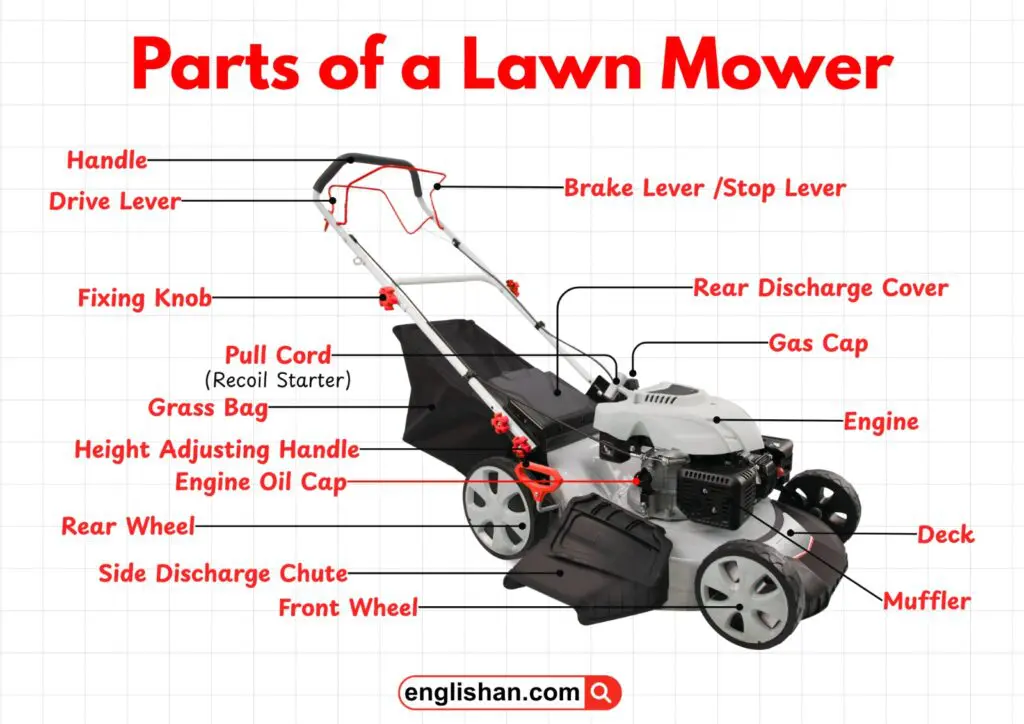
Parts of a Lawn Mower: Quick Visual Overview
Parts of a Lawn Mower Diagram With Names
A walk-behind lawn mower is built around a flat deck with parts mounted above and below it. On top, the engine, fuel tank, and recoil starter are bolted in place, while the blade spins underneath. Wheels support the deck at its corners. From the back, a handle rises to waist height and brings the brake lever, drive lever, and pull cord within reach of your hands.
| Part | Location |
|---|---|
| 1. Handle | Rear of the deck, rising to waist height |
| 2. Brake lever | Across the top of the handle |
| 3. Drive lever | Top of the handle, on self-propelled models |
| 4. Throttle lever | Side of the handle, on some models |
| 5. Handle knobs | Joint between the upper and lower handle |
| 6. Pull cord | Top of the engine, with its grip on the handle |
| 7. Engine | Bolted to the top of the deck |
| 8. Fuel tank and gas cap | Side or top of the engine |
| 9. Oil fill cap and dipstick | Low on the engine, near the deck |
| 10. Spark plug | Front of the engine, under a rubber boot |
| 11. Air filter | Side of the engine, in a plastic housing |
| 12. Primer bulb | Beside the air filter or on the carburetor |
| 13. Muffler | Exhaust side of the engine, behind a heat shield |
| 14. Deck | Under the engine, a few inches above the grass |
| 15. Blade | Under the deck, bolted to the crankshaft |
| 16. Grass bag | Behind the deck, hooked under the handle |
| 17. Rear discharge flap | Back edge of the deck |
| 18. Side discharge chute | Side opening of the deck |
| 19. Front wheels | Front corners of the deck |
| 20. Rear wheels | Rear corners of the deck |
| 21. Cutting height adjustment lever | Beside each wheel or on one side of the deck |
Parts of a Lawn Mower Engine
Engine parts turn gasoline and air into the spin that drives the blade, and on a push mower they are packed around one small cylinder.
Gas Engine
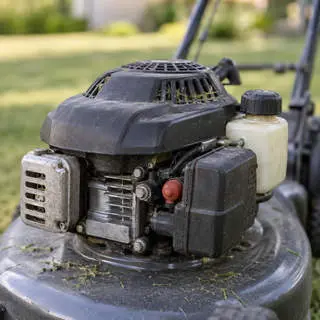
Bolted to the top of the deck, the engine on a gas push mower is a small four-stroke engine with one cylinder. Air cools it instead of liquid, and its crankshaft drops straight down through the deck to the blade.
On the engine, a label states its size in cubic centimeters (cc), commonly between 140 cc and 200 cc on a push mower. Battery mowers replace the whole engine with an electric motor, and push reel mowers turn their blades from the wheels alone.
Under the metal shroud on top of the engine, hidden parts spin the crankshaft and fire the spark plug:
- Flywheel: This heavy metal disc is fixed to the top of the crankshaft, with magnets set into its rim. Fins cast into the flywheel blow cooling air over the cylinder as it turns.
- Ignition coil: Mounted beside the flywheel, this coil of copper wire turns the passing magnets into a high-voltage pulse for the spark plug.
- Flywheel key: A small soft-metal key, the flywheel key locks the flywheel in line with the crankshaft. It shears when the blade strikes a stump, and the engine then runs rough or won’t start until it is replaced.
- Cooling fins: Cast as thin metal ridges around the cylinder, the cooling fins shed heat into the air the flywheel blows. Packed grass and mud between the fins make the engine overheat and stall.
Fuel Tank and Gas Cap
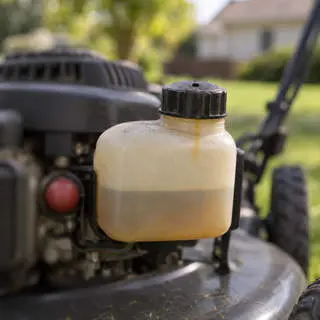
The fuel tank is a molded plastic shell on the side or top of the engine, and it stores the gasoline that feeds the carburetor. The gas cap screws onto the filler neck and seals it against dirt and spills.
Through a pinhole vent in that cap, air enters as the fuel level drops, and a clogged vent stalls the engine a few minutes after starting. In British English, the same part on a petrol mower is the petrol cap.
Oil Fill Cap and Dipstick
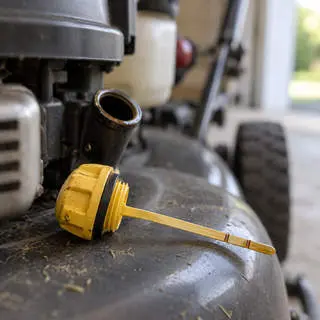
Unscrewing the plastic oil fill cap opens the tube where engine oil goes in, low on the side of the engine near the deck. On most push mowers, a plastic dipstick is molded to the underside of the cap, which lets one part seal the tube and measure the oil. Two-stroke mowers have no oil cap at all, because their oil is mixed into the fuel.
Spark Plug
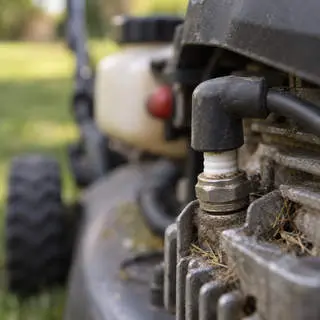
About the length of a finger, the spark plug screws into the cylinder head under a black rubber boot. Its white ceramic body rises from a metal hex base, and a thick insulated wire connects the boot to the ignition coil.
Each time the flywheel turns past the coil, the plug fires a spark across its gap and ignites the fuel and air in the cylinder. A plug fouled with black carbon makes the engine hard to start, which is why it gets replaced at the yearly tune-up.
Air Filter
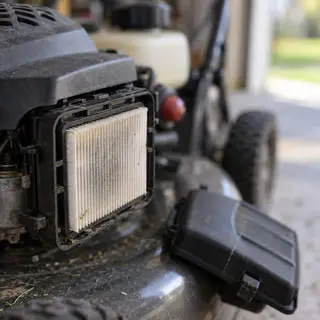
The air filter traps dust in a pleated paper or foam pad, fitted inside a plastic housing on the side of the engine. Every draw of air into the carburetor passes through it first, which keeps grass dust and grit out of the cylinder. A clogged filter cuts the air supply, so the engine runs rich and loses power.
Carburetor
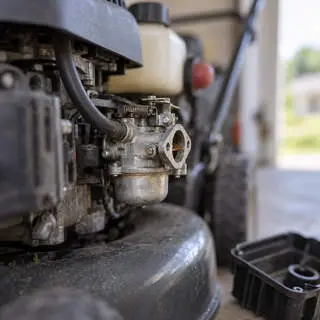
A small aluminum part bolted between the air filter and the engine, the carburetor mixes air and gasoline in the right proportion for burning. A float bowl on its underside keeps a reserve of fuel ready for each stroke. Gasoline left in that bowl over winter turns into a sticky varnish that blocks the tiny fuel jets. With the jets blocked, the engine fires on a spray of starting fluid and then stalls within seconds.
Muffler
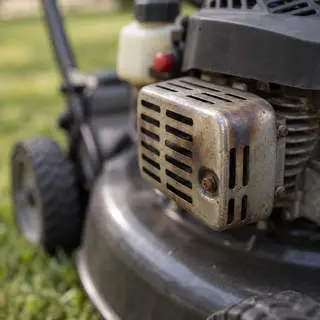
Wrapped in a slotted metal heat shield, the muffler bolts to the exhaust port on the side of the engine. It quiets the bang of each combustion stroke and sends hot exhaust away from your legs and the grass bag.
Lawn Mower Starter Parts
Before a cold gas engine fires, the primer bulb or choke enriches the fuel charge, and the pull cord spins the engine fast enough to spark.
Pull Cord (Recoil Starter)
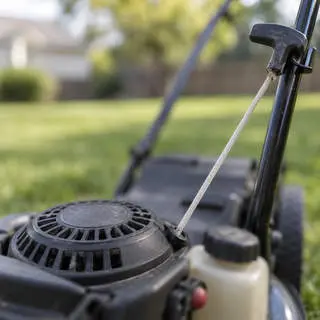
Pulling the T-shaped grip on the handle draws out a nylon rope wound on a pulley under the engine shroud. That pulley assembly is the recoil starter, and the rope is also called the starter cord or starter rope.
Small pawls on the pulley catch the flywheel and spin the crankshaft, and the flywheel magnets then pass the ignition coil to fire the spark plug. Inside the starter, a coiled spring rewinds the rope the moment you let go.
Primer Bulb
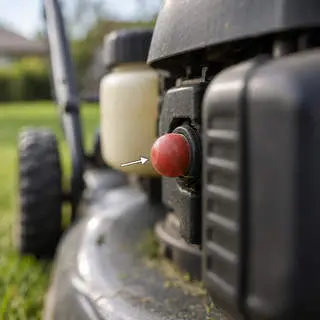
Red or black and about the size of a fingertip, the primer bulb is a soft rubber dome on the air filter housing or the carburetor. Each press forces a small squirt of fuel into the carburetor, and that squirt primes a cold engine to fire on the first or second pull.
Manufacturers set the count at three presses on most engines, and pressing more floods the carburetor with raw fuel. Skip the bulb on a warm engine, since fuel is already in its carburetor.
Choke Lever
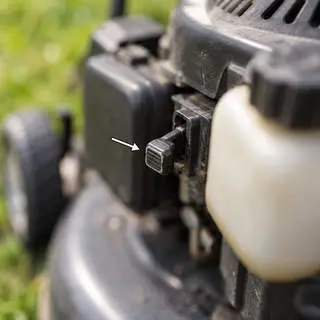
Unlike the primer bulb, the choke is a lever or tab that closes a metal plate across the carburetor’s air intake. Less air means a richer mix of fuel, and a cold engine needs that richer mix to fire. Once the engine warms up, move the choke back to the run position, or the engine runs rough and stalls. Many newer engines are built with an automatic choke and no choke lever at all.
Parts of a Lawn Mower Deck
Tip a push mower on its side with the air filter facing up, and one blade shows under the deck, bolted to the center of a steel dome.
Mower Deck
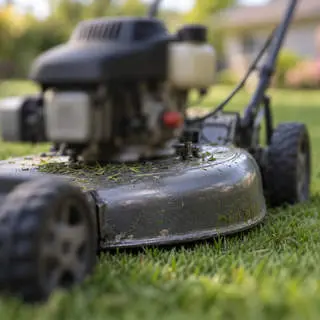
The deck forms the body of the mower, a domed housing of steel, aluminum, or plastic. Its width sets the cutting width, and 21 inches is the standard size for a US push mower.
As the blade spins, its curved tips pull air up into the dome, and that airflow lifts the grass upright before the cut. Many steel decks come with a washout port, a hose fitting on top that sprays water under the deck while the blade turns.
Mower Blade
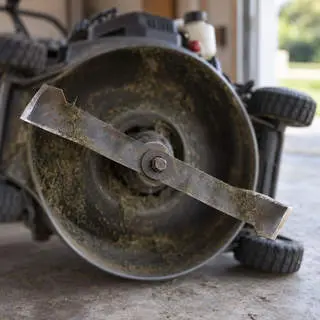
Bolted across the underside of the deck, the blade is a flat bar of hardened steel. Each end is sharpened to a cutting edge, and the tips curve upward into a lift that throws air and clippings toward the discharge opening. A sharp blade shears grass off square, whereas a dull one tears it and leaves frayed tips that turn brown a day later. Sharpen or replace the blade at least once a season.
Safety: Pull the boot off the spark plug, or take the battery out of an electric mower, before your hands go anywhere near the blade.
Blade Adapter
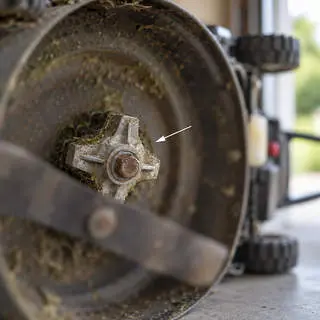
A cast metal hub about the width of a jar lid, the blade adapter slides onto the lower end of the crankshaft. Raised studs or a shaped center on the adapter lock into the blade and stop it from slipping on the shaft. Through the blade’s center hole, the blade bolt threads into the crankshaft and clamps all three parts together.
Lawn Mower Handle Parts and Controls
On a self-propelled mower, the brake lever and the drive lever cross the top of the handle as matching U-shaped bars, one running the blade and the other the wheels.
Mower Handle
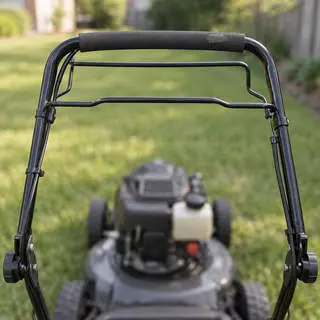
The handle is a pair of steel tubes that rise from the back of the deck and meet in a crossbar at waist height. You steer the mower by pushing down and sideways on that crossbar, since the front wheels on most push mowers do not swivel. Cables for the brake lever, drive lever, and throttle clip along the tubes down to the engine.
Handle Knobs
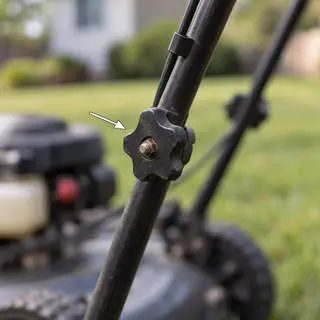
Shaped like a star or a wing and molded from plastic, the handle knobs screw onto bolts where the upper and lower handle tubes meet. Tightening them clamps the handle rigid for mowing, and loosening them lets the upper handle fold flat for storage. Some manuals call them fixing knobs or handle wing nuts.
Brake Lever
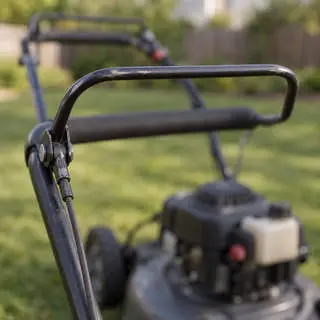
The brake lever is the U-shaped bar in front of the handle’s crossbar, and you hold it against the handle the whole time the engine runs. Manuals also call it the blade control bail, the safety bail, or the operator presence control. A cable links it to a brake pad beside the flywheel.
Letting go releases the cable, and the pad clamps the flywheel as the ignition is grounded. The engine and the blade then stop together. US federal safety rules for walk-behind rotary mowers (16 CFR 1205.5) require the blade to stop within 3.0 seconds of release. Mowers with a blade brake clutch stop only the blade and keep the engine running.
Drive Lever
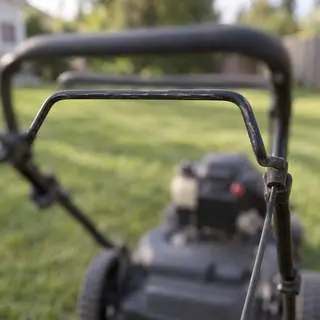
Shaped like the brake lever and mounted beside it on the handle, the drive lever engages the self-propelled drive. Squeezing it pulls a drive cable that engages the gearbox on the wheel axle, and the wheels start turning. Release it, and the wheels stop while the engine and blade keep running. Some mowers swap the bar for paddles under the grip or a speed dial, and push mowers without self-propulsion lack a drive lever.
Throttle Lever
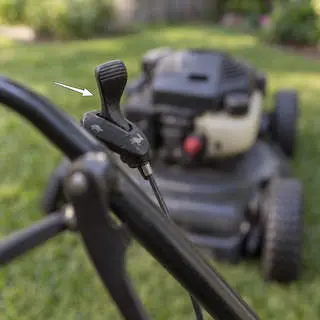
Sliding the throttle lever between the rabbit and turtle symbols sets the engine speed through a cable to the carburetor. Full speed spins the blade fastest and produces the strongest airflow into the grass bag. Many newer mowers leave out the throttle lever and run at one speed set at the factory.
Grass Bag and Discharge Parts
Whether the clippings end up in a bag, back on the lawn, or in a row beside the mower depends on the part fitted to the deck’s discharge opening. Mowers sold as 3-in-1 models take a bag, a mulching plug, or a side chute on the same deck.
Grass Bag
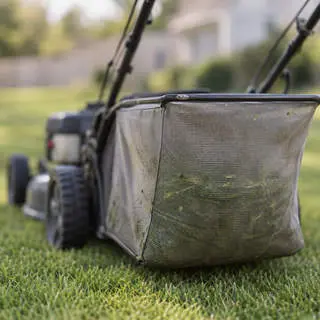
The grass bag is a fabric or mesh sack on a wire frame that hooks onto the back of the deck. Air blown by the blade escapes through the mesh, and the clippings stay inside. Empty it before it packs solid, since a packed bag blocks the airflow and leaves clippings strewn on the lawn. American manuals also call it a grass catcher, and many British mowers collect into a rigid plastic grass box instead.
Rear Discharge Flap
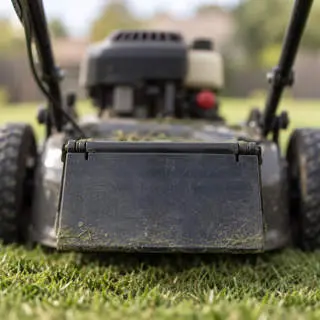
Hinged across the back edge of the deck and held down by a spring, the rear discharge flap closes the rear opening whenever the grass bag is off. Lift it to hook the bag frame in place, and it drops onto the frame as you let go. With no bag fitted, the flap stops stones and sticks thrown by the blade from flying toward your feet.
Side Discharge Chute
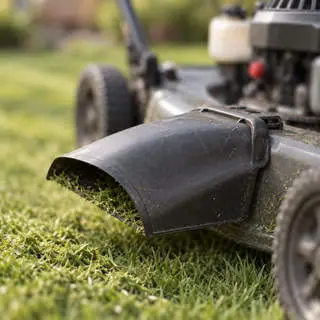
Throwing clippings out in a row beside the mower, the side discharge chute is a curved plastic chute clipped over an opening in the side of the deck. A spring-loaded door closes that opening when the chute comes off. Side discharge suits tall or overgrown grass that would jam a bag.
Mulching Plug
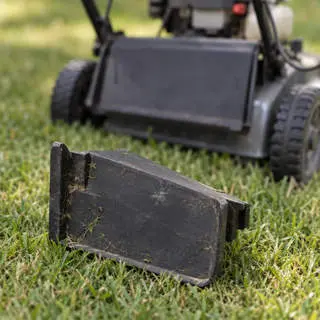
Shaped to fill the rear discharge opening, the mulching plug is a molded plastic insert that keeps clippings under the deck. Trapped under the dome, the clippings circle past the blade several times and fall back into the lawn as fine pieces. A mulching blade, with extra curves along its edge, chops the circling clippings finer still.
Wheels and Drive System Parts
The wheels keep the deck at a set height above the grass, and on self-propelled mowers the engine drives one pair of them through a belt and a gearbox.
Front Wheels
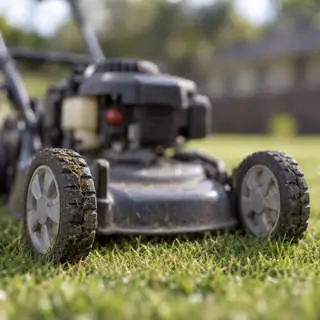
Fixed in line rather than swiveling on most push mowers, the front wheels roll at the leading corners of the deck. Each one turns on a plastic bushing or a ball bearing. On front-wheel-drive models, gears inside the front hubs turn them. Lifting the handle raises those driven wheels off the ground for a tight turn.
Rear Wheels
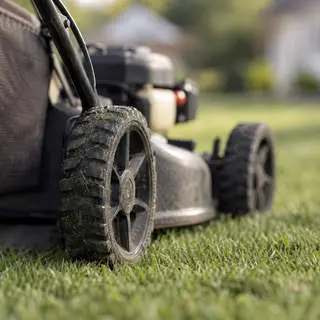
Larger than the front pair on high-wheel models, the rear wheels carry the back of the deck beside the grass bag. On rear-wheel-drive mowers, toothed rings inside the rear hubs mesh with gears on the transmission’s axle. Rear-wheel drive keeps traction as the bag fills, because the bag’s weight presses down on the driven wheels.
Cutting Height Adjustment Lever
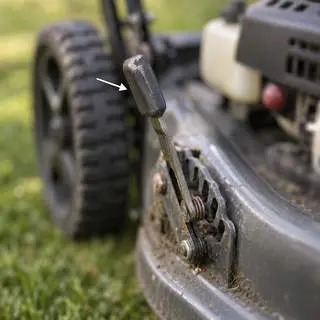
Spring-loaded and notched, the cutting height adjustment lever is mounted beside each wheel or once on the side of the deck. Moving it raises or lowers the wheel against the deck, which changes how far the blade spins above the soil. Mowers with one lever per wheel need all four set to the same notch, or the cut comes out uneven.
Drive Belt
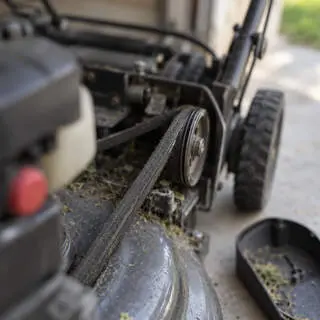
A rubber V-belt, the drive belt loops from a pulley on the crankshaft to a pulley on the transmission. On most push mowers, it turns under a plastic cover at the back of the deck. A stretched or cracked belt slips, and the mower slows on slopes before it stops moving under power.
Transmission
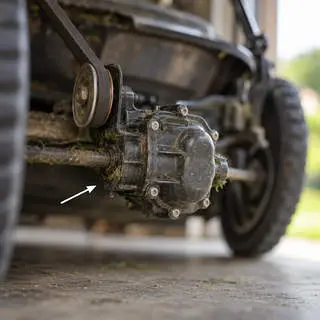
Turning the fast spin of the belt into the slow turn of the wheels, the transmission is a small sealed gearbox on the drive axle. Parts catalogs list the same gearbox as the gear case. Squeezing the drive lever pulls the drive cable, which engages a clutch inside the transmission and sets the axle turning.
Parts of an Electric Lawn Mower
An electric mower shares the deck, blade, wheels, and handle of a gas mower. It has no fuel tank, spark plug, carburetor, or pull cord, and these electrical parts take their place:
- Battery: Removable and rechargeable, the lithium-ion battery clicks into a covered bay on top of the mower, with its voltage and amp-hour rating printed on the case. A higher amp-hour rating means longer mowing on one charge.
- Electric motor: Housed under the plastic hood where a gas engine would be bolted, the electric motor spins the blade directly. A push button on the handle starts it while you squeeze the brake lever.
- Safety key: A small plastic plug, the safety key fits a socket near the battery, and the motor will not run without it. Pull it out whenever the mower is stored.
Parts of a Lawn Mower Blade
Lay a push mower blade flat on a bench, and its length divides into named zones from the center out:
- Center hole: This hole in the middle of the blade fits over the blade adapter, and its shape (round, star, or bow-tie) matches one adapter design only.
- Flat: The flat is the unsharpened middle stretch of the blade. Many blades are stamped there with a part number and a mark for the side that faces the grass.
- Cutting edge: Each end is ground to a sharpened bevel along its leading edge, and this bevel is the only part you sharpen. Take the same amount of metal from both ends, which keeps the blade balanced on its center.
- Lift: Also called the sail or wing, the lift is the upturned trailing edge behind each cutting edge. Its airflow carries clippings into the bag, and a high-lift blade curves up more steeply for bagging.
Refit the blade with the lift pointing up toward the deck. Installed upside down, the dull back edge meets the grass first and tears it.
FAQs
Q1. What are the main parts of a lawn mower?
The main parts of a lawn mower are the engine or electric motor, the deck, the blade, the wheels, and the handle with its controls. The engine is bolted on top of the deck, and the blade spins underneath it.
Q2. What is the part called that you pull to start a lawn mower?
The part you pull to start a lawn mower is the pull cord, also called the starter cord or starter rope. The cord winds onto the recoil starter, a spring-loaded pulley under the engine shroud.
Q3. What is the bar on a lawn mower handle called?
The bar on a lawn mower handle is the brake lever, also called the blade control bail or operator presence control. Releasing it stops the engine and the blade within seconds.
Q4. What is the flap on the back of a lawn mower called?
The flap on the back of a lawn mower is the rear discharge flap, also called the rear deflector or rear guard. It closes the rear opening when the grass bag is off.
Q5. How many parts are in a lawn mower?
A walk-behind lawn mower is assembled from well over a hundred parts once every bolt, spring, and washer is counted. Replacement parts catalogs for a single push mower model number each of them, from the blade and engine down to the hubcaps.
Q6. Are lawn mower parts interchangeable?
Yes, some lawn mower parts are interchangeable, but only when the size and fitting match. Spark plugs, air filters, and universal blades fit several models, while decks, transmissions, and drive cables fit only the model they were built for.
Q7. What are spindles on a lawn mower?
Spindles are the shaft-and-bearing assemblies that support and spin the blades on a riding mower or zero-turn deck. Push mowers need no spindles, since their blade bolts straight to the engine’s crankshaft through the blade adapter.
You May Also Like