

The parts of an air compressor are the inlet filter, the pump, the motor, the check valve, the air tank, the pressure switch, the regulator, and the gauges. The pump compresses the air, the tank stores it, and the pressure switch starts and stops the motor.
Air tools connect at the outlet of the regulator. The parts of a drill and the parts of an angle grinder describe two power tools found in the same workshop. The piston compressor comes first and the rotary screw compressor after it.
Parts of an Air Compressor Labeled Diagram
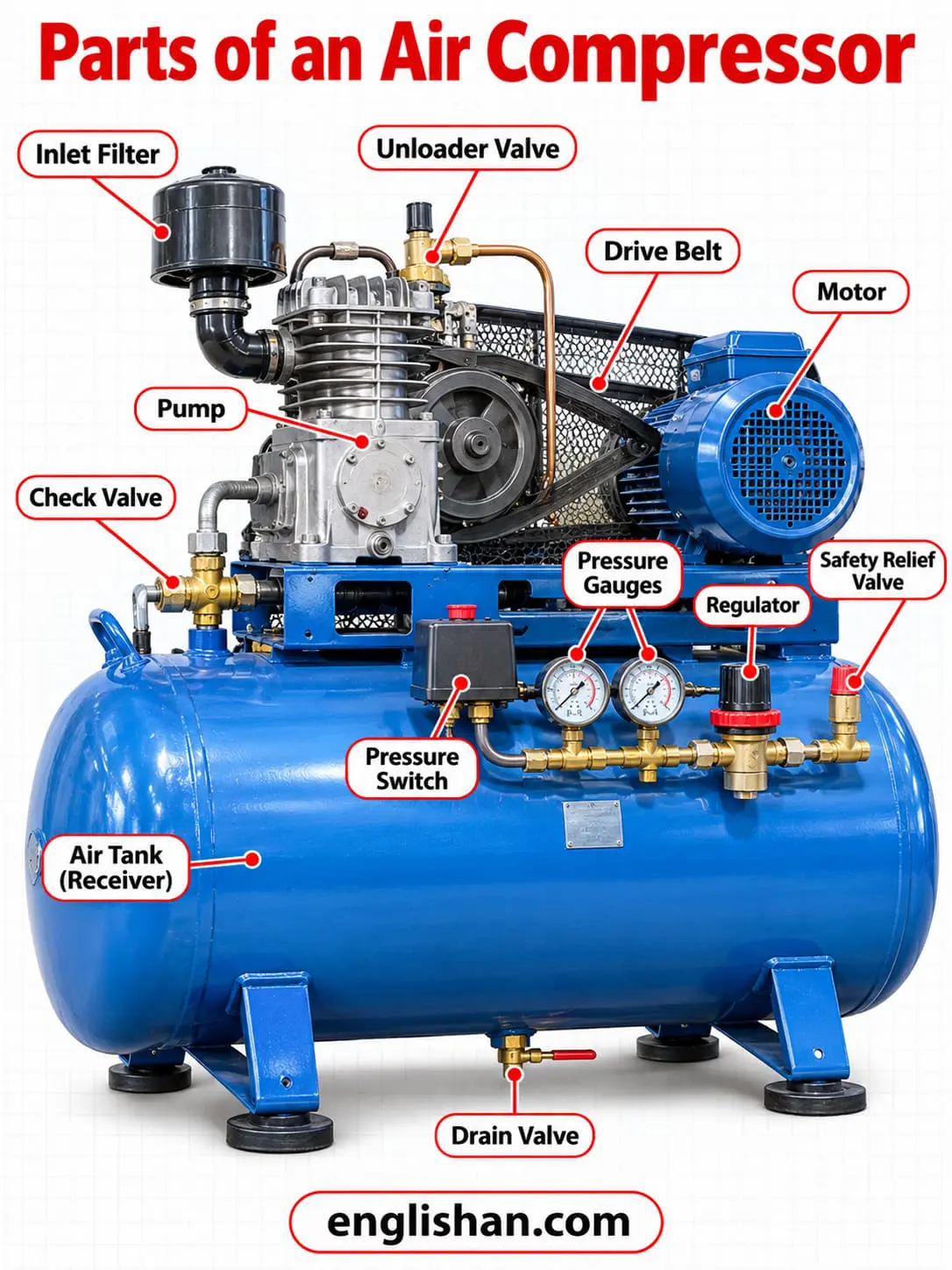
In a labeled diagram, the air path runs in order from the inlet filter to the pump, through the check valve into the tank, and out through the regulator. The motor drives the pump, and the pressure switch controls the motor.
| Part | Where you find it |
|---|---|
| 1. Inlet filter | First in the air path, at the pump inlet |
| 2. Pump | Compression unit where the air is compressed |
| 3. Motor | Electric or gasoline drive that powers the pump |
| 4. Drive belt | Belt and two pulleys between the motor and the pump on belt-drive units |
| 5. Check valve | Pump outlet or tank inlet |
| 6. Unloader valve | Between the pump and the check valve, or built into the pressure switch on small units |
| 7. Air tank | Receiver downstream of the pump |
| 8. Pressure switch | Palm-sized housing mounted on the tank |
| 9. Pressure gauges | Two dials, one for tank pressure and one for outlet pressure |
| 10. Regulator | Valve downstream of the tank that sets the outlet pressure |
| 11. Safety relief valve | Spring-loaded valve that vents over the rated tank pressure |
| 12. Drain valve | Bottom of the tank |
Parts of a Piston Air Compressor Pump
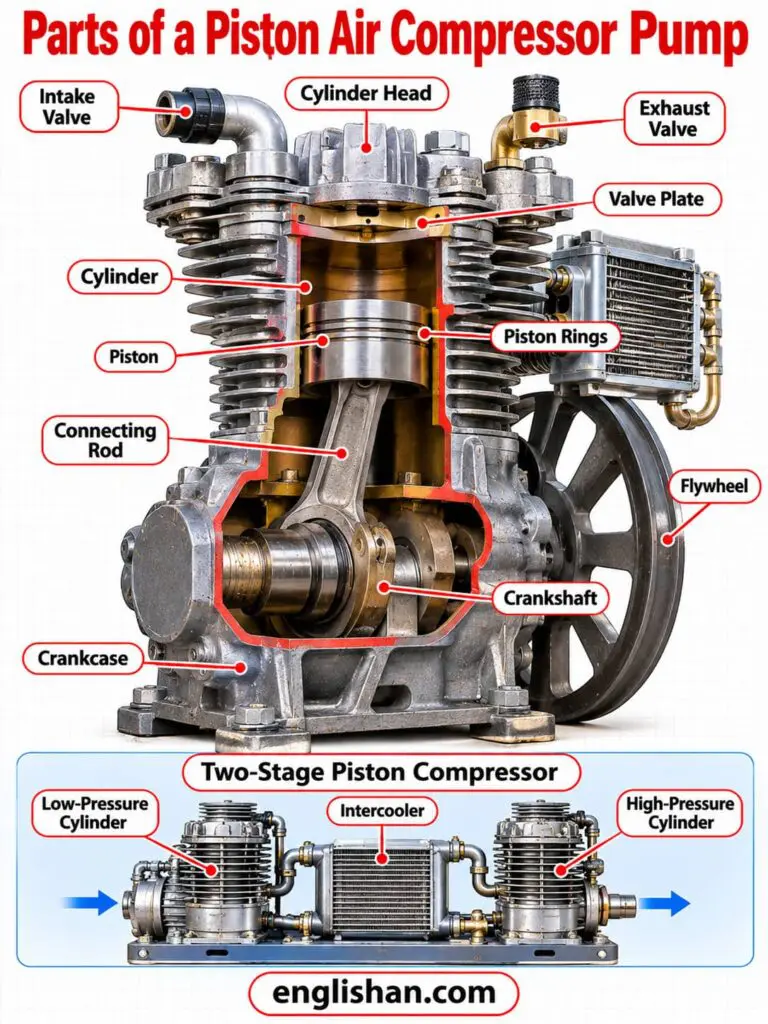
A piston pump uses pistons driven by a crankshaft. Its parts are the cylinder, the piston, the valve plate, the crankshaft, and the crankcase.
Cylinder and Cylinder Head
The cylinder is the bore where the piston travels. The cylinder head seals the top of the bore and holds the valve ports. A two-stage pump has a larger low-pressure cylinder and a smaller high-pressure cylinder.
Piston and Piston Rings
The piston compresses the air on the upstroke. Piston rings seal the gap between the piston and the cylinder wall. Worn rings are the main cause of oil entering the air stream on an oil-lubricated machine.
Valve Plate
The valve plate is a thin metal plate with precision-cut inlet and exhaust reeds. The intake valve opens on the downstroke, and the exhaust valve opens on the upstroke. A cracked or stuck reed is the most common reason a compressor fails to build pressure.
Crankshaft and Connecting Rod
The crankshaft is driven by the motor and converts rotation into piston movement. The connecting rod links the piston to the crankshaft. Bearing wear shows up as knocking.
Crankcase
The crankcase is the sealed lower housing of the pump, and it holds the crankcase oil.
Intercooler
An intercooler is found on two-stage pumps only. It is placed between the two stages and cools the air before the second stage compresses it. On small reciprocating units, the flywheel drives a fan that blows ambient air across the intercooler.
Parts of an Air Compressor Motor and Drive Belt
Among the parts of an air compressor, the motor supplies the mechanical energy that turns the pump. It is electric or gasoline, and it is rated in horsepower. Small reciprocating compressors from 5 to 30 horsepower are common in automotive applications. Household, workshop, and small job-site units are rated at 1.5 horsepower or less and have an attached receiver tank.
Direct-drive units connect the motor to the pump. Belt-drive units add a belt and two pulleys, which are extra wear parts, and a worn belt reduces efficiency. Vibration pads at the mounting absorb vibration and reduce noise.
Air Compressor Tank
Among the parts of an air compressor, the air tank, also called the receiver, stores compressed air between motor cycles and stabilizes the pressure. Moisture condenses out of the air as it cools in the tank. Tank size is rated in gallons.
- ✅ Pancake: A low-profile, light tank that holds 1 to 6 gallons. It suits small repairs and tire inflation, and it lacks the power for large air tools.
- ✅ Hot dog: A heavier unit with a larger tank than the pancake. It suits staplers and airbrushes, and it needs a handle for moving.
- ✅ Twin-stack: Two hot dog tanks stacked one over the other. It powers nail and brad guns, and it weighs up to about 70 pounds.
- ✅ Vertical and horizontal: Two orientations of a tank. A vertical unit has a small footprint, and a horizontal unit is easier to carry and more stable.
Drain Valve
The drain valve is a valve at the bottom of the tank that removes moisture and condensate. It is manual or automatic.
Parts of an Air Compressor Pressure Switch
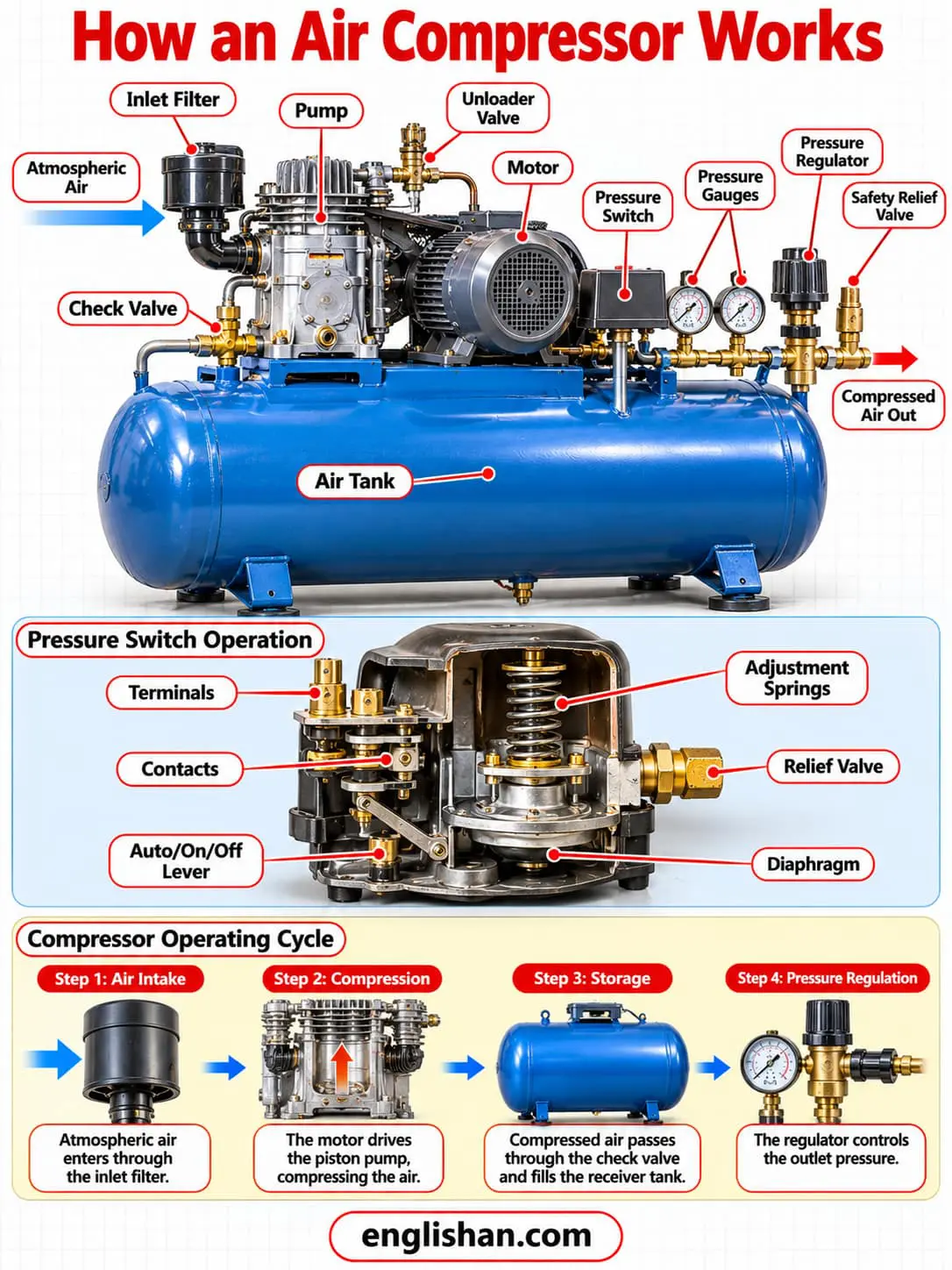
The pressure switch measures the pressure inside the tank and stops the compressor when the pressure reaches the set level. It is a small rectangular housing, about the size of a palm, mounted on the tank. A rising pressure bends a diaphragm until it reaches the cut-out pressure, where the contacts open and the motor stops. When the tank pressure falls, the diaphragm returns to its shape, and the contacts close at the cut-in pressure.
The housing holds six parts:
- ✅ Terminals: Connect the incoming and outgoing wiring.
- ✅ Contacts: Open and close the circuit.
- ✅ Diaphragm: A flexible membrane that moves with the tank pressure.
- ✅ Pressure switch relief valve: Releases the trapped pressure between the pump and the check valve.
- ✅ Adjustment springs: Set the cut-in and cut-out pressures.
- ✅ Auto/on/off lever: Disables the switch by wedging a plastic piece between the contacts.
Air Compressor Valves
Three valves among the parts of an air compressor control the direction and the limit of the air in the tank.
Check Valve
The check valve is a one-way valve at the pump outlet or the tank inlet. It prevents backflow into the pump and keeps the pressure in the tank when the compressor stops. A failed check valve causes a hiss right after shutdown.
Unloader Valve
The unloader valve is a needle valve that responds to the movements of the pressure switch. It opens when the motor shuts off and releases the air trapped around the piston, which causes the hiss of a normal shutdown. The motor then restarts without load. A hiss that lasts more than a few seconds means a leak.
Safety Relief Valve
The safety relief valve is spring-loaded and vents when the tank pressure goes over the rated maximum. ASME code requires it on all tanks.
Regulator and Pressure Gauges
Among the parts of an air compressor, the regulator is a valve downstream of the tank. A tank rated at 150 psi supplies tools that run at 90 to 125 psi, so the regulator sets the lower outlet pressure.
Two gauges show the pressure. One reads the tank pressure upstream of the regulator, and the other reads the outlet pressure downstream of it. The gauge displays pressure in psi or bar.
Inlet Filter and Gaskets
The inlet filter is the first of the parts of an air compressor in the air path, and it removes dust and particulates from the air before compression. A dirty filter restricts airflow and raises energy use, and each 2 psi of pressure drop across it costs roughly 1 percent of system capacity. Gaskets seal the joints between parts to stop air leaks, and they wear over time.
Parts of a Rotary Screw Air Compressor
A rotary screw compressor uses two meshed, rotating helical screws to force air into a smaller space. Units run from 3 to over 1,200 horsepower, and they are built as oil-flooded, water-flooded, or dry types. Screw compressors have fewer moving parts and less vibration than piston models.
Air End and Rotors
The air end is the compression unit and holds the rotors. The male rotor has convex lobes and the female rotor has concave flutes, with fewer lobes on the male rotor. Radial and axial bearings support the rotors, and shaft seals keep oil out of the compressed air.
Inlet Valve
The inlet valve controls the airflow into the air end. It closes when the compressor unloads and opens when it loads.
Oil Separator Element
The oil separator element removes the oil from the air after the air end discharge. Rotary screw units are oil-flooded by design.
Oil Cooler and Aftercooler
The oil cooler lowers the temperature of the recirculating oil. The aftercooler cools the compressed air to condense moisture.
Minimum Pressure Valve
The minimum pressure valve holds about 50 to 65 psi of back-pressure in the air end.
Air Compressor Part Names
Makers and service pages use more than one name for several parts of an air compressor.
| Part | Also called |
|---|---|
| Pump | Compression unit |
| Air tank | Receiver, air receiver |
| Check valve | Non-return valve |
| Safety relief valve | Safety pressure relief valve |
| Regulator | Pressure regulator |
| Rotary screw pump | Air end |
FAQs
The parts of an air compressor are the inlet filter, the pump, the motor, the check valve, the air tank, the pressure switch, the regulator, the gauges, the safety relief valve, and the drain valve. A piston model has a cylinder, a piston, a valve plate, and a crankshaft inside the pump. A rotary screw model has an air end with two rotors.
The main parts of an air compressor are the pump, the motor, the tank, and the pressure switch. The pump compresses the air, the motor drives it, the tank stores it, and the switch controls the motor. The check valve, the regulator, and the safety relief valve complete the machine.
The parts of a piston air compressor pump are the cylinder, the cylinder head, the piston, the piston rings, the valve plate, the crankshaft, the connecting rod, and the crankcase. A two-stage pump adds an intercooler between the stages.
A pressure switch has six parts: the terminals, the contacts, the diaphragm, the relief valve, the adjustment springs, and the auto/on/off lever. The diaphragm moves with the tank pressure and opens or closes the contacts.
The check valve is located at the pump outlet or the tank inlet, between the pump and the tank. The unloader valve is between the pump and the check valve.
A rotary screw compressor has an air end with a male rotor and a female rotor, an inlet valve, an oil separator element, an oil cooler, an aftercooler, and a minimum pressure valve. Radial and axial bearings support the rotors.
Related:
