

The parts of a hammer are a head and a handle. The head has a face on one side and a claw or a peen on the other. A neck joins the head to the handle, and the handle ends in a grip.
A claw hammer runs from the face to the grip. Ball peen, sledge, brick, and club hammers and the mallet change the head and the handle. The axe and the knife are hand tools with a head or a blade.
Parts of a Hammer Labeled Diagram
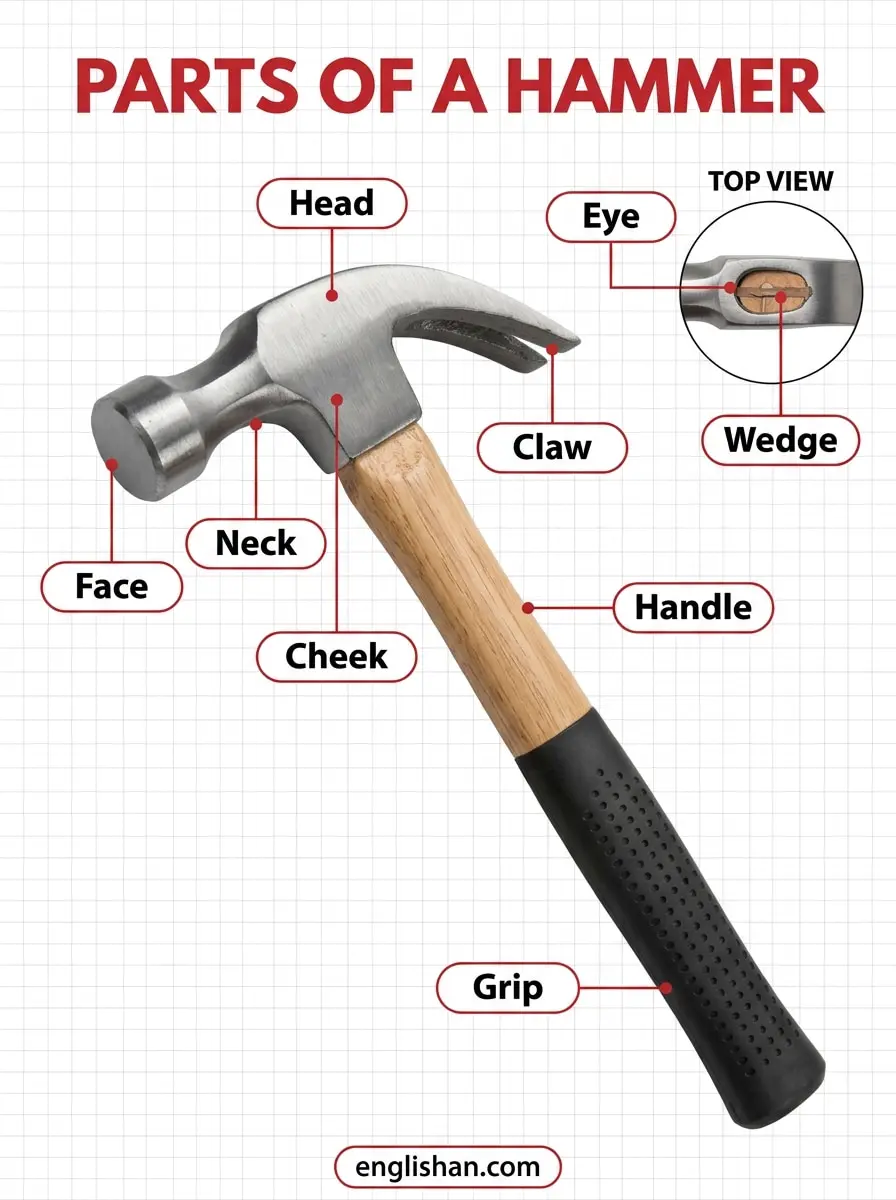
In a labeled diagram of a hammer, the face is at the front of the head. The claw or the peen is at the back, and the handle extends down from the neck to the grip.
| Part | Where you find it |
|---|---|
| 1. Head | Steel striking assembly at the top, from the face to the claw or peen |
| 2. Face | Striking surface at the front of the head |
| 3. Cheek | Side of the head between the face and the claw or peen |
| 4. Neck | Narrow part that joins the head to the handle |
| 5. Claw | Forked prong at the back of the head |
| 6. Peen | Narrow striking end at the back of the head, in place of a claw |
| 7. Eye | Hole through the head where the handle is inserted |
| 8. Wedge | Piece driven into the eye to fasten the head to the handle |
| 9. Handle | Shaft of wood, steel, or fiberglass under the head |
| 10. Grip | Rubber or polymer sleeve on the handle |
How Many Parts a Hammer Has
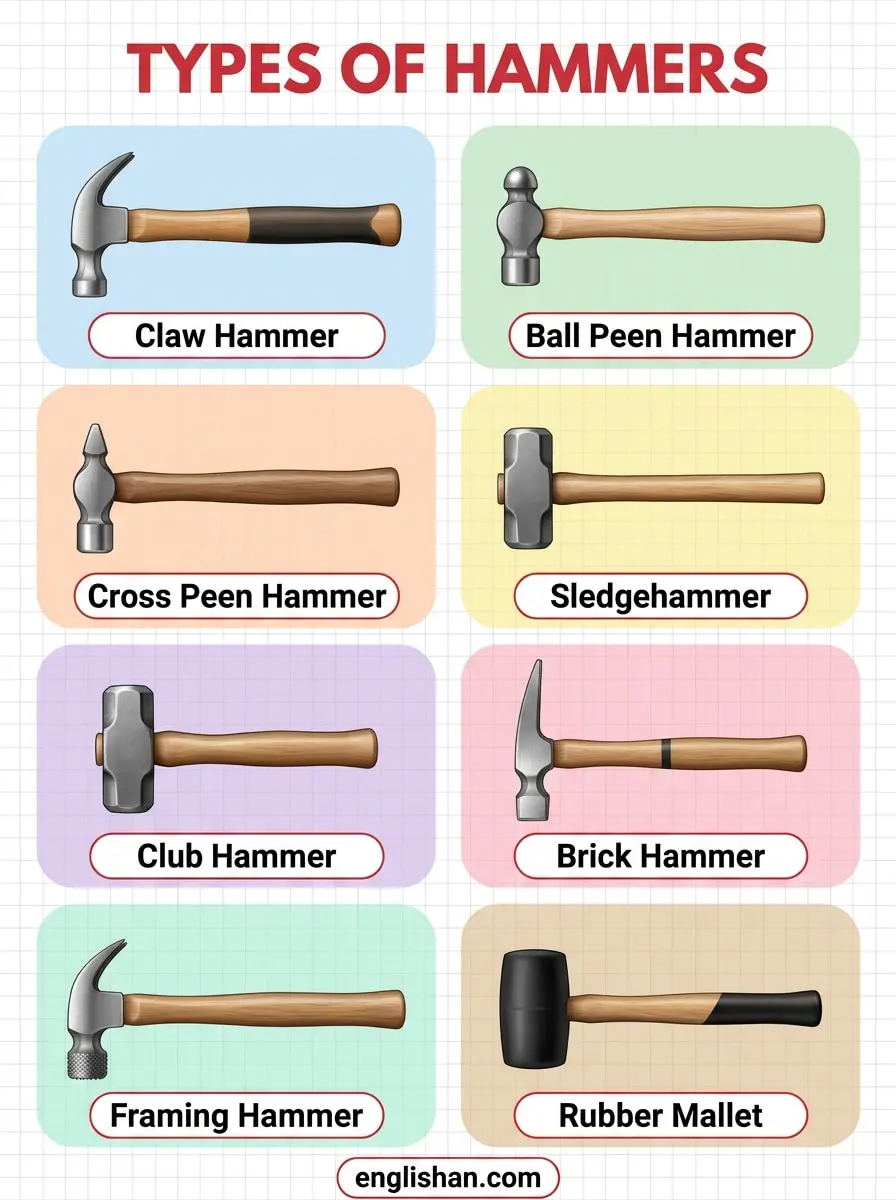
A hammer has two main parts: the head and the handle. The head is the striking assembly, and the handle is the shaft that the hand grasps. The screwdriver and the pliers are the other hand tools in the same family, each with a handle and a working end.
A count of three adds the claw or the peen, the end of the head opposite the face. Longer counts name the face, the cheek, the neck, the eye, the wedge, and the grip. Every count describes the same hammer.
Parts of a Hammer Head
The head is a compact, solid mass of steel that delivers a blow without deforming. The face, the cheek, the neck, the claw or peen, and the eye are the parts of a hammer head.
Face
The face is the striking surface that contacts the nail or the material. Its shape and size match the job of the hammer. A face is flat or slightly rounded.
Cheek and Neck
The cheek is the side of the head, and it bears the most stress when the hammer strikes. Its two horizontal sides serve as a backup striking surface. The neck is the narrower part that joins the head to the handle. Precision hammers have a larger neck.
Claw and Peen
The claw and the peen share the back of the head, and a hammer has one or the other. The claw is a forked prong that pulls nails. The peen is a narrower striking end for precise work, such as driving chisels or riveting.
Eye and Wedge
The eye is the hole through the head where the handle is inserted. The wedge is driven into the eye beside the end of the handle. It keeps a wooden or fiberglass handle from slipping out.
Hammer Handle Parts
The handle is also called the haft or the helve. It keeps the hands away from the point of impact and gives them a surface to grasp. The handle and the grip are the lower parts of a hammer.
Handle
The handle is a long shaft that joins the head at the neck. Hickory and ash are the traditional woods, because both are tough and dissipate shock. Fiberglass resin does not absorb water or decay, and steel and plastic handles are made as well.
Grip
The grip is the sleeve on the handle. It improves the grasp and absorbs shock. A rubber grip covers some handles, and a one-piece forged hammer has a polymer grip. Not every hammer has one.
Parts of a Claw Hammer
The claw hammer drives and pulls nails. The parts of a claw hammer are the face, the cheek, the neck, the claw, the eye, the wedge, the handle, and the grip.
Claw
The claw is a pair of downward-curving V-shaped prongs on the back of the head. They pull nails out of wood. A greater curve and a longer handle give more leverage.
Poll
The poll is the striking side of the head on a claw hammer. Its surface is smooth or textured, and it drives nails.
Framing Hammer
A framing hammer is an oversized claw hammer for rough carpentry. Its heavier head cuts the number of blows needed to drive a nail, and its longer handle adds leverage and head speed. The checkered milled face reduces skip-off when a blow misses the nail.
The claw is straighter, and the straight form is called a rip claw. It pries nailed boards apart instead of pulling nails. Head weight runs from 7 to 32 ounces.
Parts of a Ball Peen Hammer
The parts of a ball peen hammer are the flat face, the rounded peen, the cheek, the neck, the eye, and the handle. The ball peen replaces the claw. The spelling ball pein is an accepted variant.
The flat face strikes punches and chisels, and the rounded peen is used for peening and for rounding off the ends of rivets. A blacksmith also uses this hammer to deliver blows in forging.
Cross-Peen Hammer
A cross-peen hammer has one round face and one wedge-shaped peen. The wedge is set across the head, and it is the part that sets it apart from a ball peen hammer.
Sledgehammer Parts
The parts of a sledgehammer are the head, the face, and the handle. It is a large two-hand hammer. It scales up the parts of a hammer to a massive head and a long handle.
Sledgehammer Head and Face
The head is a flat, massive block of metal. It weighs 2.2 to 19.8 pounds, and modern heavy-duty models reach 10 to 20 pounds. The face is octagonal and about the same diameter as the head, or slightly smaller.
Sledgehammer Handle
The handle is a long shaft of wood or another solid material. It measures 20 to 39 inches, and the length follows the weight of the head.
Club and Engineer’s Hammers
A club hammer, also called a lump hammer, is a short sledgehammer for one hand. A drilling hammer is a club hammer with a 2 to 4 pound head and a 10 inch handle. An engineer’s hammer has a 2 to 4 pound head and a handle of 12 to 14 inches.
Parts of a Brick Hammer
A brick hammer, also called a bricklayer’s or stonemason’s hammer, has two working ends and a handle. One end is a flat face. The other end is a chisel-shaped blade, either short or long.
The flat face strikes. The blade chips edges and small pieces off stone and cuts bricks and concrete blocks without a separate chisel.
Mallet Parts
A mallet has a head and a handle, and its head is larger than the head of a metal hammer. Most mallets have a striking face softer than steel, which lets them strike without marring the work.
Head: The head is wood, rubber, rawhide, plastic, or metal. A split-head mallet has removable faces.
Handle: The handle is the shaft that joins the head. A beetle mallet has a handle about 3 feet long and a head 15 to 18 inches across.
Dead blow mallet: The head has an internal cavity partly filled with steel shot, lead shot, or sand. The fill evens out the impact.
Hammer Parts and Their Materials
The materials of the parts of a hammer differ between the head and the handle.
Steel: Heat-treated steel is the standard head material. Its high elasticity aids energy transfer.
Titanium: A titanium head is lighter, which allows a longer handle. Recoil is about 3 percent, against up to 30 percent for steel.
Non-sparking metal: Aluminum and beryllium copper heads are made for flammable or explosive environments.
Face surfacing: Brass, bronze, wood, plastic, rubber, and leather face a hammer for work that steel would mar.
Handle materials: Hickory and ash are the wood handles, and fiberglass, steel, plastic, and rubber-wrapped steel are the others.
FAQs
FAQs
The parts of a hammer are the head and the handle. The head has the face, the cheek, the neck, the claw or peen, the eye, and the wedge. The handle ends in the grip.
The peen is the narrow striking end at the back of the head. It replaces the claw on a ball peen or cross peen hammer, and it shapes metal.
The back of a hammer is called the claw or the peen. The claw is a forked prong that pulls nails, and the peen is a narrower striking end.
The claw pulls out nails. It is the forked prong at the back of a claw hammer head, and its curve gives leverage against the nail.
The peen and the poll start with the letter P. The peen is the narrow striking end of a ball peen hammer, and the poll is the striking side of a claw hammer.
A hammer has a steel head and a handle of hickory, ash, fiberglass, or steel. Titanium, brass, rubber, and leather are used for specialty heads and faces.
The two main parts of a hammer are the head and the handle. The head strikes, and the handle gives the hand a grasp away from the point of impact.
Related:
- Parts of Scissors
- Parts of a Sword
- Parts of a Loom
- Manual Sewing Machine Parts
- Parts of a Pottery Wheel